 by Tom Gurney
Tom Gurney BSc (Hons) is an art history expert with over 20 years experience
Published on June 19, 2020 / Updated on August 29, 2026
Email: tomgurney1@gmail.com / Phone: +44 7429 011000
A Storm Before a Cave
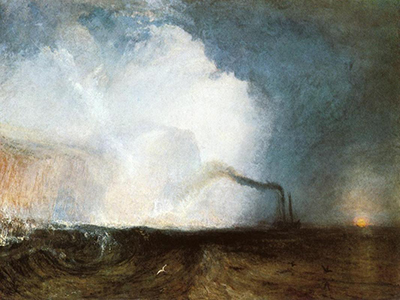
The famous cavern is not the easiest thing to find in J. M. W. Turner's Staffa, Fingal's Cave. Its mouth opens as a dark recess low in the cliffs at the left, partly screened by rain, spray and the island's warm brown rock. A heaving sea occupies the foreground. Farther right, a steam vessel advances beneath a black trail of smoke, while a small red sun touches the horizon. Turner places the spectator close to wave level, outside the shelter promised by the cave and within the weather that makes approaching it dangerous.
That decision transforms a celebrated natural wonder into an encounter. By 1832, Staffa had been described, measured, engraved, named after a literary hero and visited by generations of travellers. Its basalt pillars were commonly likened to architecture. Turner knew those traditions, had entered the cavern during a difficult voyage in August 1831 and had drawn its formations. Yet his large oil does not offer a lucid inventory of columns or a stable interior prospect. It asks what the island feels like when rock, water, air, smoke and fading sunlight can scarcely be separated.
The painting therefore holds several measures of time at once. Its basalt came from volcanic activity roughly 59 million years ago. The Gaelic name of the cave preserves an older response to its sound. The English name evokes James Macpherson's eighteenth-century Ossianic poetry. Walter Scott's verse supplied Turner's Royal Academy epigraph. A steamer represents the transport that brought modern tourists, including Turner, into the Hebrides. The weather belongs to one remembered evening; the painting turns that instant into something monumental.[1][5][7][8]
Now in the Yale Center for British Art, Staffa, Fingal's Cave was made in 1831-32 and exhibited at the Royal Academy in 1832. It is oil on canvas, measures 90.8 by 121.3 centimetres and bears accession number B1978.43.14. The work belongs to the Paul Mellon Collection.[1][2] Its later history is exceptional too: in 1845 it became the first painting by Turner to enter an American collection.[4]
At a Glance
- ArtistJoseph Mallord William Turner
- TitleStaffa, Fingal's Cave
- Date1831-32
- ExhibitedRoyal Academy, 1832
- Catalogue number453
- MediumOil on canvas
- Dimensions90.8 × 121.3 cm
- CollectionYale Center for British Art
- AccessionB1978.43.14
- CreditPaul Mellon Collection
*Artist:* Joseph Mallord William Turner (1775-1851)
*Title: Staffa, Fingal's Cave*
*Date:* 1831-32; exhibited 1832
*Medium:* Oil on canvas
*Dimensions:* 90.8 x 121.3 cm
*Collection:* Yale Center for British Art, New Haven
*Accession:* B1978.43.14
*Credit:* Paul Mellon Collection
*Royal Academy entry:* No. 453 in 1832[16]
*Subject:* The south-western cliffs of Staffa in the Inner Hebrides, approached across rough water; Fingal's Cave opens at the left and a steamer crosses the middle distance.
*Journey behind the work: Turner reached Staffa aboard the Maid of Morven* in August 1831 while gathering material for illustrations to Walter Scott.[5][14][15]
*Central tension:* An ancient volcanic island, an Ossianic name and Scott's poetry meet steam-powered travel, smoke and the bodily uncertainty of a stormy excursion.
Contents
- A Storm Before a Cave
- At a Glance
- Reading the Painting from Wave Level
- Basalt, Water and Deep Time
- An Uamh Binn, Banks and the Discovery Myth
- Fingal, Ossian and Romantic Staffa
- Scott, Sound and The Lord of the Isles
- Turner's 1831 Voyage
- From Sketchbook to Academy Canvas
- Steamer, Smoke and Modern Tourism
Reading the Painting from Wave Level
Turner's horizontal canvas is divided less by a firm horizon than by unstable bands of matter. The lower third is a dark field of water, built from broad brown-black arcs, dull green-grey passages and breaking ridges of pale foam. Waves rise toward the spectator rather than receding politely into depth. Their curved strokes establish a rolling movement that the eye feels before it understands the geography. There is no foreground shore, parapet or vessel from which to look safely. The implied position is on the sea itself.
Staffa occupies the left and centre. The nearest cliff is not a smooth wall. Repeated warm vertical strokes, dark fissures and angular ledges allow the island's columnar structure to emerge through vapour. Ochre, rust, umber and muted pink warm the rock against the blue-grey rain. Fingal's Cave appears low on the left as a deep opening beneath the cliff, its entrance dark enough to be missed at first glance. The cavern is present, but Turner refuses the frontal symmetry and inspectable interior that earlier images had taught travellers to expect.[3][5][13]
The picture's widest opening occurs not in the rock but in the sky. A pale, rain-filled brightness expands above the centre, framed by dense cloud at the upper edge and by the island below. It is neither a clear blue interval nor a simple shaft of sunlight. Grey veils cross it; spray rises into it; the dark smoke of the steamer bends across it from right to left. The result is a luminous pressure rather than settled weather. Forms become visible through the same atmosphere that threatens to erase them.
The vessel sits right of centre, small but visually insistent. A black funnel and slender uprights rise from its low hull. Smoke pours leftward in a long heavy plume, creating an arching counter-form to the cliffs and cavern. Near the far right edge, the sun is a minute orange-red disc almost resting on the sea. Its colour answers warm notes in the basalt, but its scale denies any easy triumph of light. The day is ending and the storm has not cleared.[3][4]
One other living presence matters. Near the lower centre, a pale seabird skims over a dark wave. Scholarly analysis identifies it as a mature gannet carrying a fish, based on its long wings, dark tips and silhouette.[13] It is sharply placed but not minutely described. Unlike the steamer, the bird inhabits the turbulent surface without producing a wake or dividing nature from machine. The tiny ship, low sun and flying gannet give the eye three points of focus across an otherwise continuously moving environment.
The main directional forces do not agree. Waves curve across the foreground, the ship appears to move toward the right, its smoke is driven left and the cliff rises against both. The sun sits beyond the vessel but does not supply a conventional destination, since it is already sinking. Even the broad central brightness fails to open a clear passage through the weather. Turner makes movement measurable through contrary pressures rather than through a single recession into depth. The eye crosses the canvas repeatedly, pulled from cave to ship, from ship to sun and back along the smoke to Staffa.
Turner's signature is at the lower right, yet even that mark shares the obscurity of the painted world.[3] What initially seems vague becomes highly organised under sustained looking. Cave, cliff, ship, bird and sun are all there. Their partial concealment is not the absence of observation. It is the subject: on this coast, knowledge arrives through spray, motion, danger and changing light.
Basalt, Water and Deep Time
Staffa is a small island west of Mull, but its cliffs expose a geological history on an immense scale. Around 59 million years ago, lava associated with the volcanic centre on Mull spread across damp ground. As the hot material cooled and contracted, cracks propagated through it. Where cooling was relatively even, those fractures produced the large, regular vertical columns for which Staffa is famous. Less uniform conditions created smaller, curved or angled formations. The island's apparent architecture is therefore not built masonry but the visible geometry of cooling rock.[7][8]
Fingal's Cave is one of nineteen sea caves around Staffa. Ocean swells exploit joints and weaker divisions between basalt columns. Repeated impact loosens rock, and fragments driven by the water further scour the cliffs. The cave is not a static monument left complete by a single volcanic event. Fire formed the material; cooling divided it; the sea has continued to remove and reshape it.[7] Turner's painting captures that ongoing relation. Waves strike the island while spray and rain blur its edges, making the ancient rock seem active rather than fossilised.
The columns are often compared with those of the Giant's Causeway in Northern Ireland. Both formations are of roughly similar geological age and arose through comparable cooling processes, but they belong to different eruptions. They were never one continuous stone bridge. The story of a giant crossing the sea is culturally powerful, not a geological explanation.[7] That distinction is important in front of Turner's canvas, where scientific deep time and heroic legend coexist without becoming interchangeable.
Columnar jointing also unsettles a simple division between order and violence. The regular pillars were produced by physical contraction as lava lost heat, not by calm human design. Their apparent discipline is the visible result of enormous energy followed by cooling, fracture and erosion. Conversely, the sea that looks chaotic in Turner's foreground acts consistently over long durations, enlarging weaknesses and removing rock. Architecture and storm exchange attributes: stone records movement, while water becomes an enduring maker of form.
The low viewpoint intensifies the encounter between scales. A human life, a tourist excursion and a steamship journey are momentary beside Paleocene rock. Yet the cliff is not immune to the present. Every visible wave participates in its erosion. The vessel is physically small but historically new, carrying coal-fired movement into a formation made millions of years before industrial power. Yale accordingly reads the composition as a passage from the earth's early history toward the industrial era.[1]
Turner does not illustrate a geological diagram. Much of the famous hexagonal regularity is hidden by distance and weather, and the eye sees the columns mainly as vertical rhythms. This withholding matters. Earlier viewers could possess Staffa through measurements, plans and engravings; Turner restores uncertainty to it. Deep time is not translated into a neat sequence. It appears as endurance under continuing assault, encountered by people whose modern machine is useful but visually fragile.
An Uamh Binn, Banks and the Discovery Myth
Long before the cave became widely known in English as Fingal's Cave, it carried the Gaelic name An Uamh Binn, usually translated as the melodious or musical cave. The name responds to sound: swell entering the long basalt chamber creates resonance, reverberation and an alternation of impact and pause. Staffa itself derives from a Norse term associated with staves or pillars, an apt description of the columned cliffs.[8] Gaelic and Norse naming show that the island was understood through experience and comparison before it entered the eighteenth-century tourist canon.
Joseph Banks's visit in 1772 changed the scale of Staffa's fame. Travelling with a party during a projected journey toward Iceland, Banks recorded the cavern in language of astonishment. Thomas Pennant published the account, accompanied by an image that made the columns and vault readily comprehensible. Banks called it a cave of extraordinary magnificence and emphasised the mind's difficulty in imagining such a space.[10][13] His report joined measurement to wonder, giving naturalists, antiquarians and travellers a portable description of the remote island.
It is misleading, however, to say that Banks discovered Staffa in an absolute sense. His achievement was to popularise the formation rapidly among English-speaking and learned audiences. The older names alone contradict the idea of an unknown place. Archaeological investigation has added firmer evidence: a burnt grain of barley dated to approximately 1880-1700 BC and associated pottery indicate human activity, probably occupation, on Staffa during the Middle Bronze Age.[9] The island's history cannot begin with the arrival of an eighteenth-century gentleman traveller.
Early published views typically rendered the basalt with a clarity that supported architectural analogy. Pillars could resemble a colonnade; the roof suggested ribbing or a gigantic vault. Such images helped establish the cave as a natural cathedral, something at once measurable and surpassing human construction. They also encouraged an expectation that the essential view lay inside or directly before the entrance.
Turner reverses that expectation. He had seen the interior and recorded its structure, yet the oil returns the spectator to the exposed water. The columns are screened by meteorological effects rather than displayed as specimens. Access is part of the meaning. One cannot separate the cave from slippery rock, swell, rain, limited time ashore and the boat needed to reach the island. Banks's published clarity and Turner's atmospheric obstruction are not simply fact against fantasy. They are different accounts of how a natural wonder becomes known.
Fingal, Ossian and Romantic Staffa
The name Fingal drew the cavern into another eighteenth-century phenomenon. In 1762 James Macpherson published Fingal, an Ancient Epic Poem, presenting it as the work of Ossian translated from Gaelic. In Macpherson's cycle, Ossian is the poet and son of the warrior Fingal, whose name adapts the Gaelic hero Fionn mac Cumhaill. Battles, grief, mist, mountains, sea and the voices of the dead combine in a remote heroic world.[11]
Macpherson's claims to have translated a single body of ancient written poetry became deeply controversial. By Turner's time it was widely accepted that he had composed and reshaped the texts, although he drew upon genuine Gaelic names, stories and oral materials. To call Fingal either an uncontested ancient epic or a fabrication without traditional roots obscures the productive uncertainty that helped make it influential. The poems offered European readers a northern antiquity that seemed melancholy, elemental and outside classical Mediterranean culture.[13]
Attaching Fingal's name to An Uamh Binn did not prove a historical connection between the hero and the cavern. It gave the formation a new literary identity. The basalt vault could now be imagined as architecture suited to an epic past, while its echoes suggested absent voices. Geology, sound and invented antiquity reinforced one another. Staffa became both a natural object and a theatre for cultural memory.
By 1831 this association was already international. Felix Mendelssohn's Scottish journey in 1829 contributed to the overture eventually published as Die Fingals Hohle. The music developed through several titles and revisions between 1829 and 1835; it was not a complete composition suddenly written inside the cavern.[24] Its history nevertheless shows how powerfully the Hebridean experience could move between media. Sound, not just visible rock, shaped Staffa's Romantic reputation.
Turner's oil participates in this culture without illustrating a scene from Macpherson. No bard or giant stands on the shore. Instead, antiquity is carried by title, cliff, cave and atmosphere, while the steamer declares the nineteenth-century present. Myth remains available, but it is approached by scheduled excursion, coal power and a crowd of passengers. That collision keeps the painting from becoming nostalgic scenery.
Scott, Sound and The Lord of the Isles
Walter Scott supplied the more immediate literary stimulus. His The Lord of the Isles, published in 1815, is a historical romance centred on Robert the Bruce and the political conflicts of early fourteenth-century Scotland. Scott drew upon his own 1814 voyage with the Commissioners of Northern Lights, a journey that brought him among Scottish islands and maritime infrastructure.[12][13] The poem is not an episode from Macpherson's Fingal, although Staffa's Ossianic reputation forms part of its imaginative environment.
In Canto IV, Scott turns the cave into an instrument of natural power. Turner quoted four lines in the 1832 Academy catalogue, including "That mighty surge that ebbs and swells" and the answering sound drawn from the high vault.[5][12] The sequence depends upon alternation. Water enters, withdraws and leaves an awful pause; the cavern replies. Scott then compares the varied tone with organ music and contrasts Staffa's natural architecture with the human religious remains of Iona. Nature has raised the greater shrine.
The comparison with Iona sharpened the excursion's meaning. The travellers had intended to reach both islands, one renowned for a basalt cavern and the other for Christian monuments, but bad weather prevented the second visit. Scott's poem could hold natural and human sanctuaries together; Turner's actual journey left the relation incomplete. The canvas contains no abbey and no visible worshipper. Its arch, darkness and answering light nevertheless retain a sacred architectural charge without assigning the cave to one creed.
That emphasis explains much about Turner's design even though the oil does not look directly down the chamber. Wave rhythm occupies the foreground. Smoke and cloud create a visual echo of vaulting. The painted forms seem to answer one another: dark sea against pale rain, vertical basalt against funnel and mast, cave opening against smoke arch, ancient island against recent vessel. Scott's acoustic structure becomes pictorial rather than merely illustrative.
Turner's 1831 Scottish journey was undertaken while he was preparing designs for Robert Cadell's edition of Scott's Poetical Works. He visited Scott at Abbotsford, travelled through Edinburgh and Glasgow, then continued west to gather material associated with The Lord of the Isles.[5][14] The commission gave a practical reason to study Staffa, but the Academy canvas exceeded what an engraved book illustration required. It enlarged the journey into an independent statement about marine experience.
The difference between commission and oil is crucial. A reader of Scott benefits from recognising the cavern and its columned architecture. A spectator before Turner's painting is made to confront the conditions that precede recognition. The literary quotation does not decode every form. It supplies a rhythm and a memory of sound, while the picture insists that the famous vault must first be reached through open water.
Turner's 1831 Voyage
The most vivid account of Turner's visit comes from a letter he wrote to James Lenox on 16 August 1845, fourteen years after the event. It accompanied the history of the painting's purchase and should be read as retrospective first-person testimony rather than a diary written aboard the vessel. Even with that qualification, its details correspond closely to the oil's unusual combination of danger, circling movement, rain and low sunlight.[15]
Turner recalled leaving the Sound of Mull aboard the Maid of Morven, intending to visit Staffa and continue to Iona. A strong wind and head sea delayed the steamer, so it reached Staffa too late for the intended onward journey. Passengers landed on the island's lee side and scrambled across the rocks. Some entered Fingal's Cave; others refused. Turner observed that the cavern was neither pleasant nor safe when a wave rolled directly inside. The party had only an hour before it was required to reassemble at the landing rock.[15]
Once the passengers returned, the captain considered whether to proceed to Iona despite the worsening evening. A vote rejected that risk. As compensation, the Maid of Morven steamed around Staffa three times. This circling matters for the painting. Turner did not have one fixed prospect. He experienced the island from shifting angles and distances, first while approaching, then while landing and entering, and finally from a moving vessel repeatedly passing its cliffs.
The weather continued to deteriorate. Turner remembered the sun near the horizon bursting through the rain cloud, "angry, and for wind."[15] The steamer sought shelter, and the party did not return to Tobermory until close to midnight. Yale's recent display account rightly treats the canvas as a dramatization of this remembered moment rather than a neutral topographical record.[4] The red sun, central rain and trailing smoke translate a sequence of observations into one concentrated field.
No passenger could have seen every component in precisely this relation for long. Landing, cave entry, re-embarkation, repeated circuits and sunset occurred in succession. The painting makes them simultaneous without pretending to be a clock-time record. Its cave refers to the hour ashore; its low marine position recalls the vessel; its smoke marks powered movement; its red sun belongs to the later circuits. Studio composition becomes a way to preserve the structure of an experience whose parts were separated by motion.
Turner's physical conduct is also significant. He was not looking from a comfortable mainland viewpoint at an island beyond reach. He had crossed a rough sea, climbed wet rocks and entered a cavern while swell made the attempt hazardous. The oil's wave-level position returns the spectator to that bodily insecurity. It may recall a view from the steamer, but it does not define a deck rail or hull. The lack of a secure platform lets the water press forward.
Steam travel was therefore both solution and problem. It made a demanding Hebridean excursion available within a modern itinerary, yet machinery did not cancel wind, swell, darkness or delay. The abandoned visit to Iona demonstrates the limit. Passengers could vote, captains could manoeuvre and engines could circle the island, but weather retained control of the schedule. Turner made that imbalance visible without denying the vessel's capability.
The letter also complicates any belief that atmospheric obscurity was detached from observed fact. The difficult landing, unsafe swell, low sun through rain, multiple circuits and midnight return all belong to a specific experience. Turner reorganised them, but he did not invent the painting's fundamental instability. The canvas gives memory a structure broad enough to include what a single glance could not.
From Sketchbook to Academy Canvas
Turner's drawings preserve a different kind of evidence from the 1845 recollection. In the Staffa Sketchbook, catalogued within the Turner Bequest as CCLXXIII, he recorded the coast, cave and basalt formations, with a concentrated sequence around folios 18 verso to 22. These studies show that he investigated the island's shape and the cavern's interior. They do not provide one finished blueprint for the Academy oil.[14]
That absence is revealing. The canvas combines a rough foreground sea, an expansive storm sky, a low red sun, the island and a smoking steamer in a way not wholly assembled on one surviving sheet. Turner used drawing to acquire parts and relations, then allowed memory and studio invention to organise them. Topographical knowledge is a foundation, not a constraint. The island can be recognisable while the weather exceeds any isolated notation.
A separate work on paper, A Storm at Sea, Fingal's Cave, brings the process closer to the oil. Made with blue, grey and magenta washes, it is a compact experiment in sea, atmosphere and colour rather than a detailed cavern record. Christie's has connected it with the finished painting as an early idea or colour study.[14] Its importance lies in transformation: graphite observation of rock could be joined to fluid washes capable of evoking rain and turbulent air.
The final canvas makes each medium serve a distinct function. Vertical touches recover basalt beneath mist. Broad dark curves give the sea weight. Thin veils make cloud and spray overlap. Opaque accents catch foam, bird and sun. The steamer's plume is both an object in the scene and a compositional stroke binding the right half to the island. Turner did not abandon drawing when he painted indistinctly; he embedded observed structure inside a more mobile field.
This method also explains why the work should not be judged by whether it resembles a modern photograph of the cavern entrance. Turner gathered multiple moments from a moving journey and made the act of approach central. The resulting scene is faithful to relations of scale, weather and risk even where it is not a literal transcript of one position at one instant.
Steamer, Smoke and Modern Tourism
The steam vessel is tiny compared with Staffa, but it changes the historical meaning of the whole composition. A sailing ship could have suggested an older marine continuity. Turner's black-funnelled craft belongs unmistakably to the nineteenth century. It brings industry, fuel, regular transport and commercial excursion into a landscape celebrated as ancient, remote and heroic. Yale interprets this contrast as a movement between geological deep time and the industrial age.[1][6]
The vessel is often discussed as an early, possibly the first, major Turner oil to make a steamer central to its subject. Whatever priority is assigned, its presence anticipates later works in which steam power enters marine or railway space. Yet a simple story of corrupt machine against pure nature is inadequate. Turner had travelled regularly by steamboat from the early 1820s and understood its practical power.[18] The Maid of Morven carried him to Staffa. Modern transport did not merely intrude upon his experience; it produced the conditions under which he could have it.
At the same time, the painted vessel is hardly triumphant. Its hull is low on the horizon, vulnerable beside the swelling foreground water and diminished beneath the cloud. The tall funnel gives it a dark vertical accent, but the smoke is quickly taken by the wind. Human power appears capable of motion, not mastery. Its passengers are invisible within the small form, while the gannet flies close to the waves with a confidence the ship cannot claim.
Smoke is the most ambiguous element. It marks coal consumption and converts mechanical work into a visible atmospheric trace. But Turner does not draw a clean boundary between industrial pollution and natural storm. The plume bends left, spreads and merges with the same cloud and spray that obscure Staffa. It can look like a stain, a bridge, a second vault or a shadow cast across the pale rain. The machine enters the weather pictorially as well as historically.
A modern spectator may connect that smoke with carbon emissions and climate crisis. Such a response belongs to the picture's continuing life, not to a documented warning by Turner. Early nineteenth-century viewers did not possess the present concept of anthropogenic climate change or the Anthropocene. Susan Oliver's environmental analysis makes that chronological limit explicit while still asking what industrial smoke means beside geological duration.[13] The strongest reading keeps both facts: Turner registered fossil-fuel technology as a new force, and later knowledge has changed how that mark can be seen.
The painting also exposes the paradox of Romantic tourism. Travellers sought places imagined as beyond modern urban life, yet their access increasingly depended upon modern transport, published itineraries and organised schedules. Staffa's remoteness became commercially reachable. Turner's steamer does not cancel the sublime; it carries spectators toward it, then discovers that rough water, rain and fading daylight still set the terms.
Painting the Maritime Sublime
The sublime in Staffa, Fingal's Cave is not supplied by size alone. The canvas is substantial, but the effect depends on the spectator's implied relation to what is painted. The low viewpoint removes stable ground. Foreground waves appear close enough to threaten. The cave promises enclosure yet remains difficult to reach. Visibility changes across the surface, and the sun signals that time is running out. Awe is inseparable from bodily unease.
Sound is implied everywhere. Scott's surge and answering vault prepare the imagination for booming water, but Turner's oil extends the soundscape beyond the cavern. Waves break in the foreground; wind drives smoke and rain; the steamer's engine and funnel belong to a mechanical register; the gannet introduces the cry and movement of marine life. The painting is silent as an object, yet its rhythms make silence implausible.
Yale has described Turner's layering of thin glazes over thicker impasto as a means of heightening contrast.[6] That account matches the visible alternation between veiled atmosphere and more resistant material accents. The pale central weather seems to have depth because translucent films cross and soften one another. The sea acquires weight through darker, denser strokes. Foam is dragged and touched over those arcs. Warm upright marks allow columns to emerge from the cliff without hard outlines.[3]
These methods keep opposites in contact. Warm rock stands against cool rain, yet grey passes over ochre. Light opens the sky, yet the cave remains dark. Thick and thin paint occupy the same forms. Natural cloud and artificial smoke merge. Yale's display interpretation identifies this network of warm and cool, light and dark, natural and artificial contrasts as fundamental to the work.[4] Turner makes no side visually independent.
Paint density also directs duration of looking. The opaque foam can register in an instant, while thin atmospheric transitions disclose their internal shifts slowly. Dark masses first appear general, then separate into wave, cave, cloud and smoke. Small accents work like bearings within that uncertainty. The red sun is nearly geometric; the gannet is a brief light contour; the funnel is an upright interruption. None controls the whole, but each helps the spectator test distance and orientation before those coordinates dissolve again.
Indistinctness is consequently active rather than empty. A precise form may appear only after prolonged attention: the cave mouth, the gannet, the funnel, the red sun. The spectator repeats something of the traveller's labour, distinguishing objects through weather. The picture rewards looking while refusing total command. It differs from a map or specimen because uncertainty is not an error to be removed.
The basalt is a particularly telling test. Turner had observed the columns closely and later produced an illustration whose geology Ruskin praised. In the oil, however, he allows their order to flicker through spray. The painting does not oppose knowledge and emotion. It asks how exact knowledge survives within a sensory event that exceeds the capacity to catalogue it.
This is why the steamer and bird are so effective. Each gives a temporary scale to the ancient cliff and enormous sky. The ship embodies collective human ingenuity; the gannet embodies adapted marine life. Both are small, moving and exposed. Staffa seems permanent by comparison, yet geology shows that it too is changing under every impact of the sea. The sublime emerges from unequal times and powers, none entirely still.
Royal Academy 1832
Turner exhibited Staffa, Fingal's Cave as no. 453 at the Royal Academy in 1832 and attached the lines from Scott's The Lord of the Isles.[5][16] The exhibition opened at Somerset House on 7 May and ran until 21 July. It contained 1,229 works by 635 artists, while London faced cholera and political conflict surrounding the Great Reform Act. Reported attendance fell, giving the display a troubled public setting beyond artistic debate.[17]
The best-known story from that year's hanging concerns Turner's Helvoetsluys beside John Constable's The Opening of Waterloo Bridge. On Varnishing Day, Turner added the small red buoy that prompted Constable's remark about a fired gun. That episode illuminates Turner's tactical understanding of display, but it did not concern Staffa. The two events should not be merged simply because they occurred in the same exhibition.[17]
A contemporary Spectator review provides unusually balanced evidence for the reception of Staffa. The critic complained that Turner's seas that year were not lucid enough and called them "blankety." Yet the same account noticed the basaltic columns screened by foam and spray, praised the poetic effect invested in the steam vessel and treated the paintings as the work of a genius who joined a painter's knowledge to a poet's mind.[16]
The review identifies the central wager of the canvas. Turner's diminished lucidity could be experienced as a material fault, especially by viewers expecting descriptive finish. It could also be recognised as the means by which basalt, machinery and weather acquired poetic force. The critic did not have to choose between objection and admiration. The painting generated both.
Its Academy presentation also placed a remote Hebridean island inside metropolitan culture. Visitors encountered Staffa through oil paint, Scott's printed lines and an institution devoted to public display. The steamer in the picture mirrored the technologies and commercial networks that were making distant scenery increasingly available. Even indoors, the work retained the resistance of rain, swell and obscured vision.
Indistinctness, Lenox and America
The painting's most revealing ownership episode began in 1845. James Lenox, a wealthy New York collector and bibliophile, asked the American-born artist Charles Robert Leslie to help him obtain a Turner. Leslie bought Staffa, Fingal's Cave directly from the painter in August. The transaction made it the first Turner painting to enter an American collection, at a time when the artist's late and atmospheric manner remained contentious.[4][15][19]
Lenox did not admire it immediately. After the canvas crossed the Atlantic, he found it troublingly indistinct. A surface bloom or haze associated with transport and varnish may have intensified the problem. Through Leslie, Turner accepted responsibility with the phrase that indistinctness was his "fault." That wording matters. It has often been corrupted into "forte," turning a complicated exchange into a boastful declaration of style. The surviving correspondence supports the self-critical pun, not the later slogan.[19]
Turner also proposed a practical remedy: gentle rubbing or wiping with a silk handkerchief. The treatment appears to have improved the surface, and Lenox's response changed with continued looking. He eventually wrote that he could tell Turner conscientiously how delighted he had become with the work.[19] The episode is almost a parable of the painting's demands. Immediate opacity gave way to attachment through care, time and adjusted vision.
The 1845 letter in which Turner reconstructed his voyage further personalised the acquisition. Lenox did not receive only a famous Academy canvas. He received the artist's account of the head sea, difficult landing, dangerous cave, abandoned Iona journey, circuits of the island, rain and angry sunset.[15] That narrative did not reduce the painting's ambiguity, but it anchored the atmosphere in lived travel.
Lenox later placed the work within the gallery attached to his library. His holdings became foundational to the New York Public Library, bringing Staffa into an American institutional history rather than leaving it solely in a private domestic setting. Its presence gave New York viewers access to a major Turner long before American museums possessed the depth of British art now available. Scholarship on Frederic Edwin Church places the painting within the visual culture encountered by nineteenth-century American landscape artists, while stopping short of proving that every painter saw it directly.[20]
The date of that arrival matters. Staffa crossed the Atlantic before Turner's death and before the Turner Bequest transformed access to his remaining work in Britain. American landscape painting was developing ambitious languages for wilderness, weather, geology and national scale. Lenox's canvas offered no simple model to imitate, but it made an advanced British treatment of those concerns physically present in New York. Its importance lies in availability and chronology, not in an undocumented chain of direct influence.
The New York Public Library eventually dispersed much of the inherited art collection. Staffa was sold at Parke-Bernet Galleries on 17 October 1956 with another Turner. It returned to England and was later acquired by Paul Mellon.[19] Accessible records do not justify filling every intervening transfer with certainty, nor do they securely map the two reported prices onto the two paintings. What is clear is the broader arc: direct purchase from Turner, more than a century in a New York collection, mid-twentieth-century sale, Mellon ownership and eventual public display at Yale.
That history gives the work a second form of travel. The canvas crossed the Atlantic after representing an excursion across Hebridean water. Its first American owner struggled with the very indistinctness that now makes it central to accounts of Turner's innovation. The painting's reception thus repeats its structure: approach is difficult, clarity partial and value revealed over time.
The Interior Vignette and Lasting Importance
Turner did not leave Scott's readers with only the stormy Academy oil. He developed a separate design of Fingal's Cave, Staffa for the illustrated Poetical Works. Engraved on steel by Edward Goodall and published in 1834, the vignette looks toward or into the cavern rather than holding the spectator offshore. The basalt architecture is more legible, and the natural vault answers Scott's words more directly.[21][22]
The contrast clarifies Turner's range. In the vignette, recognition and literary service are essential. The reader can connect rock formation, cavern and poem within a compact monochrome image. In the oil, colour, weather and maritime scale dominate; the cave becomes one difficult element within an environment. One design explains what Staffa's architecture is. The other makes approach, uncertainty and historical collision the subject.
John Ruskin later bought the original vignette drawing and praised it in 1878 for the accuracy of its geology, singling out Turner's understanding of basalt and the hexagonal column motif.[23] Ruskin's response is valuable because it rebuts the assumption that atmospheric painting resulted from ignorance of structure. Turner could describe columnar rock with exactness when the purpose required it. His decision to obscure it in the oil was selective, not careless.
The painting's lasting importance rests on that combination of knowledge and resistance. It contains real topography, a first-hand journey and observed geological rhythm, but none becomes a complete key. Gaelic sound survives beneath an English literary name. Macpherson's heroic antiquity overlays much older human history. Scott's medieval romance supplies an acoustic pattern. The steamer turns remoteness into a modern excursion while remaining subject to wind and sea. The gannet passes between these human frameworks with a fish in its beak.
Turner also established a way of painting modernity without isolating it from the natural world. Smoke enters cloud; mechanical motion crosses geological duration; tourism depends on both technology and weather. Later spectators can bring environmental concerns to that relation, but the historical painting remains more complex than prophecy. It records the shock of a new machine within an old environment and the impossibility of keeping their atmospheres apart.
Above all, Staffa, Fingal's Cave changes what counts as a view of a celebrated place. It does not deliver the cavern as a possession. It preserves the effort of reaching it, the danger of entering it, the briefness of seeing it and the instability of remembering it. The low red sun may illuminate the rain, but it does not clear the air. Turner's achievement is to make incomplete vision carry an extraordinary density of fact, history and feeling.
Discussion
How does Turner make difficult access, unstable weather and modern transport part of seeing Staffa?
Reader Insights
How does the low viewpoint withhold the cave's famous architectural clarity?
Where does the steamer function as access, vulnerability and modern presence at once?
How do geology, Gaelic memory, literature, weather and collecting history coexist?
Join the Conversation
Share a close observation or a source-based question for other readers.
References
- Yale Center for British Art, [*Staffa, Fingal's Cave*, B1978.43.14](https://interactive.britishart.yale.edu/critique-of-reason/360/staffa-fingals-cave).
- Google Arts & Culture and Yale Center for British Art, [*Staffa, Fingal's Cave*](https://artsandculture.google.com/asset/staffa-fingal-s-cave-joseph-mallord-william-turner-1775%E2%80%931851-british/UwGUbiwJ5MsHvQ?hl=en).
- Wikimedia Commons, [high-resolution Yale-linked image and object record](https://commons.wikimedia.org/wiki/File:Joseph_Mallord_William_Turner_-_Staffa,_Fingal%27s_Cave_-_Google_Art_Project.jpg).
- Yale Center for British Art, [third-floor large-print guide](https://britishart.yale.edu/sites/default/files/2025-06/large%20print_third%20floor_02.pdf), 2025.
- Yale University, ["Turner in Scotland"](https://artandmusic.yale.edu/romantic-landscapes/turner-scotland).
- Yale News, ["An island that captured Romantic imaginations"](https://news.yale.edu/2026/01/21/island-captured-romantic-imaginations), 21 January 2026.
- National Trust for Scotland, ["Staffa: Geology"](https://www.nts.org.uk/visit/places/staffa/highlights/geology).
- National Trust for Scotland, ["Stories from Staffa: island of staves"](https://www.nts.org.uk/stories/stories-from-staffa-island-of-staves).
- National Trust for Scotland, ["Staffa shines with new archaeological discoveries"](https://www.nts.org.uk/stories/staffa-shines-with-new-archaeologic-discoveries).
- Thomas Pennant, [*A Tour in Scotland and Voyage to the Hebrides, 1772*](https://commons.wikimedia.org/wiki/File:A_tour_in_Scotland,_and_voyage_to_the_Hebrides,_1772_(IA_tourinscotlandvo01penn).pdf), including Joseph Banks's account.
- James Macpherson, [*Fingal, an Ancient Epic Poem*](https://quod.lib.umich.edu/e/ecco/004888751.0001.000/1:5?rgn=div1;view=fulltext), 1762.
- Walter Scott, [*The Lord of the Isles*](https://upload.wikimedia.org/wikipedia/commons/5/52/The_lord_of_the_isles_(IA_lordofisles00scotrich).pdf), 1815.
- Susan Oliver, ["A Coastal Knowledge Ecology and Aesthetics of Data: Environmental Science, J. M. W. Turner, and the Bass Rock"](https://repository.essex.ac.uk/35607/1/RoN79_02_Oliver.pdf), *Romanticism on the Net* 79, 2022.
- Christie's, [J. M. W. Turner, *A Storm at Sea, Fingal's Cave*](https://www.christies.com/en/lot/lot-5582322), lot essay.
- Lenox Library, [*Catalogue of the Paintings in the Main Gallery*](https://upload.wikimedia.org/wikipedia/commons/0/00/Catalogue_of_the_paintings_in_the_main_gallery_(IA_catalogueofpaint00leno_2).pdf), entry 90, including Turner's letter of 16 August 1845.
- *The Spectator*, ["Pictures and Artists"](https://archive.spectator.co.uk/article/12th-may-1832/21/pictures-and-artists), 12 May 1832.
- Paul Mellon Centre and Royal Academy Chronicle 250, ["1832: Shot out of the Water?"](https://chronicle250.com/1832).
- Judy Egerton, National Gallery, [catalogue entry for *The Fighting Temeraire*](https://www.nationalgallery.org.uk/paintings/catalogues/egerton-2000/the-fighting-temeraire), 2000.
- Stephen J. Bury, Frick Art Reference Library, ["Turner at East 70th Street before The Frick Collection"](https://www.frick.org/blogs/chief_librarian/turner_east_70th_street_frick_collection).
- National Gallery of Art, [*Frederic Edwin Church*](https://www.nga.gov/sites/default/files/migrate_images/content/dam/ngaweb/research/publications/pdfs/frederic-edwin-church.pdf), scholarly publication.
- Fitzwilliam Museum, [Edward Goodall after Turner, *Fingal's Cave, Staffa*](https://data.fitzmuseum.cam.ac.uk/id/object/170131), P.296-1954.
- W. G. Rawlinson, [*The Engraved Work of J. M. W. Turner, R.A.*](https://upload.wikimedia.org/wikipedia/commons/4/40/The_engraved_work_of_J._M._W._Turner,_R.A._(IA_gri_33125001464789).pdf), no. 512.
- John Ruskin, [Turner lecture and catalogue material](https://www.lancaster.ac.uk/media/lancaster-university/content-assets/documents/ruskin/13Turner.pdf), Lancaster University edition.
- Yale University, [*Drei Concert-Ouverturen, No. 2 Die Fingals Hohle*](https://artandmusic.yale.edu/romantic-landscapes/mendelssohn-scotland/mendelssohn-gallery3-drei-concert-overturen-no-2-die).