by Tom Gurney
Tom Gurney BSc (Hons) is an art history expert with over 20 years experience
Published on June 19, 2020 / Updated on August 29, 2026
Email: tomgurney1@gmail.com / Phone: +44 7429 011000
A City Reached Across Water
J. M. W. Turner's Approach to Venice is not primarily a picture of monuments. It is a picture of arrival. The city extends across a low, wavering horizon while boats move over the lagoon toward it, so that Venice appears less as a collection of buildings than as a destination slowly taking form within light. Blue, lilac, rose, yellow and white pass between sky and water. A pale circular light hangs to the left; a warmer radiance spreads through the right half of the scene. The boats in the foreground are tangible enough to establish scale and direction, yet even they seem to be dissolving into reflections. Turner makes looking inseparable from moving.
The painting belongs to the National Gallery of Art in Washington, DC, where it is dated 1844. It is an oil on canvas measuring 62 by 94 centimetres, with the accession number 1937.1.110 and the credit line Andrew W. Mellon Collection.[1] These facts establish a moderately sized horizontal exhibition painting, not an unfinished studio fragment enlarged into later fame. Turner showed it at the Royal Academy in 1844 as number 356, accompanied by verses from Samuel Rogers and Lord Byron.[3] The texts identify the subject as an experience in time: the silent passage over water and the interval in which moonrise and sunset occupy the same sky.
The modern title is concise, but the word approach carries much of the painting's meaning. Venice had historically announced itself to travellers by water. There was no ordinary road running into its centre; arrival required a transfer to a boat and a gradual crossing of the lagoon. Rogers described that path as invisible, leading towards a floating city and into streets entered as if in a dream.[12] Turner does not merely illustrate the lines. He reorganises the lagoon into a field of uncertain distances, so that approach becomes a condition of expectancy. The viewer is close to the crowded vessels below, far from the fragile city, and suspended between those zones.
This dream of waterborne entry was also nearing a practical end. On the right, the National Gallery's systematic catalogue identifies the causeway then being built between the mainland and Venice.[3] Construction had begun in 1841; the masonry work was completed in October 1845 and the railway crossing opened in January 1846.[18] Turner therefore placed an old poetic mode of arrival beside the infrastructure that would transform it. The tension is subtle. No locomotive breaks the haze, and no explicit verdict is imposed. Yet a painting exhibited in 1844 could make the lagoon look timeless only while admitting, at its edge, that time was changing it.
At a Glance
- ArtistJoseph Mallord William Turner
- TitleApproach to Venice
- Date1844
- MediumOil on canvas
- Dimensions62 × 94 cm
- CollectionNational Gallery of Art, Washington
- Accession1937.1.110
- CreditAndrew W. Mellon Collection
- ExhibitedRoyal Academy, 1844, no. 356
- Butlin and JollNo. 412
Contents
- A City Reached Across Water
- What the Painting Shows
- Moonrise, Sunset and a Divided Sky
- Boats, Procession and the Word DOGE
- Venice as Place and Invention
- Three Visits in Less Than Four Weeks
- The 1840 Watercolours and the Work of Memory
- Rogers, Byron and an Altered Quotation
- The Railway Causeway and a Vanishing Mode of Arrival
- The Royal Academy in 1844
What the Painting Shows
The horizon lies below the middle of the canvas. This gives the sky and its reflections greater visual authority than the distant architecture. Across the centre, Venice forms a thin band of vertical strokes, rose-grey walls, pale towers and intermittent dark marks. The skyline does not rise into a single commanding silhouette. It trembles. Toward the left, a darker pointed form interrupts the blue-grey distance; nearer the centre and right, towers and possible domes appear through a warmer veil. The railway causeway enters from the right as an attenuated horizontal structure, its repeated supports almost absorbed by water and glare.[2][3]
The lower edge is more crowded. At left, a dark barge projects into the scene on a diagonal. Its near end is cut by the frame, a device that makes the viewer's position feel close to the traffic rather than safely detached from it. Rust-red, brown, cream and yellow strokes gather into cargo and figures. Long narrow lines extend from the craft, functioning as poles or oars and directing the eye toward the centre. The vessel carries the most concentrated mass of dark paint in the painting, anchoring an image whose upper regions might otherwise seem almost weightless.[2]
Farther back, a central boat presents a high, dark hull and an upright figure or structure against the illuminated water. Another laden craft glows rose and ochre to its right. More boats continue across the foreground, some cropped at the bottom or right edge, while smaller marks lead into the distance. The National Gallery describes barges and gondolas making their way toward the city.[1] At full resolution, however, many distinctions remain unstable. Turner gives the boats direction, weight and social activity without turning every stroke into a securely identifiable passenger, package or rigging component.[2]
Water occupies the lower third, but its colour comes from the whole sky. On the left it is blue-grey, crossed by pale horizontal touches and dark reflections. In the centre, rose and green-brown descend beneath the boats. On the right, yellow-white light spreads across the surface and nearly removes the boundary between reflection and atmosphere. Short dragged strokes describe ripples, yet many marks also expose the physical action of brush or knife. Water is simultaneously represented space and worked paint.[2][3]
The sky is built from unequal zones rather than a smooth gradient. Cooler blue and lavender gather at upper left. Red, pink and blue hatching moves through cloud. Across the top and upper right, yellow and white paint becomes thicker, broken and crusted. The brightest region is not a neatly bounded disc but an extensive luminous field. This imbalance gives the scene its directional pressure: cool depth opens at left while light accumulates toward the right, over the city and causeway. The approaching boats cross between these conditions.[2]
Turner's horizon is sufficiently legible to establish place, but sufficiently unstable to make distance felt. The painting asks the eye to do what a traveller's eye would do on the lagoon: search a luminous band for structures, compare moving boats with fixed buildings, and watch recognisable forms appear and disappear as air and water alter their edges. The apparent vagueness is therefore organised. Near and far, dark and light, solid and reflected have been assigned different degrees of definition.
Moonrise, Sunset and a Divided Sky
Turner exhibited Approach to Venice with two lines attributed to Byron: “The moon is up, and yet it is not night” and “The sun as yet disputes the day with her.”[3] The picture's divided illumination follows that cue. A small pale disc is visible low in the cooler left side, while the broadest golden brightness occupies the right. The systematic catalogue describes the scene as sunset with a full moon rising, and the National Gallery's interpretive text likewise presents moon and setting sun together.[1][3] Its current visual description, however, calls the small disc a sun.[1] The discrepancy is useful evidence of Turner's achievement: the two lights are not diagrammatically labelled, and their effects are made to mingle.
The exhibition text supports the pale disc as the moon and the warm right-hand field as the declining sun. Yet the canvas does not reduce that reading to a simple left-right emblem. A blue crescent-like sequence of strokes appears in the upper sky, brighter cloud is scattered through both zones, and yellow reflections spread far beyond a single solar source.[2] Turner evokes the coexistence of day and night more strongly than he specifies astronomical coordinates. Light travels through vapour and pigment; it is not contained by the objects that produce it.
Byron's original stanza describes an evening seen near Venice. Moon and sunset divide a cloudless, many-coloured sky. A “sea of glory” streams along the Friulian mountains, the moon rises on the other side, and the following stanzas carry those colours into the Brenta before they fade to grey.[11] It is a sequence of transition, not a static picturesque effect. Turner took the first line accurately but replaced Byron's original second line, “Sunset divides the sky with her - a sea,” with his own claim that the sun still disputes the day. The alteration turns division into contest.[3][8][11]
That contest is enacted without violence. The moon does not conquer the sun, nor does darkness engulf the city. Blue, rose and yellow remain interdependent. The water doubles their meeting, extending the sky downward until the boats appear to travel through colour. The result is temporal as well as spatial. Sunset means a day ending; Venice's historical reputation carried associations of former magnificence and political decline; the new causeway pointed toward a modern future. A single evening can therefore hold several kinds of before and after.
The Getty Museum has connected Turner's use of the altered couplet in both Modern Rome - Campo Vaccino and Approach to Venice with his interest in the rise and fall of empires.[8] That parallel should not make the two paintings interchangeable. Rome concentrates ruins, churches, animals and modern inhabitants within a densely layered city. Venice is held at a distance, its history translated into light, boats and a nearly insubstantial skyline. In both works the double sky resists a simple chronology. The past has not vanished, and the future has not yet fully arrived.
Boats, Procession and the Word DOGE
The vessels are more than foreground decoration. They provide the painting's rhythm of approach. The largest enters from the lower left; a second occupies the lower centre; another emerges from the right. Smaller craft continue between them and the city. Their spacing establishes a procession without enforcing a straight line. Some move diagonally inward, some seem to pause, and others are so lightly marked that direction remains uncertain. This varied traffic gives the lagoon the social presence of a waterway rather than the emptiness of an abstract reflective plane.[2]
The National Gallery's systematic catalogue records the word DOGE on the left foreground barge.[3] The inscription is difficult to isolate in reproduction, but the catalogue observation has encouraged historical readings. John Gage proposed that the procession might relate to dogal ceremony and to Turner's memory of Canaletto drawings of Venetian state occasions seen at Stourhead. The same catalogue immediately stresses that Martin Joll regarded the connection as tenuous.[3] That disagreement defines the responsible limit. The word can activate Venice's republican past without proving that Turner reconstructed one named ritual.
The doges had been abolished with the fall of the Venetian Republic in 1797, nearly half a century before the painting's exhibition. A barge bearing the title can therefore function as a compact historical sign amid contemporary lagoon movement. It may be a name, an evocation, or an invitation to remember ceremonial Venice. What it cannot securely do is identify every passenger or turn the vessels into an exact antiquarian reconstruction. Turner's figures are too abbreviated and the architecture too freely treated for that.[3][4]
The foreground craft also challenge the belief that late Turner abandoned incident for atmosphere. Men or women stand, bend and cluster. Cargo is piled into uneven forms. Oars and poles project into water. Dark hulls interrupt luminous reflection. These marks are small in relation to the colour field, but they carry bodily labour and transport into it. Venice is approached through people at work, not through disembodied vision alone.[2]
At the same time, movement is slowed by composition. The boats do not rush toward a vanishing point. Their broad dark bases and descending reflections make them hover. Rogers's description of gliding smoothly and silently is translated into the interval between propulsion and stillness.[12] The city's apparent distance never decisively closes. Turner turns passage into duration: the viewer can imagine continued motion, but the approach remains permanently uncompleted.
This is why the foreground barge matters even without a settled ceremonial meaning. It is both obstruction and guide. Its cropped hull blocks an easy entrance into the water, while its oars and diagonal orientation lead the eye onward. The viewer does not stand outside the traffic and inspect Venice from a neutral platform. The composition makes seeing contingent on joining a moving world of boats.
Venice as Place and Invention
Turner's Venice is recognisable without being topographically exact. The lagoon's low horizon, shallow luminous water, distant towers, clusters of boats and mainland vegetation produce a convincing environmental structure. Ruskin later argued that the view looked from the Giudecca landwards at sunset. He acknowledged that buildings on the right were largely imaginary in detail, including a connecting bridge, yet insisted that their masses, the Fusina vegetation, the mist, gold water and boatmen reproduced the character of the experience with extraordinary truth.[15] His distinction between literal detail and experiential likeness remains central.
The exact orientation has been debated. The systematic catalogue describes Venice in the distance with the mainland causeway visible to the right, while also reporting Ruskin's correction of a topographical error.[3] The painting should therefore not be read as a map with every tower assigned. Turner had accumulated architectural studies, lagoon views and memories across several journeys. In London he could combine those materials into a coherent arrival that did not correspond to a single untouched visual record.[4]
This method was neither carelessness nor licence without limits. Colin Harrison emphasises that Turner's Venetian paintings were intended as evocations of specific views carrying reflections on historical truth, rather than as blazing abstractions detached from place. Their commercial success also indicates that contemporary buyers recognised and valued them as Venetian subjects.[4] The city does not disappear; it changes its mode of presence. A tower may be a stroke, a wall a coloured haze, but their proportions and intervals sustain the idea of Venice spread over water.
The comparison with Canaletto clarifies what Turner altered. Canaletto's Venetian views commonly build urban space through precise facades, perspective, pavement, canal edges and sharply differentiated boats. Turner knew and admired that tradition, and one of his 1833 Academy titles explicitly imagined “Canaletti” painting.[4] Yet in Approach to Venice, atmosphere does not merely soften an already completed architectural drawing. It determines what can be seen. The city's partial visibility is the subject.
The Getty's comparison between Canaletto and Turner describes the difference succinctly: Canaletto delights in architecture and everyday detail, while Turner gives priority to atmosphere over accuracy.[7] Priority does not mean exclusion. Turner's boats still contain everyday movement, the causeway still belongs to current construction, and the city still occupies a plausible lagoon relation. His invention operates through selection, compression and altered emphasis.
The painting is thus a useful test of the word “truth” in Turner's art. If truth means a complete inventory of structures from one fixed coordinate, the work is inaccurate. If it means the perceived relation of city, haze, low vegetation, reflected gold, dark boats and immense lagoon sky during an approach, it can be exact in another sense. Ruskin's defence depended on that second kind of fidelity.[13][15] The strongest reading keeps both facts in view: imaginary details are present, and the environmental experience is not imaginary.
Three Visits in Less Than Four Weeks
Venice became one of Turner's defining subjects, but he did not live there or work in it for years. Harrison calculates that his three visits, in 1819, 1833 and 1840, amounted altogether to less than four weeks of sketching.[4] This short total makes the scale of the Venetian afterlife in his art more remarkable. The city was concentrated through intense observation, repeated return, literary memory and long studio development.
The first visit came in late summer 1819 during a journey principally directed toward Rome. Turner made many pencil studies of architecture because linear notation was faster than colouring outdoors. Four luminous watercolours in the Como and Venice sketchbook are exceptional, though specialists have disagreed over whether every one was made entirely before the motif or partly from memory.[4] That uncertainty already complicates any simple division between direct record and later invention. Turner could observe on the spot and transform almost immediately.
Before seeing Venice himself, he had produced two watercolours for James Hakewill's Picturesque Tour of Italy from Hakewill's drawings. After 1819, relatively few studio works emerged at once, but two important designs were engraved for Samuel Rogers's Italy and Poems.[4] Venice entered Turner's imagination through mediated images and verse as well as travel. By the time he chose Rogers's lines for the 1844 painting, the poet's waterborne city had been part of his visual culture for years.
Turner returned in 1833 with support from his patron Hugh Munro of Novar, who expected a work developed from the journey. The visit supplied material for major oils shown through the later 1830s. It also followed Turner's successful 1833 Royal Academy encounter with Venetian themes, including Bridge of Sighs, Ducal Palace and Custom-House, Venice: Canaletti Painting.[4] Venice was therefore simultaneously an observed location, an arena of artistic rivalry and a marketable subject.
The final visit lasted about fourteen days, from 20 August to 3 September 1840.[4][6] Turner stayed at the Hotel Europa, housed in the Palazzo Giustinian, and worked with conspicuous intensity. The younger watercolourist William Callow later remembered seeing him in a gondola at sunset, sketching San Giorgio while Callow himself was smoking; Turner's persistence made him feel ashamed of idling.[6] Like any recollection, the anecdote requires care, but it agrees with the surviving volume of work.
Turner used narrow, flexible “roll” sketchbooks that could be carried easily. He made pencil records of buildings and a large body of colour studies, some possibly outdoors and others in his hotel room.[4] The 1840 material did not dictate one final painting. It became a reservoir from which he produced oils and watercolours with different viewpoints, weather, times of day and degrees of topographical specificity. Approach to Venice, exhibited four years later, is best understood as a mature synthesis from that reservoir, not as a canvas completed beside the lagoon.
The 1840 Watercolours and the Work of Memory
Around one hundred Venetian watercolours are associated with Turner's 1840 stay.[4] Some use English Whatman paper; others were made on locally acquired mid-toned sheets. They include interiors of St Mark's, theatres, moonlit scenes, storms and broad lagoon prospects. Perspective and scale can be ambiguous, while identifiable landmarks sometimes recede almost to nothing.[4] This variety shows Turner testing how little or how much information a Venetian view required.
A related watercolour known as The Approach to Venice, or Venice, from the Lagoon offers an especially close comparison. Its exact relation to the Washington oil is not one of simple transfer, yet its subject is the sensation of crossing open water toward the city. The auction catalogue describes broad washes establishing dominant colour before red notations marked the distant topography. Ribbed cloud, marine blue-green and a reserved pale strip organise the sheet before architecture becomes detailed.[5] Turner could therefore make colour carry spatial structure from the beginning.
That sequence helps explain the oil. In the Washington canvas, blue and yellow are not fillings placed inside a fixed outline of Venice. Broad colour relations establish the atmosphere and divide the scene; towers, boats and causeway emerge within them. Red and pink strokes along the horizon behave like notations amplified into paint. The method preserves the speed and openness of watercolour while exploiting oil's capacity for opacity, glaze, scraping and relief.[2][3][5]
The surviving studies also argue against the myth that indistinctness resulted from failing eyesight or uncontrolled old age. Turner gathered exact architectural information when he needed it. He could draw a tower, facade or boat with economy and precision. He then chose what to suppress in a finished work. The Getty's account of his late career emphasises continuing travel, market awareness, narrative intention and experiment rather than senile retreat.[7][8] Approach to Venice is radical because its uncertainties are composed.
Memory gave Turner permission to combine moments that direct observation would keep separate. The small disc, broad sunset, moving flotilla, city, vegetation and unfinished causeway do not need to have appeared in exactly this arrangement during one gondola ride. Their conjunction conveys what arrival had become after repeated looking and reading. The painting remembers not only physical Venice but other representations of Venice: Rogers's dream, Byron's divided sky, Canaletto's city, and Turner's own earlier sketches.
Yet memory does not make observation irrelevant. The horizontal scale of the lagoon, the way buildings lose foundations in reflection, the dark leverage of a gondolier, the warm colour of sunset dispersed across shallow water and the blue line of distant vegetation all depend on close attention. Ruskin valued the painting precisely because its invented details were held within those convincing relations.[15] The work of memory is selective fidelity, not fantasy without evidence.
Rogers, Byron and an Altered Quotation
Turner supplied two literary passages for the 1844 catalogue. From Samuel Rogers's Italy he selected the invisible sea path, departure from land, floating city, steering in, and dreamlike glide through watery streets.[3][12] The passage begins by describing Venice as a city in the sea, where salt water ebbs through broad and narrow streets and seaweed clings to palace marble. It stresses the absence of footsteps leading to the gates. Arrival is unlike entering a land city because its path leaves no track.
The painting follows this structure closely while changing its emphasis. Rogers proceeds into streets lined by domes, porticoes, statues and merchant palaces. Turner keeps those objects far away. The viewer has not yet reached the architectural passage described later in the poem. Boats and light dominate because the image preserves the threshold. In that sense the title is exact: this is not simply Venice, but the state of approaching it.
Rogers's lines also make silence active. Steering and gliding occur “smoothly, silently,” with dream functioning as a comparison for motion.[12] Turner supplies no literal sound, but the evenly spread water and hovering vessels can suggest restrained movement. The largest boat contains work and cargo, yet the panoramic effect remains calm. The city does not announce itself through noise or crowded quays. It materialises as the eye advances.
Byron contributes a different temporal pressure. In canto IV of Childe Harold's Pilgrimage, the moon rises before night while sunset divides the sky. Friuli's mountains receive a sea of glory; the Rhaetian heights retain the sunny light; the Brenta reflects purple; then colour changes and finally gives way to grey.[11] The sequence was based on an August evening near La Mira, west of Venice, rather than a generic fantasy. It combines heightened language with Byron's insistence that Italian skies could actually produce such effects.[11]
Turner's alteration of the second line is therefore deliberate and consequential. “The sun as yet disputes the day with her” is not Byron's wording.[3][8] It gives the sun agency and makes the shared sky adversarial. The image answers with balance rather than victory. The left coolness and right gold remain held together, while boats travel beneath both. Turner is quoting, correcting and picturing at once.
The altered line had already accompanied Modern Rome - Campo Vaccino in 1839.[8] Reuse does not imply laziness. It shows Turner recognising in the couplet a compact structure for places where historical time is visible. Rome's ruins and modern life share one prospect; Venice's republican memory, Austrian-era infrastructure and continuing maritime activity share another. Moon and sun provide a natural analogue for coexistence without resolution.
Both poets also shaped British expectations before travellers saw Venice. Harrison notes that Turner's Venice, like Ruskin's, was deeply informed by Byron's romantic account of a city whose beauty persisted amid decline.[4] Rogers offered the wonder of entry; Byron offered glory shadowed by loss. Turner combines them. The approach is enchanting because the city seems to float, and melancholy because floating can also mean lacking secure foundations in time.
The Railway Causeway and a Vanishing Mode of Arrival
The long structure at the right is among the painting's quietest but most historically precise elements. The trans-lagoon railway bridge was under construction when Turner painted the work. Building began in 1841 and involved tens of thousands of piles and more than two hundred masonry arches. The final arch was completed in October 1845; a test train crossed in early January 1846, followed by the official opening on 11 January.[18] In 1844, viewers encountered an unfinished promise rather than an established crossing.
The bridge would connect Venice directly to the mainland railway system. The Port of Venice describes the early nineteenth-century harbour as struggling with inadequate equipment and weak road, rail and waterway links to its hinterland; the 1846 trans-lagoon connection formed part of a larger modernisation.[19] Infrastructure cannot therefore be reduced to an aesthetic intrusion. It addressed real commercial and transport conditions.
For Turner's composition, however, the historical irony is strong. Rogers's invisible path lies over the sea because no footsteps lead to Venice's gates.[12] The railway causeway makes a visible, engineered path across that same water. One mode of approach depends on transfer, tide, oar and uncertain distance; the other promises rails, schedules and continuity with the land. Turner places the two in a single view without allowing either to eliminate the other.
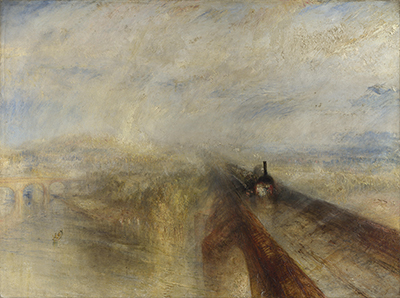
The causeway is not painted with the emphatic energy of the train in Rain, Steam, and Speed, also exhibited in 1844. It appears pale, distant and repetitive, almost as insubstantial as the city. This restraint prevents a simple contrast between brutal machine and beautiful dream. In atmospheric terms the new structure already belongs to Venice's horizon. In historical terms it will change the experience that the painting preserves.[2][3]
Nor should the image be made into a declaration against railways. Turner was capable of making steam power dynamic, dangerous and visually exhilarating. Here the evidence supports a meditation on transition, not a fixed political slogan. The bridge carries modernity into a scene already filled with working boats, trade and movement. Venice was never outside economic history. Its former power had itself depended on maritime technology and commerce.
The causeway also sharpens the significance of the viewer's implied position. The boats approach from open lagoon while the bridge approaches from land. These vectors converge on the distant city. Turner's title can encompass both, but the foreground grants visual priority to water. The old arrival occupies the present tense of the painting; the railway remains a line on the horizon, nearly finished but not yet open. That balance could exist only within a narrow historical interval.
Seen this way, Approach to Venice is not nostalgic because it omits change. It is historically alert because it lets change enter the dream. The city still rises from water, moon and sun still share the sky, and the boats still glide. Alongside them, masonry advances across the lagoon. The most modern fact in the picture is rendered with the same haze that makes old Venice enchanting.
The Royal Academy in 1844
The Royal Academy Summer Exhibition ran from 6 May to 27 July 1844 and contained 1,410 works by 747 artists.[9] Turner's painting therefore entered an exceptionally crowded visual environment. It was not encountered in isolation under modern museum lighting, but among portraits, landscapes, history subjects, sculpture and architecture. His own contributions included major marine pictures, three Venice views and Rain, Steam, and Speed. The different works tested how far contemporary spectators would accept atmosphere, speed and broken form as finished painting.[3][10]
Approach to Venice was one of three similarly sized Venetian oils Turner showed that year. The others were Venice - Maria della Salute and Venice Quay, Ducal Palace.[3] The systematic catalogue notes that all three were more atmospheric than the Venice paintings of the previous year. The repeated format allowed Turner to vary the city's relation to light and viewpoint while presenting a recognisable group. This was sustained exhibition strategy, not a single accidental experiment.
The Times responded with admiration qualified by distance. According to the systematic catalogue, it praised the rich foreground greens and delicately blended cloud and distance, but suggested that the spectator should accept a general impression from the middle of the room. It left Turner's supporters and detractors to decide whether such images were dazzling unrealities or realities seized in an instant.[3] The language identifies the critical problem: did rapid apprehension reveal truth, or evade the detail expected of a completed picture?
The Spectator made the same issue explicit. It called Turner pre-eminent in daring originality and credited him with truth and power in natural phenomena when viewed from an appropriate distance. His seas, clouds, space and light were compelling, but form and substance could be vague. The review found the architecture of his other Venice pictures too evanescent for anything but a fairy city, while Approach to Venice, though beautiful in colour, was a “vision of enchantment.”[10]
That phrase can sound wholly complimentary now, but it carried reservation. Enchantment might delight without satisfying demands for material structure. The critic treated Turner's works as magnificent studies of composition, colour and atmosphere while hesitating to call them complete pictures.[10] Turner's literary framing intensified the ambiguity. Rogers and Byron authorised dream, magic and divided light, but they could also appear to excuse imprecision.
The criticism shows that nineteenth-century viewers were not simply blind to qualities later audiences discovered. They saw the colour, atmosphere, distance and radical treatment of form very clearly. Their disagreement concerned the status of those qualities within finished art. Approach to Venice was challenging because it made evanescence carry the burden that architecture traditionally bore.
Its position beside Rain, Steam, and Speed also complicates any division between retrospective Venice and modern Britain. The Spectator accepted Turner's atmospheric licence more readily in sea scenes than in a railway subject, where looseness of form seemed harder to tolerate.[10] Yet Approach to Venice contains its own railway structure, almost hidden in luminous distance. Across the exhibition, Turner explored modern movement both as rushing mechanical force and as a barely visible transformation of an ancient city.
Ruskin: Praise, Correction and Loss
John Ruskin's responses to Approach to Venice changed over time, and that change is part of the painting's history. In the fifth edition of the first volume of Modern Painters in 1848, he remembered it as the most perfectly beautiful colour he had seen produced by human hands.[3][13] The superlative helped establish the work as a touchstone for Turner's late colour, but it also set a standard against which any physical alteration would seem catastrophic.
By 1856 Ruskin described the painting as a miserable wreck of dead colours, claiming that it had once stood beyond comparison among Turner's Venetian views.[3] He later repeated a broader story of late oils rotting, fading, cracking, mouldering and suffering through cleaning and retouching.[14] Such statements cannot be accepted uncritically as technical diagnosis. Ruskin was a passionate witness with strong ideas about preservation, ownership and the moral value of art. His language registers perceived loss and personal distress as much as measurable condition.
The surviving object does support part of the concern. The 1992 systematic catalogue records abrasion or possible fading of coloured glazes, extensive craquelure, scattered retouching and a varnish applied in 1971 that had yellowed slightly by the time of publication.[3] It also notes that the foreground greens praised in 1844 were no longer as prominent. Ruskin may exaggerate the totality of ruin, but his changing response cannot simply be dismissed.
His topographical commentary is equally important. A later account preserved in The Turner Gallery acknowledges invented building details while arguing that the masses, vegetation near Fusina, mist, water, air, prows and boatmen make the work exceptionally like the experience of looking from the Giudecca landwards at sunset.[15] Ruskin's praise depends not on denying inaccuracy but on locating a more consequential truth in relations of colour, distance and motion.
That argument shaped the modern understanding of Turner. It allowed broken detail to be interpreted as disciplined perception rather than incompetence. Yet Ruskin did not celebrate abstraction. He remained deeply committed to observed nature and could correct Turner's geography even while defending his synthesis. The city had to be recognisable in character, not merely beautiful as paint.
Ruskin's chronology also reveals how reputation and material history interact. He first encountered an image whose colour seemed unsurpassable; later he believed that colour had deteriorated; still later he described surviving drawings as evidence of what the oils had once been.[14] Every judgment compares the visible object with a remembered or imagined former state. Modern viewers, lacking access to the painting in 1844, should neither claim that nothing changed nor reconstruct its original colour solely from Ruskin's grief.
His advocacy nevertheless ensured that Approach to Venice was discussed as more than a decorative lagoon scene. It became evidence in debates about colour, truth, finish and the survival of modern painting. The work's present fame rests partly on those debates, but the canvas remains capable of resisting them. Its roughness, delicacy, faded passages and encrusted highlights do not resolve into one story of either perfect preservation or total loss.
How the Surface Makes Light
The National Gallery's 1992 technical account describes a medium-weight, finely plain-woven canvas with an off-white ground.[3] Turner built the image through thick white impasto covered by very thin, transparent coloured glazes. This combination produces a flickering effect because light interacts differently with raised opaque paint and translucent colour. The visible surface confirms the contrast: ridges and crusts catch light physically, while blue, pink, green and brown appear to hover or sink within thinner passages.[2][3]
White is not simply the colour of clouds. It is the structural source of luminosity. In the upper right, thick pale paint breaks into irregular peaks, scrapes and dragged bands. Yellow glazes and touches pass over or between those ridges. Elsewhere, a thin blue veil allows the pale ground or underpaint to remain active. The scene seems lit from within because Turner prevents every layer from becoming equally opaque.[2]
The lower boats are made through denser local contrasts. Dark green-black and brown hulls meet orange, pink and white cargo. Reflections descend as softened versions of those colours, sometimes interrupted by horizontal ripples. Fine linear accents create oars, poles and possible rigging. These local marks are not fully blended into atmospheric haze; their resistance gives the foreground weight.[2]
In the distant city, Turner's handling changes again. Short vertical strokes stand for towers and walls. Pink and cream run laterally across the horizon. Some structures emerge through scumbling, while others are reduced to interruptions in colour. The method avoids a hard boundary between architecture and air. Venice appears to rise from the lagoon because the same pale and rose tones participate in building, sky and reflection.[2]
The 1992 report records that the canvas had been lined in 1971 and that lining had slightly flattened the impasto. It also notes extensive craquelure disrupting the composition, scattered small retouches, abrasion or possible fading of glazes, and slight yellowing in the dammar varnish then present.[3] These observations should be dated. They describe examination available for that catalogue, not every later conservation decision or the exact present state.
They do, however, explain why reproductions and historical descriptions may disagree. Thin glazes are vulnerable to abrasion and some colourants can fade; a yellowing varnish can shift relations among blue, white and green; flattened relief changes how highlights catch illumination. Turner's late effect depended on subtle differences among layers, so relatively small physical changes could alter the balance substantially.[3]
The surface also guards against calling the painting effortless. Its apparent speed rests on accumulation: ground, impasto, glaze, scumble, incision-like lines, dragged strokes and revisions. The related watercolour shows Turner beginning with broad colour fields and adding notational topography.[5] The oil translates that economy into a much more materially complex structure. Spontaneity is an effect achieved through decisions across layers.
This distinction matters when the painting is compared with Impressionism or abstraction. The National Gallery's late-work guide notes that the free handling and fused light of the later Venices can look forward to subsequent art, but it also distinguishes Turner's Romantic use of colour from later Impressionist aims.[20] He is not simply recording one optical instant, nor is he discarding subject. Material experiment serves a city remembered through history, poetry, travel and approach.
Wethered, Collectors and the Engraved Afterlife
William Wethered of King's Lynn is the first documented owner in the National Gallery's provenance, although the exact initial transaction is not fully recorded. He possessed the painting by 1849 and probably acquired it in connection with the 1844 exhibition.[1][3][21] His response was active rather than merely acquisitive. He asked Turner for another approach to Venice with a related effect.
Turner's October 1844 reply thanked Wethered for the commission and for allowing some change, while acknowledging that Wethered probably wanted something close to the same effect. The second painting was never executed.[3] The exchange is valuable because it links the picture's atmospheric innovation to patron demand. At least one buyer did not consider the image too vague to own; he wanted Turner to revisit its achievement.
The known ownership after Wethered is unusually mobile. The painting passed through Benjamin Godfrey Windus, sales involving Christie's and Foster's, the dealer Ernest Gambart, Charles Birch, Joseph Gillott, Thomas Agnew & Sons, James Fallows, a dealer named Smith, W. and Emma Moir, and the Tennant family.[1][3] This history places the work inside the expanding nineteenth-century market for Turner, where dealers, industrial fortunes and major private collections repeatedly revalued late paintings.
In 1923 the painting was sold through Charles Carstairs for Knoedler to Andrew W. Mellon. Mellon transferred it to his educational and charitable trust in 1934, and it entered the National Gallery of Art as a gift in 1937.[1] It therefore reached a national collection in the United States through private collecting, rather than entering the British national collection through Turner's bequest.
Prints carried the composition to viewers who could not see the oil. Robert Wallis produced a large engraving, published in 1859, and Rawlinson catalogued it as number 679.[3][16] British Museum records document further reproductive circulation, including later prints after the painting.[17] Engraving necessarily translated Turner's colour into line and tone, making boats, architecture and reflection more explicit while sacrificing the chromatic structure Ruskin valued.
The painting also continued to travel in exhibitions. It appeared in Birmingham in 1860, Liverpool in 1881, Manchester in 1887, a Royal Academy winter exhibition in 1903, Venice in 1983-84, Turner and Venice in 2003-04, the major Turner exhibition of 2007-08 and Painting Set Free in 2014-15.[1] These settings repeatedly changed the comparisons around it: British landscape, Victorian collecting, Venice imagery, late style and international modernity.
Its afterlife therefore contains a productive paradox. A picture about silent, gradual approach became highly mobile through sales, prints, loans and transatlantic collecting. Its city remains far away within the composition, but the object itself has circulated widely. That movement helped turn one collector's 1844 purchase into a central public image of late Turner.
Why Approach to Venice Matters
Approach to Venice matters because it holds apparent opposites together without simplifying them. It is topographical and invented, historical and contemporary, literary and material, tranquil and unsettled. Boats and city remain recognisable, yet the dominant event is the passage of colour through air and water. Turner does not choose between place and atmosphere. He makes atmosphere the means by which place becomes visible.
The painting is also unusually exact about a changing form of travel. Rogers's invisible path, the gondolier's oar and the crowded barges belong to an old aquatic entrance. The unfinished railway causeway belongs to a new connection with the mainland. Both are present in 1844, but they do not possess equal visual force. The water approach fills the foreground and determines the viewer's experience; the railway is still a pale line in the distance. Turner captures a transition before it has settled into history.
Moonrise and sunset offer the larger structure for that transition. The pale disc and golden field cannot be reduced to a single stable light. Byron's original sequence follows colour toward extinction; Turner's alteration makes sun and moon dispute possession of the day.[3][11] Venice likewise seems caught between former power, present beauty and approaching modernity. The city is neither alive in its republican splendour nor dead as a ruin. It persists as movement, reflection and memory.
The work's surface gives that idea physical form. Thick white ridges and thin coloured glazes produce light through difference. Boats condense into dark material clusters; the city thins into vertical signs; sky and water trade colours. Historical abrasion, fading, lining and retouching have complicated the effect, just as Ruskin feared, but they have not erased the structure that made his praise possible.[2][3]
Calling the painting proto-Impressionist or nearly abstract can identify real formal freedoms, but either label becomes misleading if it removes the poem, causeway, patrons, boats, city and exhibition controversy. Turner was not escaping meaning. He was finding a way for broken form and luminous colour to carry more kinds of meaning at once.[4][7][20]
The approach never ends. The boats remain on the lagoon, Venice remains across the water, and the two lights remain in the sky. That permanent suspension is the painting's deepest achievement. Turner gives the viewer not the possession of a famous city, but the more unstable experience of seeing it come into being.
Discussion
How does Turner make arrival a suspended experience of movement, light, memory and historical change?
Reader Insights
How do the pale left disc and broad right-hand radiance divide and join the sky?
Where do boats create movement, and where does the composition hold them in suspension?
What does the unfinished railway causeway add to Rogers's waterborne approach?
Join the Conversation
Share a close observation or a source-based question for other readers.
References
- National Gallery of Art, [*Approach to Venice*](https://www.nga.gov/artworks/117-approach-venice), 1937.1.110.
- National Gallery of Art, [public-domain high-resolution image of *Approach to Venice*](https://api.nga.gov/iiif/4f117b4f-4efe-4b2e-88e7-a01975003d95/full/full/0/default.jpg).
- John Hayes, [*British Paintings of the Sixteenth through Nineteenth Centuries*](https://www.nga.gov/content/dam/ngaweb/research/publications/pdfs/british-paintings-16th-19th-centuries.pdf), National Gallery of Art, 1992, pp. 288-291.
- Colin Harrison, [“Turner's Paintings of Venice”](https://ora.ox.ac.uk/objects/uuid:83e230f9-3d9e-454f-a797-3ad6b7826054/files/sh702q7860), University of Oxford.
- Christie's, [*The Approach to Venice, or Venice, from the Lagoon*](https://www.christies.com/lot/lot-6520627), lot essay.
- British Museum, [Turner Venice drawing](https://www.britishmuseum.org/collection/object/P_1958-0712-443), 1958,0712.443.
- J. Paul Getty Museum, [*J. M. W. Turner: Painting Set Free*](https://www.getty.edu/art/exhibitions/turner/).
- J. Paul Getty Museum, [“Getty Presents J.M.W. Turner: Painting Set Free”](https://www.getty.edu/news/getty-presents-english-painter-jmw-turner-painting-set-free/).
- Royal Academy and Paul Mellon Centre, [1844 Summer Exhibition Chronicle](https://chronicle250.com/1844).
- *The Spectator*, [“Fine Arts”](https://archive.spectator.co.uk/article/11th-may-1844/18/fine-arts), 11 May 1844.
- Lord Byron, [*Childe Harold's Pilgrimage*, canto IV](https://www.newsteadabbeybyronsociety.org/works/downloads/childe4.pdf).
- Samuel Rogers, [*Italy*, “Venice”](https://upload.wikimedia.org/wikipedia/commons/3/34/Poems_%28IA_poemssam02roge%29.pdf).
- John Ruskin, [*Modern Painters*, Library Edition](https://www.lancaster.ac.uk/media/lancaster-university/content-assets/documents/ruskin/3-7ModernPainters.pdf).
- John Ruskin, [*Notes by Mr Ruskin on His Collection of Drawings by the Late J. M. W. Turner*](https://upload.wikimedia.org/wikipedia/commons/5/52/Notes_by_Mr._Ruskin_%28IA_notesbymrruskin00ruskrich%29.pdf), 1878.
- [*The Turner Gallery: A Series of One Hundred and Twenty Engravings*](https://upload.wikimedia.org/wikipedia/commons/d/de/The_Turner_Gallery%3B_a_series_of_one_hundred_and_twenty_engravings_from_the_works_of_the_late_J.M.W._Turner%2C_R.A.%3B_%28IA_gri_33125008236784%29.pdf), 1878.
- W. G. Rawlinson, [*The Engraved Work of J. M. W. Turner, R.A.*](https://upload.wikimedia.org/wikipedia/commons/4/40/The_engraved_work_of_J._M._W._Turner%2C_R.A._%28IA_gri_33125001464789%29.pdf), no. 679.
- British Museum, [collection records for prints after *The Approach to Venice*](https://www.britishmuseum.org/collection/term/BIB3860).
- Venezia Heritage Tower, [“Ponte della Liberta”](https://tour.veneziaheritagetower.com/aziende/ponte-della-liberta/).
- Port of Venice, [history of the port](https://www.port.venice.it/offerta-portuale/i-porti/porto-di-venezia/).
- National Gallery of Art, [*I Am Still Learning: Late Works by Masters*](https://www.nga.gov/sites/default/files/migrate_images/content/dam/ngaweb/education/learning-resources/teaching-packets/pdfs/still-learning-tp.pdf).
- Wisbech and Fenland Museum, [Townshend Manuscript Collection catalogue](https://www.wisbechmuseum.org.uk/perch/resources/wisbechandfenlandmuseumtownshend-manuscriptcollectionedited-min.pdf), Turner and William Wethered records.