by Tom Gurney
Tom Gurney BSc (Hons) is an art history expert with over 20 years experience
Published on June 19, 2020 / Updated on August 29, 2026
Email: tomgurney1@gmail.com / Phone: +44 7429 011000
Introduction
J. M. W. Turner's Modern Rome - Campo Vaccino looks across the Roman Forum before archaeology separated many of its monuments from the life around them. Three ancient columns rise at the right. A pale dome and brick bell tower emerge farther back. The Colosseum almost disappears into luminous distance. Along the broken foreground, however, women spread washing, children gather, goats feed among weeds and stones, a religious company moves near a church, and an investigator climbs a ladder. Rome is not presented as one lost civilisation beneath one later city. Different ages remain physically entangled.
Turner exhibited the oil at the Royal Academy in 1839 as catalogue number 70. The J. Paul Getty Museum, which acquired it in 2011, records dimensions of 91.8 by 122.6 centimetres and accession number 2011.6.[1][3] Although painted in England, it was the culminating result of Turner's encounters with Rome in 1819 and 1828-29. The city seen directly had been carried for years through sketchbooks, memory, literature and other art.
The old name in the title is essential. Campo Vaccino referred to the cattle pasture into which the ancient Forum had changed after the end of Roman rule. By Turner's lifetime, portions had been exposed and studied, but the later systematic clearances had not yet remade the district as the archaeological precinct familiar today.[10] Cattle, goats, churches, workshops, houses and ruins could still form one inhabited environment.
Turner does not preserve that environment neutrally. His viewpoint seems to sweep down from the Capitoline Hill and across the valley with impossible freedom. Buildings are compressed, intervals altered and atmosphere allowed to dissolve hard edges. The panorama is accurate enough to be recognised, yet too deliberately assembled to function as a measured record. Its subject is Rome as accumulated experience.
The divided sky deepens that accumulation. Turner accompanied the Academy title with an adaptation of Byron in which moon and sun share a day that has not yet become night.[5][9] Getty identifies a rising moon on the left and a setting sun on the right; another expert has read Turner's changed wording as suggesting morning and renewal.[1][6] The disagreement should remain open. The painting's force lies less in fixing an hour than in making several times appear together.
At a Glance
- ArtistJoseph Mallord William Turner
- TitleModern Rome - Campo Vaccino
- ExhibitedRoyal Academy, 1839
- Catalogue number70
- MediumOil paint on canvas
- Dimensions91.8 × 122.6 cm
- CollectionJ. Paul Getty Museum
- Accession2011.6
- First ownerHugh Munro of Novar
- CompanionAncient Rome; Agrippina Landing with the Ashes of Germanicus
The composition has the breadth of a panorama but the surface intensity of a late Turner exhibition picture. Almost half of the canvas is pale sky. Blue, pearl, cream and thin grey pass into one another without a firm boundary, allowing towers and distant hills to lose definition as they rise. Below, the Forum gathers in warmer whites, pinks and golds. The foreground becomes denser still, with ochre earth, russet masonry, dark plants, green foliage and small accents of clothing.
The eye enters from a high, uneven ridge running diagonally across the lower third. Fallen blocks, scrub, animals and figures prevent a smooth descent. At lower left, a group of women and children occupies a patch of broken ground; cloth, baskets and domestic work bring ordinary scale to the ancient view. Nearer the centre, goats and their keepers move beside a large pale fragment. At the right, a reclining or seated figure is absorbed into stone and vegetation. The high-resolution image supports these broad relationships, though the smallest gestures and objects should not be forced into exact names.[4]
Architecture creates a second rhythm. The three tall columns at the right, associated with the Temple of Vespasian and Titus, rise sharply against the sky. The Temple of Saturn and Arch of Septimius Severus help define the nearer Forum. Across the middle distance appear the Temple of Antoninus and Faustina, the Colosseum, Santa Francesca Romana with its brick campanile, and Santi Luca e Martina with its pale Baroque dome.[2] Turner makes no visual distinction between monuments considered “classical” and structures built many centuries later. All are Roman facts.
This refusal of hierarchy extends to human activity. A religious group near Santi Luca e Martina belongs to the Christian city. An archaeologist on a ladder represents the modern investigation of antiquity. Women drying sheets and people tending animals inhabit the ground through labour rather than learned contemplation.[5][6] No one stands apart as a Grand Tourist surveying picturesque decay. The spectator receives the elevated privilege that the painted inhabitants do not need.
Light binds these disparate elements without making them uniform. Pale architecture seems to absorb the sky, while the lower foreground resists dissolution through rougher textures and deeper colours. The result is not a simple movement from dark present to radiant past. Modern bodies occupy both light and shade; ancient fragments can be massive, broken or nearly transparent. Turner uses atmosphere to connect periods while paint preserves their material differences.
Contents
- Introduction
- At a Glance
- From the Capitoline Hill
- Ancient Stones and Modern Lives
- Campo Vaccino and the Changing Forum
- The Grand Tour View Tradition
- Two Roman Journeys
- Sketchbooks, Memory and Altered Topography
- Byron and the Divided Sky
- Ancient Rome as a Companion
From the Capitoline Hill
The apparent viewpoint lies on or near the Capitoline Hill, looking east and south-east along the Forum valley. From this height, the eye can pass over the nearer ruins towards the Colosseum and the distant Roman skyline. Getty's cultural-object record aptly describes the movement as a swoop down upon the Campo Vaccino rather than a stationary gaze.[2] Turner gives the spectator the sensation of descending through space while remaining above it.
At the right edge, the great column group acts as a near marker. Its surviving entablature and capitals retain enough architectural weight to establish scale, but their warm surfaces merge with the ridge below. Farther left, the Arch of Septimius Severus and neighbouring remains lead towards Santi Luca e Martina. The church's dome is conspicuously pale, while the brick campanile of Santa Francesca Romana supplies a narrow vertical near the centre. The Colosseum glows in the distance as a softened, almost rectangular mass.
These landmarks do not line up as they would in a rigorous survey. Turner increased the visual relation between the Arch of Septimius Severus and the Temple of Vespasian and Titus, compressing ground that would otherwise weaken the composition.[5] He also arranged the distant structures so that Rome appears fuller and more continuous than one fixed prospect permits. Such changes are not failures of recognition. The associated drawings prove that he knew the individual forms with considerable specificity.
The expansive view is nevertheless anchored in small transitions. A path or ledge travels across the lower slope. Figures and animals repeat the direction at changing scales. Pale blocks carry the eye towards architecture, while dark vegetation interrupts any single passage into depth. In the middle distance, cattle and scattered people prevent the Forum floor from becoming an empty band. Recession is built through use as much as through perspective.
Turner also weakens the ordinary distinction between foreground detail and far distance. Some near forms are brushed broadly or veiled by glaze, while a tiny remote tower can retain a precise accent. The spectator continually changes focus, looking first for named monuments and then for lives almost lost among them. Rome cannot be grasped in one act of inspection.
The aerial construction gives the city an emotional unity that strict topography would not. A measurable view would divide objects by distance and orientation. Turner's altered panorama allows the Forum, churches, Colosseum, pasture and skyline to participate in one atmospheric field. The city seems to gather itself beneath the viewer, not as an intact historical moment but as centuries held together by light.
Ancient Stones and Modern Lives
The lower register is where Turner's argument becomes most concrete. A conventional view of ruins might use local figures as picturesque accessories or measures of scale. Here they are too numerous and too various to remain decorative. Women work with cloth; children cluster nearby; goats browse among debris; keepers attend them; cattle occupy the old Forum; worshippers or monks gather near the church; an archaeologist examines a structure from a ladder.[2][5][6] Each activity claims a different Rome.
Domestic labour is especially important. The pale textile at the left can echo the surrounding stone in colour, but it belongs to cleaning, drying and repeated use. A basket or bundle places bodily needs beside inscriptions and temples. The women do not mourn antiquity or perform a classical story. Their attention is directed towards immediate tasks. Turner lets modern life continue without asking permission from the ruins.
The animals recover the title's agricultural history. Cattle gave the Campo Vaccino its name; goats animate the rougher foreground where grazing can occur between fallen blocks and weeds. Pasture might appear to mark decline when compared with the political centre of the Roman Empire. Yet it is also productive occupation. The ground feeds living creatures after its ceremonial and governmental functions have changed.
Religious continuity complicates any opposition between pagan ruin and Christian intrusion. Several ancient buildings in and around the Forum survived partly because later communities adapted them. Santi Luca e Martina rose over the former Secretarium Senatus; the Temple of Antoninus and Faustina became San Lorenzo in Miranda; the Curia became Sant'Adriano; other temples were incorporated into churches.[10] Conversion altered meaning but could preserve fabric that abandonment might have destroyed.
The archaeologist introduces another relation to the past. His ladder implies close, physical scrutiny rather than distant admiration. Investigation is active labour, comparable in one sense to washing or herding. Yet it also anticipates the transformation of the district. Excavation would recover Roman levels while removing later deposits, vegetation and uses. Knowledge gained clarity by changing the scene it sought to understand.
Turner's human scale keeps imperial language from dominating. A large pale fragment in the foreground bears an inscription associated with Pontifex Maximus, the Roman office of chief priest later attached to emperors. It may invoke authority, but the stone now lies among plants, animals and ordinary bodies.[5] The title survives while its political world does not. Around it, unrecorded lives continue.
This is why the picture cannot be reduced to nostalgia. Turner certainly valued ruins and the imaginative reach they offered, but he did not empty modern Rome to make antiquity noble. The ancient city is fragmented; the inhabited city is visually abundant. Decay and continuation occur together, and neither cancels the other.
Campo Vaccino and the Changing Forum
The Roman Forum developed from the late seventh century BCE after the marshy valley between the surrounding hills was reclaimed. Over many centuries it became a centre for political assembly, law, commerce, worship, ceremony and imperial commemoration. Temples, basilicas, arches and civic buildings accumulated rather than arising from one unified plan.[10] Even at the height of Roman power, the district was already a record of different periods.
Its uses changed drastically after late antiquity. Flood deposits and debris raised ground levels; buildings were dismantled for material, fortified, inhabited or converted into churches. Burial and agriculture entered spaces once devoted to public government. By the early modern era, much of the valley functioned as meadow and pasture, hence the name Campo Vaccino, commonly understood as cattle field or cow pasture.[10]
That name does not mean every monument had vanished beneath untouched soil. Excavations and clearances had begun before Turner painted the canvas, including work around prominent arches and temples. Antiquarians, architects and artists had long measured visible remains. The ladder in the middle distance acknowledges investigation already under way. What had not yet occurred was the extensive later campaign that isolated ancient structures and removed much post-antique fabric.
Turner's view therefore captures a transitional condition rather than a pristine survival. Ancient columns stand partly exposed; Baroque churches remain visually and socially dominant; pasture continues; archaeological attention has arrived. The district can be read as a civic ruin, a Christian quarter, agricultural ground and an emerging field of historical science at the same time.
Modern photographs often encourage a different understanding. Cleared foundations, designated paths and explanatory boundaries make chronology easier to sort. They also suppress the densely inhabited mixture Turner knew. His painting is evidence not only for the appearance of particular monuments but for relations later interventions dissolved: washing near masonry, livestock among inscriptions, churches embedded in antique terrain, and excavation beside ongoing use.
The official history of the Forum emphasises that conversion helped several ancient structures survive.[10] This point unsettles the idea that later Rome merely damaged classical Rome. A church could obscure an earlier function while conserving walls and columns. Pasture could signal political loss while preventing dense redevelopment. Archaeology could recover knowledge while dismantling a long-lived environment.
Turner makes those ambiguities visible without turning them into an illustrated lecture. Warm light crosses every period. Plants cover both natural and cut stone. Figures move without regard for historical boundaries. The Campo Vaccino is not shown as the embarrassing interval before modern recovery; it is a valid Roman condition whose own complexity deserved remembrance.
The Grand Tour View Tradition
Long before Turner arrived, the Forum had become one of the central subjects through which European travellers imagined Rome. Painters, draughtsmen and printmakers offered recognisable prospects to visitors who wished to study, remember or possess the city. The official archaeological park places Turner's Campo Vaccino within a lineage that includes Gaspar van Wittel, Canaletto, Giovanni Battista Piranesi and Jean-Baptiste-Camille Corot.[11]
Each inherited a problem: Rome's fame depended upon historical knowledge, while its visual reality consisted of structures from many eras, active streets, plants, animals and broken ground. A view could clarify monuments by adjusting them, enlarge ruins to increase sublimity, introduce staffage to convey scale, or organise disorder into a persuasive prospect. Topographical art was never simply mechanical transcription.
Van Wittel's broad urban descriptions established a precise veduta tradition in which buildings and open space could be read with unusual clarity. Canaletto brought exact-seeming architecture into carefully controlled pictorial arrangements. Piranesi intensified scale, shadow and the imaginative power of fragments. Their images circulated beyond Italy, shaping expectations before travellers encountered the physical city.
Turner understood that inheritance but rejected the stable air often associated with souvenir views. His distant forms dissolve; near matter can be uncertain; the sky carries as much visual weight as architecture. Recognisable monuments do not become evenly legible. The viewer must work between knowledge of Rome and the optical experience of light.
This difference does not make his painting anti-topographical. Specific landmarks, observed column groups and the orientation from the Capitoline remain indispensable. Without them, the work would lose the historical density that distinguishes Rome from an invented classical landscape. Turner stretches the veduta until atmosphere, memory and temporal argument enter its structure.
Grand Tour culture also encouraged comparison between the present and a revered past. Travellers might lament modern poverty or disorder against imagined imperial grandeur. Turner's crowded foreground resists such condescension. The modern inhabitants are not evidence of moral inferiority. Their work, worship and animal husbandry are forms of continuity, while the companion canvas exposes violence within ancient splendour.
The painting consequently performs two kinds of transport. It gives distant viewers enough monuments to recognise the Roman Forum, satisfying the desire for place. At the same time, its high sweep and divided light create an encounter no visitor could repeat exactly. Rome is offered not as an owned memory but as a city whose meanings exceed the traveller's view.
Two Roman Journeys
Turner left England for his first Italian journey on 31 July 1819 and reached Rome near the end of September. The visit was the culmination of years spent learning Italy through paintings, watercolours, prints, poetry and the reports of other travellers. Once there, he worked with remarkable intensity. Sotheby's records eight sketchbooks and about 120 watercolour and gouache studies associated with this Roman period.[5]
Sir Thomas Lawrence, then in Rome, wrote on 6 October that Turner felt the beauty of the atmosphere and scenery. The observation matters because light was not an abstract late invention imposed upon imperfect memories. It was one of the qualities that struck Turner immediately.[5][6] Pencil supplied rapid architectural information, while colour allowed him to register relations among stone, sky, vegetation and air.
Several works followed the journey. Rome from the Vatican, exhibited in 1820, joined a panoramic city prospect to Raphael and Renaissance history. Forum Romanum, made for the architect Sir John Soane, combined ancient and modern Rome through a more emphatic architectural construction. The Bay of Baiae of 1823 extended the Italian experience southward. These works did not exhaust the drawings; the records remained available for later synthesis.
Turner returned in 1828. He arrived in Rome in early October, stayed near the Spanish Steps at 12 Piazza Mignanelli, and exhibited recent paintings in rooms near the Quattro Fontane. The display included The Vision of Medea, Regulus and a view of Orvieto. Contemporary reactions were mixed, but the episode demonstrated his willingness to place increasingly diffuse, imaginative work before a Roman audience.[5]
He left on 3 January 1829 and never returned. The second journey broadened his memory of the city, though Modern Rome depends chiefly upon detailed Forum material from 1819. David Blayney Brown argues that the later visit encouraged a more assimilated vision in which architecture could be expressed through recollection and atmosphere rather than rebuilt from exact description.[6]
The ten-year interval between the second departure and the 1839 painting is crucial. Turner was not attempting to reproduce yesterday's view. Rome had become a durable field of associations. Each later Italian canvas could reactivate direct observation while altering its emphasis according to literary, historical and pictorial needs.
Travel and memory should therefore not be treated as opposites. The drawings made invention responsible. They anchored columns, arches and spatial relations in things Turner had seen. Memory allowed him to judge which features carried Rome most powerfully after incidental detail had fallen away. The finished oil gains authority from the friction between the two.
Sketchbooks, Memory and Altered Topography
The preparatory trail for Modern Rome is unusually specific. Three drawings in the Albano, Nemi, Rome sketchbook, Turner Bequest CLXXXII, numbers 57 and 65a-b, relate to groups of columns in the finished composition. A watercolour of the north end of the Forum, number 3 in the same sequence, corresponds closely to the right-hand side.[5] Turner did not invent the monumental vocabulary from generalized recollection.
These studies nevertheless function as components rather than a complete design. A sketchbook preserves what the artist could see from successive positions. The oil asks how those observations might be brought into one commanding statement. Turner altered intervals, selected landmarks and adjusted scale to create a panorama more comprehensive than any single station.
The clearest example joins the arch dedicated to Septimius Severus more tightly to the surviving Vespasian and Titus column group. Their apparent proximity is heightened for pictorial effect.[5] The change strengthens the near-right architectural mass and gives the view a sequence of recognisable verticals. It also compresses imperial history into a visually concentrated field.
Turner's procedure resembles historical memory itself. Memory does not preserve every interval with equal force. It groups prominent events, allows minor connections to fade and places distant moments into meaningful proximity. The canvas makes Rome behave similarly: monuments several centuries apart and buildings separated in space become neighbours within a remembered city.
Atmosphere is part of that construction, not a veil hiding missing knowledge. Pale glazes and scumbles let the Colosseum, towers and hills recede at different rates. Some structures remain legible through silhouette; others survive as warm interruptions within light. The city seems to appear as the viewer looks, a process closer to recollection than to architectural inventory.
The elevated angle gives Turner further freedom. Because the spectator looks down and across, ordinary ground measurements are hard to verify. Diagonal ridges and overlapping forms disguise transitions. The swooping sensation makes compression feel like breadth. What might appear distorted in a plan becomes convincing in an experience of movement.[2]
This is not an argument that accuracy was irrelevant. The painting relies upon enough exact information for deviations to matter. Turner knew which buildings could represent republican, imperial, Christian and Baroque Rome; he understood how the Forum lay beneath the Capitoline; he retained observed column groupings. His freedom is strongest because it works upon disciplined knowledge.
By 1839, those drawings had become more than practical notes. They connected the mature painter to the excitement of his first Roman arrival two decades earlier. Reusing them allowed past experience to enter a picture about the persistence of pasts. The method and subject mirror one another.
Byron and the Divided Sky
Turner's Academy epigraph changes two lines from Byron's Childe Harold's Pilgrimage. Byron wrote, “The Moon is up, and yet it is not night,” followed by “Sunset divides the sky with her.” Turner retained the first thought, then made the second line “The sun divides the day with her.”[5][9] The substitution of “sun” for “sunset,” “day” for “sky,” and a slightly altered grammar changes both emphasis and possibility.
Byron's stanza does not describe Rome. It evokes an evening seen from Venice, where moon and sunset share the heavens and coloured light reaches towards the Alpine distance.[9] Turner transferred that suspended illumination to the Forum. The borrowing is therefore an act of relocation, just as the visual composition relocates buildings within an altered panorama.
The preceding stanza supplied language even closer to Turner's Roman terrain. Byron praised Italy's beautiful weeds, rich waste, glorious wreck and graced ruin.[9] Those paradoxes could describe the lower half of the painting: plants flourishing among fallen masonry, productive pasture occupying an imperial centre, and beauty arising from historical damage. Turner did not quote those lines in the Academy catalogue, but the surrounding poem helps explain why Byron was such an apt companion.
What hour does the painting show? Getty's interpretation identifies the moon rising on the left while the sun sets behind the Capitoline on the right.[1] This accords with Byron's original evening and with the convention of a divided sunset sky. The technical examination also found an earlier painted position for the sun, slightly lower and farther right, confirming Turner's active adjustment of the disc.[5]
David Blayney Brown has proposed another reading. Because Turner removed “sunset” and made the sun divide the “day,” the change may shift the scene towards morning. In that interpretation, modern Rome is not merely the ruined aftermath of ancient greatness; dawn suggests renewal.[6] The crowded present, worshippers, domestic work and animals support continuity rather than terminal decline.
Neither account resolves every feature. Celestial discs are difficult to separate from the glowing atmosphere, and Turner's verse deliberately retains the paradox of moonlight within day. It is more useful to recognise that the picture refuses one temporal direction. Sunset can imply ending; dawn can imply return; moon and sun make successive hours simultaneous.
The divided sky also echoes Rome's divided historical identity without splitting the canvas into halves. Ancient and modern, pagan and Christian, ruin and use occupy the same field just as moon and sun occupy one day. Byron gave Turner a language for coexistence. Turner's alterations made that language answer to a city in which time had accumulated materially.
Ancient Rome as a Companion
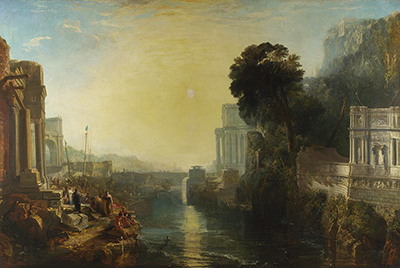
At the 1839 Academy exhibition, Modern Rome appeared with Ancient Rome; Agrippina Landing with the Ashes of Germanicus. The Triumphal Bridge and Palace of the Caesars Restored. The companion, now Tate N00523, is also an oil of 1839 and is almost the same size.[14] Turner conceived the two as a pendant, inviting comparison across imagined historical states.
The ancient canvas seems at first to offer what the modern view lacks: intact marble architecture, ceremonial splendour and a restored imperial city. Yet its narrative is mournful. Agrippina brings home the ashes of her husband Germanicus, whose death was associated with imperial suspicion and alleged poisoning. The episode anticipates political repression and the violence of Tiberian rule.[15]
Turner also relocates the event. Agrippina historically landed at Brundisium rather than Rome, but the altered setting allows private grief to enter the capital's magnificent architecture.[15] Like Modern Rome, the companion sacrifices literal place to concentrated historical meaning. Reconstruction is not presented as documentary certainty.
The pair therefore does more than contrast glorious past with degraded present. Ancient Rome contains ashes, bereavement and the seeds of tyranny. Modern Rome contains broken monuments, but also children, work, worship, research and animal life. One city is architecturally complete yet morally troubled; the other is materially fragmented yet socially continuous.
Light sustains the reversal. The ancient scene is immersed in orange-gold brilliance, with a moon that can be read as a tragic undercurrent.[13][15] The modern picture receives paler, more dispersed radiance shared by sun and moon. Both suspend ordinary time. Neither assigns uncomplicated hope to brightness or uncomplicated loss to shadow.
Turner had recently explored another ancient-modern pairing. At the Academy in 1838 he showed Ancient Italy: Ovid Banished from Rome and Modern Italy: The Pifferari, both acquired by Hugh Munro of Novar. Modern Rome can be understood as the culminating work in this sequence of comparisons, though Munro's decision to buy it but not its companion does not prove that he read the series in one fixed way.[5][6]
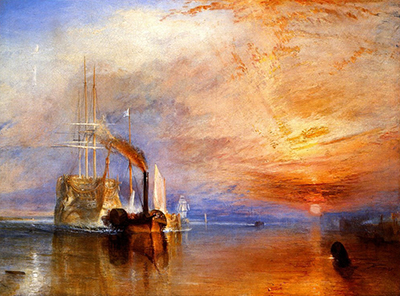
The Roman pair was hung in the East Room near The Fighting Temeraire. That canvas also brings old and new orders together and places sun and moon within a transitional light. The juxtaposition would have made Turner's recurring structures visible across radically different subjects: imperial history, lived urban ruin and a veteran warship towed by steam power.[5][13]
Seen as a group, the works reject linear triumph. Newness does not simply improve upon age, and the past is not innocent because it has become beautiful. Turner asks how historical change feels when several times remain visible at once.
Paint, Surface and Atmospheric Structure
The extraordinary preservation of Modern Rome makes its material evidence especially valuable. Getty describes the work as remarkably fresh and largely untouched since it left Turner's hands.[1] A detailed report prepared before the 2010 sale examined the support, underlayers, revisions and surface under several forms of illumination.[5] Its findings show that apparent spontaneity rests upon a complex sequence.
The canvas has not been lined in the usual later conservation sense with an overall adhesive. Turner appears to have worked with an additional loose canvas behind the primary support from the beginning. A white ground covered the front, followed by a reddish-fawn lay-in visible in some intervals. Infrared examination found no general underdrawing, although the small ladder figure may have been picked out with a graphite-like material.[5]
Turner built the scene through contrasting consistencies. Clouds and celestial light include raised opaque paint. Architectural passages combine thicker strokes with translucent films. Thin glazes drift across completed forms, unifying separate buildings in atmosphere, while dry scumbles catch raised texture. Dribbled liquid colour, rubbed transitions and touches made with fingers or the end of a brush disturb any uniform finish.[5]
The sky shows particularly physical control. Turner smoothed areas with a rag or finger, then set thicker light against them. The result is broad without being empty. Small changes in opacity make vapour seem to advance or withdraw. Architecture below can be sharply stated, then partially submerged beneath a later veil, as if distance were painted over solidity.
Technical examination revealed a pentimento in the position of the sun, formerly slightly lower and farther to the right. The change confirms that the celestial structure was composed, not simply transcribed from one observation. Four pinholes near the corners may have assisted perspective construction or kept another surface away from wet paint, but their purpose remains uncertain.[5]
Drying cracks in the lower left arose during Turner's own working process. Rather than treating every crack as accidental damage, he appears to have incorporated or obscured some with later marks. A staff or spear-like accent crosses one area; dark glaze and foliage modify others. Scratching and fingerprints likewise belong to the making of the image, allowing lower colour to reappear or a wet film to be lightened.[5]
The frame left impressions in paint that was still wet or not fully hardened, and the varnish seems to have been applied while the canvas remained framed. The 2010 report found no clear evidence of a later overall revarnishing.[5] These observations help explain the unusual immediacy of the surface, though they should not become a romantic story of one feverish session. Turner revised, layered, waited, covered and reopened.
Material procedure supports the historical argument. Solid forms receive glazes that make them temporally uncertain. Cracks become incorporated rather than erased. Earlier positions remain beneath later decisions. The surface, like Rome, is an accumulation in which alteration does not wholly destroy what came before.
The Royal Academy and Divided Reception
The Royal Academy Summer Exhibition of 1839 ran from 6 May to 27 July at Trafalgar Square. It contained 1,390 works by 747 artists.[12] Turner occupied a prominent and controversial position. His Roman pendant and The Fighting Temeraire placed three ambitious meditations on history, light and change before the same public.
The responses reveal admiration and bewilderment in close proximity. The Spectator regretted what it called Turner's extravagances but declared his power in representing an atmosphere of light impossible not to admire. It described Modern Rome as immersed in radiance, crossed by silvery light from a newly risen moon.[13] Even qualified praise recognised that atmosphere had become the work's principal expressive medium.
The same review found The Fighting Temeraire more intelligible, identifying a clear contrast between old warship and energetic steam tug.[13] The comparison is revealing. Modern Rome contains no single narrative focus equivalent to the vessel. Its figures disperse through architecture and pasture; its old and new orders cannot be assigned to two objects. Viewers had to infer structure from a field of sensations.
Other critics resisted that demand. Blackwood's Edinburgh Magazine complained that the ancient and modern Roman pictures dissolved into confused red, blue and white effects and rejected their simultaneous sun and moon. The Athenaeum described the pair as examples of the artist's wildest manner. William Makepeace Thackeray admitted in Fraser's Magazine that most of Turner's exhibits were incomprehensible to him.[5] Such reactions record a genuine problem of legibility, not merely failure to appreciate genius.
The painting challenged several expectations at once. Its title promised a recognisable urban view, but exact architecture repeatedly dissolved. Its pendant format promised historical comparison, but the modern canvas was not a moral condemnation of the present. Its literary quotation promised interpretation, but Turner altered Byron and left the hour uncertain. Its minute incidents invited close reading, while the luminous field overwhelmed detail from across the room.
Later knowledge of Ruskin's defence can flatten this reception into enemies and champions. Ruskin was already angered by attacks on Turner during the 1830s and soon developed the arguments that led to Modern Painters, but there is no need to invent a specific published verdict from him on Modern Rome. The contemporary evidence already contains a broad range from wonder to exasperation.
The debate confirms Turner's achievement. Critics agreed that the picture made light impossible to ignore. They disagreed about whether radiance revealed Rome or prevented representation. That dispute remains productive because the architecture both appears and dissolves. The canvas is neither a clear record overlaid with effects nor pure atmosphere supplied with names. Its meaning resides in the unstable exchange between them.
Hugh Munro, the Roseberys and the 2010 Sale
Hugh Andrew Johnstone Munro of Novar acquired Modern Rome directly from Turner at the 1839 Academy exhibition. Munro was twenty-two years younger than the artist and became a close friend, important patron and eventually one of Turner's executors. Turner visited his Scottish estate in 1830, and Munro assembled major paintings and watercolours across the artist's career.[5]
His Italian holdings were particularly strong. He commissioned Rome from Mount Aventine as a panoramic record and acquired Juliet and her Nurse, Ancient Italy, Modern Italy and other late exhibition pictures. Modern Rome could connect these works through its synthesis of Italian place, literature and modern life. Since Munro did not buy Ancient Rome, however, any claim that he intended one precise sequence remains conjectural.[6]
The painting stayed in his collection until the Novar sale at Christie's on 6 April 1878. Listed as lot 99, it was bought through “Davis” for Archibald Primrose, 5th Earl of Rosebery, and his wife Hannah de Rothschild for 4,450 guineas. The purchase has been associated with their marriage that year. Rosebery later served as British prime minister in 1894-95.[5][7]
It descended through the Rosebery family and was placed on long-term loan to the National Gallery of Scotland from 1978 until 2010. This history gave the canvas public visibility without changing private ownership. Its survival behind glass and limited intervention contributed to the exceptional condition noted when it returned to the market.[5]
Sotheby's offered the painting in London on 7 July 2010 as lot 57. Six bidders competed, and the final price including premium was GBP29,721,250, then an auction record for Turner.[5] The buyer was acting for the J. Paul Getty Museum. Before the work could leave Britain permanently, its cultural importance triggered formal export review.
The culture minister placed a temporary bar on export after the Reviewing Committee judged it to satisfy all three Waverley criteria and marked the case as outstanding. The committee considered the picture closely connected with national history and life, of exceptional aesthetic importance, and of exceptional significance for study. The fair matching amount, including relevant tax, was GBP30,284,968.75.[7][8]
The deferral allowed a British institution or private purchaser committed to public access an opportunity to match that amount. No successful offer emerged before the period ended, and the export licence was issued.[8] The process did not reverse the sale or establish wrongdoing. It recorded the painting's importance, created time for a domestic purchase and then permitted lawful export when the required funds were not secured.
The Getty acquisition entered the collection as 2011.6.[1] The move ended more than 170 years of British private ownership but brought the painting into a museum able to preserve, study and display it publicly in Los Angeles. Its ownership history now forms another layer in the long movement between private possession, national significance and international access.
Why Modern Rome Matters
Modern Rome - Campo Vaccino is often called Turner's final great statement on the city. The description is persuasive because the work gathers two Roman journeys, twenty years of reflection, earlier panoramas, the Academy pendant tradition, Byron's poetry and a lifetime of competition with old-master landscape into one concentrated image.[5][6][16] Yet culmination does not mean summary alone. Turner creates a new account of historical time.
The picture refuses to make antiquity fully recoverable. Its monuments are recognisable but broken, shifted and absorbed by later Rome. Nor does it condemn the present as a fall from imperial perfection. The companion's Agrippina carries ashes into architectural splendour, exposing violence within the ancient ideal. Modern women, children, herders, worshippers and investigators give the ruined city continuing purpose.[14][15][17]
It also records a physical condition that later archaeology transformed. The Forum Turner knew was partly excavated but still joined to churches, pasture and ordinary occupation. Subsequent clearance increased knowledge of Roman levels while removing much of this visible coexistence. The painting therefore preserves relations unavailable in the modern precinct, even as its altered topography prevents use as a literal survey.[10]
Turner's visual method makes this historical argument felt rather than merely stated. Warm broken matter occupies the lower edge. Architecture rises, pales and passes into air. Glazes cover earlier forms without erasing them; revised positions remain within the structure; cracks are incorporated into later marks. Surface and subject share a logic of survival through alteration.
The uncertain hour is equally important. If the sun is setting, Rome glows at an ending while the moon rises. If the light is morning, ruins participate in renewal. Turner's changed Byron line permits both movements. Day is divided but not destroyed. The painting can hold decline and continuation without deciding that one is the final truth.
This openness distinguishes the work from a picturesque inventory of famous remains. Turner does not ask the viewer only to identify the Colosseum, temples, arch and churches. He asks how those objects coexist with washing, grazing, worship and study; how visual pleasure relates to loss; and whether historical knowledge clarifies the past by separating it from the lives that followed.
The high viewpoint might seem to promise mastery, yet the panorama never becomes fully possessable. Some figures remain indistinct. Distances are compressed. Light conceals as it reveals. Even the exact time resists agreement. Turner grants a commanding sweep while denying complete control over Rome's meanings.
That tension explains the painting's durability. It can reward archaeological recognition, social history, literary reading, technical examination and direct attention to colour without collapsing into any one of them. Every approach discovers a different Rome inside the same field.
The Campo Vaccino was once the political centre of an empire, later a pasture, then an object of excavation and now a protected archaeological landscape. Turner's canvas catches no stage in isolation. Ancient power persists as fragments; Christian Rome occupies antique ground; labour and animals inhabit both; modern inquiry begins to alter what it studies. Above them, moon and sun share a sky that may be ending or beginning.
For Turner, modernity did not erase the past. It consisted of living among pasts that remained active, damaged and continually reinterpreted. Modern Rome - Campo Vaccino makes that condition luminous. Its Rome is not eternal because nothing changes. It is enduring because change never exhausts what the city can mean.
Discussion
How does Turner make modern Rome a simultaneous experience of ruin, work, worship, study and atmospheric change?
Reader Insights
Where do ancient fragments and present-day activity resist a simple decline narrative?
How does compression create a stronger idea of Rome than a measurable panorama?
What supports sunset and moonrise, and what leaves room for a morning reading?
Join the Conversation
Share a close observation or a source-based question for other readers.
References
- J. Paul Getty Museum, “Modern Rome - Campo Vaccino,” 2011.6: https://www.getty.edu/art/collection/object/103QTP
- Getty CONA, full record for “Modern Rome - Campo Vaccino”: https://www.getty.edu/cona/CONAFullSubject.aspx?subid=700008295
- Google Arts & Culture and J. Paul Getty Museum, “Modern Rome - Campo Vaccino”: https://artsandculture.google.com/asset/modern-rome-campo-vaccino-0000/vAEtuewGQu2rRw
- Wikimedia Commons, Getty high-resolution image and metadata for “Modern Rome - Campo Vaccino”: https://commons.wikimedia.org/wiki/File:JMW_Turner_-_Modern_Rome_-_Campo_Vacino.jpg
- Sotheby's, Old Master and British Paintings Evening Sale, London, 7 July 2010, lot 57: https://www.sothebys.com/en/auctions/ecatalogue/2010/old-master-and-british-paintings-evening-sale-l10033/lot.57.html
- David Blayney Brown, expert adviser's statement on “Modern Rome - Campo Vaccino,” Arts Council England, 2010: https://www.artscouncil.org.uk/sites/default/files/download-file/turnervaccino_expert.pdf
- Department for Culture, Media and Sport, temporary export bar announcement for “Modern Rome - Campo Vaccino,” 3 November 2010: https://www.gov.uk/government/news/jmw-turner-s-final-masterpiece-of-the-eternal-city-modern-rome-campo-vaccino-under-threat-of-permanent-export
- Reviewing Committee on the Export of Works of Art, *Export of Objects of Cultural Interest 2010/11*, case 9: https://assets.publishing.service.gov.uk/media/5a79959be5274a684690aa01/2010-11_Annual_Report_Export_of_Objects_of_Cultural_Interest.pdf
- Lord Byron, *Childe Harold's Pilgrimage*, Canto IV, stanzas 26-27, Coleridge and Prothero edition: https://en.wikisource.org/wiki/Page:The_Works_of_Lord_Byron_(ed._Coleridge,_Prothero)_-_Volume_2.djvu/390
- Parco archeologico del Colosseo, “The Roman Forum”: https://colosseo.it/en/area/the-roman-forum/
- Parco archeologico del Colosseo, “The Views of the Grand Tour”: https://colosseo.it/en/itineraries/the-views-of-the-grand-tour-2/
- Paul Mellon Centre and Royal Academy Chronicle 250, “1839: Henry Howard and J.M.W. Turner”: https://chronicle250.com/1839
- *The Spectator*, 11 May 1839, excerpted in Lancaster University's Ruskin research edition: https://www.lancaster.ac.uk/fass/ruskin/empi/notes/ymisc09.htm
- Tate, “Ancient Rome; Agrippina Landing with the Ashes of Germanicus,” N00523: https://www.tate.org.uk/art/artworks/turner-ancient-rome-agrippina-landing-with-the-ashes-of-germanicus-n00523
- The Frick Collection, “Ancient Rome; Agrippina Landing with the Ashes of Germanicus”: https://www.frick.org/exhibitions/turner/115
- J. Paul Getty Museum, *J.M.W. Turner: Painting Set Free*: https://www.getty.edu/art/exhibitions/turner/
- Wikimedia Commons, high-resolution image and metadata for Tate N00523: https://commons.wikimedia.org/wiki/File:Joseph_Mallord_William_Turner_-_Ancient_Rome;_Agrippina_Landing_with_the_Ashes_of_Germanicus_-_Google_Art_Project.jpg