 View the object record
at the Kimbell
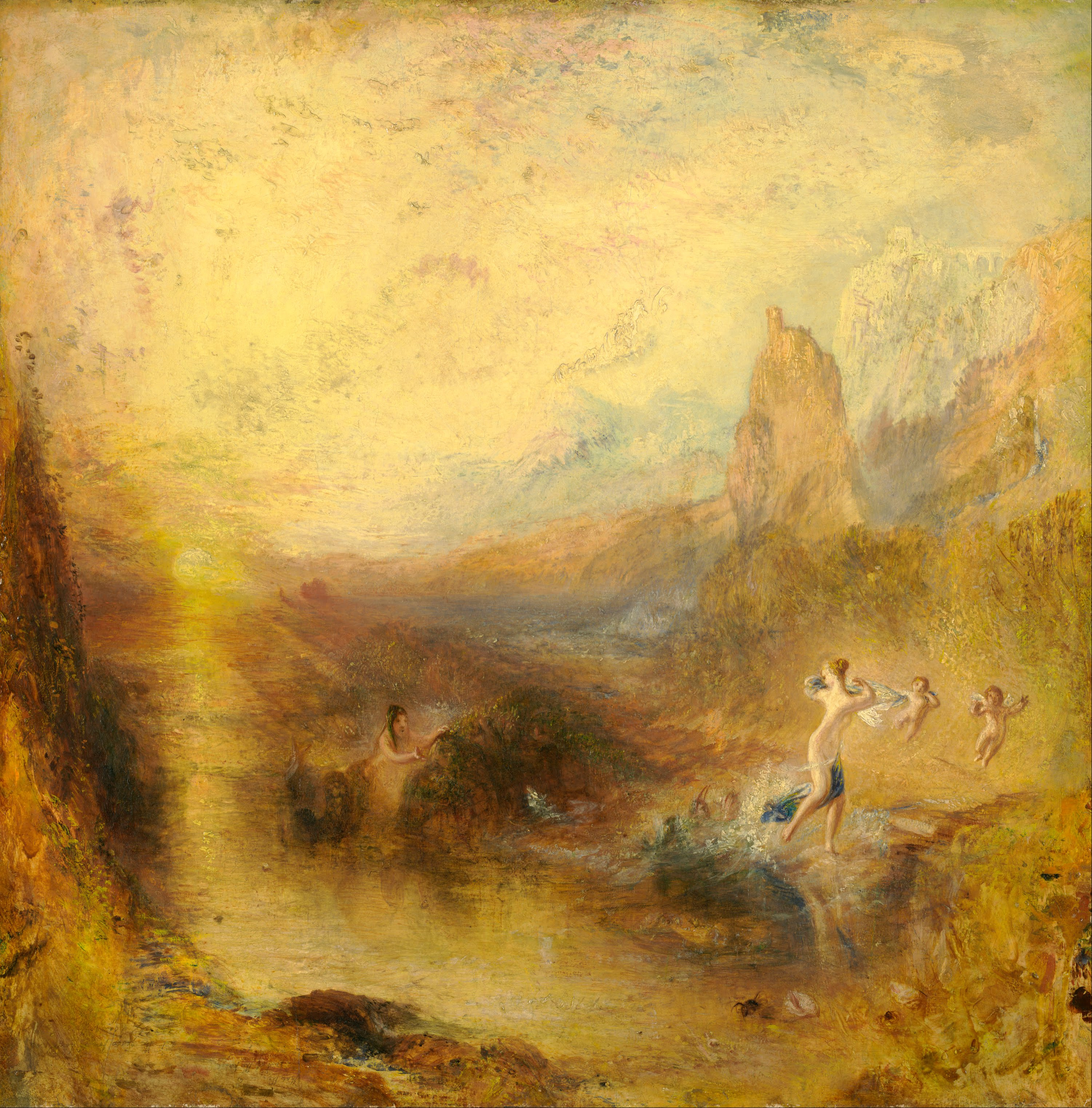
Kimbell Art Museum, AP 1966.11. Public-domain image via Google Art Project and Wikimedia Commons.
 by Tom Gurney
Tom Gurney BSc (Hons) is an art history expert with over 20 years experience
Published on June 19, 2020 / Updated on August 29, 2026
Email: tomgurney1@gmail.com / Phone: +44 7429 011000
Glaucus and Scylla at the Kimbell Art Museum
J. M. W. Turner painted Glaucus and Scylla in 1841 and exhibited it that year at the Royal Academy as number 542. It is now in the Kimbell Art Museum, Fort Worth, with the accession number AP 1966.11. The work is oil on a wooden panel measuring 78.3 by 77.5 centimetres, or 30 13/16 by 30 1/2 inches.[1] These nearly equal dimensions are the beginning of its unusual visual history.
The panel itself is almost square. Turner nevertheless presented it in a circular frame at the 1841 exhibition. A contemporary critic called it one of two circular “rondos,” confirming that the first audience saw a round composition rather than all four corners now visible in digital reproductions.[2][16] The distinction matters because the painting's running figures, curving shore and low sun acquire a stronger rotational force when enclosed by a circle.
The subject comes from Ovid's Metamorphoses. Glaucus, once a mortal fisherman, has been changed into a sea god. He desires Scylla, who is frightened by his marine body and flees onto land. His attempt to enlist Circe's magic will lead to jealousy and a second, horrifying transformation. Turner chooses the pursuit before that violence is complete: Scylla remains visibly human while moving away from Glaucus.[3][4]
This timing is easily confused. The current Kimbell summary says that Circe transformed Glaucus to frighten Scylla.[1] Ovid states otherwise. Glaucus was transformed through miraculous grass before meeting her; Circe later poisons Scylla's bathing place after Glaucus refuses the sorceress's advances.[3][4] Object information from the museum is authoritative, but the ancient narrative must be reconstructed from the poem.
The painting is dominated less by anatomy than by light. A low sun burns at the left horizon, its reflection entering a narrow inlet. Gold, cream, pale pink and blue-green spread across sky, mountain and water. Glaucus is a dark, half-emergent form left of centre; Scylla is a sharply lit nude running at lower right, accompanied by two winged figures and streaming cloth.[24][25]
The institutional title is concise compared with many of Turner's late exhibition captions. It supplies no quotation, location or explanatory subtitle. An 1841 viewer therefore had to recognise the classical names or consult Ovid before the landscape's narrative sequence became precise. That economy places unusual weight on the visible opposition between water-bound pursuer and land-bound fugitive. The panel can be admired as colour immediately, but its human conflict arrives through slower identification.
That imbalance between vast radiance and small bodies is not an escape from the story. It is Turner's means of giving desire, refusal and approaching metamorphosis an environment. The landscape appears beautiful enough to promise harmony, yet almost every narrative fact concerns incompatible longing and damaged agency.
The object has another exceptional history. It passed from Turner's patron Benjamin Godfrey Windus through prominent European collections, was seized and forcibly sold by Vichy authorities as Jewish property in 1943, entered the Kimbell in 1966, was restituted to the Jaffe heirs in 2006 and was purchased back by the museum in 2007.[1][21] Its present credit preserves that interruption rather than disguising it.
A Landscape Flooded with Gold
The first visual fact is abundance. Pale yellow fills much of the sky and descends into water, rock and human flesh. Turner does not confine sunlight to a disk and reflection; he makes it the common substance through which separate things appear. At moments the image seems less painted with local colours than immersed in luminous atmosphere.
The sun itself lies low at far left, partly contained by a dark vertical bank. Its reflection forms a broken golden column down the inlet. That axis is offset from the figures, so the brightest event does not spotlight the mythological action. Scylla and Glaucus inhabit the consequences of light rather than receiving theatrical illumination from above.
Across the upper half, cream shifts toward pink and muted blue-green. Thin drawn accents and small darker marks interrupt the field without closing it into solid cloud. The atmosphere can be read as sunset, although the exact hour is less important than the sensation of light saturating every interval.
The land is more varied than the overall gold first suggests. A dark brown mass presses in from the left. Low shores divide the reflective inlet from rougher water. Near the right centre, a tall warm rock rises like a broken tower, backed by paler cliffs or mountains. Vegetation, exposed earth and stone are entangled through quick touches rather than assigned separate zones.
The sea narrows toward the sun and broadens into the foreground. It is calm enough to hold reflection but unsettled around Glaucus and Scylla, where blue-grey, white and brown marks create shallow turbulence. Water is therefore both continuous surface and local disturbance.
The current square view reveals worked corners. Lower left contains ochre shore and dark debris; lower right continues golden ground around shells and marine forms. Their resolution supports the conservation conclusion that Turner painted a square design before it was masked by a round frame.[2] The corners are not blank production margins.
When mentally cropped to a circle, the dark left bank and golden right ground form opposing weights around the luminous centre. The eye turns from the sun along the inlet, across Glaucus's reach, through Scylla's flight and back through the curved lower shore. The tondo does not simply decorate a square image. It changes how narrative time circulates.
Kimbell commentary compares the flood of light to developments later associated with Impressionism and Abstract Expressionism.[1] Those affinities describe the painting's afterlife, but they should not erase its 1841 structure. Sun, inlet, figures, shells and rocks remain purposeful. Turner makes representation unusually unstable; he does not abandon it.
Contents
- Glaucus and Scylla at the Kimbell Art Museum
- A Landscape Flooded with Gold
- Finding Glaucus and Scylla
- Glaucus Before the Pursuit
- Circe, Jealousy and Scylla's Transformation
- The Moment Turner Selects
- Light, Beauty and Moral Unease
- Marine Life and the Mutable Body
- The Unpublished Liber Studiorum Design
- Salvator Rosa, Laurent de La Hyre and the Pictorial Tradition
Finding Glaucus and Scylla
Scylla is the more immediately legible figure. She runs toward the right foreground with one leg extended and the other bent behind. Her pale body catches the strongest local light, and a blue-dark strip of cloth sharpens the curve of her lower body. White fabric or spray streams back toward the pursuit.
Two small winged figures accompany her. One is close to the flying cloth; the other hovers farther right with arms raised. Their flesh is warmer and darker than Scylla's, but each is visibly separated from the golden ground. A hostile critic in 1841 called them doll-like Cupids stripping her clothes.[2] The remark is cruel, yet it proves that contemporary viewers could identify the figures and infer an action.
The image itself is less explicit. One winged child seems to grasp drapery, but whether the figures expose, assist or embody erotic pressure is open. They do not appear in Ovid's account of this encounter. Turner introduces them as a visual language of desire, then makes their relation to Scylla uncomfortable rather than festive.
Glaucus is harder to find. He emerges left of centre from dark rock and water, facing right. An extended arm reaches toward Scylla. His head is framed by green-black, hood-like marine material, while the lower body disappears into the inlet. The absence of clear legs is appropriate to his transformed state, but individual fins and scales should not be invented from broken paint.
Distance makes Glaucus visually subordinate to the woman he pursues. Ovid gives him a long account of his former life; Turner gives him a compact dark presence. His reach carries direction across the centre, yet he cannot bridge the space to Scylla. Water and rock hold them in different elements.
The figures are arranged along a descending diagonal from Glaucus toward Scylla and the winged children. Their movement runs against the sun's vertical reflection. Desire crosses the picture horizontally while light enters it vertically. These two systems intersect without resolving each other.
Scylla's drapery intensifies this crossing. Blue and white strokes stream behind her torso, occupying the interval between her body and the nearest winged figure. Cloth can indicate speed because it records resistance from air, yet here it also becomes something another body may grasp. The same painted passage therefore communicates motion and compromised control. Turner makes a classical accessory carry the pressure of the pursuit.
Scylla's flight should be named as refusal. She is not Glaucus's lover in Ovid, and she does not consent to his pursuit. The brightness of her body can invite aesthetic admiration, but her action is away from him. Turner's narrative remains intelligible because pose and interval establish that direction even when faces are tiny.
The scene is therefore neither a conventional embrace nor the completed monster episode. It is an unstable middle. Glaucus has already left human form; Scylla has not yet lost hers. The visible distance between them is where the later catastrophe begins.
Glaucus Before the Pursuit
Ovid introduces Glaucus near the end of book XIII of the Metamorphoses. He was a mortal fisherman associated with the coast of Boeotia. He worked with nets and line, making his living at the boundary between land and sea. His transformation begins not with Circe but with an inexplicable event among his catch.[3]
The Grass That Changes Him
Fish laid on a patch of grass revive and return to the water. Glaucus tastes the plants to discover their power. A sudden desire for the sea overcomes him, and he abandons the shore. Oceanus and Tethys receive him, remove his mortal qualities and make him a marine deity.[3]
The change is both bodily and social. Ovid describes altered hair, skin and lower form, but Glaucus also moves from labour to divinity. The fisherman who drew creatures from the sea is absorbed into the element he once exploited. Unlike many transformations in Ovid, his grants immortality and a new community.
This history helps explain Turner's half-submerged figure. Glaucus does not merely stand in water; he belongs to it. His dark body merges with marine rock and current because the old boundary between man and environment has already collapsed. The image's ambiguity can thus carry narrative precision.
Glaucus meets Scylla after his transformation. She withdraws when she sees him and listens from a secure position on land as he recounts how he became a god. His story is intended to persuade, but it does not overcome her fear. Ovid ends book XIII with the encounter unresolved and begins book XIV with Glaucus swimming away to seek Circe.[3][4]
The encounter follows another damaged love triangle in book XIII. Scylla has listened while Galatea recounts how the Cyclops Polyphemus desired her and killed the youth Acis, whom she loved. Glaucus then arrives and desires Scylla. This narrative succession makes rejection, rivalry and metamorphosis recur before Circe even enters. Turner selects the second pursuit, but an Ovidian reader reaches it carrying the memory of the first woman's unwanted suitor and the violence directed at her chosen partner.[3]
Turner uses this border between books as a visual border between elements. Glaucus remains in or beside the water; Scylla gains the land. The inlet is not neutral scenery between lovers. It materialises unequal capacities. He can traverse the sea freely, while her safety depends on retreat.
The fisherman's past also makes the lower foreground meaningful. Shells, fish-like bodies and crustacean forms recall a littoral world of capture and transformation. They are not a coded inventory of Glaucus's biography, but they locate divine myth within the material environment from which he came.
His elevated status does not make his desire just. Ovid allows a sympathetic account of rejection while showing that Glaucus seeks magical alteration of Scylla's will. Turner's dark reach preserves that tension. He is vulnerable, transformed and disappointed, but Scylla's movement still matters.
Circe, Jealousy and Scylla's Transformation
At the opening of book XIV, Glaucus travels past Etna, the Cyclops' country and the dangerous strait between Sicily and Italy. He reaches Circe's home because her knowledge of herbs appears capable of solving his desire. He asks her not to cure him but to make Scylla feel the same passion.[4][5]
Circe answers with a striking argument. She tells Glaucus to seek someone willing, then offers herself as that person. Her appeal recognises reciprocity at the level of speech: desire should meet desire. Glaucus refuses and declares that he will not change his love while Scylla remains unchanged.[4]
The word “unchanged” becomes cruelly prophetic. Circe cannot attack Glaucus, whom she still wants, so she directs resentment toward the absent woman. She collects harmful plants, mixes them with incantations and contaminates the curved inlet where Scylla escapes the midday heat.[4][5]
Scylla enters waist-deep and finds barking creatures around her. At first she tries to flee them, not understanding that they have become part of her body. Ovid makes the horror depend on failed separation: what she fears moves with her. Her legs and lower body are replaced or encircled by canine jaws.[4]
The metamorphosis turns a place of refuge into its opposite. Water had allowed Scylla relief from sun and pursuit; Circe weaponises it. The inlet's gentle curve becomes a trap. Turner does not paint that moment literally, but his beautiful narrow water and strange littoral life can make safety feel precarious.
Glaucus mourns and rejects Circe. Scylla remains in the strait, where she later takes sailors from Odysseus and threatens Trojan ships. Ovid finally changes her into a rock that mariners continue to avoid.[4] Her victimisation does not prevent her from becoming dangerous to others.
The two central transformations are morally and materially unequal. Glaucus chooses to taste the grass, even if he cannot foresee the result, and divine powers admit him to immortality. Scylla chooses only to enter a familiar pool; another person has secretly contaminated it, and the result destroys her human form. Ovid links both changes through herbs and water while distinguishing experiment from assault. Turner's intact running Scylla preserves the last interval before that distinction becomes bodily.
This is a chain of displaced harm. Glaucus cannot obtain Scylla's love and seeks coercive magic. Circe cannot obtain Glaucus's love and attacks Scylla. Scylla's damaged body then destroys sailors. Desire passes through unequal power until private rejection becomes geographical terror.
Turner's painting is luminous enough to tempt a purely poetic reading. Ovid resists that comfort. The later monster is produced by jealousy, magical violence and an assault on bodily autonomy. Any account of the golden landscape must keep that future within view.
The Moment Turner Selects
Turner shows Scylla fleeing Glaucus, not Scylla discovering canine monsters around her body. Her legs remain human and visible. Glaucus is already marine. The composition therefore belongs primarily to the conclusion of book XIII, before he asks Circe for help.[3]
That selection gives the painting forward pressure. Viewers who know the poem recognise that the flight will lead Glaucus to Circe and Circe to revenge. The image does not need to combine every episode in one physical instant. A sunset can carry approaching consequence without becoming a chronological diagram.
The two red-brown forms on the distant horizon have been interpreted by the Kimbell and Christie's as an allusion to Scylla's eventual rocky state.[1][2] Their colour and separation make the proposal plausible. At the scale of the image, however, they are also ordinary distant projections. “Foreshadowing” is safer than “depiction.”
The low sun has similarly been read as Circe, daughter of the Sun.[2] Turner does not paint a female body there. Light can make her power imaginatively present, especially because its gold reaches toward Scylla, but the disk remains a sunset within the represented world. Symbol and natural phenomenon need not exclude each other.
The winged figures compress another aspect of the story. Cupid's presence turns longing into a visible force, while their handling of cloth makes Scylla's body the contested centre of that force. They externalise erotic pressure without clarifying whether they help Glaucus, tease Scylla or simply mark the scene as a myth of desire.
Small marine forms in the foreground introduce the language of hybrid bodies before Scylla's change. Their claws, shells and fins make transformation imaginable as a rearrangement of natural parts. Yet none is securely attached to her. The boundary between omen and habitat remains open.
Turner thereby uses what might be called distributed narrative. Past transformation occupies Glaucus's body. Present refusal occupies Scylla's run. Desire occupies the Cupids and reaching arm. Circe's future revenge occupies the threatening beauty of light and water. Final petrification may flicker in distant rocks.
This distribution is more exact than a confused summary. Each temporal layer is attached to a visible relation, but the painting never pretends they occur simultaneously. Its instability lies in anticipation, not in careless mythological sequence.
Light, Beauty and Moral Unease
The light in Glaucus and Scylla is exceptionally beautiful. It softens rock, opens space and draws gold through the inlet. That beauty can seem at odds with a story of pursuit and bodily violation. Turner makes the conflict central rather than resolving it.
If the sun evokes Circe, radiance becomes double. She is daughter of the solar god and a practitioner of destructive magic. Warmth can signify desire; glare can signify jealousy; the same light that reveals Scylla can expose her to danger. The sunset is not coded as evil, but it is no longer morally neutral.
Scylla's body participates in the luminous field. Her skin shares cream and gold with the ground, while blue drapery gives her a sharper edge. She risks dissolution into the atmosphere at the same moment that narrative requires her bodily integrity to matter. Turner's handling makes that tension visible.
Glaucus is comparatively dark. His altered body belongs to water and rock, and his desire crosses toward the illuminated woman. A simple light-equals-good reading fails: the pursuer is shadowed, but the destructive Circean association belongs to the sun. Turner distributes moral ambiguity across colour rather than assigning a hue to each character.
The golden distance also makes the setting seem ideal. Classical landscape often offered an ordered world in which human history could become exemplary. Here order is threatened from within. The curved inlet is beautiful because it gathers light; in Ovid, a similarly curved pool becomes the mechanism of attack.
Turner further unsettles ideal order by refusing a clear architectural anchor. The tall rock right of centre can resemble a tower or ruin from afar, but close inspection lets it return to geology. Pale marks behind it can suggest cliffs, buildings or vapour. Classical landscape convention encourages the viewer to seek a constructed civilisation in the distance; the surface repeatedly answers with forms whose category is still changing.
Later comparisons with Impressionism or nonrepresentational colour respond to Turner's refusal to stabilise every form.[1] Yet the ethical unease depends on representation. We must see Scylla's direction, Glaucus's reach and the water between them before luminous dissolution acquires meaning.
The sublime is less obvious than in Turner's storms, but it remains relevant. Magnitude lies in light rather than violent scale. The atmosphere exceeds the figures and complicates rapid judgement. Beauty does not reassure; it makes danger harder to separate from attraction.
This is why the painting should not be reduced to an illustration of a moral lesson. It offers no simple punishment fitted to a vice. Scylla suffers for another person's jealousy. Glaucus's elevation does not teach him reciprocity. Circe's intelligence about willing love does not govern her action. Turner's beauty holds those failures without pretending to explain them away.
Marine Life and the Mutable Body
The lower foreground is crowded with small, partly legible objects. A dark crab-like or crustacean form lies near the lower centre. Pale shell forms and fish-like bodies appear toward the right. Brown, blue and white touches in the shallows can suggest fins, spray, weeds or living creatures according to viewing distance.[24][25]
These details anchor the myth in a littoral ecology. Glaucus began with caught fish and magical grass; Scylla's future body combines human and animal forms; the strait will become a habitat of maritime fear. Shore life is not decorative surplus.
Christie's notes a specific resemblance between crustaceans here and those in Turner's War: The Exile and the Rock Limpet, exhibited in 1842.[2] The comparison connects two shaped late paintings in which a small foreground creature complicates human ambition. In War, Napoleon contemplates a limpet; in Glaucus and Scylla, marine forms gather below a failed pursuit.
The visible creatures resist exact naming because Turner often defines them with a few accents. This should not be treated as careless zoology. Their mutability is formally appropriate to Ovid, whose poem repeatedly shifts bodies across species, matter and element.
Glaucus's form exemplifies that threshold. His upper body retains gesture and intention, while the lower portion merges into water and dark material. He is recognisable as a person without being optically separable from his new environment. Transformation is represented as altered relation, not merely an attached tail.
Scylla's body remains more complete, which makes knowledge of her future painful. Her moving legs are precisely what Circe's poison will attack. Turner gives them light and direction before Ovid's narrative replaces them with a ring of jaws.
The Cupids introduce a different kind of hybrid: human infants with wings. Classical art naturalised such beings through convention. Their accepted strangeness sits beside the feared strangeness of Glaucus and the future horror of Scylla, revealing that “monster” is partly a cultural category.
The whole landscape participates in change. Rock loosens into atmosphere, water takes the colour of sky, and bodies approach their surroundings. Turner does not illustrate metamorphosis only through iconography. He makes every boundary provisional, while preserving enough difference for pursuit and refusal to remain clear.
The Unpublished Liber Studiorum Design
Turner had treated the subject roughly three decades earlier for the Liber Studiorum. The project, issued between 1807 and 1819, used etching and mezzotint to explore categories and possibilities of landscape. Glaucus and Scylla, traditionally numbered 73, reached proof stages but was not published in the original series.[6][8]
The British Museum describes a small rocky bay, trees rising on the right, Glaucus as a Triton beckoning from the sea and Scylla fleeing across the beach. Turner etched the principal lines; William Say worked on the tonal plate. Surviving impressions and states preserve a design developed around 1810-15.[6][7]
The early composition is horizontal. Shore, water, figures and sun occupy clearer layers than in the 1841 oil. Glaucus's marine identity is more conventionally legible, and Scylla's path across the beach is easier to follow. Monochrome tone creates drama through light and dark rather than saturated gold.
That design itself relates to Turner's 1811 watercolour Chryses. An early exhibition catalogue observed that Turner adapted its shore composition when developing the Liber subject.[2] The transfer shows his willingness to replace one classical narrative with another while retaining a tested landscape structure.
The later oil is not an enlarged colour version. Turner turns the horizontal bay into a near-square field, lowers and intensifies the sun, separates the principal figures across greater atmospheric uncertainty and adds winged companions. The old design becomes raw material for a new conception.
Returning to an unpublished subject is significant. The Liber plate had not achieved broad public circulation during Turner's lifetime, but the image remained within his working memory and print archive. In 1841 he could revisit an unresolved possibility rather than quote a famous success.
Manchester's digital catalogue places the design among the final intended Liber subjects.[8] Christie's suggests that this recurrence anticipates Turner's broader return to Liber themes in shaped paintings of the mid-1840s.[2] The connection is persuasive, though it does not prove a fixed late cycle planned in advance.
Across the two versions, the enduring core is a boundary: sea god in water, fleeing woman on land, sunlight opening the distance. What changes is the confidence with which those elements can be separated. The 1841 painting transforms a landscape category into an atmosphere of unstable desire.
Salvator Rosa, Laurent de La Hyre and the Pictorial Tradition
Glaucus and Scylla was not among the most common mythological subjects, but Turner had significant precedents. Salvator Rosa explored it in painting and print. Rosa's rocky landscapes and learned fables had long appealed to British collectors, writers and theorists of the picturesque.[9][12]
The Courtauld's study of Rosa's British afterlife places Turner's early Liber design and the Kimbell oil within that relation. Turner retained a characteristically Salvatorial subject while radically changing its visual language through loaded, luminous handling.[9] Influence here means argument and transformation, not obedience.
An Antonini etching after Rosa demonstrates how the composition circulated through reproductive print.[12] Glaucus emerges from water below, while Scylla occupies higher land. The division of elements creates the pursuit before any brushwork is considered. Turner could inherit this durable structure and then submit it to atmosphere.
Laurent de La Hyre's circa 1644 Glaucus and Scylla at the Getty offers a different comparison. Glaucus rises with a carefully modelled beard and scaly tail, drawing aside the beard to reveal Cupid's arrow. Scylla stands clearly above him amid reeds and rock. Soft pink, blue and green support a decorative account of divine love.[10][11]
La Hyre's painting belonged to a group made as designs for mythological tapestries. Its bodies and attributes needed to communicate through translation into woven form.[11] Turner's panel moves in the opposite direction. It weakens contour, reduces the figures and lets colour exceed iconographic clarity.
The comparison also exposes Turner's altered treatment of erotic convention. La Hyre gives Glaucus Cupid's arrow, making the sea god visibly wounded by love and directing sympathy toward his condition. Turner's Cupids hover around Scylla instead. Their relocation shifts attention from the pursuer's inward suffering to the pursued woman's exposed body and flying cloth. It does not settle Turner's judgement, but it changes where desire becomes optically active.
Rosa and La Hyre show that Cupids, fish tails, rocky separation and gestures of pursuit formed an available visual vocabulary. Turner does not need to derive each feature from one object. His originality lies in making the inherited vocabulary nearly disappear into a late landscape without losing its narrative charge.
Claude Lorrain remains relevant because Turner repeatedly used luminous historical landscape to join small narratives with expansive nature. Ulysses deriding Polyphemus of 1829 had already turned a classical sea story into sunrise, colour and atmospheric scale.[18] But Rosa supplies the more exact subject lineage for Glaucus and Scylla.
The painting therefore looks backward in several directions at once: to Ovid, seventeenth-century art, reproductive prints and Turner's own Liber. Its modern appearance results from compression of that memory, not freedom from it.
An Imagined Strait after Italy
Ovid locates the story around southern Italy and Sicily. At the beginning of book XIV, Glaucus leaves Etna and the opposing settlements of Zancle and Rhegium, crosses the Tyrrhenian water and reaches Circe. Scylla's later monster identity becomes attached to the dangerous strait.[4][5]
Turner knew Italy deeply but did not visit Sicily. He first reached Rome in 1819, returned for an extended stay in 1828-29, visited Venice in 1833, travelled to Turin in 1836 and made his final productive Venetian visit in 1840.[13] The Kimbell landscape is therefore imagined rather than topographically recorded.
Its invention rests on substantial experience. Italian coasts, mountains, rivers, ruined architecture and changing light entered Turner's sketchbooks over decades. The 1840 Venetian journey was immediately recent and renewed his attention to colour reflected from water and forms suspended in haze.[13]
The old-master dimension preceded travel. Royal Academy teaching, London collections, books and prints introduced classical and Renaissance Italy to Turner while he was young. The mythological shore combines textual geography with a pictorial country he had studied before and after seeing it.[13]
A 1902 Sedelmeyer catalogue identifies a smoking peak as Etna.[2] The upper right does contain pale mountain forms, while red and grey accents can suggest vapour. The observation belongs to the painting's reception, but it is not enough to map the scene as a measured Sicilian view.
Ovid's geography itself is mobile. Glaucus passes Etna before visiting Circe, then Circe travels to Scylla's inlet. Turner gathers mountain, sun, coast and strait into a single arena rather than illustrating an itinerary stop by stop. Myth gives him permission to compose place as memory.
Venetian colour also complicates a narrowly Sicilian reading. Gold on water, dissolved architecture-like rock and atmospheric continuity belong to Turner's 1840-41 practice across many subjects. The painted light is Italian in cultural association without being meteorological evidence for one location.
The result is a credible mythic coast rather than a named prospect. Water divides land, mountains close the distance, and a low sun converts geography into fate. Turner makes the strait feel ancient and observed while preserving its status as imaginative synthesis.
The Square Panel and Circular Frame
Turner's shaped-format experiment began publicly with Bacchus and Ariadne in 1840. That painting used a square canvas with a circular glaze and brilliant yellow effect. The Royal Academy Chronicle describes it as the announcement of a new formal phase.[17]
In 1841, Glaucus and Scylla and The Dawn of Christianity appeared as circular pendants. Turner did not cut the supports into disks. He used framing to control the visible image, retaining the practical square while offering the audience a tondo.[2][16]
The tondo had Renaissance prestige. Raphael's Madonna della Sedia has been proposed as a precedent, especially because Turner had placed that famous round composition within Rome from the Vatican in 1820.[2] This is a useful art-historical relation, though no note from Turner identifies it as the immediate cause.
The circle creates compositional consequences. It removes stable horizontal corners, encourages rotation and turns the shoreline into an enclosing arc. Scylla appears to run along the circumference, while Glaucus reaches across a curving interior. The sun's reflection becomes a spoke within the design.
The full-square image produces a different experience. Dark left edge, bright right ground and lower debris widen the world beyond the circle. Modern viewers can compare the support Turner painted with the aperture through which the first audience interpreted it.[24][25]
That comparison also warns against treating reproduction as neutral. A rectangular photograph naturally presents all the paint Turner applied, while the historical frame presented the artist's final exhibition decision. Neither view is dispensable. The square reveals process, corner finish and peripheral shore; the circle reveals the compressed rotation praised in 1841. Responsible analysis moves between object and original display instead of declaring one the authentic image.
Some scholars have connected the round format to Fortune's wheel or to a pun on Turner's name.[2] The possibility suits a painter alert to verbal play and a myth governed by change. It remains conjectural and should not displace observable effects.
The format also distinguishes the work from Turner's large rectangular exhibition histories. At roughly thirty-one inches, it offers concentration rather than panorama. Myth is not staged across a broad theatrical frieze but folded into a compact optical world.
Turner continued with octagonal frames and square supports in later years. The experiment was therefore sustained, not an isolated novelty. Glaucus and Scylla occupies an early point where panel, frame, colour and narrative were being rethought together.
A Hidden Warning beneath the Paint
Conservation examination revealed an extraordinary practical record beneath the lower-left paint. Infrared imaging exposed a pencil message on the prepared ground from the panel maker or colourman. It warns Turner of a crack and offers to provide a canvas replacement by Monday.[2]
Turner proceeded with the panel. That decision is important because the support's flaw was known before painting. The object was not a casual scrap discovered after the fact; it represented a conscious acceptance of material risk, perhaps under exhibition pressure.
The note also confirms that format involved collaboration. Prepared supports, grounds and delivery schedules belonged to a trade network around the supposedly solitary genius. The panel arrived with advice and an alternative. Turner's experiment depended on ordinary workshop logistics.
The warning appears above the gesso preparation and below the painted image, fixing it to a narrow stage in production.[2] It is not a later restorer's comment or an inscription added to the back. Turner painted directly over knowledge of the defect. That stratigraphic position turns a few hurried pencil words into unusually intimate evidence about decision-making before the Royal Academy deadline.
Wood gave the painting a different later history from canvas. It did not require the heat and pressure of lining, treatments that could flatten textured paint or disturb unstable mixtures. Christie's reports the surface as exceptionally well preserved for a late Turner.[2]
Pearling is visible in parts of the surface. Conservation interpretation has suggested that watercolour may have been used over oil, consistent with experiments associated with Turner at this time.[2] “May” is essential. The visible effect and analytical proposal do not establish a complete recipe for every passage.
The account also discusses newly available yellows and additions such as wax, resin or other media within Turner's late practice.[2] These contextual facts explain why his surfaces can be vulnerable. They should not be converted into an unsupported list of ingredients for each golden area.
Material survival affects interpretation. The delicate glazes and opaque accents allow the light to feel layered rather than uniformly yellow. Fine linear marks remain visible across broad haze. Scylla's body and drapery retain enough definition to carry the narrative.
The hidden warning adds a fitting counterpoint to the myth. A painting about irreversible transformation began with a choice between supports. Turner declined the substitute and made the cracked panel endure. Unlike Scylla, the object was altered through an informed decision by its maker.
The Dawn of Christianity as a Pendant
The Dawn of Christianity (The Flight into Egypt), now at National Museums NI, was exhibited in the same Royal Academy room in 1841. It too appeared within a circular frame and was bought by Benjamin Godfrey Windus.[14][19] The two works remained together for about thirty years.
Those facts make a pendant relationship highly likely. Contemporary criticism reinforces it by calling the pair warm and cool “rondos” of prismatic colour.[16] Glaucus and Scylla glows with sunset gold; Dawn organises paler, cooler light around Christian flight and renewal.
The supports differ. Dawn is oil and beeswax on canvas, whereas Glaucus and Scylla is oil on panel.[1][14] Turner sought visual correspondence without requiring identical materials. Framing supplied the shared external geometry.
National Museums NI identifies the Holy Family escaping Herod, broken Egyptian structures, a beam directed toward the Christ child and a foreground snake. Ruined architecture stands for fading power, while new light signifies the arrival of Christianity.[14] The image combines danger, migration and promised salvation.
The pagan pendant offers no comparable redemption. Glaucus's desire initiates an appeal to magic; Circe's jealousy deforms Scylla; future sailors die. Its sunset beauty surrounds a chain of harm rather than an escape toward spiritual dawn.
One proposed pairing therefore contrasts old pagan metamorphosis with Christian renewal, sunset with dawn, dangerous desire with salvation. Another stresses hidden threats within beautiful settings: Scylla's future and the snake before the Holy Family.[2] Neither programme has been documented by Turner.
There is also a complication. Bacchus and Ariadne of 1840 has been proposed as an earlier intended companion to Dawn because both reveal renewed Venetian and Titianesque interests.[2][17] The history of conception may be less tidy than the 1841 display.
The strongest conclusion stays with what the Academy audience encountered: two round, contrasted colour worlds, hung together and purchased together. Their relation invited comparison before any critic agreed on a theological key.
The Royal Academy in 1841
The Royal Academy exhibition opened on 3 May and closed on 24 July 1841. It contained 1,343 works by 711 exhibitors and occupied rooms at the National Gallery in Trafalgar Square.[15] Turner's compact tondo competed within a crowded field, not an isolated modern display.
Turner submitted six oils. Three were Venetian subjects, joined by Schloss Rosenau, The Dawn of Christianity and Glaucus and Scylla.[2] The group ranged from recent travel and royal association to scripture and Ovidian myth.
Venice was especially current because Turner had returned there in 1840. Water, architecture and coloured atmosphere in those canvases provided a contemporary context for the mythological inlet. The same painter could make a named modern city and an invented ancient coast share visual means.
Schloss Rosenau engaged the German birthplace of Prince Albert and may have courted royal attention. The two tondos addressed longer histories of painting and belief. Turner used the annual exhibition to demonstrate breadth rather than offer six variations on one theme.
The circular frames would have been conspicuous among rectangles. They announced experiment before viewers deciphered Scylla or Glaucus. Their warm-cool pairing also encouraged critics to discuss colour as music, rhythm and harmony rather than only as local description.
Hanging the two together made comparison unavoidable. A viewer could move between pagan sunset and Christian dawn, panel and canvas, pursuit and escape, warm and cool effects. The relationship operated spatially even if its theological programme remained uncertain. Windus's purchase of both preserved that encounter after the exhibition, showing that the pairing had economic as well as critical force.
Number 542 came late in the catalogue. Turner's name and reputation assured attention, but his recent work was increasingly contested. Critics could admire colour while attacking drawing, or treat unusual handling as evidence of declining sight. The mythological bodies became tests of his continuing competence.
The wider exhibition received complaints about mediocrity, entrance charges and the direction of British art.[15] Turner was both senior Academician and target. His long institutional success did not protect the tondos from ridicule.
This context matters to the painting's scale of ambition. Turner presented an uncommon classical subject, revived an unpublished design, chose a flawed panel, masked it as a circle and flooded it with light before the largest public tribunal of his profession. Nothing about the work suggests private retreat.
Praise, Ridicule and the Problem of the Figures
The Spectator responded quickly and positively. On 8 May, it called Turner's two circular studies brilliant warm and cool harmonies in prismatic hues.[16] The language recognises the pair and treats colour organisation as a serious achievement.
This praise is striking because it does not depend on narrating Ovid. “Rondo” borrows from music and circular form, suggesting recurrence and movement. “Harmony” treats colour relations as coherent even when bodies and rocks appear unstable. The critic saw formal order within Turner's freedom.
Other responses were severe. The Athenaeum grouped the three non-Venetian works as products of impaired sight and reckless execution.[2] That attack transformed stylistic disagreement into a claim about the artist's body. Turner's age became an explanation for what critics refused to accept.
Blackwood's Magazine addressed number 542 more specifically. It mocked the small Cupids, imagined them stripping Scylla and claimed that her body lacked flesh.[2] The joke depends on recognising nude, cloth and winged figures, then judging their handling against expected anatomical solidity.
Such criticism disproves a later caricature in which Turner's contemporaries could see nothing at all. They identified the action enough to satirise it. Their objection was that the figures seemed insubstantial, doll-like or badly drawn within a surface dominated by colour.
Modern admiration can reverse the imbalance too easily. Calling the work proto-abstract may praise the very qualities critics rejected, but it can still neglect the bodies. Scylla's insubstantiality matters because the story threatens her bodily integrity. Glaucus's dissolution matters because he has already changed species.
The divided response also shows why Windus's purchase was consequential. A buyer had to value the colour experiment while public commentary questioned Turner's competence. Patronage did not merely reward established taste; it helped preserve a contested direction.
No single review defines the work. The Spectator grasped chromatic structure; hostile critics registered the vulnerability of figure painting, however unfairly. Together they reveal a canvas poised between narrative recognition and optical autonomy.
Benjamin Godfrey Windus and the First Purchase
Benjamin Godfrey Windus bought Glaucus and Scylla and The Dawn of Christianity at the 1841 exhibition.[1][19] They were his first oil paintings by Turner after years of collecting the artist's works on paper.
By 1839, Windus owned more than two hundred Turner watercolours and drawings. His Tottenham home held framed works in the library and extensive groups in portfolios. The collection allowed viewers to compare topography, literary illustration and changing technique at unusual depth.[19][20]
Windus was not simply a retired coachmaker, as later anecdotes often imply. He inherited family wealth, held property and served as a director of the Globe Insurance Company, while retaining links to the Coachmakers' Company.[19] His means supported connoisseurship on a major scale.
He also admitted visitors with introductions. Guidebooks noted regular viewing days, and Turner himself asked permission to send people to see the drawings.[19] A private collection thus performed a partly public educational function before broad museum access to Turner existed.
Ruskin remembered Windus's rooms as formative. In Praeterita, he described walls and portfolios filled with the England series and illustrations to Scott, Byron and other publications.[20] His later claim that almost nobody truly cared for Turner except Windus and himself is rhetorical, but it captures the patron's place in Ruskin's personal history.
Buying the tondos extended this commitment into Turner's disputed late oils. Windus did not need the Blackwood's critic to approve Scylla's anatomy. He had enough knowledge of the artist's range to understand the painting as development rather than collapse.
The pair remained in his ownership through attempted sales in the 1850s. Bought-in lots and falling prices show that critical controversy had market consequences.[1][2] The works could be prestigious and difficult to place at once.
Windus eventually dispersed much of his collection without creating a public bequest. Yet his purchase kept the tondos together through their first decades and placed Glaucus and Scylla within a setting where Turner's long development could be studied. That context suited a painting born from a thirty-year return.
From Windus to the Jaffe Collection
The painting was offered at Windus's Christie’s sale in June 1853 and bought in at £735. It appeared again in March 1859 and was again bought in, this time at £294. In July 1862 it sold for £294 to the dealer Thomas Rought.[1][2]
The sequence records a substantial fall from the 1853 valuation and demonstrates the uncertain market for Turner's late vision. A failed sale is not a transfer of ownership; distinguishing buy-ins from purchases keeps the chain intelligible.
Rought passed the work to Louis Huth, whose collection included modern painting and decorative arts. At Huth's 1872 sale, Arthur Tooth and Sons bought it for £535. The sale separated Glaucus and Scylla from The Dawn of Christianity after roughly three decades together.[2]
It subsequently belonged to Jose de Murrieta, Marquis de Santurce. His 1883 sale bought the work in at £570. Sir Horatio Davies later owned it at Watcombe Hall, and Charles Sedelmeyer had it in Paris by 1902.[1][2]
Sedelmeyer's illustrated catalogue described the marine god emerging behind rock, Scylla with two Cupids, high mountains and a smoking Etna.[2] The entry preserves how the painting was framed and read at the start of the twentieth century. Its Etna identification remains historical interpretation rather than proven topography.
John and Anna Jaffe acquired the Turner from Sedelmeyer in 1902 or 1903 for their villa in Nice.[1][21] British-born Jewish collectors and cultural patrons, they assembled important British, Dutch and Venetian works and lent them to exhibitions.
In 1934, the painting appeared at the Musee Massena in an exhibition on the English presence in Nice and Provence.[2] A catalogue celebrated its triumphant light. That public loan confirms the Jaffes' active participation in the cultural life of their adopted city.
The movement from Tottenham to Nice altered the painting's setting but not its visibility. Windus opened his collection to selected visitors; the Jaffes lent works publicly. Both histories make the later confiscation more than a break in private ownership. It destroyed a cultivated relationship between collectors, place and public culture.
Vichy Seizure and the 2006 Restitution
After John Jaffe's death, Anna remained in Nice as persecution intensified under the collaborationist Vichy government. She died in 1942. In July 1943, authorities seized the villa and sold the collection at the Hotel Savoy under the Commissariat aux questions juives.[21]
The Turner appeared as lot 121 and sold for 28,000 francs. This was not an ordinary disposal chosen by an owner. It was a forced transaction directed against Jewish property within a regime of persecution. The provenance must name that coercion plainly.
The auction setting did not sanitise the seizure. Cataloguing, bidding and payment supplied the outward forms of a market while the owner and heirs lacked meaningful control. This distinction is crucial because later records can make every change of possession look equivalent. The 1943 entry belongs to a machinery of racial expropriation, not to the voluntary collecting and dispersal seen in the Windus or Huth sales.
The painting later belonged to Emile Leitz in Paris. Agnew's acquired it in 1956, after which it passed through Howard Young Galleries, Mrs Chamberlain and Newhouse Galleries. The Kimbell Art Foundation bought it in 1966.[1][2]
For decades, the museum possessed the work in good faith but without a resolved wartime chain. A Jaffe heir approached the Kimbell with documentation. The institution conducted its own investigation and concluded that the 1943 sale had been forced and that the claimants represented the legitimate ownership interest.[23]
The Kimbell restituted Glaucus and Scylla to the heirs in 2006.[1][21] Restitution did not depend on pretending that the museum had carried out the original wrong. It recognised that lawful present stewardship could not erase unlawful dispossession in the chain of title.
The heirs then chose to offer the painting at Christie's in New York on 19 April 2007. The Kimbell bought it for $6,424,000 including premium.[22] Return and repurchase were separate acts: first ownership was restored, then a new sale occurred on terms controlled by the heirs.
The price is sometimes reported as $5.7 million because auction accounts distinguish hammer price from the total including buyer's premium. Christie's final result gives $6.424 million.[22] Using the inclusive figure prevents an apparent contradiction while keeping attention on the substantive point: the museum did not retain the painting merely by acknowledging the claim. It surrendered title and later paid in an open transaction.
The current credit line makes both visible. It does not simply say “acquired 1966” or “purchased 2007.” By recording restitution and reacquisition, the museum acknowledges that its relationship to the object was interrupted by a superior claim.[1]
No repurchase can reverse persecution or reconstruct the Jaffe collection in its villa. It can, however, establish a more honest institutional future. The painting's modern history is therefore not an uplifting appendix detached from art; it is evidence of how beauty, ownership and public trust can be severed and partially repaired.
Metamorphosis, Refusal and Turner's Achievement
Glaucus and Scylla concentrates an enormous narrative into a small interval. One body has changed, another is still human, a refusal is in motion and revenge has not yet begun. Turner makes the interval legible through distance: Glaucus reaches from water while Scylla runs across land.
Ovid's sequence prevents a sentimental love story. Glaucus asks magic to alter Scylla's desire. Circe articulates the value of willing reciprocity, then attacks a rival who is not present to defend herself. Scylla's refuge becomes the medium of her mutilation. Turner places that future beneath a beautiful sky.
The beauty is not false. Gold light on water, pale mountains and a curving shore possess real visual harmony. The painting's force comes from refusing to let harmony settle the human relations. Radiance can accompany jealousy, pursuit and approaching terror.
Turner's return to his unpublished Liber Studiorum design adds the dimension of personal metamorphosis. An early horizontal sepia composition becomes a near-square oil shown as a tondo. Clear tonal staging becomes chromatic immersion. The myth changes as the artist's visual language changes.
Old masters remain present without controlling the result. Rosa supplied a subject of rocky pursuit; La Hyre demonstrated the decorative clarity of sea god, nymph and Cupid; Claude offered luminous history; Venetian experience refreshed Turner's colour. The 1841 panel compresses those inheritances until they become atmosphere.
Its material body carries another transformation. A flawed square panel was accepted, painted and masked as a circle. Delicate layers survived because wood avoided later lining. The hidden warning records a practical decision beneath visionary effect.
Windus's purchase preserved a work mocked by critics. The Jaffes later made it part of a generous cultural life in Nice. Vichy seizure violently redirected that history. Restitution and paid reacquisition finally changed the meaning of the Kimbell's ownership.
The figures remain the moral centre despite their scale. Scylla's running body is not merely a pale accent. Glaucus's reach is not merely a dark stroke. The Cupids are not harmless ornament. Turner makes each difficult to hold because the story itself concerns bodies that desire, refuse, transform and lose control.
That difficulty explains the painting's lasting modernity better than calling it an anticipation of abstraction. Turner does not dissolve meaning into colour. He asks colour to bear incompatible meanings at once: sunset and Circe, beauty and threat, flesh and atmosphere, ancient myth and present looking.
Scylla has not yet become the rock sailors fear. For the instant Turner preserves, she can still run. The circle of the composition appears to turn around that fragile freedom, while light carries the knowledge that it will not last.
Discussion
How does Turner's golden light change the way we read pursuit, refusal and approaching transformation?
Reader Insights
Which visible details distinguish the pursuit from Scylla's later transformation?
How does imagining the square panel inside its historical circular frame change the composition?
Can the radiant landscape remain beautiful without softening Scylla's refusal?
Join the Conversation
Share a close observation or a source-based question for other readers.
References
- Kimbell Art Museum, “Glaucus and Scylla,” AP 1966.11, https://kimbellart.org/collection/ap-196611
- Christie's, “Joseph Mallord William Turner, Glaucus and Scylla,” lot 122, 19 April 2007, https://www.christies.com/en/lot/lot-4892978
- Ovid, *Metamorphoses*, book XIII, Perseus Digital Library, https://www.perseus.tufts.edu/hopper/text?doc=Perseus%3Atext%3A1999.02.0028%3Abook%3D13
- Ovid, *Metamorphoses*, book XIV, Perseus Digital Library, https://www.perseus.tufts.edu/hopper/text?doc=Perseus%3Atext%3A1999.02.0028%3Abook%3D14
- A. S. Kline, trans., Ovid, *Metamorphoses*, book XIV, University of Virginia Ovid Collection, https://ovid.lib.virginia.edu/trans/Metamorph14.htm
- British Museum, “Glaucus and Scylla,” *Liber Studiorum*, 1852,1009.1368, https://www.britishmuseum.org/collection/object/P_1852-1009-1368
- National Gallery of Victoria, “Glaucus and Scylla,” 1813, 2206A-4, https://www.ngv.vic.gov.au/explore/collection/work/40978/
- University of Manchester, *Liber Studiorum*, F073 “Glaucus and Scylla,” https://jmwturnersprints.manchester.ac.uk/original-publications/liber-studiorum/
- Giulia Martina Weston, “Rosa's Fall: From Picturesque to Ruskin's Anti-Turner,” Courtauld, https://courtauld.ac.uk/research/research-resources/publications/courtauld-books-online/ruskins-ecologies-figures-of-relation-from-modern-painters-to-the-storm-cloud/8-rosas-fall-from-picturesque-to-ruskins-anti-turner-salvator-rosa-in-victorian-britain-giulia-martina-weston/
- J. Paul Getty Museum, Laurent de La Hyre, “Glaucus and Scylla,” 84.PA.13, https://www.getty.edu/art/collection/object/103RFQ
- J. Paul Getty Museum, *Masterpieces of Painting in the J. Paul Getty Museum*, Laurent de La Hyre entry, https://www.getty.edu/publications/resources/virtuallibrary/0892361379.pdf
- National Galleries of Scotland, Carlo Antonini after Salvator Rosa, “Glaucus and Scylla,” P 2155.22, https://www.nationalgalleries.org/art-and-artists/156206
- National Galleries of Scotland, “Turner & Italy,” 2009, https://www.nationalgalleries.org/exhibition/turner-italy
- National Museums NI, “The Dawn of Christianity (The Flight into Egypt),” BELUM.U224, https://collections.nationalmuseumsni.org/object-belum-u224
- Royal Academy Chronicle, “1841: A Tale of Two Bishops,” https://chronicle250.com/1841
- “Fine Arts: The Royal Academy Exhibition,” *The Spectator*, 8 May 1841, https://archive.spectator.co.uk/article/8th-may-1841/19/fine-arts
- Royal Academy Chronicle, “1840: Turner ‘out-Turnered’,” https://chronicle250.com/1840
- National Gallery, “Ulysses deriding Polyphemus - Homer's Odyssey,” NG508, https://www.nationalgallery.org.uk/paintings/joseph-mallord-william-turner-ulysses-deriding-polyphemus-homers-odyssey
- Turner in Tottenham, “Benjamin Godfrey Windus: the Turner collector,” https://www.turnerintottenham.uk/bg-windus.html
- John Ruskin, *Praeterita*, Project Gutenberg, https://www.gutenberg.org/cache/epub/64645/pg64645-images.html
- Christie's, “The John and Anna Jaffe Collection,” *Restituted Art at Christie's*, https://www.christies.com/en/services/restitution/restituted-art-at-christies
- Christie's, post-sale release, 19 April 2007, https://www.christies.com/presscenter/pdf/04202007/105254.pdf
- US Congress, *Review of the Repatriation of Holocaust Art Assets in the United States*, 2006, https://www.congress.gov/109/chrg/CHRG-109hhrg31542/CHRG-109hhrg31542.pdf
- Google Arts & Culture, Kimbell Art Museum, “Glaucus and Scylla,” high-resolution presentation, https://artsandculture.google.com/asset/glaucus-and-scylla-joseph-mallord-william-turner/ZQHoP72MPVWjyw?hl=en
- Wikimedia Commons, public-domain Google Art Project image, https://commons.wikimedia.org/wiki/File:Joseph_Mallord_William_Turner_-_Glaucus_and_Scylla_-_Google_Art_Project.jpg