 View the object record
at the Clark
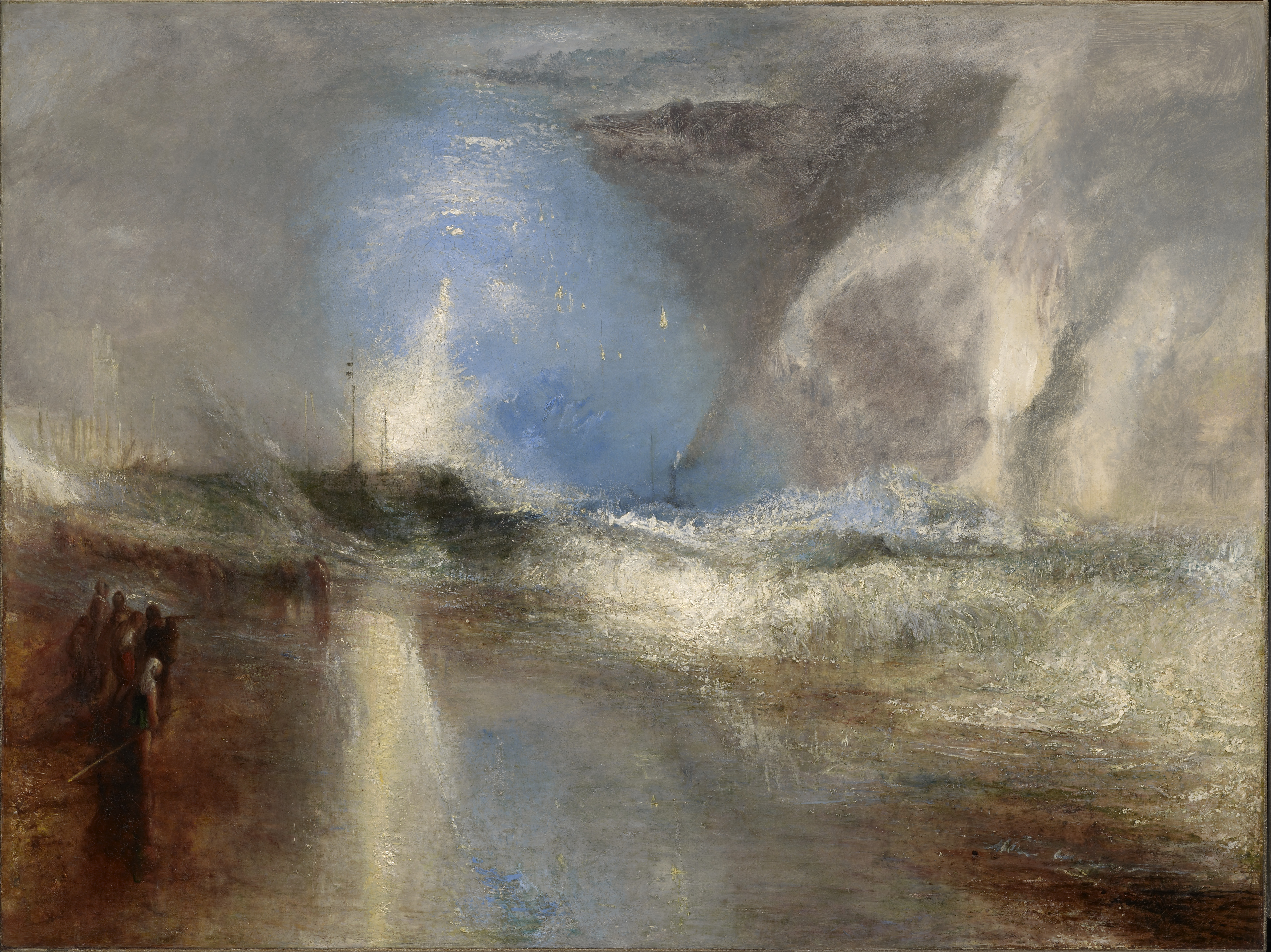
Clark Art Institute, 1955.37. Public-domain museum image via Wikimedia Commons; calibration strip removed without cropping the painted composition.
 by Tom Gurney
Tom Gurney BSc (Hons) is an art history expert with over 20 years experience
Published on June 19, 2020 / Updated on August 29, 2026
Email: tomgurney1@gmail.com / Phone: +44 7429 011000
Rockets and Blue Lights at the Clark
J. M. W. Turner's Rockets and Blue Lights (Close at Hand) to Warn Steamboats of Shoal Water is an oil on canvas of 1840 in the Clark Art Institute, Williamstown, Massachusetts. The current record gives its dimensions as 92.1 by 122.2 centimetres, or 36 1/4 by 48 1/8 inches, and its accession number as 1955.37.[1][3] The Clark's scholarly catalogue records the slightly different measurement 91.7 by 122.3 centimetres, a minor variation that does not affect the work's identity.[2]
Turner first exhibited the painting at the Royal Academy in 1840 as catalogue number 419. Its unusually long title was practical as well as poetic: rockets and blue lights close to shore warn steam-powered vessels that they are approaching shallow water.[10][11] A storm, a harbour, modern transport and human signalling occupy one field.
The scene is associated with Margate. A group watches from the wet beach at lower left, while steamers struggle among breakers beyond them. A rocket rises near the harbour side, artificial light enters cloud and water, and smoke from the vessels merges with sea mist. The shore is close enough to be seen yet difficult to reach.
This is neither a documented shipwreck nor a celebration of machinery in calm conditions. No named vessel, dated storm or casualty is securely attached to it. The boats remain under way, signals remain active and the outcome is suspended. Turner paints navigation as a process whose success cannot yet be known.
The painting also presents an exceptional problem of survival. Large portions of Turner's final paint and glazes have been lost through delamination, damage and past treatment. A right-hand steamboat, people on its deck and much of its smoke plume, all recorded during the nineteenth century, are no longer visible in the oil.[2] The current canvas cannot be read as a complete expression of his 1840 design.
Robert Carrick's chromolithograph of 1852 consequently becomes essential evidence. It was made while William Day, its publisher, owned Turner's painting and preserves boats, figures, harbour structures and signals that have since diminished or disappeared.[18][19] Yet it is an interpretation in another medium, not a substitute original.
The work must therefore be seen in layers: the damaged but authentic canvas at the Clark, the fuller composition documented by Carrick and early photographs, the preparatory Margate study, and the hostile responses of its first viewers. Together they reveal a late Turner more precise and more complicated than either “formless abstraction” or simple maritime illustration allows.
Looking at the Surviving Surface
In its present condition, the painting is organised around a broad opening of intense blue. That colour extends from the centre-left sky into the lower middle, bordered by grey, brown, cream and black. The blue feels almost continuous between air and water because many intervening details have weakened.[3]
A great dark mass curls through the upper right. Brown-black paint collects into a hooked cloud or smoke form, then thins toward the pale edge. At far right, a tall whitish plume descends or rises beside a large breaker. It may contain smoke, vapour and spray, but the vessel that originally helped explain it has gone.
Near the centre-left, a low dark form survives as the most legible steamboat. Thin verticals rise from it, though funnel, mast and signal apparatus are difficult to separate. White paint gathers around its hull and projects it from the blue. The boat appears less like a diagrammed machine than a resistant weight surrounded by moving substance.
Surf forms the strongest horizontal division. A broken ridge runs across the middle, changing from smaller blue-white disturbance near the harbour to dense, loaded cream at right. The largest wave advances diagonally and breaks into thick light. Beneath it, reddish-brown and grey-green water slide toward the lower edge.
The foreground beach begins at the bottom left in deep rust, brown and near-black. Several people cluster close to its boundary with the water. A taller figure stands among shorter or bending bodies, but faces and exact gestures are now difficult to recover. Their presence is more secure than any specific identity.
A pale vertical reflection falls through the centre-left foreground. Its upper source is dispersed among rocket light, cloud and spray. The light interrupts the darker beach and water like a path, but no boat can simply travel along it. Reflection offers visual connection rather than navigable depth.
The upper-left sky is quieter, composed largely of muted grey and thin veil-like colour. High-resolution inspection reveals cracks, islands of paint and unequal surfaces across these passages. Some restraint belongs to Turner; some results from missing upper layers. The eye cannot responsibly assign every softness to his intention.[2]
Present appearance nevertheless remains powerful. Loss has not removed the relation between cold blue opening, hot brown shore, black smoke and white surge. Nor has it erased the spectators' proximity to the water. What survives is a real historical object, not merely a damaged carrier for a vanished ideal.
Its condition demands a disciplined kind of looking. Description begins with what is visible, then conservation evidence limits interpretation. The result is not less imaginative. It allows the difference between Turner's atmosphere and the painting's later history to become part of what the object now means.
Contents
- Rockets and Blue Lights at the Clark
- Looking at the Surviving Surface
- Recovering the Fuller Design through Carrick
- The Watchers on the Wet Beach
- Margate behind the Storm
- Stone Pier, Jetty and Shoal Water
- Steamers and the Resort Economy
- What Rockets and Blue Lights Did
- Waves Breaking on a Lee Shore
- Seven Paintings at the Royal Academy in 1840
Recovering the Fuller Design through Carrick
Robert Carrick produced his chromolithograph in 1852 for Day & Son. Tate records a large colour print measuring about 56.2 by 75.8 centimetres.[20] William Day chose Carrick as an artist capable of interpreting Turner's subtleties, acknowledging from the outset that the print was a creative translation.[2]
The completed impression makes the marine incident strikingly legible. A central steamer carries a dark funnel and low hull. Farther right, a paddle steamer appears nearly broadside, with a mast, paddle box, small deck figures and a towering black plume. White waves converge around both vessels.[18][19]
The right-hand ship explains forms that seem detached in the current oil. Its smoke curves upward and left into the storm mass, while pale vapour or spray rises beside it. Without the hull, the surviving plume at the Clark can look like an entirely atmospheric column. Carrick restores the technological source within the weather.
At left, harbour structures become clearer. A stone arm projects into the sea, a tower or lighthouse rises beyond it, and lines of masts or posts occupy the approach. These verticals establish a working port rather than an indefinite coast. Their relative fragility against the waves measures the pressure of the storm.
A rocket ascends from the harbour side and bends across a luminous area. Nearby light burns or hangs as a separate signal. Carrick defines a sequence of launch, flare and reflection that is harder to reconstruct on the oil. The artificial illumination does not cancel darkness; it cuts temporary information through it.
The foreground group is also fuller. Six figures are visible along the beach, matching the number given in a 1910 sale catalogue.[24] One appears to raise a telescope or point toward the steamers. A front figure holds a long pole, staff or tool. Others stand farther up the wet strand.
Carrick's print shifts the total colour toward brown, olive, ochre and creamy white. The Clark canvas now opens into a much brighter modern blue. This difference cannot be used as a simple before-and-after measure. Chromolithographic inks, the printmaker's decisions, later fading and photographic reproduction all affect colour.
Narrative evidence is stronger than exact hue. The print confirms multiple powered vessels, shore watchers, harbour fabric, rocket, light and a populated right-hand boat. It demonstrates that Turner's exhibited design contained more object information than the present canvas reveals.
It does not authorise unlimited reconstruction. Carrick may sharpen contours, adjust tone or clarify details for print. The responsible reading uses his image to identify major lost relations while preserving uncertainty about every mast, figure and cloud edge.
The print is therefore both witness and interpretation. It helps recover Turner's maritime drama precisely because its difference from oil remains acknowledged.
The Watchers on the Wet Beach
The shore group gives the storm a public audience. In Carrick, six people stand or bend at the lower left while further dark bodies appear nearer the water. Their attention moves outward toward the vessels and signals.[19][24]
One figure seems to use a telescope. That optical instrument is important even if the precise hand position remains somewhat compressed. It turns looking into work: danger must be detected, distance judged and signals related to moving craft.
The telescope also doubles the spectator's role. People before the canvas search for boats and lights just as the painted observer searches the sea. Turner's difficult image makes us repeat the act it represents. Recognition is delayed by spray, smoke, scale and, today, physical loss.
Another foreground figure holds a long pole or staff. It might be connected with beach work, signalling or movement over unstable ground, but the object does not securely establish an occupation. The 1910 catalogue calls the group fishermen; that historic reading is plausible without proving that every person shares one trade.[24]
Nor can their relationships be reconstructed. Later accounts sometimes imagine families waiting for loved ones, but no source identifies wives, husbands or children. Anxiety may reasonably be inferred from the storm and collective attention; a complete domestic story cannot.
The people are not wholly passive. Someone observes through an instrument, signals appear from the harbour area, and the group occupies a place from which warning can be communicated. Watching can be part of practical response even when physical rescue is impossible.
Their land is only relatively safe. The figures stand on a dark wet strand, with reflective water cutting into the foreground. Breakers arrive close by, and spray reduces the separation between beach and sea. Turner does not provide an elevated promenade outside danger.
Scale makes them vulnerable without erasing them. The storm fills most of the canvas, yet the concentrated red-brown group anchors the left edge. Human bodies are small, but their looking determines how the whole event is understood.
The crowd also makes modern transport socially visible. A steamer approaching Margate carried passengers, crew, schedules and expectations. Its difficulty would be witnessed by people whose town depended increasingly on sea traffic. The threatened machine is not an isolated technological symbol.
In the present oil, the group has darkened and lost definition. Carrick and the early written record help restore its activity while preventing invention. The figures remain specific enough to matter and indistinct enough to resist sentimental naming.
Margate behind the Storm
The related oil study identifies the coast as Margate. Waves Breaking on a Lee Shore at Margate, painted about 1840, looks east across sand toward the Stone Pier and lighthouse. Turner Contemporary connects that study directly to the Clark composition.[4][5]
Turner's relationship with Margate was unusually long. He first came in 1786 as a child and returned repeatedly in adulthood. From the 1820s he travelled there regularly by steamboat, stayed at the Ship Inn and observed the coast under changing light and weather.[4][9]
Sophia Booth, his landlady, became his companion after her husband John's death in 1833. Their association gives the late Margate works a personal setting, but biography should not be turned into a code. No shore figure can be identified as Booth, and no storm effect has a documented private meaning.
The physical viewpoint is more productive. From near the inn, Turner could look east toward the harbour arm, lighthouse, sands and approaches. The Stone Pier appears at left in the study, while open water dominates the right. That basic arrangement survives in Rockets and Blue Lights.
Thanet's broad sky encouraged close attention to transitions of sun, rain and marine vapour. Turner reportedly called the skies there the loveliest in Europe.[4] Whether or not every word was recorded at the moment of utterance, the remark corresponds to a substantial body of work rather than a single picturesque visit.
Margate was also a modern resort linked to London. The scene's steamers belong to the very system Turner used to reach the town. Personal mobility, mass tourism and marine risk meet in the same vessels.
The finished painting goes beyond a direct observed view. It adds a concentrated storm, multiple boats, pyrotechnic warning and a watching group. No evidence identifies one evening on which Turner witnessed the complete event. Margate provides the geography; studio composition constructs the crisis.
This combination was normal to his practice. Repeated observation supplied coast, sky and vessel behaviour, while an exhibition picture required scale, incident and a visual argument. Invention does not weaken local truth when it is grounded in sustained experience.
The place also corrects vague labels such as “an English harbour town.” Margate's tidal shallows, landing infrastructure and excursion steamers explain the title's exact concern with shoal water. The topography is not incidental scenery behind a universal storm.
Turner makes one of his most familiar coasts difficult to recognise because danger changes the terms of seeing. A place of arrival becomes a field where arrival is uncertain.
Stone Pier, Jetty and Shoal Water
Margate's Stone Pier was rebuilt between 1810 and 1815 after severe damage in the storm of 1808. Designed by John Rennie, it curves around the harbour and measures about 900 feet long, 60 feet wide and 26 feet high. A raised promenade ran toward the lighthouse.[7][8]
The structure served commerce, landing and leisure. Its curve protected part of the harbour, while its upper walk allowed visitors to approach the sea as spectators. Turner places this engineered edge at the left, where it offers orientation without controlling the whole coast.
Tide remained a fundamental limit. Margate's wide sands and shallow approaches made landing difficult when water withdrew. Jarvis's Jetty, built in 1824, extended more than a thousand feet eastward so steamers could reach a landing stage across changing depth.[7]
Even that long timber structure could be insufficient at low tide. Passengers sometimes transferred in small rowing boats rather than stepping directly from steamer to pier. The system adapted to shoal water but did not abolish it.
The title therefore names an ordinary navigational hazard intensified by storm. “Shoal” means water too shallow for safe passage at a vessel's draught, often above sandbank or gradually rising seabed. It need not imply an isolated rock or one famous offshore bank.
An older suggestion placed the ship on Goodwin Sands, but its documentary origin is uncertain.[2] The Margate study and immediate harbour geography provide stronger evidence. It is safer to describe the threatened steamers near Margate's tidal shallows than to fix them on the Goodwins.
Turner uses the pier as a threshold between human organisation and open water. Masts, tower and harbour arm form a thin vertical-and-horizontal network. Waves repeatedly cross and obscure it. Infrastructure remains present but visually permeable.
Signals extend that network beyond masonry. A rocket can rise above spray, and a brilliant light can be read from farther away than a person or wall. The harbour communicates with vessels before they physically enter it.
Yet communication is temporary. Pyrotechnic light burns, falls and disappears; the rocket's path is brief. Compared with the fixed pier, it is less durable but more visible in storm. Turner gives permanent and transient forms of guidance complementary tasks.
The harbour's historical development turns the painting into a scene of maintenance rather than primitive exposure. People have rebuilt after storms, extended landings and devised warning methods. The sea's continuing danger does not erase those efforts; it explains them.
Steamers and the Resort Economy
Regular steamer service between London and Margate began in 1815. The Thames, also known as the Margery, was among the early vessels. Steam initially reduced the journey to a dependable eight hours, then to about six and a half hours by 1840.[7]
Speed and regularity changed who could reach the resort. Historic England records annual arrivals by sea increasing from around 22,000 in 1815 to 109,000 in 1835.[7] The growth was not merely a story of machinery; it reorganised work, lodging, leisure and the town's relation to London.
Steam power offered an important advantage over sail: propulsion did not stop when wind failed or changed direction. A scheduled vessel could plan departures and arrivals with a confidence impossible for sailing packets. By 1825, forty-five steamship companies were registered in London.[17]
The advantages came with costs. Early engines consumed large quantities of coal and water, occupied cargo or passenger space and required expensive maintenance. Paddle wheels and shallow-draught hulls helped some coastal services but did not make vessels invulnerable to beam seas, grounding or mechanical failure.
Turner's steamers retain masts because the technologies overlapped. Early powered vessels often carried sail as support, and maritime transition did not replace one complete system overnight. In Carrick, funnel, mast and paddle structure coexist.[19]
Smoke makes power visible. A sailing ship's motive force is read indirectly through canvas and heel; a steamer expels a dark atmospheric product. The right vessel's plume announces machinery even where its hull is partly hidden by waves.
That plume also exposes a paradox. Steam makes the vessel less dependent on wind, but its smoke is seized by the same air that drives cloud and surf. Technology produces its own weather-like form without escaping meteorology.
The people on shore could be watching neighbours, crews or anonymous scheduled traffic. Whatever their relationships, the arrival matters to a community increasingly connected through these boats. A delayed or endangered steamer interrupts a social timetable.
Turner had direct knowledge of the service as a passenger. His repeated journeys to Sophia Booth's inn made modern transport part of his working method. The artist who paints a steamer struggling to reach Margate depended on steam to move between Margate and London.
The painting consequently avoids nostalgia for an untouched coast. Pier, jetty, powered craft and mass visitors already belong to the landscape. Its question is not whether modernity should enter nature, but how modern systems behave once they are there.
What Rockets and Blue Lights Did
The long title supplies operational information. Rockets and blue lights are close at hand to warn steam-boats of shoal-water.[11] They are signals within the event, not merely fireworks decorating a storm.
Period “blue light” was a pyrotechnic composition used for naval signalling and illumination in the eighteenth and nineteenth centuries.[15] It was not simply a lantern with blue glass, nor was it identical to a modern colour-coded distress flare.
The name can mislead. Historical recipes often burned with brilliant white or bluish-white intensity rather than the saturated blue expected today. Research into coastal signal stations records lights visible across substantial distances and designed to persist for minutes.[16] Turner's blue field need not represent the literal hue of every device.
Rockets served a different spatial purpose. Propelled upward, they carried illumination or signal above waves, spray and low structures. Their trajectory could identify the harbour side and provide a bearing when fixed objects were obscured.
Ian Warrell interprets the principal rocket as fired from the harbour to shed light and guide the steamers.[4] Carrick supports a left-side launch or origin. Other summaries describe boats sending signals. The image may contain reciprocal warning and distress, but the title's explicit function is warning vessels away from shallow water.
The rocket's curve appears in Carrick as a pale arc over the bright centre. A suspended flame or descending light occupies another point nearer the vessels.[19] Turner distributes signalling through time: ignition, ascent, burning and reflection cannot be compressed into one static symbol without leaving traces.
Chemical fire also links technology to colour. Powder transforms rapidly into heat, light, smoke and residue. Steam engines transform water through heat; storm transforms sea into vapour and spray. The painting repeatedly moves matter between states.
Those similarities do not make the substances indistinguishable in practice. Sailors needed to tell signal from random light and harbour from cloud. Turner places high informational demand on both crew and viewer. The scene's visual confusion represents a situation in which correct reading matters.
No later international code should be projected backward. Red, green and white running-light regulations developed after 1840. The painting belongs to a period of varied pyrotechnic and local practices rather than the mature modern system.
Signals mean that human agency continues during danger. The boats are not abandoned to elemental fate; people observe, burn lights and navigate. Turner makes the outcome uncertain without making response absent.
Waves Breaking on a Lee Shore
The Tate's Waves Breaking on a Lee Shore at Margate is a preparatory oil on canvas of about 1840, measuring 59.7 by 95.2 centimetres.[5][6] It is substantially smaller than the Clark painting but large enough to function as a serious compositional experiment.
Turner rarely made separate oil studies for Royal Academy pictures, which gives this surviving canvas unusual importance.[4] It records decisions before the fuller narrative was added and allows the design's development to be followed in the same broad medium.
The study is built from distinct zones. Yellow and pale blue open the sky above Margate, a neutral grey foreground spans the lower field, and dark weather gathers toward the right. The harbour wall and lighthouse appear at left.[4]
Thick white waves break across the middle. Their crests rise and collapse through loaded paint rather than precise contour. A spindly mast behind central spray hints at a vessel, while smoke at right implies another craft beyond clear visibility.
The study already contains the essential conflict between harbour orientation and sea motion. Pier and lighthouse supply fixed coordinates; breakers obscure them. It also establishes the wide format through which the coast becomes a continuous pressure rather than a framed central incident.
For the exhibited painting, Turner transferred and enlarged the structure. He added at least two steamboats, strengthened the rocket and signal lights, developed the foreground group and made modern navigation the explicit subject. “Finish” meant narrative specification as well as surface refinement.[4]
The relation counters the idea that the Clark painting was made through uncontrolled last-minute improvisation. Broad zones were tested first. Turner could then use vigorous marks within an already organised field.
The study was not publicly exhibited until after 1910.[4] Its current appeal as an open or unfinished work belongs to a later history of taste. Royal Academy viewers in 1840 encountered the larger resolved painting, not this private stage.
Ironically, damage has made the Clark oil resemble a study more closely than it did when new. Missing upper layers expose broad colour divisions and reduce objects. The preparatory canvas must not be used to justify that loss as Turner's intended final appearance.
Together the two oils show how an observed Margate shore became an exhibition drama. Turner began with weather and wave structure, then populated the danger with machines, signals and witnesses.
Seven Paintings at the Royal Academy in 1840
Turner exhibited seven oils at the Royal Academy in 1840. Rockets and Blue Lights appeared as number 419 among a group ranging from Venice and Naples to mythology, moonlight and the slave trade.[10][11]
The submission included Slave Ship, Bacchus and Ariadne, Neapolitan Fisher-Girls Surprised Bathing by Moonlight, The New Moon, Venice, the Bridge of Sighs and another Venetian view.[10] Turner presented no single late style; he tested related colour and light problems across very different subjects.
Royal Academy exhibitions were crowded comparative environments. Pictures hung above, below and beside one another, and visitors judged them against detailed narrative, portraiture and the polished marines of artists such as Clarkson Stanfield. Legibility was public competition.
The title helped viewers find a subject in Turner's swirling paint. Its parenthesis, hyphenated steam-boats and specific shoal-water warning read almost like a compressed report. Language compensates for difficult vision while making that difficulty part of the scene.
The canvas's standard exhibition scale also mattered. Around three by four feet, it was large enough for bodily impact but not a monumental panorama. Figures and ships could recede into atmosphere while the total weather field remained immediate.
Turner had long been a Royal Academician and former Professor of Perspective. The radical appearance was not the product of someone excluded from academic knowledge. He chose to strain conventions from a position of institutional experience.
The Chronicle's phrase “out-Turnered” captures how critics felt that an established artist had exaggerated his recognised qualities.[10] Brilliant colour, atmospheric dissolution and unusual finish could be read as self-caricature because earlier Turners supplied a more comfortable standard.
Yet the exhibition context also gave the picture urgency. Steamers, excursion traffic and artificial signals belonged to current life. Turner inserted a modern emergency among subjects derived from myth, history and admired cities.
The work returned in 1841 at the British Institution under a shortened title, Blue Lights (close at hand) to warn Steam-boats of shoal-water.[2] Re-exhibition offered another chance for judgment but did not settle its reception.
Its first public life therefore began in dispute. Long before conservation altered the surface, viewers argued over whether Turner's visual language was adequately finished, intelligible or worthy of a conspicuous place.
Critics Confronting Formlessness
The hostile reviews are unusually valuable because they describe difficulty when the painting was fresh. Its present losses cannot account for all of the original bewilderment.[2]
Reverend John Eagles attacked Turner's late works as “absurd extravagances” and called Rockets without form and shape.[2] His complaint joined technical judgment to institutional criticism: the Royal Academy disgraced itself, he thought, by hanging such pictures prominently.
The Athenaeum claimed that titles were necessary to decipher the canvases and compared them to “spoiled canvasses” used for trying primitive colours.[2] The insult identifies what disturbed the reviewer: pigment appeared to precede stable object description.
After the British Institution showing in 1841, the Art-Union suggested that the work would be equally comprehensible upside down.[2] The joke assumes a proper landscape must provide unmistakable orientation through horizon, gravity and hierarchical form.
Turner's picture does possess a shore, horizon, boats and upright structures. Critics' inability or unwillingness to find them reflects the pressure exerted by smoke, surf and light, not their total absence. Carrick later proved that the design could be translated into a highly legible image.
Some objections were grounded in standards of finish. Reviewers compared Turner's moving water to badly mixed hair powder and pomatum.[4] Loaded, broken white did not resemble the controlled transparent surface they expected from prestigious oil painting.
John Landseer answered this climate by distinguishing visionary or imaginative Turner from more literal marine practice.[2] His defence did not require denying that the image was difficult. It challenged the assumption that descriptive ease was the only measure of success.
The dispute should not be retold as modern genius defeating foolish Victorians. Contemporary viewers faced genuinely radical surfaces, and some had seen earlier work in which Turner balanced atmosphere with clearer construction. Their language can be cruel while their perceptual problem remains historically informative.
Nor should later damage be used to vindicate the insults. The critics saw more boats, figures and finish than survive now. Their confusion proves that Turner's original relations were unconventional; it does not prove that today's stripped blue-grey surface exactly embodies his design.
Reception thus provides a second form of technical evidence. Carrick tells us what objects were present. Reviewers tell us that those objects were already difficult to hold together. The painting's radical character lies between legibility and dissolution.
The Museum of Modern Art's 1966 Turner: Imagination and Reality helped reposition this once-ridiculed late manner as a sustained investigation of colour and perception rather than declining control.[25]
Paint, Vapour and Loaded Surf
The Clark technical report describes a linen support covered by a thick, smooth, off-white ground.[2] Turner used that prepared brightness beneath thin paint, while heavier applications accumulated in sky, surf, sail and figures.
Thin films, palette work and unstable mixtures
Much of the paint was thin and highly mobile or resinous. Transparent brown, green and blue could establish deep atmosphere without concealing the ground. Additional glazes would have adjusted temperature, density and recession, but many upper films are now missing.[2]
The nearly transparent ship was painted over an already completed sky. That sequence matters: Turner did not reserve a clean silhouette and fill it like an outlined object. He inserted machinery into atmosphere, allowing some underlying colour to remain active through the hull.
Black ink or water-based dark material may have reinforced the boat and its shadow.[2] The combination of unlike media could sharpen specific accents while also creating long-term vulnerabilities. Technical variety is not visible as one uniform oil layer.
Smooth palette-knife work appears in the left clouds. Elsewhere broad brushes, scumbling and loaded touches produce rough surf. A knife can flatten or spread colour; a brush can drag it across underlying texture; both leave direction as evidence of movement.
White is structural. Swathes around the central steamer separate its dark mass from sky and water, making the boat project toward the viewer.[2] The pigment is not only foam or smoke; it manipulates spatial relation.
The same colour can carry several substances. Opaque white becomes breaker crest at the horizon, spray at right, rocket glare near the centre and vapour around machinery. Context distinguishes them, while partial overlap makes the storm difficult to parse.
Black and brown have similar mobility. Dense paint forms smoke, thinned colour becomes shadowed cloud, and red-brown spreads across wet sand. Turner makes natural and industrial matter visually contiguous without claiming they are physically identical.
Some amber-coloured paint has broken into islands, possibly because of high resin content. Greens and browns were vulnerable to later solvents.[2] Material choices that enabled luminosity and transparent depth also contributed to fragility.
No inventory of marks can be read without the condition record. A pale patch may be Turner's highlight, exposed ground, abraded underlayer, fill or retouching. Conservation does not diminish visual analysis; it tells analysis which distinctions must remain provisional.
A Canvas Altered by Damage and Treatment
The painting's troubled condition developed over many episodes. An early lining may have been applied in the nineteenth century, suggesting damage before detailed modern records began. Treatment around the early twentieth century is also likely because the work passed repeatedly through dealers and collections.[2]
De Wild apparently treated it in 1947 and removed at least some varnish. Between 1962 and 1965, William Suhr removed two thick glue-paste linings and attached a commercially primed canvas lining with gelatin.[2]
Suhr faced widespread cleavage. Layers separated from one another, paint detached from ground, and ground layers divided internally. Earlier lining heat had already damaged the surface, leaving blistering visible around the headland and nearby waves.
The canvas also shows wandering age cracks, traction cracking and a bull's-eye network caused by a blow near the broad white reflection. Abrasion and solvent erosion reduced detail, especially in transparent green and brown passages. Fills and retouching accumulated around losses.[2]
In 2002, conservator David Bull removed discoloured varnish and overpaint. Examination then revealed that much of the upper half displayed Turner's underlayers because final paint had flaked or delaminated. The loss was not simply an illusion caused by cloudy varnish.[2]
Large affected zones include the right third above the wave crest, parts of the central upper sky and an area around the pale tower at left. Sharp changes under magnification distinguish missing upper paint from intentionally thin transitions.
Some large losses still contain small islands of original upper colour. This evidence indicates that fuller films once extended across areas now dominated by underpaint. The current blue field is authentic material but not necessarily the final colour balance Turner left.
Infrared examination found darkened tide-like lines in some damaged areas, raising the possibility of water or another liquid event. The evidence does not identify when or how it happened. Multiple causes remain possible.
The Clark decided not to reconstruct the absent steamer, smoke and glazing. Such repainting would require conjecture and risk obscuring surviving Turner. The 2002 treatment left the object's unresolved condition visible.[2]
That decision creates an ethical limit for interpretation. Carrick can explain missing relations, but prose should not pretend the canvas still contains them. The work now records Turner's 1840 act and the consequences of nearly two centuries of material history.
The condition history also acquired a memorable train-accident story, but archival evidence does not allow it to stand.
A dramatic explanation once attached the damage to a railway collision. William Day later recalled that a specially fitted van carrying John Naylor's paintings to the Manchester Art Treasures Exhibition of 1857 was struck by a train at a level crossing.[2]
The story has obvious appeal. Modern transport damages a painting about modern transport; industrial accident seems to repeat the canvas's conflict between machine and danger. Narrative symmetry can make weak evidence feel persuasive.
Clark research tested the claim against exhibition records. Naylor lent several paintings to Manchester, and correspondence shows that requested works received exceptional insurance against travel and fire. Rockets and Blue Lights was not among the requested or lent pictures.[2]
Had it suffered major damage in the documented collision, the owner would also have had reason to make a claim. No such evidence has emerged. The train event cannot explain the painting's condition.
Rejecting that story does not mean no accident occurred. The early lining, possible liquid tide marks, impact crack and severe delamination indicate substantial events or mishandling. Their exact sequence remains incomplete.
Conservation studios themselves may have contributed. Heat, adhesives, solvent action and attempts to flatten unstable layers can produce long-term change even when intended to preserve. The technical report distributes responsibility across time rather than assigning one villain.
The distinction matters because the canvas has provoked modern controversy over restoration. Strong claims that one treatment alone destroyed a pristine Turner oversimplify evidence of earlier loss, just as blaming the 1857 train ignores the loan record.
Historical method here resembles navigation. A compelling signal must be tested against fixed coordinates. Provenance, correspondence, treatment records and physical examination provide those bearings.
The disproved accident remains useful as reception history. It shows how audiences seek a single event capable of explaining a visibly difficult object. The painting instead requires acceptance of cumulative, partially unknowable change.
Turner's scene withholds the steamboats' outcome. The object's later history similarly withholds one final cause. In both cases, responsible interpretation resists closing uncertainty with a memorable story.
Steam, Smoke and Elemental Continuity
Steam power enters the painting through vessels whose machinery is partly hidden. Funnels and paddle forms identify propulsion, but black smoke and white vapour carry the engine's effects far beyond the hull. Technology occupies atmosphere.[17][19]
Combustion turns coal into heat, motion and exhaust. Boilers turn water into pressurised vapour, which becomes mechanical force before re-entering the air. The storm likewise shifts water among sea, spray, cloud and rain. Turner finds visual correspondences in these transformations.
The correspondence does not erase historical difference. Smoke is pollution and evidence of fuel; storm cloud belongs to meteorology; rocket flare is chemical signal. Their boundaries blur because wind moves them together, not because all matter has one moral meaning.
The right-hand plume in Carrick makes this fusion especially forceful. Dense black exhaust bends into the dark sky while a lighter column rises nearby. Waves obscure the point at which machinery ends and weather begins.[19]
The steamboats are not powerless symbols. They continue to make headway, hold crews and respond to signals. Steam's independence from wind gave such vessels real advantages in coastal service. Turner represents vulnerability without denying capability.
Nor is nature simply victorious. The harbour stands, rockets rise and people coordinate observation. Human systems penetrate the storm with light, masonry and propulsion. Their scale is limited, but their activity structures the scene.
Suspended outcome keeps the balance open. No boat is visibly secure in harbour, yet none is definitively sunk. The right steamer rides alarmingly close to breaking water; the central vessel remains upright. Danger is a condition of navigation rather than proof of disaster.
The painting's modernity lies partly in this refusal of a single verdict. Industrial technology can expand mobility and expose more people to systematic risk. A scheduled excursion becomes possible because of steam, and the same schedule may bring a crowded vessel toward shoals in bad weather.
Turner also treats spectatorship as a modern relation. Shore observers watch machines move through an environment shaped by infrastructure. Their distant concern resembles the public attention directed toward technological accidents in newspapers and exhibitions.
Paint itself mediates the forces. Thin glaze, loaded white and dark scumble make steam and storm continuous while tiny hard accents preserve vessel identity. Representation performs controlled transformation analogous to the subject it describes.
Blue, White and Goethe's Colour Theory
Charles Lock Eastlake published his English translation of Goethe's Theory of Colours in 1840.[14] The timing has encouraged scholars to connect the book with Turner's experiments in Rockets and Blue Lights and other works shown that year.[2]
Goethe approached colour through observed relations, including contrast between light and darkness and experiential distinctions between warm and cold hues. His system disputed Newtonian explanation while offering painters a language for optical and emotional effects.[14]
The Clark marine presents a powerful cool scale. Blue opens through the centre, white encircles vessels and grey mediates toward black smoke. Red-brown figures and beach provide a concentrated warmer counterfield rather than covering the whole canvas.
Its proposed relation to the hot reds and yellows of Slave Ship makes these polarities more visible. Two similarly sized marines shown in 1840 could establish a colour dialogue across cold present danger and fiery historical atrocity.[2][12]
Evidence must remain bounded. Turner had explored warm/cool opposition, coloured shadow and atmospheric contrast long before Eastlake's publication. His practical knowledge came from decades of watercolour, oil, print supervision and old-master study.
Direct engagement with Goethe becomes indisputable in the titles of the 1843 pair Light and Colour (Goethe's Theory) and Shade and Darkness. For the 1840 canvas, influence is persuasive rather than exhaustively documented.
The painting also complicates any neat cool-equals-negative formula. Blue can mean open sky, reflected water, artificial light or exposed underpaint. White can project a steamer forward, describe foam and represent signal glare. Function depends on placement as much as hue.
The current condition adds another caution. Missing glazes have altered chromatic balance. The unusually broad clear blue cannot be assumed to match its 1840 intensity, while Carrick's brown-rich print cannot provide an exact colour restoration.[2][19]
The Clark catalogue also invokes Turner's study of Watteau, especially the use of white to control depth.[2] That precedent reminds us that theory and pictorial tradition worked together. Turner did not derive spatial colour from one scientific text.
Goethe is most useful as a vocabulary of active opposition. Cold and warm, light and dark, visibility and obscurity meet without cancelling each other. The canvas turns those relations into maritime stakes.
Rockets and Slave Ship in 1840
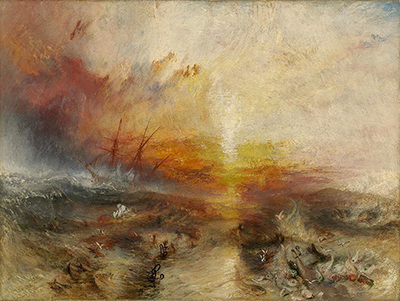
Turner exhibited Slave Ship (Slavers Throwing Overboard the Dead and Dying, Typhoon Coming On) at the same 1840 Royal Academy exhibition. The Boston canvas measures 90.8 by 122.6 centimetres, close to Rockets in scale.[12]
The two works share storm-driven seas, endangered bodies or vessels, extreme colour and long explanatory titles. Both make atmospheric force carry historical meaning. Their proximity has led scholars to propose a chromatic or conceptual pairing.[2]
The contrast is striking. Slave Ship burns with red, orange and yellow around a setting sun and approaching typhoon. Rockets is organised around blue, white, grey and smoke-black. Warm and cold scales seem to answer each other.
Their subjects cannot be reduced to that formal relation. Slave Ship refers to the Zong atrocity of 1781, when enslaved people were thrown overboard so owners could pursue insurance, and Turner's title and verse condemn a market in human lives.[12]
Rockets addresses contemporary steam navigation and warning near Margate. Its vessels are vulnerable, but their danger is not ethically equivalent to deliberate mass murder. Colour comparison must not flatten historical difference.
The technologies also occupy opposite moral fields. In Slave Ship, maritime commerce and insurance participate in atrocity. In Rockets, steamboats, harbour engineering and pyrotechnics support mobility and protection while remaining fallible. Modern systems are neither uniformly emancipatory nor uniformly destructive.
It is not certain that Turner formally hung the canvases as pendants. Shared year and scale support dialogue, but catalogue position alone does not prove a paired display. The stronger language is that scholars have read them together.
The MFA's modern interpretation places Slave Ship at the centre of Turner's engagement with social and technological change.[13] Rockets broadens that account by showing ordinary infrastructure under stress rather than a named crime.
Both pictures make viewers work through beautiful colour toward difficult subject matter. Sensory attraction is not escape from history; it is the means by which attention is held long enough for danger to emerge.
Read together, they reveal Turner's 1840 exhibition as a deliberate expansion of marine painting. Sea and sky become fields in which empire, commerce, steam, signalling, violence and perception can be tested at once.
From Rockets to the 1842 Snow Storm
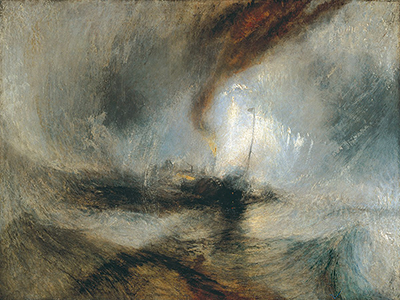
Two years later Turner exhibited Snow Storm—Steam-Boat off a Harbour's Mouth Making Signals in Shallow Water, and Going by the Lead. The Tate oil measures 91.4 by 121.9 centimetres, nearly the same exhibition format.[22][23]
The title continues several concerns of Rockets: a steam-powered vessel, harbour approach, shallow water, signals and difficult navigation. It adds the sounding lead, an instrument for measuring depth, and Turner's claim that “the Author” experienced the storm when the Ariel left Harwich.
That claim belongs only to the 1842 picture. It must not be used to name a vessel in Rockets or convert the Margate scene into direct eyewitness testimony. The Ariel, Harwich date and famous storm anecdote concern a separate object.
Composition changes significantly. Snow Storm concentrates force into a vortex around one central steamboat. Circular motion reduces the distinction among wave, rain, smoke and paddle. The viewer seems trapped within the weather system.
Rockets retains a stronger shore-to-sea axis. Spectators occupy the left foreground, harbour structures establish one edge and several vessels distribute attention horizontally. Signals connect land and water across distance.
The progression is not simply from representation to abstraction. The 1840 painting was originally more detailed than it now appears, while the 1842 work uses intense rotation to stage a different problem. Both combine exact operational titles with difficult paint.
Sounding and signalling are forms of measurement. One tests unseen depth beneath a hull; the other projects visible information through air. Turner places instruments inside conditions that make data urgent and uncertain.
The machines also occupy different dramatic positions. In Rockets, viewers on land can still watch and perhaps assist. In Snow Storm, the vessel becomes the centre from which the surrounding world is experienced. Spectatorial distance contracts.
The National Gallery of Art's exhibition sequence places the Margate study, shore figures, Rockets-related works and Snow Storm within one concentrated late marine development.[22] That sequence supports continuity without merging identities.
Together the works show Turner returning to a contemporary maritime problem until each version found a distinct visual structure. Steam did not provide one symbol; it generated multiple ways to paint perception under pressure.
Carrick, Day and the Colour Print
William Day owned Rockets and Blue Lights around 1850-52. As a principal in the lithographic firm Day & Son, he was positioned to turn the painting into an ambitious colour print. Robert Carrick completed the chromolithograph in 1852.[2][18]
Chromolithography built colour through successive stones or plates. Each carried part of the image, and careful registration combined them on paper. The process transformed Turner's singular oil surface into a reproducible structure of layered inks.
That transformation suited the subject. A painting concerned with steam, chemistry and signalling entered circulation through a relatively new industrial colour technology. Mechanical reproduction did not merely distribute an old-fashioned scene; it interpreted modern content through modern means.
Day emphasised Carrick's artistic capacity rather than claiming photographic exactitude.[2] The printmaker had to decide how sharply to define boats, how many tones could model smoke and where white paper should carry light. Technical fidelity required invention.
A complete impression preserves the large right steamer and its crew, central craft, shore group, rocket and harbour. These details make Carrick invaluable to present scholarship. They also explain why nineteenth-century viewers could discuss a more populated painting than the Clark now holds.[18][19]
The print's warm tone must be handled differently. Ink choices and surviving impressions mediate colour; no print can reproduce oil's resinous transparency, raised white or shifting varnish. It provides relational evidence, not an exact pigment map.
The British Museum's impression entered the collection as 1861,0608.155.[18] Tate acquired another example, T06627, and describes steamships, coast figures and the 1852 publication.[20] Institutional duplication supports the print's independent historical status.
James McNeill Whistler made a watercolour copy around 1854-55 from Carrick, not directly from Turner's oil.[21] Broad wash, bodycolour, scraping and detail translate the chromolithograph into another singular hand-made object.
That chain matters: Turner to Carrick to Whistler is not one unchanged image. Each medium filters colour, scale and edge. The derivative works reveal circulation while warning against treating reproduction as transparent.
Carrick's print now performs a role its maker could not foresee. It is not only a popular version but evidence for lost paint. Reproductive technology has become part of conservation knowledge.
Provenance, Exhibitions and Changing Visibility
The earliest documented ownership includes Turner's dealer Thomas Griffith in 1843 and Charles Birch of Birmingham by 1850. William Day then owned the painting around 1850-52, when Carrick's print was commissioned.[2]
Birch later sold it to John Naylor of Leighton Hall, who had it by 1856. Agnew's handled transactions involving John Graham and Henry McConnel during the 1860s. Mary McConnel inherited it and sold it at Christie's in 1886.[2]
Sir Julian Goldsmid acquired the painting through Agnew's. After his 1896 sale, it passed through Agnew's, Galerie Sedelmeyer and James Orrock before Charles T. Yerkes bought it around 1901.[2]
The Yerkes collection sale in New York in 1910 provided a detailed catalogue description. It identified storm, rockets, a nearly hidden steamer, another vessel, distant dangerous coast and six fishermen in the foreground.[24] The account preserves how the composition appeared before further twentieth-century change.
Duveen Brothers bought at that sale and sold the work to George Eastman in 1914. It returned through Knoedler, went to industrialist Charles M. Schwab in 1916 and was sold by Knoedler to Robert Sterling Clark on 31 December 1932.[2]
The painting entered the Sterling and Francine Clark Art Institute in 1955 as accession 1955.37.[1] Its passage through dealers, industrial fortunes and an American museum mirrors the international market for late Turner.
Public appearances began with London in 1840 and 1841. Later exhibitions included Birmingham in 1850, London in 1896 and 1899, Cardiff in 1913, New York in 1914 and 1928, Youngstown in 1917, and Williamstown displays after the Clark opened.[2]
The 2003-04 late-seascapes exhibition placed the work's condition and radical style under renewed scrutiny. Modern display increasingly required conservation explanation because viewers could no longer assume that all visible thinness was Turner's finish.
Provenance is thus part of visual history. Each movement created opportunities for accident, lining, cleaning, photography and reinterpretation. The ownership chain does not identify one moment of loss, but it establishes the contexts through which change could occur.
Museum access introduces another tension. Stable display lets audiences study the canvas, while digital imaging magnifies cracks and underlayers beyond normal viewing. Carrick can be opened beside it. The work now exists publicly as an object and an evidence network.
What the Painting Still Achieves
Rockets and Blue Lights remains an extraordinary work, but not because damage accidentally made Turner look modern. Its radical character was recognised, often angrily, when the surface was fuller. Critics in 1840 already struggled with its mixture of paint, weather and machinery.[2][10]
The original design joined a precise place to an unresolved incident. Margate's Stone Pier, shallow sands and steam traffic supplied practical conditions. Turner organised them into a storm whose result remains open.
Its long title is part of that achievement. Words name objects and purpose, then the painting makes them difficult to find. The viewer learns what signals do and must search for the signals. Knowledge does not eliminate perceptual strain.
The steamers embody modern confidence and exposure. Engines permit scheduled movement against wind, but no machinery abolishes depth, tide or wave. Rockets and blue lights extend human control through information rather than force.
Shore spectators add an ethics of attention. They cannot command the vessels, yet looking, signalling and waiting matter. Their telescope condenses the work's demand: continue to search through obscurity without inventing what cannot be seen.
Colour carries this relation. Cold blue opens space, white advances as surf and flare, black smoke makes propulsion atmospheric, and warm beach anchors bodies. The contrasts are theoretical enough to invite Goethe and concrete enough to describe a working coast.
Carrick's chromolithograph extends the painting's argument into reproduction. Layered industrial inks preserve a machine-age marine and, unexpectedly, become evidence for what the oil lost. Technology both enters the image and protects its memory.
Conservation history prevents a simple celebration. Present beauty includes exposed lower layers Turner did not intend as final. Respect for the object requires admiration and qualification together.
That qualification does not reduce the canvas to a ruin. Surviving Turner paint still establishes scale, movement, hue and extraordinary continuity among sea, sky, smoke and signal. Missing forms can be historically recovered without being physically repainted.
The painting's deepest modernity lies in this sustained uncertainty. Machines move but may not arrive; lights communicate but may not save; viewers know the title but still struggle to see; the canvas survives but no longer intact. Turner gives every system real power and a visible limit.
Discussion
How should we look at a painting whose surviving surface is powerful but no longer preserves the full design seen by Turner's first audiences?
Reader Insights
Which passages describe Turner's surviving paint, and which details depend on Carrick's later record?
How do rockets and blue lights connect harbour knowledge to vessels obscured by storm and surf?
Does steam power appear defeated, assisted or simply tested by the Margate coast?
Join the Conversation
Share a close observation or a source-based question for other readers.
References
- Clark Art Institute, “Rockets and Blue Lights (Close at Hand) to Warn Steamboats of Shoal Water,” 1955.37, https://www.clarkart.edu/ArtPiece/Detail/Rockets-and-Blue-Lights-(Close-at-Hand)-to-Warn-Steamboats-of-Shoal-Water
- Sarah Lees, ed., *Nineteenth-Century European Paintings at the Sterling and Francine Clark Art Institute*, volume 2, catalogue 342 and technical report, https://media.clarkart.edu/1955.37_EuroCat.pdf
- Wikimedia Commons, Clark high-resolution public-domain image, https://commons.wikimedia.org/wiki/File:Joseph_Mallord_William_Turner_-_Rockets_and_Blue_Lights_(Close_at_Hand)_to_Warn_Steamboats_of_Shoal_Water_-_1955.37_-_Clark_Art_Institute.tiff
- Turner Contemporary, Ian Warrell, “JMW Turner: Breaking Waves,” https://turnercontemporary.org/whats-on/exhibitions/turner-250-breaking-waves
- National Gallery of Australia, “Waves Breaking on a Lee Shore at Margate,” Tate study, https://digital.nga.gov.au/archive/exhibition/turner/default.cfm?irn=230483&bioartistirn=18113&mystartrow=109&realstartrow=109&mnuid=srch&viewid=2
- Tate, “Waves Breaking on a Lee Shore at Margate (Study for ‘Rockets and Blue Lights’),” https://shop.tate.org.uk/jmw-turner-waves-breaking-on-a-lee-shore-at-margate/turner1523.html
- Historic England, *Margate's Seaside Heritage*, https://historicengland.org.uk/images-books/publications/margates-seaside-heritage/margates-seaside-heritage/
- Historic England, “Stone Pier, The Parade, Margate,” list entry 1260334, https://historicengland.org.uk/listing/the-list/list-entry/1260334
- Turner Contemporary, “Our Story,” https://turnercontemporary.org/our-story
- Royal Academy Chronicle, Amy Concannon, “1840: Turner ‘out-Turnered’,” https://chronicle250.com/1840
- Royal Academy of Arts, *Exhibition Catalogue*, 1840, embedded at https://chronicle250.com/1840#catalogue
- Museum of Fine Arts, Boston, “Slave Ship,” 99.22, https://collections.mfa.org/objects/31102/slave-ship-slavers-throwing-overboard-the-dead-and-dying-t
- Museum of Fine Arts, Boston, “Turner's Modern World,” https://www.mfa.org/exhibition/turners-modern-world
- Johann Wolfgang von Goethe, *Theory of Colours*, translated by Charles Lock Eastlake, 1840, Project Gutenberg, https://www.gutenberg.org/cache/epub/50572/pg50572-images.html
- Naval History and Heritage Command, “Blue Light,” https://www.history.navy.mil/research/histories/ship-histories/danfs/b/blue-light-i.html
- Mark Samuel Rathbone, Irish coastal signal-station research, Technological University of the Shannon repository, https://research.thea.ie/bitstream/handle/20.500.12065/3957/Rathbone%20Volume%20I%20TEXT%20FINAL.pdf?isAllowed=y&sequence=1
- Royal Museums Greenwich, “Sail to Steam: A History of Maritime Change,” https://www.rmg.co.uk/stories/ocean/sailing-ships-steam-power-how-industrial-revolution-changed-life-sea-forever
- British Museum, Robert Carrick after Turner, “Rockets and Blue Lights,” 1861,0608.155, https://www.britishmuseum.org/collection/object/P_1861-0608-155
- Wikimedia Commons, British Museum image of Carrick's 1852 chromolithograph, https://commons.wikimedia.org/wiki/File:Rockets_and_Blue_Lights_(BM_1861,0608.155).jpg
- Tate, Robert Carrick after Turner, “Rockets and Blue Lights,” T06627, https://shop.tate.org.uk/jmw-turner-rockets-and-blue-lights/turner016.html
- University of Glasgow, Whistler Paintings, “Copy after Turner's ‘Rockets and blue lights’,” M.176, https://whistlerpaintings.gla.ac.uk/catalogue/printdisplay/?mid=m0176
- National Gallery of Art, *J.M.W. Turner* 2007 exhibition image list, https://www.nga.gov/content/dam/ngaweb/press/exh/2832/2832-list.pdf
- Tate, “Snow Storm—Steam-Boat off a Harbour's Mouth,” N00530, https://shop.tate.org.uk/jmw-turner-snow-storm/turner041.html
- American Art Association, *Catalogue of Exceedingly Valuable Ancient and Modern Paintings*, Yerkes sale, 1910, https://upload.wikimedia.org/wikipedia/commons/4/48/Catalogue_of_exceedingly_valuable_ancient_and_modern_paintings_(IA_catalogueofexcee00amer).pdf
- Museum of Modern Art, *Turner: Imagination and Reality*, 1966, https://assets.moma.org/documents/moma_catalogue_2572_300062313.pdf