 by Tom Gurney
Tom Gurney BSc (Hons) is an art history expert with over 20 years experience
Published on June 19, 2020 / Updated on August 29, 2026
Email: tomgurney1@gmail.com / Phone: +44 7429 011000
Overview
J. M. W. Turner lived through a period in which Britain changed visibly. Steam engines, railways, bridges, factories, expanded print culture, parliamentary reform, industrial labour, urban crowds and new forms of transport altered the way people moved, worked, saw and imagined power. Turner did not respond to this world with a simple yes or no. His art does not make him merely a celebrant of industry or an enemy of it. It shows modernity as pressure: visual, social, political, technological and symbolic.
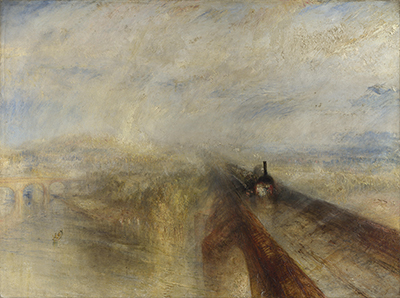
The clearest example is Rain, Steam, and Speed - The Great Western Railway. The National Gallery identifies the setting as Brunel's Maidenhead Railway Bridge, completed in 1838 and carrying Great Western trains from July 1839, with the locomotive entering the scene through rain. [1] The painting does not present the railway as a neatly illustrated machine. It presents speed as an event in weather. The train, bridge, rain, river, field and viewer's eye are forced into one rushing experience.
Turner's modernity was broader than railways. The National Gallery's artist record notes his interest in contemporary technology through works such as The Fighting Temeraire and Rain, Steam, and Speed. [2] The Metropolitan Museum of Art's Heilbrunn essay similarly places him among artists who found subjects in the world around them, including the 1834 Parliament fire and the railway painting. [3] These sources support a careful account: Turner made modern life worthy of ambitious painting without flattening it into propaganda.
Industrial modernity in Turner is therefore not a style label. It is a set of subjects and conditions. Steam changes the sea and river. Bridges change distance. Fire turns government into drama. Railways alter speed and perception. Print circulation changes audiences. Exhibition culture turns new technologies into public arguments. Older forms of power do not disappear; they meet newer ones under conditions of smoke, rain, glare and uncertainty.
This is why Turner's modern subjects can feel unstable. He often paints the modern world through weather and light rather than through hard-edged description. That choice does not make the subject vague. It shows how modern experience felt: sudden, atmospheric, noisy, public, hard to separate from older landscapes and older institutions. Turner made change visible by making visibility itself difficult.
At a Glance
- Central questionHow Turner made nineteenth-century change visible
- Railway focusRain, Steam, and Speed, exhibited 1844 [1]
- Engineered spaceBridges, railways and altered movement
- Steam powerMechanical force within water, smoke and weather
- Public eventThe 1834 Parliament fire and its multiple versions
- Social fieldLabour, passengers, crowds, risk and mobility
- Image circulationExhibitions, criticism, engraving and print culture
- Visual methodRain, smoke, speed, flame and diagonal pressure
- Interpretive cautionNeither simple celebration nor rejection of industry
- Historical frameNineteenth-century modernity, not twentieth-century modernism
Contents
- Overview
- Modernity as Pressure, Not Position
- Railways and the Experience of Speed
- Steam, Sail and Changing Power
- Bridges, Rivers and Engineered Space
- Fire, Parliament and Public Drama
- Industry, Labour and Social Change
- Print, Exhibition and Modern Audiences
- Technique and the Look of Modernity
- How to Read Turner’s Industrial Modernity
Modernity as Pressure, Not Position
It is tempting to ask whether Turner was for or against industry. That question is too narrow. A painting can show fascination, anxiety, admiration, grief and critique at the same time. Turner often places modern machines within older landscapes or older symbolic structures, allowing viewers to feel conflict without receiving a single verdict.
In Rain, Steam, and Speed, the railway is not hidden. It is the central force of the picture. Yet it is not isolated from nature. Rain blurs it. The bridge carries it. The Thames lies below it. A hare, now difficult to see because of paint change, was included by Turner as a detail connected to speed and the natural world. [1] The painting's modernity lies in the relation among these elements, not in the train alone.
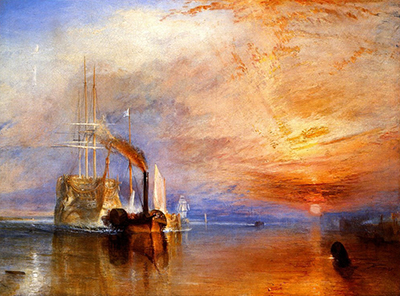
The same complexity appears in The Fighting Temeraire. The National Gallery explains that Turner probably did not witness the towing of the ship and instead imaginatively reconstructed the event from contemporary reports. [4] The old warship is moved by a steam tug, and the scene becomes a meditation on the passing of sail power into steam power. The tug is necessary and unsentimental; the ship is dignified and obsolete. The painting is neither simple nostalgia nor simple celebration.
Turner repeatedly makes modernity visible through collision. Old and new, natural and mechanical, public and private, documentary and poetic, all meet in the same image. He does not separate the modern machine from atmosphere because machines were experienced within atmosphere: smoke, rain, fog, fire, river mist, crowd noise and exhibition debate.
This pressure also affects composition. Modern subjects often enter Turner's pictures diagonally, abruptly or through clouds of obscuring matter. A train bursts through rain. A tug pulls a ghostlike ship. Fire expands across water and sky. These are not only subjects; they are forces that change how a picture is organised.
The word modernity can therefore be useful only if it stays specific. In Turner it may mean a machine, but it may also mean a crowd watching a disaster, a new bridge changing a river, a painting entering public debate, or an old institution being seen through fire and smoke. Modernity is not one object. It is a change in relations: between speed and sight, between technology and nature, between public event and private memory, between older symbols and new kinds of power.
Turner gives those relations physical form. He does not lecture the viewer about industrial society. He makes the viewer feel what it is like to look when the scene will not settle. This is why rain, steam, smoke and flame matter so much. They are not only atmospheric effects; they are the material signs of a world in motion.
Railways and the Experience of Speed
The railway offered Turner a new kind of subject: speed made visible. Earlier landscape painting could show roads, rivers, boats and animals, but the railway changed the relation between human movement and distance. In the 1840s, rail travel compressed space and altered perception. It was not simply a new object in the landscape; it changed how the landscape could be experienced.
The National Gallery records that Rain, Steam, and Speed shows a steam engine crossing the Maidenhead Viaduct on the Great Western line, and that average Great Western Railway engine speed in 1844 was 33 mph, with much higher speeds possible on long level stretches. [1] Turner used that fact of acceleration pictorially. The bridge thrusts the eye into depth. The train comes toward the viewer. Rain turns the scene into moving sensation.
The painting is central to Turner's modernity because it does not merely identify the railway. It creates a visual equivalent for speed. The train is partly clear and partly swallowed by weather. The bridge is both engineered structure and compositional vector. The river and fields remain, but they no longer define a calm rural scene. They are crossed by a new force.
The National Gallery also cautions against treating the picture as a rejection of modernity, noting Turner's interest in industry, technology and new forms of transport. [1] That caution is important. The painting's drama should not be mistaken for hostility. Turner sees the train and bridge as serious subjects. He also sees that seriousness through rain, opacity and disturbance.
The railway painting should be preserved for its own full treatment, but in the wider modernity story it shows Turner's central method: he turns technological change into a problem of perception. How does the eye register speed? How does weather alter machinery? How does engineering transform landscape without erasing it? These are painterly questions and historical questions at once.
The painting also changes the status of the viewer. Traditional landscape often invites the eye to move calmly through foreground, middle distance and horizon. Turner's train disrupts that leisurely movement. The viewer is met by a force coming forward. The diagonal of the bridge does not simply guide attention; it accelerates it. Looking becomes part of the experience of speed.
This matters because railway travel altered perception beyond painting. Passengers saw landscape from moving compartments. Fields, rivers, villages and weather passed in sequences rather than stable views. Turner did not need to illustrate a railway timetable to address that change. By making the train emerge through rain on a severe diagonal, he made the modern experience of movement into pictorial structure.
The railway also brings together engineering and uncertainty. Brunel's viaduct is a rational structure, built to carry routine movement. Turner's atmosphere makes that certainty unstable. Rain interrupts the view, the train's form partly dissolves, and the bridge's power is felt as much as measured. The modern machine is real, but it is still subject to weather, material change and human perception.
Steam, Sail and Changing Power
Steam power changed Turner's maritime and river world as much as his railway world. Steam tugs, steamships and locomotives altered movement, labour and visual atmosphere. They produced smoke, speed and new forms of mechanical regularity. Yet they remained exposed to weather, water and human use.
The Fighting Temeraire offers a compact image of this transition. The National Gallery describes a veteran warship, associated with Trafalgar, being towed to be broken up by a paddle-wheel steam tug. [4] Turner alters and heightens the event, but the historical contrast remains legible: sail power and naval memory are pulled by steam toward dismantling.
This is not only a technological contrast. It is a change in political and emotional meaning. The Temeraire had belonged to a world of naval war and national commemoration. The tug belongs to commerce, utility and industrial movement. Turner puts both in the same water. The old order does not simply vanish; it is carried by the new one.
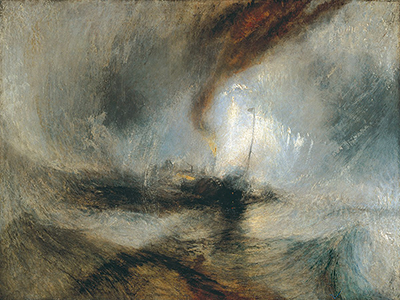
Steam also produced new visual matter. Smoke could become cloudlike; steam could merge with mist; mechanical power could appear through darkness and glow. Turner did not paint modern machinery as clean industrial diagram. He made it atmospheric. This is why his modern subjects can seem both precise and elusive. The object may be historical, but its appearance is unstable.
The relation between steam and water also matters. Steam power depends on fire and water, two elements Turner had always painted with intensity. Modernity did not remove elemental forces from his art. It recombined them. Engines, boilers, smoke, rain, rivers and sea all belong to a world where technology and nature are physically entangled.
This is one reason Turner could paint modern machines without abandoning landscape tradition. Steam power did not arrive outside the landscape; it entered rivers, harbours, bridges, tunnels, rain and fields. The machine became another force within an already active world. Turner could therefore use old landscape resources to address new technologies. Light, distance, reflection and weather remained central, but their meanings changed when a locomotive or steam tug entered the scene.
The steam tug in The Fighting Temeraire is especially rich because it is visually small but historically decisive. It does the work. The larger ship carries memory and dignity, but it no longer controls its own movement. Turner makes modern power look practical, dark, smoky and almost blunt. The image's emotional force depends on that imbalance between visual scale and historical function.
Bridges, Rivers and Engineered Space
Bridges are central to Turner's industrial modernity because they change how space is crossed. A bridge is engineering, infrastructure and visual structure at once. It makes movement possible and gives the painter a new kind of diagonal, span or horizon. Turner understood that bridges were not only practical forms. They were signs of modern control over water, distance and trade.
In Rain, Steam, and Speed, Brunel's Maidenhead Viaduct is not a background detail. It is the track of the picture's energy. The National Gallery describes how the foreshortened bridge guides the eye toward the horizon and suggests the train's speed through rain. [1] Turner uses engineering as composition. The bridge becomes the form through which modern motion enters landscape painting.
Rivers also remain active. The Thames beneath the railway is not erased by the train. It persists as an older corridor of transport, labour and reflection. The painting therefore holds two kinds of movement together: river movement and railway movement. The railway crosses the river, but the river still shapes the scene's light and depth.
This crossing of old and new movement recurs throughout Turner's modern subjects. Canals, bridges, piers, working rivers and railway viaducts all belong to a landscape being reorganised by infrastructure. Turner did not need to paint factory interiors to register industrial change. He could show the visible consequences of new movement systems: smoke in air, bridges over water, vessels under tow, crowds watching disaster, trains cutting through rain.
Engineered space also changes public viewing. A bridge or railway line directs the viewer's eye with a force different from a road or river bend. It is straighter, harder, more assertive. Turner could use that force while softening it through weather and light. The result is a modern scene that never becomes merely mechanical.
Bridges also carry political and economic meaning. They require planning, capital, labour and authority. They organise movement in ways that affect trade, work and daily life. In Turner, this meaning is usually embedded rather than announced. A bridge may first appear as a compositional device, but it also marks a society capable of reshaping water and distance.
This is why rivers are so important to his modernity. A river is an older infrastructure, long before the railway. It carries boats, goods, people, reflections and public ceremonies. When a new bridge or train crosses it, the older system remains visible below. Turner often lets such layers coexist. Modernity is not a blank replacement of the past; it is a new crossing over old movement.
The visual complexity of such scenes comes from that layering. A viewer sees engineering, weather, water, labour and memory at once. The modern world is not shown as a single clean invention. It appears as an accumulation of systems, each affecting the others.
Fire, Parliament and Public Drama
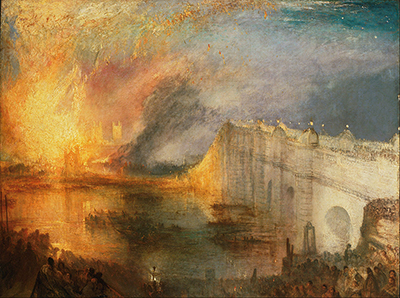
The burning of the Houses of Parliament in 1834 gave Turner a modern public event in which fire, water, politics, crowds and image-making converged. UK Parliament explains that the disaster began after obsolete tally sticks were burned in underfloor stoves, and that by evening flames had spread through the Palace. [5] The event destroyed both Houses of Parliament while Westminster Hall and several other parts survived. [5]
This was not an industrial subject in the narrow sense of factory labour, but it was modern in its public character. A government building became a drama witnessed by crowds, reported in public culture and represented by artists. The fire turned state architecture into light, smoke and reflection. The Thames made it visible as a river event.
The Met Heilbrunn essay states that Turner observed the conflagration from a boat in the Thames and recorded it in watercolours and oil paintings. [3] That river position matters. Turner was not only painting a building on fire; he was painting a public crisis seen across water. Boats, crowds, smoke, flame and reflection made the event a modern visual field.
Version caution is essential. Cleveland Museum of Art notes that Turner painted two versions of the event: Cleveland's view downriver from the southeast bank of the Thames, and another version at Philadelphia showing the fire from directly across Westminster Bridge. [6] Philadelphia's record likewise identifies its painting with the evening of 16 October 1834, when fire broke out in England's Houses of Parliament. [7] These are related works, not interchangeable illustrations.
The fire paintings show how Turner used modern drama without reducing it to journalism. Cleveland's account says he magnified the flames and used the disaster as a starting point to express human helplessness before destructive natural power. [6] That interpretation needs care, but it points to Turner's method. Actual event becomes pictorial pressure: fire becomes colour, river becomes mirror, crowd becomes witness, architecture becomes vulnerability.
The Parliament fire also reveals how modern events circulated quickly as images. A dramatic urban disaster did not remain only a local emergency. It became something witnessed, discussed, sketched, painted and collected. Turner was part of that process. His response belongs to a culture in which public events could become visual commodities and national memories.
The two major oil versions matter because they show how a single event could generate different pictorial arguments. A downriver view changes the relation of flame, crowd, river and distance. A view across Westminster Bridge changes the role of architecture and approach. These differences are not incidental. They show Turner rethinking the event through viewpoint, composition and atmosphere.
The fire subject also brings state power into Turner's modernity. This is not a factory or railway, but the seat of government under threat. The event exposes the vulnerability of institutions that may seem permanent. Fire consumes architecture; crowds watch; water reflects the drama; artists transform it. Modern public life is shown as both powerful and fragile.
Industry, Labour and Social Change
Industrial modernity was not only machinery. It was labour, class, movement, risk and social transformation. Turner often approaches these issues indirectly. A train implies passengers, workers, engineers and capital. A tug implies labour and shipbreaking. A fire implies officials, workmen, crowds, firefighters and public institutions. A bridge implies design, finance, construction and maintenance.
The National Gallery's railway account includes details that open this social field: the train pulls open goods wagons in which cheaper-fare passengers could travel. [1] That small fact matters. Modern transport was not only a technological marvel; it reorganised ordinary mobility. It changed who could move, how quickly, under what conditions and with what risks.
Turner did not paint industrial life like a documentary social reformer. He was not producing a statistical account of labour or poverty. But his modern subjects are not empty of social meaning. Smoke, speed, crowded rivers, burning public buildings and mechanical transport all belong to social experience. They show modernity as something people inhabit, not only something they admire.
The challenge is to avoid overclaiming. It would be wrong to turn every modern object in Turner into a political argument. It would also be wrong to strip those objects of social meaning. The better approach is to ask what pressures the image makes visible. Does it show new speed? A changing relation between nature and machine? A public event? A technology crossing older land and water? A crowd watching power fail?
Turner often makes such pressure felt through atmosphere rather than explicit commentary. That is why his modernity can look ambiguous. The ambiguity is not evasiveness. It reflects the complexity of a world in which technological change produced wonder, anxiety, opportunity, violence, mobility and loss at the same time.
Industrial labour also appears through traces rather than portraits. The railway requires engineers, builders, drivers, stokers, maintenance workers and passengers. A steam tug implies crews, shipbreakers and river labour. Firefighting on the Thames implies coordinated effort under dangerous conditions. Turner rarely isolates these workers as the main subject, but the images depend on their presence.
This indirectness should be read carefully. It does not make Turner a labour historian in the modern sense. It does show that his modern images are inhabited by work. Machines do not move themselves socially, even if they appear visually dominant. Bridges do not build themselves. Fires are fought by people. Transport systems depend on bodies, schedules, wages and risk. Turner's atmospheric modernity rests on those realities.
The social range of modern movement is especially important. Cheaper railway travel, river transport and urban crowds all suggest a changing public sphere. Turner shows a world where more people can move, gather, watch and become part of events. That expansion of experience is one of the quiet forms of modernity in his art.
Print, Exhibition and Modern Audiences
Modernity also changed how art circulated. Turner worked within Royal Academy exhibition culture, private patronage, his own gallery, print series and an expanding public for reproduced images. A modern subject could be seen in a crowded exhibition, discussed in criticism, engraved, remembered and later collected. The image's audience was part of its modern life.
The Met notes Turner's work in print culture, including watercolours used as the basis for engraved series and the Liber Studiorum, whose categories included Marine, Mountainous, Pastoral, Historical, Architectural and Epic Pastoral. [3] Print culture matters for industrial modernity because it helped images move through the same expanding world of circulation that railways and steam also transformed.
The railway painting itself entered exhibition debate. Viewers encountered it not as an isolated object but as a public statement within the Royal Academy world. Its subject was contemporary transport; its handling was loose and atmospheric; its title foregrounded rain, steam and speed rather than topographical description alone. That combination made the modern subject difficult to classify.
Prints also changed how details could be read. The National Gallery notes that the hare in Rain, Steam, and Speed can be seen in an 1859 engraving, although it is now invisible in the painting because the paint has become transparent with age. [1] This is a reminder that modern image culture includes reproduction, interpretation and material change. What viewers know of a painting may come from later images as well as the object itself.
Turner's modernity is therefore not only in what he painted. It is also in how his images entered systems of display, criticism, reproduction and memory. Modern subjects needed modern audiences, and Turner was alert to the force of public looking.
Royal Academy exhibition culture sharpened this force. A painting of a train or burning Parliament did not appear in a neutral space. It appeared among other works, under critical scrutiny, before viewers who brought political, technological and aesthetic assumptions with them. Turner's modern subjects became arguments because they were publicly staged.
Print culture multiplied that staging. Engravings, illustrated publications and critical descriptions could carry an image beyond the exhibition room. They could also clarify, alter or stabilise details that were hard to see in the painting. The modern audience did not encounter Turner only face to face. It encountered Turner through text, print, memory and debate.
This matters for a painting like Rain, Steam, and Speed, where the title itself is almost programmatic. It names rain, steam and speed as forces rather than giving only a geographical description. The title helps direct the viewer toward modern experience. It turns the picture into an encounter with conditions, not just a record of a railway bridge.
Technique and the Look of Modernity
Turner's handling helped make modernity visible. Steam, rain, speed and fire all require technical choices. A hard-edged train would give one kind of modern image; Turner's blurred, atmospheric train gives another. A fire can be described architecturally, but Turner often makes it spread through colour and reflection. A tug can be drawn precisely, yet its smoke can merge with sunset and river air.
Joyce Townsend's How Turner Painted, described by Thames & Hudson as covering modified paint media, innovative watercolour methods, composition process and X-ray photography, supports a technical view of Turner's effects. [8] Modernity in Turner is not only iconography. It is also material process: how paint, paper, light and surface make change visible.
Technical caution also prevents overreading. A detail may fade, become transparent or be clarified through later engraving. A surface may look unfinished because of Turner's handling, later condition or both. A modern effect may depend on the way paint carries light rather than on a neatly identifiable object. This is especially important for Rain, Steam, and Speed, where the sensation of speed depends on weather, diagonal structure and the difficulty of seeing.
Turner used looseness as a way to register forces that resist fixed outline. Rain, smoke, steam, firelight and speed do not sit still. His handling lets those forces disturb the picture. That disturbance is not a lack of skill. It is part of the subject. A modern world of acceleration and combustion required a different kind of pictorial pressure.
This technical modernity should not be confused with twentieth-century modernism. Turner was a nineteenth-century artist shaped by the Royal Academy, old masters, landscape tradition, watercolour practice, print culture and public exhibition. His art can look forward, but its methods belong to his time. The point is not that Turner became a later modernist early. The point is that he found nineteenth-century means for painting nineteenth-century change.
The technical side also helps explain why modernity in Turner feels emotional without becoming purely subjective. Paint handling gives sensation a material basis. A diagonal is not just a symbol of speed; it is a structure that moves the eye. A blurred edge is not just a mood; it is a way of making rain or smoke interfere with recognition. A blaze of colour is not just excitement; it is a way of turning fire into spatial force.
Technical evidence also reminds readers that present appearance may differ from original appearance. The National Gallery's note on the hare in Rain, Steam, and Speed is a useful case: a meaningful detail has become difficult to see because of material change, but an engraving preserves knowledge of it. [1] Modernity is therefore not only a historical subject within the painting. It also belongs to the later history of viewing, reproduction and conservation.
How to Read Turner’s Industrial Modernity
Start by asking what kind of change the work stages. Is it speed, fire, steam, public drama, infrastructure, mechanical movement, institutional crisis, social mobility or the replacement of one power by another? Turner rarely treats modernity as a single subject. He breaks it into experiences.
Then ask how older structures remain. A train crosses a river. A steam tug moves a sailing warship. A modern fire consumes ancient and political architecture. A public exhibition makes contemporary technology into cultural argument. Turner's modern scenes are powerful because they show continuity under pressure, not clean historical replacement.
Next, pay attention to weather and atmosphere. In Turner, modernity is often seen through rain, smoke, mist, sunset, reflection or flame. These conditions are not decorative. They shape meaning. They make the modern machine or event harder to see, and that difficulty becomes part of the experience.
It is also important to ask what evidence supports any story about the image. The National Gallery warns that Turner probably did not witness the Temeraire being towed. [4] The railway painting has stories attached to travel and speed, but the Gallery treats some connections cautiously. [1] The Parliament fire has multiple versions and related works. Good interpretation respects those limits.
Finally, avoid making Turner too neat. He was not simply pro-industry, anti-industry, modernist, nostalgic, conservative or radical. His modern works are more interesting because they resist those reductions. They show a painter using the full resources of landscape, marine painting, technical experiment and public exhibition to confront a world in motion.
It helps to read across groups of works rather than isolating one masterpiece. Rain, Steam, and Speed shows railway motion; The Fighting Temeraire stages sail and steam; the Parliament fire paintings transform civic disaster into public drama; maritime subjects show steam entering older water worlds; works on paper show how travel and observation fed finished images. Together they show Turner asking how painting can keep pace with change.
The answer is not a theory of progress. Turner does not say that the new world is simply better or worse than the old one. He paints the passage between them. That passage is smoky, wet, luminous, crowded and unstable. It is exactly there, in the unsettled movement between old and new, that Turner's industrial modernity lives.
Frequently Asked Questions
It means the visual and social pressure of nineteenth-century change: railways, steam, bridges, fire, industry, public drama, print circulation and altered experiences of speed and distance. Turner painted these forces without reducing them to simple approval or rejection.
Not simply. The National Gallery notes Turner's interest in industry, technology and new transport, and says it is unlikely that the painting rejects modernity. It presents the railway as a serious subject seen through rain, speed and atmosphere. [1]
It stages the transition from sail to steam. The old warship is towed by a steam tug to be broken up, turning technological change into an image of memory, utility and loss. [4]
Turner can look forward to later art, but he should not be treated as a twentieth-century modernist. His modernity belongs to nineteenth-century subjects, materials, exhibition culture and landscape traditions.
Discussion
How does Turner make technological and social change visible without offering a single verdict?
Reader Insights
How does the composition change the viewer's experience of speed?
What happens when machinery is seen through rain, smoke or fire?
Which older forms of power remain visible beside the new?
Join the Conversation
Share a close observation or a question for other readers.
References
- National Gallery, London, "Rain, Steam, and Speed - The Great Western Railway." https://www.nationalgallery.org.uk/paintings/joseph-mallord-william-turner-rain-steam-and-speed-the-great-western-railway
- National Gallery, London, "Joseph Mallord William Turner 1775-1851." https://www.nationalgallery.org.uk/artists/joseph-mallord-william-turner
- Elizabeth E. Barker, "Joseph Mallord William Turner (1775-1851)," The Metropolitan Museum of Art, Heilbrunn Timeline of Art History. https://www.metmuseum.org/essays/joseph-mallord-william-turner-1775-1851
- National Gallery, London, "The Fighting Temeraire." https://www.nationalgallery.org.uk/paintings/joseph-mallord-william-turner-the-fighting-temeraire
- UK Parliament, "The Great Fire of 1834." https://www.parliament.uk/about/living-heritage/building/palace/architecture/palacestructure/great-fire/
- Cleveland Museum of Art, "The Burning of the Houses of Lords and Commons, 16 October 1834." https://www.clevelandart.org/art/1942.647
- Philadelphia Museum of Art, "The Burning of the Houses of Lords and Commons, October 16, 1834." https://www.philamuseum.org/objects/103831
- Thames & Hudson, Joyce H. Townsend with Tony Smibert, *How Turner Painted*. https://www.thamesandhudsonusa.com/books/how-turner-painted-softcover