


 by
Tom Gurney
Tom Gurney BSc (Hons) is an art history expert with over 20 years experience
Written on November 8, 2026 / Updated on November 8, 2026
Email:
tomgurney1@gmail.com
/ Phone:
+44 7429 011000
The Windmill on the Onbekende Gracht, Amsterdam
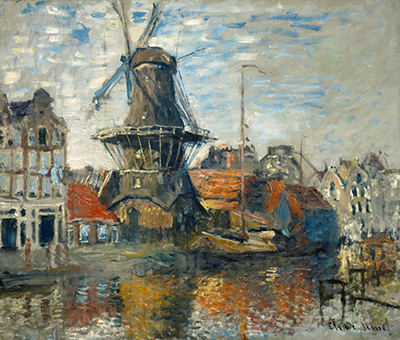
Claude Monet’s The Windmill on the Onbekende Gracht, Amsterdam brings a dark windmill, moored boats and waterside buildings into a scene animated by reflections. Painted in 1874, the canvas belongs to the Museum of Fine Arts, Houston, where it is accession 98.293. Orange roofs and white walls punctuate the bank behind the canal, while the mill rises above them as the principal landmark. The setting is specific, but Monet also makes the water an active part of the composition: reflected shapes break apart as they move towards the viewer.[1][2][3]
At a Glance
A windmill beside the canal
The windmill provides a strong dark centre within an otherwise varied bank of buildings. Its height draws attention upwards, while the surrounding roofs return the eye to the horizontal line of the waterside. Monet gives this landmark enough weight to organise the view without isolating it from its setting. The houses, boats and reflections continue around it, so the mill belongs to a working canal landscape.
Barges establish a lower band between the bank and the open water. Their darker hulls interrupt the reflected buildings and create a transition from solid forms to broken colour. They also offer a useful measure of scale: the large upright mill appears above objects that sit close to the canal surface. The scene combines architecture and transport within a single compact stretch of Amsterdam.
The white houses on the right and the orange roof passages introduce brighter notes against the darker landmark. These differences help distinguish one part of the bank from another. The eye can move along the waterfront, pause at a light wall or roof, and then follow its reflection down into the canal. Colour connects the upper and lower parts of the image without making them exact duplicates.
Water and brushwork
The canal occupies a substantial part of the foreground. It gives the buildings room to reappear as reflections, but those reflections have a different texture from the objects above. Upright structures become interrupted strokes, and the outlines of roofs lose their firmness. This makes the lower part of the painting a changing field rather than a second, inverted picture of the bank.
Warm and cool marks meet across the surface. Orange and pale passages answer the roofs and walls, while darker strokes recall the mill and boats. Their broken arrangement suggests water that cannot hold every boundary in place. Monet allows the viewer to recognise a relationship between an object and its reflection while also seeing the distinct brushmarks that construct the painted surface.
The combination of a stable skyline and less stable reflections gives the composition its particular balance. The mill remains a landmark above the bank, while its surroundings continue to change in the water below. Looking alternately at the two zones reveals how much of the painting’s activity occurs through repeated colours, interrupted contours and differences in the direction of the marks.
Amsterdam in 1874
The museum dates this painting to 1874. That places it with Monet’s Amsterdam views rather than assigning it automatically to his better-known Dutch stay at Zaandam in 1871. The distinction matters because a windmill subject alone cannot establish a year or a location. This particular work has its own title, catalogue entry and collection history, which provide a more precise starting point.[1][2]
Earlier accounts associated the canvas with 1871. The museum’s scholarly catalogue discusses the later redating, recorded in 1996, to 1874. The present date therefore reflects a history of research, rather than an unchanged label carried from the first descriptions of the picture. Keeping the older date in its historical context explains why different years may appear in books or reproductions.[2]
Wildenstein places W302 among other Amsterdam paintings, including the separate entries W300, W301, W303, W304 and W305. These neighbouring numbers help locate it within a group, but they do not make the canvases interchangeable. Differences of viewpoint, skyline and format belong to individual works. The Houston windmill painting should retain its own evidence rather than borrowing a building identification or ownership record from a nearby entry.[4]
Which windmill is shown?
The identification of the mill has also changed. The museum’s scholarly catalogue identifies it as De Eendracht, drawing on research in Amsterdam’s municipal archives. This is more specific than recognising a typical Dutch windmill. It attaches a name to the structure in the painting through documentary research and helps distinguish this site from other mills that have been connected with Monet’s work.[2]
Older descriptions used the name Gooyer. Wildenstein’s 1996 entry already flags The Gooyer Windmill as an incorrect title. The museum catalogue also discusses confusion involving the name Roozeboom. These corrections are useful because familiar building names can persist long after an identification has been revised. They should be presented as earlier proposals, with De Eendracht identified as the museum catalogue’s conclusion.[2][4]
A mill’s name can affect much more than a title. Stories about demolition, relocation or a later building on the site depend on the right structure having been identified. For that reason, those histories should not be transferred between differently named mills. The documented identification clarifies the setting while the painting itself continues to offer the visible relationship of dark mill, canal traffic and bright waterside buildings.[2]
The painting as an object
The Museum of Fine Arts, Houston records an oil on canvas measuring 54 by 64.1 centimetres. Its museum-contributed Google Arts & Culture record gives the same dimensions and medium. The lower-right signature reads Claude Monet. Together with accession 98.293 and catalogue number W302, these details identify the physical painting independently of the variations in its title or the earlier date attached to it.[1][3][4]
Wildenstein’s older catalogue gives dimensions of 56 by 65 centimetres. This difference should remain visible as a difference between records; it is not a reason to silently combine the measurements. The current museum measurement is used here, while the earlier figure belongs to the publication’s documentation. The same care applies to collection status, which also changed after that catalogue appeared.[1][3][4]
From dealers to the Beck collection
The published provenance traces the painting through Parisian dealers before its later American history. The names include Chaîne and Simonson, Bernheim-Jeune, Rosenberg and Durand-Ruel. The museum records a purchase by Paul Cassirer on 15 June 1912. Bodenheimer, Wildenstein and Alex. Reid and Lefevre appear in the subsequent chain. These entries describe successive stages in the work’s circulation, rather than different Amsterdam canvases with similar titles.[1][4]
The painting later belonged to Mr and Mrs Thomas D. Neelands Jr. It appeared as lot 9 in the Neelands estate sale on 26 April 1972. The museum’s provenance includes Acquavella and records the Beck purchase in 1972. This sequence connects the dealer and auction history to the Houston collection, where John A. and Audrey Jones Beck assembled the group with which the canvas is associated.[1][4]
The 1996 Wildenstein catalogue describes the work as a permanent loan from the Beck collection to the Houston museum. The later museum record states that it entered the collection in 1998 as a gift of Audrey Jones Beck. Both statements have a place in its history, but they describe different moments. The older loan record should therefore not replace the accession and gift information now supplied by the museum.[1][2][4]
A landmark and its reflection
The canvas holds together a recognisable place and an active painted surface. The windmill fixes attention above the canal, the barges establish a low horizontal rhythm, and the light houses and warm roofs supply colours that recur in the water. Following those repetitions offers a way into the painting even before its changing names and dates are considered. The image’s visual coherence survives the revisions to its documentation.
Those revisions nevertheless make the work easier to understand precisely. The 1874 date, the museum catalogue’s De Eendracht identification and the 1998 gift each answer a different question: when Monet painted it, what landmark he represented, and how the canvas entered the museum collection. Keeping those answers distinct allows the painting’s Amsterdam setting, physical identity and later history to remain clear.[1][2]
Frequently Asked Questions
Discussion
Look at the mill, canal and reflections. These editorial prompts invite your observations.
Reader Insights
Follow one roof colour from the bank into its reflection.
Compare the mill’s upright form with the low line of the boats.
How do the light houses help organise the dark central landmark?
Join the Conversation
Share a detail, comparison or question about the Amsterdam windmill below.
References
- Museum of Fine Arts, Houston — The Windmill on the Onbekende Gracht, Amsterdam, accession 98.293: object metadata and provenance. View source
- Museum of Fine Arts, Houston — The Beck Collection scholarly catalogue, object 43851: dating, naming research and acquisition history. View source
- Museum of Fine Arts, Houston / Google Arts & Culture — Museum-contributed object record: date, medium, dimensions and gift credit. View source
- Daniel Wildenstein / Wildenstein Plattner Institute — Monet, volume II, 1996, entry 302, printed pages 128–129 (digital viewer 132–133): signature and historical provenance. View source







