


 by
Tom Gurney
Tom Gurney BSc (Hons) is an art history expert with over 20 years experience
Published on October 6, 2016 / Updated on October 23, 2026
Email:
tomgurney1@gmail.com
/ Phone:
+44 7429 011000
Camille Monet and a Child in the Garden
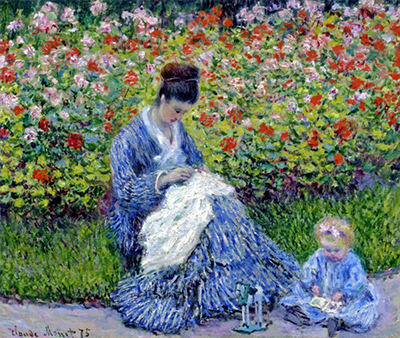
Camille Monet and a Child in the Artist's Garden in Argenteuil is an 1875 oil painting in the Museum of Fine Arts, Boston. Monet presents his wife sewing beside a small child, with flowering bushes forming a dense screen behind them. The picture combines a familiar domestic activity with sustained attention to the colours and textures of the garden. [1] [2]
At a Glance
- Artist Claude Monet
- Date 1875
- Medium Oil on canvas
- Dimensions 55.3 x 64.7 cm
- Collection Museum of Fine Arts, Boston
- Credit and inventory Anonymous gift in memory of Mr. and Mrs. Edwin S. Webster, 1976; 1976.833. [1]
Camille at work
Camille sits with her head bent over the pale fabric gathered in her lap. Her hands meet near its upper edge, and the concentration of the pose contrasts with the loosely suggested flowers behind her. The National Gallery of Victoria's exhibition label identifies her activity as sewing, an ordinary task made central to the picture. [2]
Her face is small, but the angle of the head is decisive. Rather than looking out towards the viewer, she attends to what she is doing. The pose keeps the scene self-contained: we are allowed to observe without being directly addressed.
The striped dress spreads across the lower part of the canvas, its folds establishing a broad diagonal between the upper body and the child. Blue, white and darker strokes suggest both the pattern of the material and the way it changes direction as it falls. The white work in her lap interrupts that pattern with a comparatively luminous area.
This is an intimate view without being an exhaustive likeness. Monet gives enough information to establish a person and an activity, but does not describe every stitch or facial feature. The figure remains connected to the surrounding painted surface rather than being finished in an entirely separate, more precise manner.
The child and the foreground
The child sits low at the right, close to the edge of Camille's dress. Pale hair and a small pink accent distinguish the head, while the blue-and-white clothing forms a smaller counterpart to the adult's garment. Their proximity brings the two figures together even though each appears absorbed in a separate activity.
Small objects near the child's feet add another level of domestic detail. Their scale and abbreviated handling encourage close looking, but they do not become the painting's main subject. The foreground remains a narrow area of pale ground rather than a fully described play space.
The museum title and exhibition label call the figure a child without supplying a name. That wording is worth preserving. The presence of Camille does not automatically establish that every young figure beside her must be Monet's son Jean. Identification requires documentation beyond a general family setting. [1] [2]
The low placement of both figures is important to the composition. Above their seated bodies, the flowers seem to rise in a dense wall. The garden does not recede towards a distant horizon; it presses close around them, making their quiet activities part of an enveloping environment.
A rose bed that is more than a backdrop
Red, pink and pale blossoms spread through the upper half of the picture. Darker green intervals keep these bright notes distinct, while patches of yellow-green vegetation carry the colour into the grass around the figures. The National Gallery of Victoria describes the rose bed as a subject in its own right, not merely scenery behind Camille and the child. [2]
There is a strong contrast between the repeated strokes of the dress and the more scattered touches of the flowers. Yet the two kinds of pattern also connect. Neither clothing nor vegetation is reduced to a smooth, closed shape. Both emerge through neighbouring marks of different colour and direction.
The flowers seem abundant partly because they extend beyond the frame. We cannot count the bushes or see exactly where the bed ends. Cropping turns a portion of the garden into an almost continuous surface of growth, with the figures held against it.
This does not make the painting a botanical inventory. Individual flowers are less important than the distribution of warm and cool passages, bright touches and deeper gaps. The eye moves between recognising blossoms and following the painted pattern through which they are suggested.
Argenteuil, rather than Giverny
The setting belongs to Monet's years at Argenteuil , not to the later garden at Giverny. The National Gallery of Art places his arrival in late 1871 and his departure for Vetheuil in 1878. Argenteuil combined a still-rustic environment with rapid modernisation and access to Paris; it also became an important meeting place for the painters who exhibited together in 1874. [4]
The private garden offered a different subject from the town's river traffic, bridges and industrial edges. Within this smaller setting, Monet could observe familiar people and cultivated plants without making those wider surroundings visible. Their absence from this canvas does not mean they were absent from his life.
Katie Hanson, in the exhibition catalogue French Impressionism, notes that scholars have reconstructed the layout of Monet's Argenteuil garden, but that the tightly cropped Boston painting withholds such a complete view from its spectator. It is specific to a place while remaining selective about what that place reveals. [3]
That selectivity is central to the picture's intimacy. We are not invited to tour the house or survey the whole property. The scene concentrates on two seated figures, a strip of ground and the flowers immediately around them.
A related garden painting of 1876
Monet continued to explore the relation between Camille and the garden. In the Metropolitan Museum's separate Camille Monet in the Garden at Argenteuil, dated 1876, she is placed beside a tall stand of hollyhocks. The museum describes her as almost incidental beside the flowers and notes the substantial group of house-and-garden pictures Monet made that year. [5]
The comparison clarifies what is distinctive about the Boston canvas. Here the act of sewing and the nearby child retain a stronger domestic focus. At the same time, the abundant rose bed competes with the figures for attention. Monet does not force a choice between family scene and garden study; he makes their different patterns work together.
The paintings also differ in format. The Boston work spreads horizontally, allowing adult and child to sit alongside one another. The Met's vertical composition gives greater prominence to upward-growing plants. These are separate pictorial solutions, not different titles for the same image.
The limits of an idyllic scene
The brightness of the flowers and the absorbed poses can suggest calm, but they do not document every aspect of the family's circumstances. Hanson observes that the profusion of the garden complicates a simple account of modest domestic life. The picture's appealing appearance should not be mistaken for proof of either uninterrupted happiness or uninterrupted poverty. [3]
Likewise, Camille's lowered head is explained sufficiently by her work. It does not justify a medical diagnosis, a particular sadness or a retrospective story about her death. The painting rewards attention to the activity and setting it actually presents.
Its strength lies in the connection between modest scale and rich visual incident. A dress pattern, a handful of sewing, a child's small occupation and a crowded bed of roses all receive attention. Through their conjunction, Monet turns a familiar garden moment into a carefully sustained exploration of people, colour and place.
Frequently Asked Questions
In 1875. [1]
The Museum of Fine Arts, Boston, accession 1976.833. [1]
The exhibition label identifies her activity as sewing. [2]
Discussion
Look again at the images and ideas explored in Camille Monet and a Child in the Garden. These editorial prompts invite your observations.
Reader Insights
How does the patterned dress interact with the flowers behind Camille?
Do the figures or the rose bed attract your attention first?
What does the close cropping reveal about the garden, and what does it leave out?
Join the Conversation
Share a detail, comparison or question about Camille Monet and a Child in the Garden below.
References
- National Gallery of Victoria , French Impressionism from the Museum of Fine Arts, Boston, 2025 loan checklist, p. 33: 1976.833. View source .
- National Gallery of Victoria , Monet in situ, exhibition labels: Camille Monet and a child in the artist's garden in Argenteuil. View source .
- Katie Hanson , Immediacy and Infinity: Monet in situ, in French Impressionism, National Gallery of Victoria, 2021, pp. 184-189, especially pp. 186-187. View source .
- National Gallery of Art , Claude Monet: biography and Argenteuil context. View source .
- Metropolitan Museum of Art , Camille Monet (1847-1879) in the Garden at Argenteuil, 1876, 2000.93.1. View source .







