


 by
Tom Gurney
Tom Gurney BSc (Hons) is an art history expert with over 20 years experience
Written on November 8, 2026 / Updated on November 8, 2026
Email:
tomgurney1@gmail.com
/ Phone:
+44 7429 011000
The Riverbank at Petit-Gennevilliers, Sunset
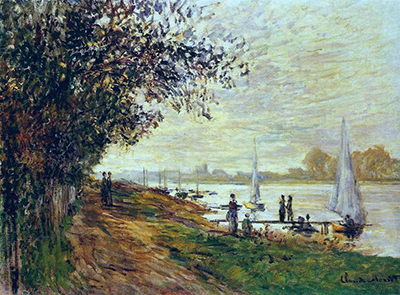
Claude Monet’s The Riverbank at Petit-Gennevilliers, Sunset presents the Seine through the shaded edge of an inhabited bank. A slanting path, small figures and a landing lead towards the water, while sails open the composition to the right. Dated 1875 and catalogued as Wildenstein 374, it belongs to a particular group of river views around Argenteuil and Petit-Gennevilliers. Its sunset title directs attention to the distribution of light across trees, sky and water, without reducing the picture to one bright colour or a literal image of the sun.[1][2]
At a Glance
Identifying the 1875 painting
The painting is signed Claude Monet at the lower right and dated to 1875. Christie’s records an oil on canvas measuring 55 by 73.9 centimetres; the earlier Wildenstein catalogue gives 54 by 73. Both records identify the work as W374. These are slightly different published measurements for the same catalogued canvas. The signature itself records the artist’s name, while 1875 is the date assigned to the work.[1][2]
Its French title, La berge du Petit-Gennevilliers, soleil couchant, locates the view on a riverbank and describes an evening light effect. The place was part of the Seine landscape opposite Argenteuil. Naming that setting helps orient the viewer, while the combination of the catalogue number, date and composition identifies this particular object among Monet’s many pictures of the river.[1][2]
The bank as a route into the picture
The strongest movement begins on the left. Dark foliage hangs over a slanting strip of bank, and the path draws the eye away from the immediate foreground towards the smaller figures further along it. This is more than a convenient border to a river view. The land supplies the route by which the spectator enters the composition, allowing the open water to be encountered gradually.
The edge of the bank acts as a hinge between two kinds of space. On one side are trees, earth and the uneven movements of people; on the other, the broad surface of the Seine. The diagonal joins foreground and distance without dividing the image into rigid compartments. As it recedes, it also reduces the scale of the figures, giving the eye a sequence of distances to compare.
The nearest foliage has a different weight from the distant shore. It forms a darker screen through which the river is seen, while the smaller shapes beyond it remain more open to the sky. This contrast gives the bank both closeness and depth. The viewer can register the thickness of the shaded edge and, almost at once, the space extending past it.
Figures, landing and river traffic
Small figures occupy the bank and the landing area. They introduce human scale without becoming individual portraits. A person close to the foreground and another further along the path are understood partly through their difference in size and their position against the ground. Their clothing and gestures contribute coloured accents, but the landscape remains the larger structure that brings them together.
The landing creates a point of contact between the inhabited bank and the water. It helps connect the apparently separate activities of walking and boating. Rather than treating the river as a surface beyond reach, the composition gives it an accessible edge. This modest feature is important because it makes the place feel used, while leaving enough open water for the view to expand.
A large sail on the right provides another kind of upright shape. Its relatively clear form can be read against the surrounding water and sky, balancing the denser vegetation on the left. The two sides do not have to mirror one another to establish equilibrium. One gathers weight through overlapping foliage and figures; the other gains emphasis through a more isolated shape.
The boats also change how the water is perceived. They supply points of comparison across its breadth, so that the river becomes a space occupied at different distances. Looking from the bank towards a sail is a different movement from following the path inland. Monet brings these directions into the same view, making the eye alternate between travel along the shore and movement across the Seine.
Sunset and the distribution of light
The title’s sunset effect is carried by the relationship of the whole scene rather than by a single conspicuous disk of the sun. Pale, warm light in the sky meets cooler and darker passages below. The overhanging trees preserve a strong area of shade, while the more open river and the sail give the light a different kind of visibility. These contrasts allow an evening atmosphere to develop across several surfaces.
Christie’s interprets the scene as a late-afternoon view and discusses a late-spring or summer setting. Those are useful readings of the image, rather than a recorded clock time or a documented day of work. The distinction leaves room to look carefully at what the painting supplies: the relative warmth of the sky, the weight of the shaded bank and the way figures and vessels become legible against their surroundings.[1]
Water, foliage and sky respond differently to paint. The vegetation is built from overlapping marks that suggest density and uneven growth. The water offers a more continuous field in which smaller interruptions can suggest reflection or movement. Above them, the sky opens a quieter area. The differences make the picture varied without requiring every passage to be equally detailed or equally active.
The evening reading is therefore strengthened by the composition’s unequal distribution of light. A shaded area can make an adjacent pale passage seem more luminous. A small bright shape can hold the eye more firmly when surrounded by muted colour. These are relationships within the painted surface; they can be studied without assuming a particular pigment mixture or reconstructing the order in which Monet applied the paint.
A specific view among related riverbanks
Wildenstein places the work beside other Seine views, including W373 and W375. The proximity of catalogue entries is useful for comparison, but it does not make their titles, dimensions or histories interchangeable. W374 is the sunset riverbank considered here. The neighbouring works offer other arrangements of the familiar river setting, each with a separate composition and history.[2][3]
The comparison is especially productive when attention stays with the pictorial decisions. How much of the bank is included? Does a sail interrupt the open water? Is the nearest vegetation a screen or a smaller accent? Such questions show how the same general setting can support different compositions. They also give a more precise account of Monet’s repeated interest in the Seine than a broad claim that he simply painted one view again and again.
This picture joins leisure and the physical structure of a riverbank. The people and vessels suggest ways of using the place, while the path, landing and trees make those activities spatially intelligible. The scene’s apparent ease depends on that organisation. Colour and arrangement bring the small figures into an environment whose scale remains larger than their individual activities.
Documented ownership and the limits of the record
The published provenance provides a sequence of recorded ownership and sale points. It includes a Drouot sale in 1910 and Strolin, followed by a 1921 sale and Matsukata. Later names in the recorded chain include Pacquement, Wildenstein and Sickles. Christie’s then records Gould in 1971, a sale in 1985 and the subsequent consigning ownership. These entries describe stages in the object’s history; they do not establish its present owner.[1][2]
The catalogue and auction records also document exhibitions in 1955, 1973 and 1980, while the earlier bibliography includes a 1924 catalogue listing. Such references explain how the work has entered public and scholarly accounts at different moments. Together they trace successive periods of visibility, while the present collection remains unestablished in the cited records.[1][2]
The identity remains anchored in the canvas itself: a sloping inhabited bank, shaded foliage, a landing and sails set against the open river. Its small human figures guide the view without exhausting it. In this particular 1875 arrangement, the Seine is both a route through a landscape and an expanse of reflected light, held together by the movement from the dark edge of the bank towards the lighter distance.
Frequently Asked Questions
Discussion
Look again at the riverbank, figures and light in this painting. These editorial prompts invite your observations.
Reader Insights
Follow the diagonal bank from the nearest figures towards the landing.
Compare the weight of the left-hand foliage with the sail on the right.
Which features make this riverbank feel inhabited and accessible?
Join the Conversation
Share a detail, comparison or question about The Riverbank at Petit-Gennevilliers, Sunset below.
References
- Christie’s — Claude Monet, La berge du Petit-Gennevilliers, soleil couchant: object, provenance, exhibitions and catalogue essay. View source
- Daniel Wildenstein / Wildenstein Plattner Institute — Monet, volume II, 1996, entry 374, printed page 154 (digital viewer 158): identity, plate and historical record. View source
- Christie’s — Separate W375 riverbank: object record, provenance and comparative context. View source







