


 by
Tom Gurney
Tom Gurney BSc (Hons) is an art history expert with over 20 years experience
Published on October 6, 2016 / Updated on October 23, 2026
Email:
tomgurney1@gmail.com
/ Phone:
+44 7429 011000
The Artist's House at Argenteuil
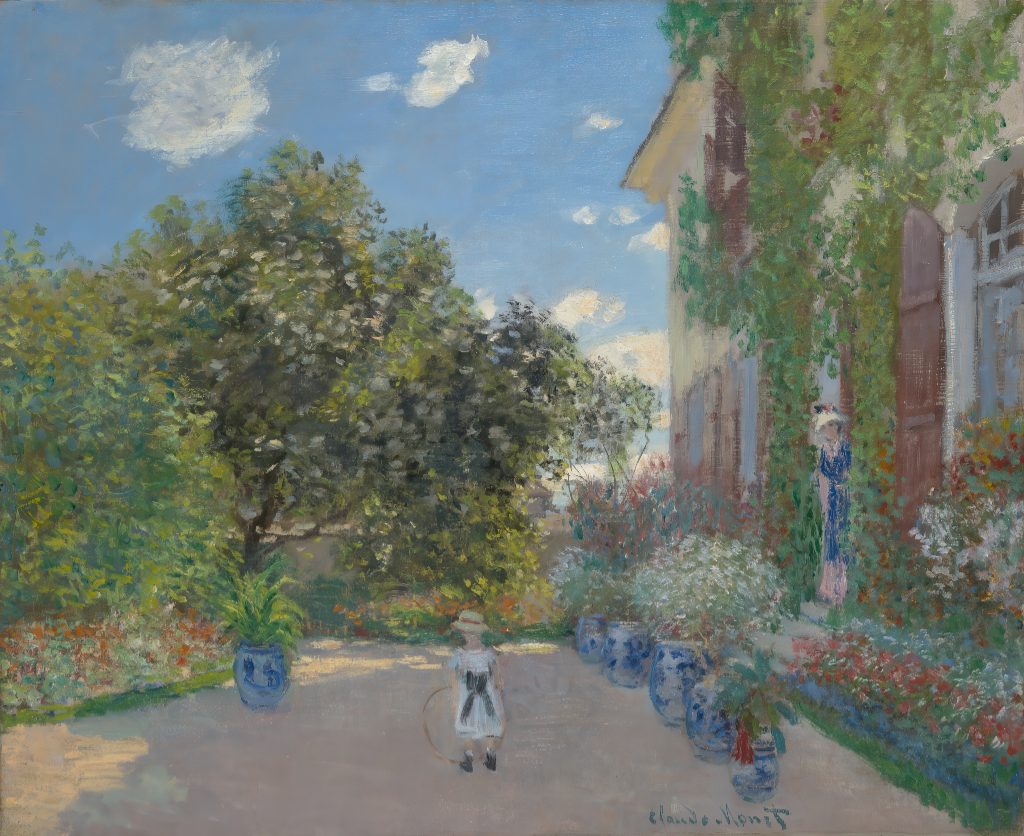
The Artist's House at Argenteuil is Claude Monet's 1873 painting in the Art Institute of Chicago, inventory 1933.1153. [1] Jean stands with a hoop in the courtyard, while Camille appears in the doorway of the vine-covered house. Trees, flowers and blue-and-white pots surround them. This small domestic scene combines a view of family life with a carefully organised relationship between architecture, plants and open space.
At a Glance
- Artist Claude Monet
- Date 1873
- Medium Oil on canvas
- Dimensions 60.2 x 73.3 cm
- Collection Art Institute of Chicago
- Accession 1933.1153
- Credit Mr. and Mrs. Martin A. Ryerson Collection. [1]
Jean in the open courtyard
Jean is small in relation to the house, yet his position makes him difficult to overlook. He stands near the centre of the pale courtyard, turned away from the viewer. A dark sash interrupts his light clothes, and the hoop extends to one side of his body. The museum identifies him as Monet's son, aged about five or six. [1]
The space around him matters as much as the toy. Dense planting fills the left side, and pots and flowerbeds run beside the house on the right, but the immediate courtyard is comparatively empty. The child becomes a point around which the rest of the garden can be measured.
Although the hoop suggests play, the figure appears momentarily still. The painting does not show a race or a game in progress, nor does it explain what Jean is thinking. A pause in a familiar activity gives the scene its quiet focus without requiring an invented family incident.
The light costume also relates to the pale ground. Jean belongs within the courtyard's colours, while the sash and shoes provide just enough contrast to prevent the figure from disappearing into it.
Camille and the inhabited house
Camille is placed much farther to the right, at the threshold rather than in the middle of the garden. Her blue clothing stands against the darker doorway and the surrounding vines. The distance between mother and child connects the house with the outdoor space without making the picture a conventional double portrait.
The building recedes from the right edge towards the centre. Its nearest windows and shutters are large enough to register clearly, while those farther away become less distinct. This perspective gives the courtyard a long side and a destination.
Vegetation complicates the architectural order. Vines rise across the facade, spread around openings and continue beyond the top of the frame. The house is neither a bare geometric construction nor wholly hidden by foliage. It participates in the garden's growth.
The doorway is especially effective because it marks a transition. Camille can be read as belonging to the interior while looking towards Jean outside. The picture keeps both spaces connected, even though it reveals very little of the rooms behind her.
Pots, paths and the shape of the garden
Blue-and-white containers recur at different distances. Several follow the house along the right, while a single conspicuous pot stands to the left of Jean. Their repeated curved profiles contrast with the straighter edges of the building and courtyard.
They also give the plants a visible structure. Some foliage grows freely in beds; other plants rise from containers whose decoration remains readable below the leaves. Gardening here involves placement and maintenance, not simply allowing vegetation to fill every available surface.
The courtyard narrows into the distance. Its converging edges and the diminishing pots direct attention past the child towards the rear of the garden. At the same time, the low beds keep the view open enough for Jean's figure to stand clearly against the ground.
Red, white and blue accents appear among the flowers beside the house. On the left, larger masses of green provide a different scale and density. This unequal distribution is part of the composition's balance: the two sides need not contain the same objects to hold the scene together.
Light without a uniformly sunny surface
The sky is a strong blue, with several white clouds, but much of the garden is shaded. The broad foreground is not the brightest part of the picture. Lighter patches appear farther back and near the left edge, while cooler tones run across the open ground.
The house remains luminous despite those shadows. Its pale upper wall contrasts with dark shutters and green vines, allowing the building to register strongly without a separate spotlight. Light is conveyed through relationships between adjacent colours rather than through a simple division into bright objects and black shadows.
The leaves offer another kind of contrast. Their small, varied marks catch the eye differently from the broader areas of wall and courtyard. Moving between them changes the pace of looking, from dispersed touches to larger planes.
This is one reason the scene can feel full of daylight without every part being directly illuminated. The sky, facade, flowers and shaded ground contribute different notes. Monet's technique is visible in how those notes remain distinct while belonging to the same setting.
A composition that Monet revised
The finished arrangement was not simply accepted at the first attempt. The Art Institute's technical report finds evidence that Jean originally appeared facing the viewer, apparently crouching or sitting, in an area close to the present figure. Infrared examination helps reveal rough facial features beneath later paint. [2]
The same study discusses an additional pot that Monet removed near the surviving vessel on the left. Changing the number and placement of objects altered the relation between the child, the ceramics and the open ground. [2]
These revisions matter because the surface can otherwise look effortlessly immediate. Visible brushwork and a convincing outdoor setting do not mean the artist made no adjustments. The final picture contains decisions about where a body should face and how much visual weight a repeated object should carry.
They also caution against treating the scene as a photographic record of one instant. Monet could draw on a familiar place and real family members while reorganising their appearance in paint. The evidence establishes changes, not a complete account of every session or the precise reason for each alteration.
The first Argenteuil home
The family lived in this rented house from the end of 1871 until the summer of 1874, within Monet's longer residence at Argenteuil . Gloria Groom's catalogue study connects that more settled household with support from the dealer Paul Durand-Ruel, while noting that the financial situation became less secure again in 1874. [2]
The painting offers a view of comfort, but it should not be made to guarantee permanent prosperity. A carefully tended garden can present an attractive aspect of a household without explaining all its circumstances.
Paul Hayes Tucker's study of this canvas draws attention to the contrast between the garden's abundance and Jean's stillness. His questions about the child's mood remain interpretations, not a recovered conversation between mother and son. [3]
The later gardens at Giverny would give Monet other ways to bring cultivation and painting together. This earlier courtyard is compelling on its own terms: a place where a child's activity, a doorway and the arrangement of plants organise a domestic world.
Related views and the Chicago collection
Renoir's Monet Painting in His Argenteuil Garden shows a different arrangement, with an easel, a fence, dahlias and a blue-shuttered house. Tucker compares that setting with Monet's dahlia garden painting , not securely with the Chicago canvas. [3] The shared 1873 date is not proof that Renoir painted Monet making this particular house view.
The distinction helps keep the Monet and Renoir relationship specific. Artists working around the same garden could choose different viewpoints and different subjects within it. A title containing garden or house is not enough to identify a canvas.
The Chicago painting passed through Durand-Ruel and Potter Palmer before Martin A. Ryerson acquired it in 1912; it entered the Art Institute through his 1933 bequest. [1]
Its lasting interest does not depend on an exceptional event. An ordinary courtyard becomes a complex meeting of still figures, growing plants, enclosing walls and shifting light. The revision evidence makes that apparent ease more, rather than less, remarkable.
Frequently Asked Questions
The Art Institute of Chicago, inventory 1933.1153. [1]
The museum identifies Monet's son Jean with the hoop and his wife Camille in the doorway. [1]
Technical examination indicates an earlier, front-facing figure, apparently crouching or seated. [2]
No. The related setting is associated with a different dahlia garden view; the identification should not be asserted. [3]
Discussion
Look again at the images and ideas explored in The Artist's House at Argenteuil. These editorial prompts invite your observations.
Reader Insights
How does the open ground make Jean the focus?
What changes when the house is seen as part of the garden rather than its backdrop?
How do the documented revisions affect your impression of spontaneity?
Join the Conversation
Share a detail, comparison or question about The Artist's House at Argenteuil below.
References
- Art Institute of Chicago , The Artist's House at Argenteuil,1873,1933.1153, current object record and provenance. View source .
- Gloria Groom , with research by Genevieve Westerby, and Art Institute conservation study, Cat.15: The Artist's House at Argenteuil. View source .
- Paul Hayes Tucker , The Impressionists at Argenteuil, National Gallery of Art,2000, cats.18-20, pp.88-94. View source .







