


 by
Tom Gurney
Tom Gurney BSc (Hons) is an art history expert with over 20 years experience
Written on November 8, 2026 / Updated on November 8, 2026
Email:
tomgurney1@gmail.com
/ Phone:
+44 7429 011000
Bennecourt (1887)
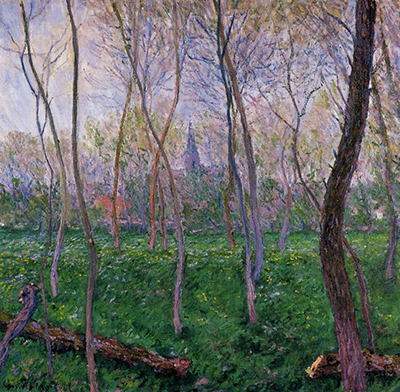
Claude Monet’s Bennecourt of 1887 places the viewer among trees rather than beside an open river prospect. Slender trunks rise through pale, varied foliage, while a fallen branch crosses the green foreground. This nearly square oil painting is W1126 in the catalogue raisonné. Its first recorded owner was the painter John Singer Sargent, who acquired it directly from Monet in August 1887. The image discussed here is distinct from Monet’s much earlier riverside painting with Camille at Bennecourt.[1][2][4]
At a Glance
Identifying the 1887 canvas
The painting is signed Claude Monet and dated 87 at the lower left. Sotheby’s 2024 catalogue records dimensions of 81.8 by 82.5 centimetres; the earlier catalogue raisonné gives the rounded measurement 81 by 81. In both records it is W1126. The woodland composition and its almost square format help distinguish this object when a short title such as Bennecourt could otherwise refer to several paintings.[1][2]
There is no seated figure dominating this view and no wide stretch of river opening across its centre. The eye meets a screen of trunks, a richly coloured ground and a distant area that remains partly screened by vegetation. Those visible features provide a useful starting point before interpreting the landscape or attaching a story to it. The village name identifies the setting without requiring the village itself to become the main painted subject.
Bennecourt and the Giverny years
Monet had settled in rented accommodation at Giverny in 1883. The Musée des impressionnismes Giverny’s chronology places his winter Bennecourt views in 1887, within a period of sustained exploration of the surrounding countryside. Meadows, trees, the Epte and the Seine offered subjects beyond the boundaries of his own garden. This painting belongs to those early Giverny years, before the later water-lily imagery came to dominate his reputation.[3]
The catalogue raisonné relates W1126 to the preceding picture, W1125, a winter view through trees toward Bennecourt. Its account of that earlier viewpoint describes Monet crossing the bridge that had linked Bennecourt and Bonnières since 1884 to reach the Grande Île. It then places W1126 nearby, somewhat later, when vegetation had begun to turn green again. This gives a more precise setting than an unspecified forest, while leaving the exact date open.[2]
A seasonal change is also visible in the relationship between ground and canopy. The lower area is densely green and scattered with bright yellow notes; above it, the trees remain open enough for pale colours to pass between their branches. The picture does not divide neatly into bare winter trees and fully developed summer foliage. It holds different densities of growth together within one closely observed view.
Trunks, space and the square format
The nearly square format makes the rising trees feel contained within a compact field. Their slender lines extend beyond the upper edge, so that the wood seems to continue outside the frame. At the same time, the fallen branch near the bottom prevents the composition from becoming only a row of uprights. Its diagonal movement carries attention across the foreground and into the spaces between the standing trees.
The broad trunk at the right is especially important. Darker and heavier than the surrounding saplings, it provides a strong near edge without forming a straight architectural boundary. Its irregular shape answers the broken form at the lower left. Between these weightier elements, thinner stems produce a more delicate rhythm. Their different widths give the wood depth even where the background is difficult to separate into distinct layers.
There is no broad path inviting a simple walk into the distance. Instead, the viewer’s attention moves through many narrow intervals. Some gaps reveal lighter colour; others are filled by further branches or darker vegetation. The result is a space that can be entered visually without becoming completely open. The trees both reveal and obstruct what lies beyond them.
This layered arrangement also changes the role of the background. Rather than supplying a single distant focal point, the pale areas appear repeatedly between the trunks. They draw the eye upward and across the surface. The foreground remains strong because its greens are fuller and its fallen wood more clearly weighted, but the lighter passages stop the whole scene from becoming a dense, closed wall.
Colour and the woodland floor
Green is the most extensive colour in the lower half, yet it is far from uniform. Darker areas sit beside small brighter patches, while yellow flower-like touches interrupt the ground. Their scattered distribution avoids the regularity of a pattern laid over a flat surface. They can be read together as a flowering floor and individually as small, active marks of paint.
The trunks are equally varied. Some lean toward violet or pink, others toward brown and grey. These differences make them relate to the colours behind and around them, rather than functioning only as dark outlines. Near the top, pale blue, lavender and warmer touches interweave with branches. Colour therefore helps connect parts of the scene that a strictly drawn contour would keep apart.
The fallen branch introduces another texture. Its darker, broken form sits across the softer green ground, making the near space feel more tangible. At the right, the thick upright trunk supplies a related weight. Neither element cancels the overall lightness of the canopy. Instead, they establish a lower and lateral framework against which the smaller touches become more noticeable.
From a distance, the many marks combine into a coherent woodland. Closer looking makes their differences of direction and colour more prominent. The picture works through that exchange between recognisable trees and an intricate painted surface. Such an effect does not prove that the canvas was finished in a single outdoor sitting, and the reproduction alone cannot identify the pigments Monet used.
A related winter view and drawings
W1125, now associated with the Columbus Museum of Art, is the most immediate comparison supplied by the catalogue. Its tree screen and glimpse toward Bennecourt belong to the same local exploration, but it is a different canvas. Its ownership history and museum destination must not be transferred to W1126 merely because the paintings are adjacent in the catalogue and close in subject.[2][5]
The comparison gives seasonal colour a concrete role. In the winter view, elongated dark shadows stretch across a relatively open ground. In W1126, the denser green floor and fallen wood change the emphasis. Both pictures rely on trees interrupting the space, but the later greening alters how strongly the ground and the light beyond the trunks compete for attention.[2]
The catalogue also records two preliminary pencil studies for W1126 in a Marmottan sketchbook, inventory 5129, on folios 29 verso and 30 recto. Their existence adds a preparatory stage to the painting’s documented context. The catalogue reference does not, by itself, reveal every change made on the canvas or establish how closely a particular painted branch follows a drawn line.[2]
Sargent and the later owners
Sargent’s acquisition in August 1887 gives the painting an early connection with another working artist. The Giverny museum’s chronology records Sargent among Monet’s visitors in the summer of 1885 and notes that such visits recurred. That wider association helps explain why his ownership is interesting, without turning the provenance into evidence that Sargent watched this particular painting being made.[1][3]
The 2024 provenance lists Julie H. Heyneman after Sargent, followed by Aline Barnsdall, who owned the work by 1940. It then passed by descent to Aline Devine. Knoedler handled it on consignment, and Pauline Settle Ney acquired it in May 1953. Ney’s estate consigned it to Sotheby’s New York in November 1986, where the later 2024 consignor acquired it. A dealer’s consignment and a museum loan are different from a change of permanent ownership.[1]
The recorded exhibitions include a London showing in 1936 under the title Spring Landscape, then dated 1886, and an extended loan to the Los Angeles County Museum of Art in 1940. Those historical labels do not supersede the current identification as an 1887 painting. It returned to auction as lot 13 in Sotheby’s Modern Evening Auction in May 2024. The accessible record gives an estimate, not a publicly readable sale result; its present owner is not established here.[1]
A different Bennecourt in 1868
The Art Institute of Chicago owns On the Bank of the Seine, Bennecourt, painted in 1868, W110, inventory 1922.427. In that horizontal river landscape, Monet’s future wife Camille sits on an island looking toward Gloton. It is a different painting, made nineteen years before W1126. Camille’s presence, the river reflection and the earlier canvas’s technical findings therefore belong to that work, not to this woodland scene.[4]
The contrast is useful without forcing either picture into a simple story of progress. The earlier scene opens outward across water; the 1887 picture places trunks between the viewer and the farther landscape. One provides a broad prospect, while the other builds its space through repeated interruptions. Sharing a place name does not erase those different pictorial choices.
Looking again through the trees
Follow the fallen branch across the foreground, then compare the heavy right-hand trunk with the thinner stems. Notice how patches of pale background appear between them, and how the yellow marks change the greens below. Returning to the whole square reveals a balance between enclosure and openness: the trees screen the landscape without entirely closing it off.
Frequently Asked Questions
Yes. The provenance records Sargent acquiring it directly from Monet in August 1887. It later passed through several other owners.[1]
Discussion
These editorial prompts invite your observations about the woodland composition.
Reader Insights
Which gap between the trunks draws your eye farthest into the scene?
How do the yellow touches change your reading of the green floor?
What changes when you follow the fallen branch rather than the upright trees?
Join the Conversation
Share an observation or question about Bennecourt of 1887 below.
References
- Sotheby’s — Claude Monet, Bennecourt, Modern Evening Auction, May 2024, lot 13: description, provenance and exhibitions. View source
- Wildenstein Plattner Institute — Daniel Wildenstein, Monet, Catalogue Raisonné, volume III, W1125 and W1126, printed pages 426–427. View source
- Musée des impressionnismes Giverny — Before the Water Lilies: Monet Discovers Giverny, 1883–1890, 2026 press pack, introduction and timeline, pages 3, 9–10. View source
- Art Institute of Chicago — On the Bank of the Seine, Bennecourt, 1868, W110, 1922.427: object record and collection label. View source
- Columbus Museum of Art — Collection highlights: Claude Monet, View of Bennecourt, 1887. View source







