


 by
Tom Gurney
Tom Gurney BSc (Hons) is an art history expert with over 20 years experience
Published on October 6, 2016 / Updated on October 23, 2026
Email:
tomgurney1@gmail.com
/ Phone:
+44 7429 011000
Arrival of the Normandy Train, Gare Saint-Lazare
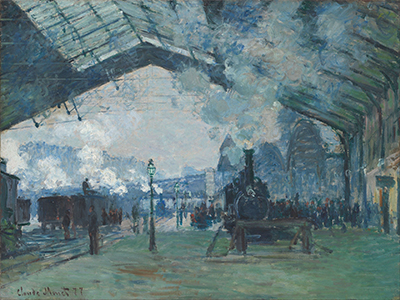
Arrival of the Normandy Train, Gare Saint-Lazare is Claude Monet's 1877 painting in the Art Institute of Chicago, inventory 1933.1158. A locomotive faces the viewer beneath an iron-and-glass roof, while steam spreads through the space above it. Measuring 60.3 x 80.2 cm, this is an intimate view of a large modern interior. [1]
At a Glance
A locomotive under a roof of steam
The engine stands just to the right of centre. Its round front and tall chimney make it recognisable, even though much of its outline merges with darker people and structures behind it.
The roof occupies an unusually large part of the image. Its peak lies left of the locomotive, while the long right-hand slope descends through repeated bands of ironwork. This unequal arrangement prevents the view from becoming a simple symmetrical tunnel.
Steam pushes into the upper right, interrupting the regular structure. Some beams remain clearly visible; others disappear into pale blue-grey paint. The roof seems substantial and permeable at the same time.
This is not merely a train portrait with an architectural backdrop. The engine matters partly because it produces an atmosphere capable of transforming the building around it.
The Gare Saint-Lazare overview follows Monet's wider station project. The Chicago canvas offers one particularly concentrated encounter between machinery, enclosure and changing visibility.
Rails, lamps and people
The foreground is open enough for diagonal rails and platform edges to lead the eye towards the trains. A slender lamp near the centre creates a contrasting vertical, holding its position against the spreading vapour.
At the left, a line of darker carriages and scattered figures balances the larger engine. Beyond them, the station opens towards pale buildings and a blue-grey distance.
The people are not all identical marks. Some gather in a crowd near the locomotive, while isolated upright forms stand out against the lighter ground. Their scale helps make the roof feel large.
Monet does not turn them into a sequence of individually readable stories. A passenger's destination, occupation or mood cannot reliably be extracted from a few strokes of colour.
Instead, the figures make the place inhabited. Their dispersed movements contrast with the fixed rails and beams, adding another kind of activity to the scene without taking attention entirely away from the approaching or newly arrived train.
Light inside an industrial building
The painting's light is not confined to a distant patch of sky. It enters through the glazed roof and spreads through the vapour, producing brightness within the dark enclosure.
Blue, green and grey dominate, but small reddish-brown accents help distinguish people and details. The dark engine remains legible because of the lighter air around it, not because every mechanical part has been carefully outlined.
The National Gallery's discussion of its separate station painting emphasises this meeting of natural light and an engineered interior. Its account of the railway's connections with Normandy and the western suburbs also explains why the terminal was familiar territory for Monet. [3]
The Paris article supplies the broader city setting. Here the modern city becomes visible through a particular experience: looking into a roofed space in which steam repeatedly obscures solid objects.
The result can feel atmospheric without ceasing to be industrial. Vapour and iron are not alternative subjects; their interaction is the picture's central visual problem.
What technical examination establishes
The Art Institute's technical report finds a varied surface, with exposed pale ground, thin applications and thicker strokes. It also records an important revision: iron tie rods beneath the right side of the roof were painted over by steam. [2]
That change matters visually. The surviving grid at the left is answered less rigidly on the right, where vapour interrupts the architecture. A material alteration helped create the final imbalance.
The report does not justify describing the entire canvas as a mass of thick blobs. Some passages depend on open, economical marks rather than a continuous crust of paint.
Nor does a lively surface establish that the whole work was completed in one sitting. A picture can preserve the sensation of rapid observation while containing decisions made at different stages.
The Technique article distinguishes visible handling from documented process. In this case, examination of the actual canvas gives a firmer account than a general formula about how all Impressionist paintings were made.
Planning a difficult modern subject
The scholarly catalogue relates the Chicago composition to a pencil sketch in Monet's station sketchbook, now at the Musee Marmottan Monet. Its notes also caution that the famous story of specially stoked engines comes through Jean Renoir's much later recollection. [2]
The distinction is important. A related drawing supports planning; an entertaining retrospective story does not give an exact record of the railway's operations on the day this canvas was painted.
The picture itself has a clear structure. The lamp, roof peak, rails and locomotive provide stable positions around which looser passages can develop.
In that sense, uncertainty belongs to what Monet shows, not to an absence of pictorial control. The vapour hides parts of the station, but the painting still gives us enough fixed points to understand the space.
The Drawings guide considers this connection between preparation and a seemingly spontaneous result. At Saint-Lazare, changing visibility made a durable compositional framework especially useful.
A distinct work within the station group
Monet made several views of the station and its approaches in early 1877. The National Gallery identifies a dozen pictures, differing in viewpoint and degree of finish. Its own canvas is smaller than the Chicago work and is a separate object with its own technical history. [3]
Comparison should therefore begin with differences, rather than treating every station image as another reproduction of the same scene. A shift of viewpoint changes the roof's geometry, the position of the engines and the balance between enclosed and open space.
Chicago's current museum account connects this repeated investigation with Monet's later practice of returning to a motif. [1] That relationship does not mean the station pictures already follow every method of the later grainstack or cathedral groups.
The Painting Series guide follows those developments. Arrival of the Normandy Train remains distinctive because its large roof and forward-facing engine give temporary steam a particularly strong structural setting.
Reception was not simply rejection
The Chicago painting appeared as number 97 in the third Impressionist exhibition in April 1877. The Art Institute's scholarly account records Charles Bigot's favourable response to this particular work. It was neither the largest nor the most finished of the station canvases. [2]
That evidence complicates the familiar story of a misunderstood innovation condemned by every contemporary viewer. Responses to a group, an artist and an individual picture are not necessarily the same.
The painting's clarity may help explain why it could be read despite its sketch-like handling: a locomotive, a roof and a station crowd remain identifiable through the haze.
In 1998, the National Gallery of Art and the Musee d'Orsay organised an exhibition bringing Monet's station pictures into dialogue with Manet and Caillebotte. The accompanying study considered the artists' different approaches to the same changing neighbourhood. [4] [5]
The Reception article considers the wider history of such responses. This canvas has both a specific early exhibition record and a later place in the study of modern Paris.
From early collectors to Chicago
The museum's provenance records Monet's sale to Ernest Hoschede in March 1877, followed by ownership by Georges de Bellio in 1878. Martin A. Ryerson bought the painting through Durand-Ruel in 1911; it entered the Art Institute through his bequest in 1933. [1]
That history identifies the canvas more securely than the abbreviated title Gare Saint-Lazare alone. Numerous views share the station's name, but they do not share one collection history.
Seen as an individual work, Arrival of the Normandy Train rewards attention to small balances: the dark round engine beneath pale steam, the lamp against open space, and the roof's hard lines dissolving at the right.
Its subject is modern transport, but its effect depends on sustained looking. Iron, people and machinery become a changing arrangement of colour and visibility, without losing their recognisable place in a working railway station.
Frequently Asked Questions
It belongs to the Art Institute of Chicago, inventory 1933.1158. [1]
It is signed and dated 1877. [1]
No. The Art Institute's scholarly catalogue explicitly distinguishes it from the largest and most finished station pictures. [2]
Yes. Technical examination documents roof tie rods covered by steam. [2]
Discussion
Look again at the images and ideas explored in Arrival of the Normandy Train, Gare Saint-Lazare. These editorial prompts invite your observations.
Reader Insights
Compare the rigid roof at the left with the steam-obscured structure at the right.
Follow the rails from the foreground towards the locomotive.
Consider how little detail is needed to make the station crowd recognisable.
Join the Conversation
Share a detail, comparison or question about Arrival of the Normandy Train, Gare Saint-Lazare below.
References
- Art Institute of Chicago , Arrival of the Normandy Train, Gare Saint-Lazare, 1877, 1933.1158; current object record, provenance and collection information. View source .
- Art Institute of Chicago , Monet Paintings and Drawings, 2014, Cat. 16; curatorial entry, technical report, preparatory sketch, reception and documentary cautions. View source .
- National Gallery, London , The Gare St-Lazare, 1877, NG6479; a distinct canvas, station context and the 1877 group. View source .
- National Gallery of Art , Manet, Monet, and the Gare Saint-Lazare, 1998; past exhibition record. View source .
- Juliet Wilson-Bareau / National Gallery of Art , Manet, Monet, and the Gare Saint-Lazare, 1998; institutional catalogue description and neighbourhood context. View source .







