


 by
Tom Gurney
Tom Gurney BSc (Hons) is an art history expert with over 20 years experience
Published on October 6, 2016 / Updated on October 23, 2026
Email:
tomgurney1@gmail.com
/ Phone:
+44 7429 011000
Boats in the Pool of London
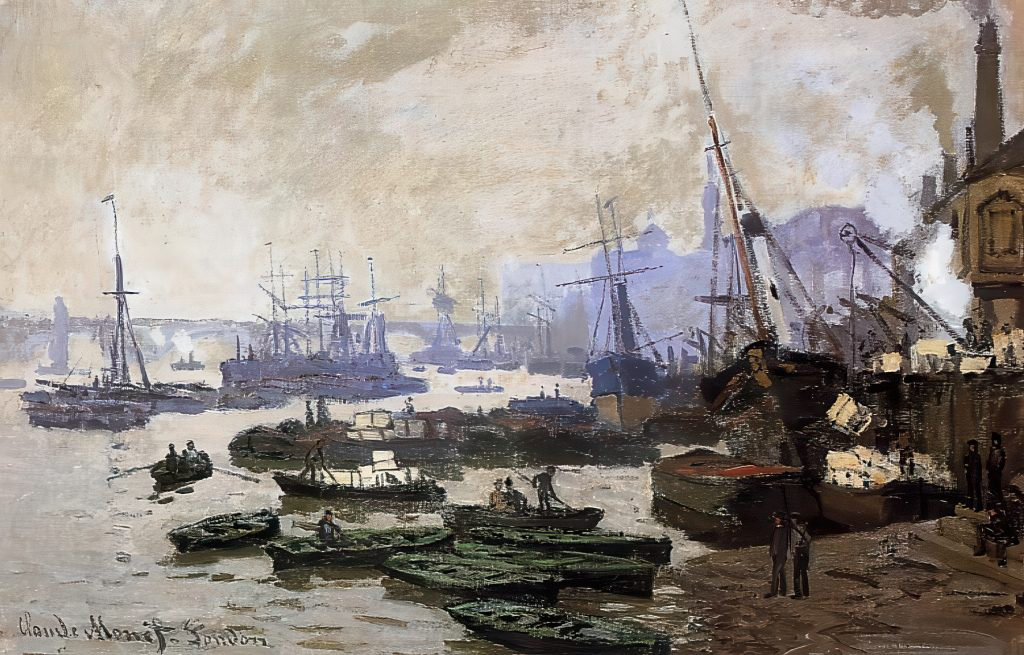
Boats in the Pool of London belongs to Claude Monet's first encounter with the Thames in 1870-71, rather than the famous bridge series begun almost thirty years later. A crowded foreground of small craft and river workers opens towards larger ships, a distant bridge and a sky veiled by haze. The painting is catalogued by Daniel Wildenstein as number 167, under the English title Boats in the Port of London . It is distinct from the similarly named The Pool of London in the collection of Amgueddfa Cymru - Museum Wales. [1] [2] [3]
At a Glance
A working river rather than an empty view
The composition gives the river several different rhythms. Small boats stretch sideways across the foreground, their low shapes repeated at slightly different angles. Beyond them, the masts of larger vessels rise into the sky. The nearer bank enters from the right, making an uneven edge against the water rather than a neat horizontal boundary. People appear as part of this working margin, close to the boats and bundles, not as isolated portraits.
There is no single vessel that turns the scene into the story of a famous ship. Attention shifts between activities and distances. The dark mass of a large hull at the right helps balance the more open water at the left, while repeated masts carry the eye towards the hazier middle ground. The picture's interest lies partly in this combination of practical congestion and open space: the river is busy, yet the large sky still governs its atmosphere.
Low tide and the upstream direction
Wildenstein identifies the subject as the Thames at low tide, looking upstream with London Bridge in the background. That description gives a useful orientation to the scene without requiring an invented position for every boat. It also distinguishes this view from Monet's pictures farther upriver near Westminster. The bridge visible here belongs to the commercial Pool, not to the Houses of Parliament setting. [1]
The low river level makes the near edge especially noticeable. A sloping area of shore and the compact boats in shallow water occupy much more of the foreground than a distant skyline. The observer is brought close to the practical business of reaching and using the river. Farther away, boats and structures lose some of that firmness within the light.
This transition from a strongly marked bank to a less certain distance gives the painting depth without making the foreground a decorative frame. Its irregular activity is essential to the scene. The Thames appears as a place being used, not merely a reflective surface below a picturesque city.
Monet's first stay in London
Monet reached London in September 1870 during the Franco-Prussian War and remained until May 1871. The National Gallery identifies a small group of city views from that stay, including park scenes, two views of the Pool and its own The Thames below Westminster . These early pictures belong to a period of displacement, before the independent exhibition of 1874 made the Impressionist name familiar. [2]
The circumstances differ markedly from his later visits. In 1870-71, London was a refuge for Monet and his family as well as a source of subjects. The surviving works move between riverside industry and public green spaces. Together, they show the breadth of his attention: the city could be encountered through moving water, machinery, ships, paths, scattered figures and overcast weather. [2] [4]
The London paintings therefore begin earlier than the celebrated views from the Savoy. Boats in the Pool of London preserves a close engagement with a working waterfront, rather than a distant anticipation of the later series alone.
The Pool and the commercial city
The Pool lay below London Bridge, where the bridge limited the upstream movement of oceangoing shipping. Princeton University Art Museum describes this part of the Thames as a centre of mercantile trade, with customs administration, markets and transport facilities along the north bank. Its discussion concerns the Cardiff painting, but the geographical and economic setting helps explain the wider attraction of the district. [5]
That setting matters to the range of forms in Monet's view. A river port brings low craft and tall-rigged ships into the same visual field. Its banks are places of transfer, where people and goods pass between land and water. The masts and hulls are consequently more than convenient compositional accents: they belong to the daily organisation of the waterfront.
The painting does not explain individual cargoes or identify the people working there. Its subject remains visual rather than a detailed record of port administration. Even so, the concentration of boats and riverside activity prevents the atmosphere from becoming detached from the commercial city.
Colour, haze and differences of touch
The overall colour is restrained compared with many of Monet's later London paintings. Pale browns, greys and cooler blue-violet passages spread across the sky and distance, while the closest boats contain stronger darks. Small warmer accents interrupt that subdued range without overturning it. The near and far parts of the scene are connected by atmosphere but are not equally dissolved within it.
The handling changes with the subject. Thin upright lines describe rigging, broader dark patches hold the boats together, and the sky carries a much looser movement of paint. A distant building can register as a block of tone while a nearby mast needs a sharper edge. This variety helps make the port legible without turning the canvas into a uniformly detailed inventory.
Haze should not automatically be read as a purely natural mist. The National Gallery's account of the contemporary Westminster view emphasises London's industrial pollution and its effect on colour and visibility. That broader context belongs to the city Monet was painting, although it cannot identify the exact weather or mixture of smoke in this particular scene. [2]
A related painting, not the Cardiff canvas
Museum Wales dates its The Pool of London to 1871 and records dimensions of 48.5 by 74.5 cm, accession NMW A 2486. It identifies the Custom House on the right and London Bridge in the background. The museum purchased that work in 1980. Those details belong to the Cardiff object and should not be transferred to the smaller painting discussed here. [3]
The two works nevertheless make a productive comparison. They show that the Pool was a subject to which Monet returned during the same early stay, rather than an isolated excursion from his park and Westminster views. Similar titles reflect the shared stretch of river, but a title alone is not enough to establish that two references describe the same canvas. Wildenstein's separate numbers, 167 and 168, preserve the distinction. [1] [3]
Looking between them shifts attention from a generic idea of London fog to decisions about viewpoint, river level, foreground traffic and the distance given to the opposite bank. A repeated location can produce a different organisation of the whole picture.
Whistler and a shared Thames landscape
Art historian Katharine Lochnan discusses this painting in her study of Whistler and Monet. She compares the restricted palettes and atmospheric effects of Monet's early Thames views with Whistler's river paintings, and their structure with his Thames etchings. Her account names Boats in the Port of London explicitly as Wildenstein 167. This gives the comparison a firm object identity rather than relying on two artists having painted the same city. [6]
Lochnan also stresses the limited documentation for reconstructing the relationship. Visual affinities can suggest familiarity and exchange, but they are not a transcript of what Monet saw on a particular day. The comparison is most useful when it remains a question about selection and arrangement: how a busy river can be organised into tonal areas, and how ordinary shipping can become the subject of an ambitious painting. [6]
Monet's relationship with other artists was part of his development. It need not reduce his London view to a borrowed formula, any more than the presence of similar boats makes two Thames paintings interchangeable.
Before the later bridge series
When Monet returned in 1899, 1900 and 1901, he developed a much larger project around Waterloo Bridge, Charing Cross Bridge and the Houses of Parliament. The Courtauld describes those paintings as a coherent set, begun through direct experience in London and subsequently worked on in his Giverny studio. The later dates on some canvases reflect that extended process. [7]
The difference helps locate Boats in the Pool of London within the career. It is not a study for the later bridge paintings, and no such preparatory role needs to be invented. Its busy near bank and individually legible craft make a different kind of encounter with the river. What continues is an interest in the interaction of built structures, movement and unstable visibility. [1] [7]
The early painting rewards attention on its own terms. The shallow foreground, dense traffic and great pale sky make the working Pool a complete subject. The later Waterloo Bridge and Houses of Parliament pictures reveal how far Monet's response to London could change, not a standard against which the earlier work is merely incomplete.
Frequently Asked Questions
The catalogue places the painting in 1871, during his first London stay. [1]
No. That later project began during visits in 1899-1901 and concentrated on different river motifs. [7]
Discussion
Look again at the images and ideas explored in Boats in the Pool of London. These editorial prompts invite your observations.
Reader Insights
Compare the detail of the near boats with the hazier forms across the river.
How does the low bank affect the feeling of proximity to the working port?
What changes between Monet's early Pool view and his later bridge paintings?
Join the Conversation
Share a detail, comparison or question about Boats in the Pool of London below.
References
- Daniel Wildenstein / Wildenstein Plattner Institute , Monet, volume II, catalogue raisonne, 1996, entry 167 and adjacent entry 168; viewer page 83. View source .
- National Gallery, London , The Thames below Westminster, NG6399; the 1870-71 stay and early London subjects. View source .
- Amgueddfa Cymru - Museum Wales , The Pool of London, NMW A 2486; governing record for the separate Cardiff painting. View source .
- Philadelphia Museum of Art , Green Park, London, object 104454; family refuge and the early park paintings. View source .
- Princeton University Art Museum , The British Passion for Landscape; commercial geography of the Pool, discussed with the Cardiff painting. View source .
- Katharine Lochnan , Whistler and Monet: Impressionism and Britain, in James McNeill Whistler in Context, Smithsonian Institution, pp.45-49; object identity and bounded visual comparisons. View source .
- The Courtauld , The Changing City: Monet and London; the later 1899-1901 project and studio completion. View source .







