


 by
Tom Gurney
Tom Gurney BSc (Hons) is an art history expert with over 20 years experience
Published on October 6, 2016 / Updated on October 23, 2026
Email:
tomgurney1@gmail.com
/ Phone:
+44 7429 011000
Charing Cross Bridge, London
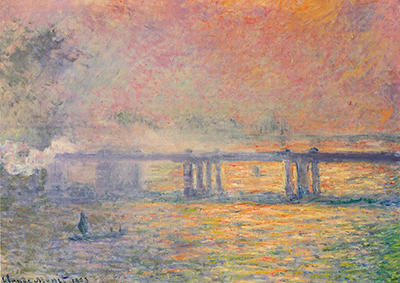
Claude Monet painted Charing Cross Bridge repeatedly as part of his London views. The example shown here is the Saint Louis Art Museum's Charing Cross Bridge, dated 1903. [1] Its railway structure crosses a river of gold, green and blue beneath an atmosphere alive with pink and orange light.
At a Glance
The railway crossing and the river
The bridge stretches across the middle of the image. Its horizontal deck is supported by groups of vertical piers, whose cool blue-grey colour contrasts with the warmer light around them. Although the structure is partly softened by the atmosphere, its repeated supports give the composition a firm rhythm.
Below it, the river is much less regular. Short strokes and small patches of colour cross the foreground, interrupting the reflected light. Gold and orange are strongest towards the centre and right, while cooler green and blue passages gather towards the edges.
A small dark sailing craft appears in the lower left. Beside the broad span and expansive water, it offers a compact accent rather than a detailed maritime story. Its pointed shape is easier to grasp than many of the more elusive forms farther away.
The museum identifies a train moving across the bridge. [1] The plume above the crossing introduces a different kind of shape: irregular and dispersing, it spreads into the same atmosphere that makes the distant city difficult to separate into individual buildings.
A view from the Savoy
Monet's London painting visits took place in 1899, 1900 and 1901. The Courtauld places the bridge pictures within three principal Thames subjects: Charing Cross Bridge, Waterloo Bridge and the Houses of Parliament. [3]
The Expert Adviser's report published by Arts Council England explains the directions of his working views. From the Savoy Hotel, Waterloo Bridge lay towards the morning light in the east, while Charing Cross Bridge was an afternoon subject in the other direction. The Parliament view required a different position across the river. [4]
These arrangements gave Monet distinct problems without requiring him to move through an unlimited sequence of sites. A change in direction altered the relation between light and architecture. A change in weather could then transform the same span while the basic viewpoint remained recognisable.
The hotel was therefore more than a convenient address. Its elevated outlook helped establish a repeatable framework. Within that framework, the artist could return to a familiar crossing and concentrate on differences in visibility, colour and reflected light.
Fog was not simply grey
The pinks and oranges of the sky are essential to the featured painting. They keep the atmosphere from becoming an empty veil placed in front of a conventionally coloured city. The air seems to have its own shifting density, absorbing some forms and allowing others to emerge.
The Courtauld's account connects London's fog with pollution from coal-burning factories, domestic stoves and steam transport. It also notes that these conditions could produce a range of colours, rather than a uniformly grey appearance. [3]
This historical context should not turn the picture into a celebration of pollution. The visual attraction of an effect and the harm caused by polluted air are different matters. A painting can make unusual colour compelling without supplying a judgement that the city's living conditions were desirable.
Nor is every indistinct passage evidence of one particular pollutant. Monet was making a picture, not an air-quality measurement. What can be seen directly is the interaction of warm light, cooler structure and an atmosphere that prevents the distant city from becoming sharply outlined.
Why make a series of one bridge?
The Arts Council report records thirty-four Charing Cross Bridge paintings in the catalogue raisonne, within a larger Thames project of at least ninety-four surviving canvases. Thirty-seven London views were selected for the Paris exhibition of 1904. [4]
Those figures refer to different groups. The bridge paintings are a subset of the Thames works, and the exhibition selection is another subset, not a list of everything Monet painted in London. The distinction prevents a familiar misunderstanding in which every number becomes a competing total for the same series.
Repetition also changed how an individual picture could be understood. One view might emphasise the bridge as a dark silhouette; another might give greater weight to a luminous reflection. The shared subject makes these choices easier to notice.
The railway crossing remains a point of reference, but it does not dictate one fixed appearance. Its piers can seem heavy, faint or almost suspended depending on the surrounding colour. The series turns that instability into a sustained subject, allowing architecture and atmosphere to remain equally important.
Dates and completion at Giverny
A date later than 1901 does not establish an additional painting visit to London. The Courtauld explains that Monet continued working on the canvases in his Giverny studio, using memory and invention alongside what he had begun before the views themselves. [3]
This helps make sense of the 1903 date on the Saint Louis painting. It belongs to a process that extended beyond the stays at the Savoy, rather than contradicting their chronology. The visible result should not be reduced to either an instantaneous outdoor record or a wholly invented scene.
The work of completion also involved judging paintings in relation to one another. A series places demands on the balance between difference and continuity: each canvas needs its own character, while the group needs enough consistency for comparisons to remain meaningful.
Museum Wales provides a useful separate example. Its Charing Cross Bridge is dated 1902 and was bought by Margaret Davies in 1913, later entering the museum through her bequest. [5] That ownership date concerns one painting. It is not evidence that the entire series first found buyers in 1913.
The Saint Louis canvas and its history
The featured painting is W1548 in Wildenstein's catalogue. [2] The Saint Louis museum traces it from Monet to Durand-Ruel in March 1913, to Arthur B. Emmons that May, and back to the dealer in December. The museum purchased it in 1915. [1]
This particular history distinguishes it from the smaller Cardiff painting and the other versions scattered among public and private collections. Similar titles can conceal different dates, dimensions and ownership records, so a bridge name alone is not a complete identification.
Its colour arrangement is equally distinctive. The brightest river passages answer the warm sky, while the bridge's cooler supports remain readable within them. The small boat near the left edge gives the open water a point of focus without diminishing the breadth of the span.
Among Monet's London paintings , Charing Cross Bridge offers a meeting of modern transport and unstable visibility. The crossing supplies a repeated structure; the atmosphere keeps changing its apparent substance. That tension gives the series a purpose beyond recording a famous place, and gives this canvas a particular identity within the larger group.
Frequently Asked Questions
He continued work on the Thames canvases at Giverny. [3]
No. Thirty-seven were selected from a substantially larger project. [4]
No. Museum Wales owns a separate Charing Cross Bridge, dated 1902. [5]
Discussion
Look again at the images and ideas explored in Charing Cross Bridge, London. These editorial prompts invite your observations.
Reader Insights
Do the bridge's piers seem solid or partly dissolved by the surrounding colour?
How does the small sailing craft change your sense of scale?
Which colours link the sky most strongly with the river?
Join the Conversation
Share a detail, comparison or question about Charing Cross Bridge, London below.
References
- Saint Louis Art Museum , Charing Cross Bridge, 1903, accession 22:1915, object and provenance record. View source .
- Daniel Wildenstein , Monet: Catalogue raisonne, 1996, volume III, W1548, p. 669, Wildenstein Plattner Institute digital edition. View source .
- Francesca Herrick and Nadine Mahoney , The Changing City: Monet and London, Courtauld educational resource. View source .
- Arts Council England , Charing Cross Bridge: Expert Adviser's statement, contextual account of the Thames project and working viewpoints; the case itself concerns the separate W1545 painting. View source .
- Amgueddfa Cymru - Museum Wales , Charing Cross Bridge, 1902, NMW A 2483. View source .







