


 by
Tom Gurney
Tom Gurney BSc (Hons) is an art history expert with over 20 years experience
Published on October 6, 2016 / Updated on October 23, 2026
Email:
tomgurney1@gmail.com
/ Phone:
+44 7429 011000
Green Park, London
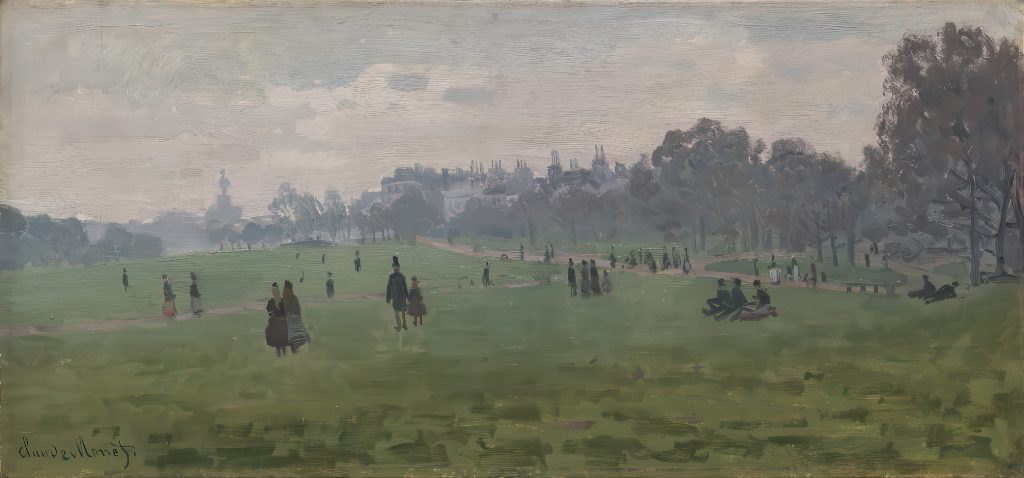
Claude Monet's Green Park, London presents an everyday city landscape under a pale, overcast sky. People cross a broad lawn or gather in small groups, while trees and the buildings of Piccadilly mark the park's edge. The Philadelphia Museum of Art dates the canvas to 1870 or 1871, during Monet's first stay in London. Its low, wide format gives a small painting an expansive field of vision. Neither a portrait of a celebrated visitor nor a record of a grand ceremony, it finds its subject in the ordinary occupation of a public space. [1]
At a Glance
An open composition with no central event
The lawn occupies much of the lower canvas. It is not a level strip of colour: darker and lighter touches suggest irregular ground, and paths interrupt the green. The eye can travel across the picture without meeting a large central object. Nearer figures give a sense of scale, while smaller marks indicate people farther away. Instead of organising a crowd around a single incident, Monet distributes attention across the space.
The trees at the right provide the heaviest vertical shapes. Their height contrasts with the long, low spread of grass and buildings, but their dark canopy does not close the picture entirely. Openings allow distant forms to remain visible. The result combines enclosure and breadth: this is a piece of land within a city, not an unlimited countryside.
The format matters to that impression. Its width encourages looking from side to side, noticing one group after another. The landscape unfolds as a sequence of encounters rather than a route towards a single dramatic destination.
Figures made from a few decisive marks
The museum identifies couples, nannies and other groups among the people sitting or walking in the park. Monet gives them presence with small touches of dark and grey paint rather than fully described faces. Near figures are sufficiently differentiated to suggest different clothes and postures, but individual names and biographies do not belong to the available evidence. [1]
One of the nearest groups stands towards the left, balanced by seated figures farther right. These interruptions in the lawn help measure distance. As the figures diminish, the scale of the open ground becomes more apparent. The social activity and the spatial organisation cannot easily be separated: the visitors make the landscape readable.
The absence of a principal character also changes the mood. No person claims the painting in the manner of a portrait sitter. The park continues around everyone. A small gesture or silhouette contributes to a larger pattern of use, suggesting the ordinary duration of a walk rather than a carefully staged historical moment.
Piccadilly and the Wellington landmark
The Philadelphia museum describes the view as looking towards Hyde Park Corner, with the substantial buildings of Piccadilly along the edge. It identifies Apsley House and the equestrian Wellington monument at the far end. The built skyline keeps the park connected to the capital's streets and public memorials even where haze softens its outlines. [1]
The monument's historical appearance is especially useful for understanding the view. English Heritage records that a giant statue of Wellington was placed on top of Wellington Arch in 1846. The arch was moved in the 1880s, the statue removed, and the quadriga now on top was installed in 1912. Today's familiar arrangement is therefore not the one Monet encountered. [3]
The distant shape is not merely a convenient landmark for a modern walking route. It belongs to a specific phase of the city's architecture. The painting brings that monumental backdrop into the same field as small, unceremonious groups on the grass, allowing public grandeur and daily leisure to coexist without turning either into a separate spectacle.
A royal park opened to the public
Green Park had become generally accessible in 1826. Historic England's account describes that change as a major shift in its use and management, followed by nineteenth-century improvements to planting and paths. The Royal Parks likewise places the opening and alterations in the 1820s. By the time Monet painted, the landscape was a managed public place with a long history, not a surviving patch of untouched nature. [4] [5]
Its relationship to Piccadilly is fundamental to the picture. The buildings lie close to the trees, and the ground opens out immediately beside a major urban boundary. The contrast between open grass and a substantial city edge does not require a division between supposedly natural and artificial worlds. Both parts belong to the lived environment.
Later changes also make the painting more than an illustration of the park as it appears now. Historic England records subsequent alterations to paths, gates, monuments and neighbouring roads. A modern map can establish the general location but cannot reproduce the precise arrangement of the 1870-71 scene. [4]
Weather without a brightly coloured sunset
The colour is quieter than the brilliant sunsets and fog effects often associated with Monet in London . A pale sky presses close to the buildings; trees and roofs merge towards the distance. The grass remains the largest area of colour, but its green is subdued, varied by darker strokes rather than lit by a strong patch of sunshine.
That restraint makes small contrasts effective. A light skirt or a dark coat can distinguish a figure without a carefully modelled head or hands. The skyline is similarly economical: a few raised shapes and chimney marks establish a city beyond the lawn. The paint does not describe every surface with the same degree of sharpness.
The holding museum places the work in the winter of 1870-71, while retaining the broader date 1870 or 1871 in its catalogue heading. The atmosphere supports its account of an overcast day, but neither the muted colour nor the surviving record supplies an exact day of execution. The picture's particular effect is more secure than an invented weather diary. [1]
Hyde Park as a close but separate comparison
Monet's Hyde Park, London , now at the RISD Museum, is the closest companion in subject. Auckland Art Gallery's 1985 Monet catalogue compares the elongated formats, scattered people and overcast conditions of the two park pictures. It also warns against treating them as a strict pair: they show different parks and organise their spaces differently. [6] [7]
The comparison is useful because it directs attention to choices within a related problem. How large should the figures be? Where should the path turn? How much of the distant city should remain visible? In Green Park , the broad lawn encourages a particularly open horizontal movement, while the great dark trees give the right side greater weight.
A technical observation about one canvas should not automatically become a fact about the other. The Auckland catalogue's discussion of underlying paint and reused canvas concerns Hyde Park . It does not establish the same physical history for Green Park . The works share a context, but each retains its own object history. [7]
From a London refuge to a museum collection
The painting belongs to the period when Monet and his family took refuge in England during the Franco-Prussian War. The National Gallery places his arrival in September 1870 and departure in May 1871. His early subjects included parks and the working Thames, bringing public leisure and urban industry into a small but varied group of views. [8]
The catalogue raisonne records Green Park as purchased from Monet by Paul Durand-Ruel in May 1872. It later passed through the collection of Alexander J. Cassatt and entered Philadelphia's public holdings through the Wilstach Fund in 1921. Those steps connect a picture made during exile to the dealer and collector networks through which Monet's work reached an international audience. [2]
The sequence should not be mistaken for a claim that the picture was immediately famous or that it alone secured Monet's career. It identifies particular transactions and a lasting museum destination. Its place within Monet's exhibition history belongs to that wider story of how new painting found viewers.
An early city landscape on its own terms
The London park pictures precede the 1874 independent exhibition that helped give Impressionism its name. Their contemporary setting and abbreviated figures show Monet working on problems that would remain important: how much detail a scene needs, how atmosphere alters distant forms, and how people occupy a landscape without becoming its sole subject. [7] [8]
The quietness of Green Park should not be confused with a lack of ambition. A small canvas can offer a broad experience by directing attention across repeated figures, paths and trees. Its sense of casual observation depends on the placement and scale of those elements.
Nor is it only a preliminary step towards the later Thames series. The park has its own character: a large public lawn, a recognisable urban boundary and a population of loosely described visitors. Looking closely restores the specificity of a scene that a general account of Monet's fascination with London fog might otherwise overlook.
Frequently Asked Questions
It is in the collection of the Philadelphia Museum of Art, object 104454. [1]
The holding museum gives 1870 or 1871, and that qualification is retained here. [1]
Discussion
Look again at the images and ideas explored in Green Park, London. These editorial prompts invite your observations.
Reader Insights
Follow the scattered figures across the lawn: which marks suggest distance?
How does the distant monument change the relationship between the park and the city?
Compare the weight of the trees with the openness of the foreground.
Join the Conversation
Share a detail, comparison or question about Green Park, London below.
References
- Philadelphia Museum of Art , Green Park, London, 1870 or 1871, object 104454; governing title, date and subject record. View source .
- Daniel Wildenstein / Wildenstein Plattner Institute , Monet, volume II, 1996, entry 165, viewer page 82; dimensions, westward view and provenance. View source .
- English Heritage , History of Wellington Arch; statue, relocation and changes to the monument. View source .
- Historic England , Green Park, register entry 1000806; public opening and changes to the landscape. View source .
- The Royal Parks , History of The Green Park; nineteenth-century public access and landscaping. View source .
- RISD Museum , Hyde Park, London, accession 42.218; separate comparative painting. View source .
- Auckland Art Gallery , Monet: Painter of Light, 1985, catalogue entry 1, p.42; comparison of the two parks and technical observations specific to Hyde Park. View source .
- National Gallery, London , The Thames below Westminster; first London stay and surviving city views. View source .







