


 by
Tom Gurney
Tom Gurney BSc (Hons) is an art history expert with over 20 years experience
Published on October 6, 2016 / Updated on October 23, 2026
Email:
tomgurney1@gmail.com
/ Phone:
+44 7429 011000
Hyde Park, London
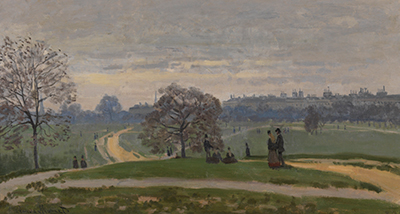
In Hyde Park, London , Claude Monet turns an ordinary public landscape into a carefully varied arrangement of paths, rising ground, trees and small figures. The city remains visible beyond the park, but no major monument dominates the picture. A pale sky and subdued colours give the scene a quiet continuity. The RISD Museum dates the oil painting to about 1871, during Monet's first London stay. It is a distinct work from his Green Park , and its particular organisation rewards looking beyond the familiar summary that Monet came to England to paint fog. [1] [2]
At a Glance
The paths organise the view
The first strong division is a pale path running across the foreground. Another route bends away from it, turning towards the left before leading back into the park. Their light tones stand out against the greens and browns of the grass. The paths offer a way into the picture, but they do not create a straight avenue ending at one commanding object. They encourage the eye to change direction.
The ground also rises and falls. A group placed on one crest can stand out against open space while people farther down become smaller interruptions in the lawn. Trees help mark these changes, their trunks and canopies providing vertical accents beside the winding routes. Buildings form a low, distant boundary instead of a grand architectural centre.
The composition is therefore more structured than its informality first suggests. It gives the impression of looking across a place while walking, discovering one connection and then another. The park is not emptied for a perfect vista; its paths and visitors continually interrupt that possibility.
Small figures and ordinary activity
The larger standing figures to the right of centre establish a near point of human scale. Other people sit or gather near the trees, and distant walkers become brief dark marks. They are not described with the detail of individual portraits, yet their changes of posture are enough to give the space a lived rhythm.
Auckland Art Gallery's catalogue notes the different kinds of touch Monet uses for foliage, people and chimney pots. It also observes that the figures remain distinct from their surroundings rather than disappearing into the mists associated with his later London work. The reduced detail is selective: it does not make every element equally vague. [2]
That balance between recognition and abbreviation is central to the scene. A dark vertical shape needs little elaboration to suggest a standing visitor beside a path. The painting can then direct more attention towards the relation between that figure and the open ground. It remains a landscape used by people rather than a crowd scene with an incidental background.
A London neighbourhood beyond the grass
The catalogue raisonne identifies the view as looking north-west, towards the houses on Bayswater Road and the spires of Christ Church and the former St James's Church. It supplies a more specific geography than the broad title Hyde Park . The row of buildings is the edge of an inhabited city, not a distant village beyond open countryside. [3]
Historic England describes Hyde Park's gently uneven ground and its northern boundary along Bayswater Road. Its history also records the growing network of drives and entrances through which the park became increasingly accessible. These features place Monet's landscape within a managed urban space. The apparently informal open ground had been shaped by planting, circulation and public use. [4]
The skyline and paths play complementary roles in the painting. One gives the view its outer limit; the others show how people pass through the space within it. The park offers breadth without isolation from London. That relationship is different from the enclosed private garden that would occupy so much of Monet's later career.
A quiet image of a contested public space
Hyde Park had a public history that extended far beyond promenading. The Royal Parks records its opening to the public in 1637 and its later use for major events, including the Great Exhibition in 1851. Public access was nevertheless not the same as unrestricted permission for every activity. [5]
The UK Parliament's account of the 1866 reform protests describes crowds barred from the park and the breaking of its railings. That episode belongs to the recent history of the place when Monet painted it. It shows why the meaning and control of public space could be politically important. [6]
Nothing in the surviving evidence used here identifies Monet's visitors as demonstrators or makes the canvas a record of that conflict. Its quiet activity should remain distinct from the dramatic history of the setting. The contrast is still revealing: the same urban landscape could accommodate ordinary leisure and become the focus of public disagreement under other circumstances.
A reused canvas beneath the immediate effect
The apparent ease of the surface does not tell the whole story of the object's making. The Auckland catalogue reports thick, dried paint beneath the visible scene that does not correspond to its forms. It interprets this as evidence of an earlier composition begun on the canvas. The old paint therefore belongs to a material history that the present image does not fully disclose. [2]
This is a precise observation about Hyde Park , not a reason to assume that every early Monet has the same construction. It also does not tell us exactly what the abandoned image represented. The evidence supports reuse, with the catalogue's qualification about the underlying composition, rather than a complete reconstruction of the earlier painting. [2]
The distinction makes the finished effect more interesting. A scene that appears to register a passing experience can be carried on an object with a prior history. Freshness is something the visible arrangement achieves; it is not proof that the canvas began blank that morning or that every mark was made in one uninterrupted sitting.
Hyde Park and Green Park are not interchangeable
The related Green Park painting is now in Philadelphia. Its holding museum gives the date as 1870 or 1871 and identifies a view towards Hyde Park Corner, with Piccadilly buildings and the Wellington landmark in the distance. Both paintings bring small groups into a wide urban park, but they do not describe the same stretch of ground. [7]
In Hyde Park , the turning paths and changes of level are especially active. In Green Park , a broader lawn spreads beneath trees concentrated towards one side. Looking between the two makes the shared problem clearer: how to distribute visitors across a space without converting them into the cast of a single event.
The pictures belong together as comparisons rather than identical statements. Their subdued conditions also challenge the idea that Monet's early Impressionist direction always required intense sunlight. A view under an overcast sky could test the relation between colour, distance and abbreviated form just as seriously as a brilliant day.
Durand-Ruel, a changing title and the gift to RISD
The RISD Museum's provenance records the painting's sale from Monet to Paul Durand-Ruel in May 1872 under the title Kensington Gardens . It subsequently passed to Ernest Hoschede in January 1877 and later returned to Durand-Ruel's holdings. The earlier title is part of its documented history, not a reason to silently replace the museum's present identification. [1]
The painting's route to Providence continued through later sales, including a London exhibition in 1936 and the Harcourt Johnstone sale of 1940. Mrs. Murray S. Danforth gave it to the RISD Museum in 1942. The object is thus evidence of a long passage through commercial and private ownership before becoming part of a public teaching collection. [1]
The sequence connects this small park view with the international circulation of Monet's work. It also gives a firm basis for describing its museum destination without inventing its current position in a gallery or a continuous public-display history. [1]
Its place among the first London pictures
Monet's first London stay lasted from September 1870 to May 1871. The National Gallery places its The Thames below Westminster within the same small group of city views as the two parks and two pictures of the Pool. He was finding subjects across very different parts of the capital while taking refuge from the Franco-Prussian War. [8]
The contrast with the river pictures is instructive. In Boats in the Pool of London , craft and waterfront work occupy the foreground. Here the routes of visitors across grass supply the principal movements. Both make a modern city visible through ordinary activity, without needing a public ceremony as the main subject.
Hyde Park also belongs to a career still developing before the first independent Impressionist exhibition of 1874. Its broad view, small accents and differentiated handling are not a complete statement of all Monet would later do. They are a particular solution to a particular place. Its value lies in that specificity: a park whose changing levels, paths and people give an apparently modest scene its complex, informal order.
Frequently Asked Questions
It is held by the RISD Museum in Providence, accession 42.218. [1]
The museum's provenance records its 1872 sale as Kensington Gardens; Hyde Park, London is its present catalogue title. [1]
The Auckland catalogue reports dried underlying paint unrelated to the visible composition, but does not identify a complete earlier subject. [2]
Discussion
Look again at the images and ideas explored in Hyde Park, London. These editorial prompts invite your observations.
Reader Insights
Trace the turning paths and notice where the eye changes direction.
How do the small groups make the size and slope of the park intelligible?
Compare this view with Green Park: what does each composition emphasise?
Join the Conversation
Share a detail, comparison or question about Hyde Park, London below.
References
- RISD Museum , Hyde Park, London, about 1871, accession 42.218; dimensions, credit and provenance. View source .
- Auckland Art Gallery , Monet: Painter of Light, 1985, catalogue entry 1, p.42; composition, differentiated brushwork and reused canvas. View source .
- Daniel Wildenstein / Wildenstein Plattner Institute , Monet, volume II, 1996, entry 164, viewer page 82; north-west view and named skyline features. View source .
- Historic England , Hyde Park, register entry 1000814; topography, Bayswater Road and managed park development. View source .
- The Royal Parks , History of the Royal Parks; public access and nineteenth-century events. View source .
- UK Parliament , Hyde Park Riot; the 1866 reform protest and conflict over access. View source .
- Philadelphia Museum of Art , Green Park, London, object 104454; separate comparative work. View source .
- National Gallery, London , The Thames below Westminster; dates and subjects of the early London stay. View source .







