by Tom Gurney
Tom Gurney BSc (Hons) is an art history expert with over 20 years experience
Published on March 30, 2026 / Updated on March 31, 2026
Email: tomgurney1@gmail.com / Phone: +44 7429 011000
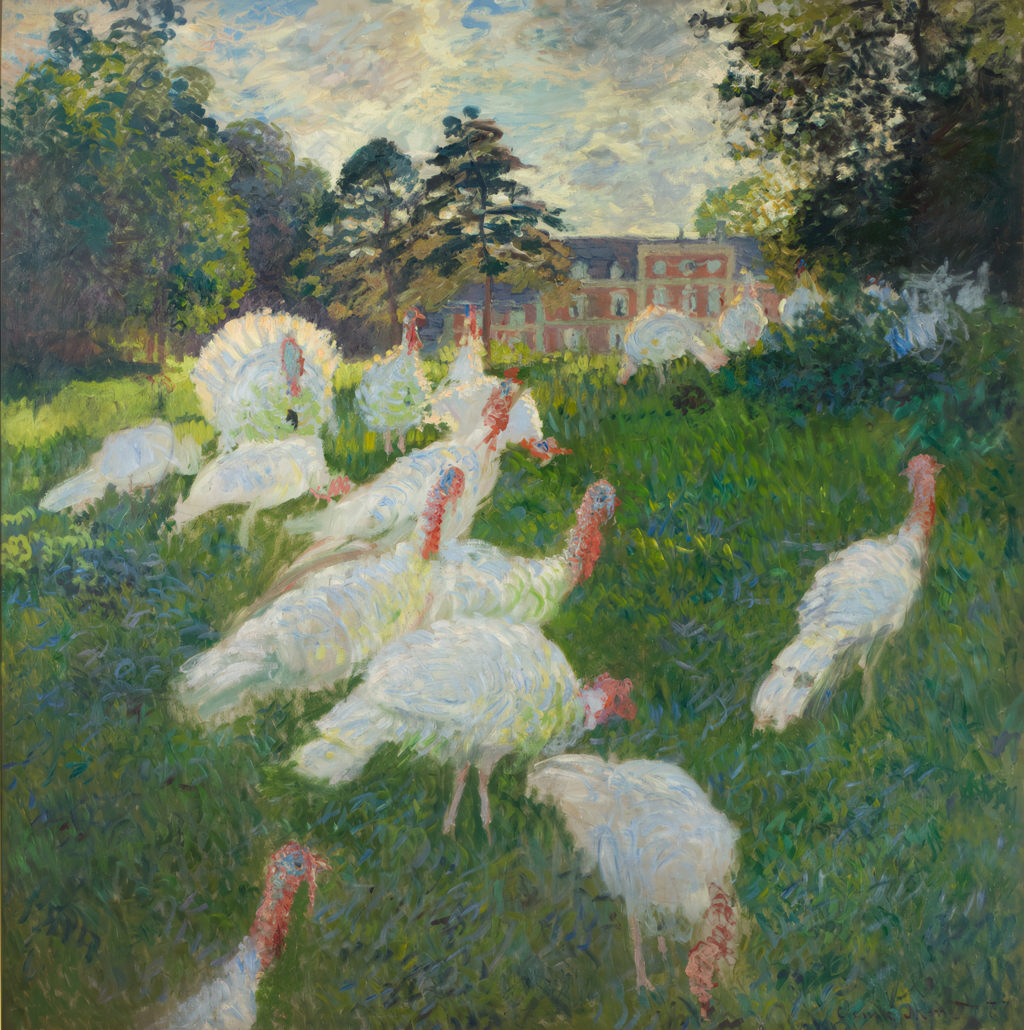
The Turkeys (1877) by Claude Monet
This charming scene from Claude Monet is unique to his oeuvre in a number of ways. Painting in 1877, The Turkeys is one of Claude Monet's most ambitious paintings. Monet completed a large commission for the estate of Ernest Hoschedé at Montgeron, with The Turkeys (Les Dindons) being one of the most memorable contributions from that.
Monet focused on domestic birds within this scene, but the overall work is a rich study of light, movement, and atmosphere. Monet had a clear plan in mind, with the overall commission intended as a decorative selection of works to hang within specific parts of the dining room of the Château de Rottembourg.
The Montgeron Commission
The Turkeys (Les Dindons) was part of a group of paintings commissioned by Ernest Hoschedé, a wealthy patron and early supporter of Impressionism. In the late 1870s Monet was still establishing his reputation and so was grateful for this large commission, particularly as his artistic integrity was protected.
Within this series, The Turkeys stands out for its distinctive subject matter. Rather than depicting fashionable leisure or sweeping landscapes, Monet turned his attention to the cultivated gardens of the estate, where everyday life unfolded in quiet, natural rhythms.
In this article we will examine this beautiful artwork, and place it within the context of Monet's significant wider commission for the dining room of the Château de Rottembourg.
- Artist:Claude Monet
- Title:The Turkeys
- Original Title (French):Les Dindons
- Year:1877
- Location Painted:Montgeron, France
- Commissioned By:Ernest Hoschedé
- Medium:Oil on canvas
- Category:Birds / Garden / Decorative Painting
- Ownership:Musée d'Orsay
Description
The Turkeys is a carefully designed composition, though it initially appears entirely informal. A group of turkeys wanders across a sunlit lawn, framed by dense foliage and trees. Their placement seems random, and natural. Once you become aware that the turkeys are arranged in a manner that leads the eye towards the background, one cannot unsee the rough path from bottom to top.
Two thirds of the length of the painting are devoted to the grassy area and turkeys, allowing this to dominate the eye. The artist then carefully plans the remaining third, with the chateau visible in the distance, and trees lining vertically either side. What space is left is devoted to the sky above.
The varying angles of the birds allows the artist to generate a feeling of movement, somewhat similar to how Camille wanders across the canvas in Woman in the Green Dress, albeit with very different subjects chosen. Monet uses the white feathers of these charming birds to reflect light around, which is key to his push towards Impressionism.
Light and Atmosphere
As with much of Monet's work, the true subject of The Turkeys is light. Sunlight filters through the trees, breaking into patches of brightness and shadow that fall across the grass and the birds. This approach helps to reduce clarity into spots of paint, which suggest an impression, rather than proving precise detail. It is this approach which upset critics at the time, but was eventually accepted as the new movement of Impressionism.
The contast in colour between the light feathers and darker green shaded grass really stands out and captures the eye's focus. The subject of the work appears immediately, but the use of light is the true genius found in this painting. There is also a small strip of grass at the top of the hill in which the shading is removed, providing further contrast.
From Observation to Decoration
What makes The Turkeys particularly significant is its dual nature. On one level, it is a direct observation of a garden scene, painted with the immediacy and freshness associated with Impressionism. On another, it is a highly considered decorative work, designed to harmonise with the interior space for which it was created - Monet's genius is able to meet the logistical requirements of the dining room layout, alongside his other works, whilst also making each work appear relaxed and natural.
This balance between spontaneity and structure marks an important stage in Monet's development. Whilst critical reception at the time may have been mixed, we can look back with hindsight and see how the different elements of his work was starting to come together at this time. It was also unusual for Monet to complete paintings that would hang together, and serve as a set of items, rather than individual commissioned paintings.
A Bridge to Giverny
Although painted several years before Monet settled at Giverny, The Turkeys anticipates many aspects of his later work. He retains a certain level of control over the environment around him, but at the same time is able to deliver a natural looking scene. Light and colour are key here, just as with his work in Giverny.
In this sense, the Montgeron series - and The Turkeys in particular - represents a crucial turning point. It bridges the lively scenes of modern life at Argenteuil with the more introspective, atmospheric works that would define Monet's mature style.
Critical Interpretation
Monet decided to focus on everyday life, and he chose Turkeys to achieve this humble scene. Birds were not a common choice in his career, but the style of the work is entirely typical. He desired to show us how a simple pick or birds strolling across grass could be beautiful, with a careful handling of colour, composition and light. There is also a suggestion of movement, helping the viewer to imagine themselves being there themselves.
Early Critical Reaction
White blobs with necks attached on a green background... lacking air... a ridiculous impression.
Contemporary critic, on Monet's The Turkeys, c. 1877
This harsh reaction reflects how radically different Monet's work appeared to contemporary audiences. What critics dismissed as unfinished or absurd was in fact a deliberate attempt to capture light, movement, and atmosphere through colour rather than detail.
This complain around Monet's style being an impression, without a refining of detail, is entirely typical for that period, but over time the artist would win over his critics and establish himself within the mainstream.
Provenance
- Collection of Ernest Hoschedé, Montgeron.
- From 1878, collection of Giuseppe de Nittis, Paris.
- From 1884, in the collection of Théodore Duret, Paris.
- 1894, sale of the Théodore Duret collection (paintings and pastels), Paris, Galerie Georges Petit, 19 March 1894, no. 24.
- From 1894, in the collection of Théodore Duret (repurchased at the sale of 19 March 1894).
- From 1903 to 1906, in the collection of François Depeaux, Rouen.
- 1906, sale of the Depeaux collection, Paris, Galerie Georges Petit, 31 May and 1 June 1906, no. 27.
- From 1906 to 1944, in the collection of Princess Edmond de Polignac (born Winnaretta Singer), later Princess of Scey-Montbéliard.
- From 1944 to 1947, Musée du Louvre, Paris.
- 1947, accepted by the French State as a bequest from Princess Edmond de Polignac to the national museums for the Louvre.
- 1947, formally assigned to the Musée du Louvre, Paris.
- From 1947 to 1986, Musée du Louvre, Galerie du Jeu de Paume, Paris.
- 1986, transferred to the Musée d'Orsay, Paris.
Exhibitions
- Third Impressionist Exhibition, Galerie Durand-Ruel, Paris, France, 1877, no. 101.
- Claude Monet, A. Rodin, Galerie Georges Petit, Paris, France, 1889, no. 31.
- Universal and International Exhibition, Palais du Cinquantenaire, Brussels, Belgium, 1910, no. 147.
- Monet, Galerie Durand-Ruel, Paris, France, 1928, no. 16.
- Claude Monet: Retrospective Exhibition, Musée de l'Orangerie, Paris, France, 1931.
- Exhibition of Masters of French 19th-Century Painting, New Burlington Galleries, London, United Kingdom, 1936.
- National Museums: New Acquisitions 1939-1945, Musée du Louvre, Paris, France, 1945.
- French Painting in the Second Half of the 19th Century and the Beginning of the 20th Century, Musée Masséna, Nice, France, 1955, no. 27.
- Homage to Claude Monet, Galeries Nationales du Grand Palais, Paris, France, 1980.
- Monet, National Museum of Western Art, Tokyo, Japan, 1982.
- Monet, National Museum of Modern Art, Kyoto, Japan, 1982-1983.
- The New Painting: Impressionism 1874-1886, National Gallery of Art, Washington, USA, 1986.
- The New Painting: Impressionism 1874-1886, M. H. de Young Memorial Museum, San Francisco, USA, 1986.
- Claude Monet - Auguste Rodin, Centenary of the 1889 Exhibition, Musée Rodin, Paris, France, 1989-1990.
- Monet: A Retrospective, Bridgestone Museum of Art (Ishibashi Foundation), Tokyo, Japan, 1994.
- Monet: A Retrospective, City Art Museum, Nagoya, Japan, 1994.
- Monet: A Retrospective, Museum of Art, Hiroshima, Japan, 1994.
- Claude Monet: 1840-1926, The Art Institute of Chicago, Chicago, USA, 1995.
- Impressionism: A New Renaissance, Fundación Mapfre, Madrid, Spain, 2010.
- Birth of Impressionism: Masterpieces from the Musée d'Orsay, Fine Arts Museums of San Francisco, San Francisco, USA, 2010.
- Claude Monet 1840-1926, Galeries Nationales du Grand Palais, Paris, France, 2010-2011.
- Birth of Impressionism: Masterpieces from the Musée d'Orsay, Frist Center for the Visual Arts, Nashville, USA, 2010-2011.
- Monet, Galleria Civica d'Arte Moderna e Contemporanea, Turin, Italy, 2015-2016.
- Orsay by Julian Schnabel, Musée d'Orsay, Paris, France, 2018-2019.
- François Depeaux: The Man with 600 Paintings, Musée des Beaux-Arts, Rouen, France, 2020.
- At the Origins of Monet's Water Lilies: The Impressionists and Decoration, Musée de l'Orangerie, Paris, France, 2022, no. 47.
- Impressionist Interiors, National Museum of Western Art, Tokyo, Japan, 2025-2026.
Legacy
Today, The Turkeys is recognised as one of the most distinctive works of Monet's early career.It is rare in its content, but also significant in how it displays sophisticated composition and luminous colour. Its ability to suggest movement also connects with the principles of Impressionism which were slowly being formed at this point.
Far from being a minor or eccentric work, it stands as a testament to Monet's willingness to experiment, to challenge expectations, and to find inspiration in the most unexpected places. The overall commission was also crucial in allowing Monet to continue to grow artistically and commercially, whilst also spreading out into decorative panel projects.
Large Image of Claude Monet's The Turkeys (Les Dindons)