


 by
Tom Gurney
Tom Gurney BSc (Hons) is an art history expert with over 20 years experience
Written on November 8, 2026 / Updated on November 8, 2026
Email:
tomgurney1@gmail.com
/ Phone:
+44 7429 011000
Arm of the Seine near Giverny
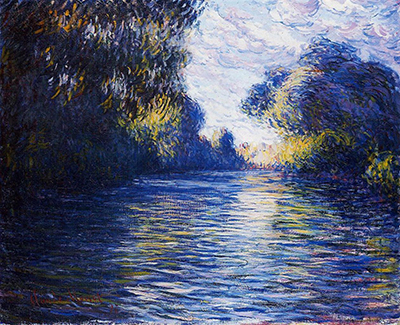
Claude Monet’s Arm of the Seine near Giverny opens a broad stretch of water between overhanging trees. Foliage presses into the view from the left, a brighter bank extends from the right, and horizontal ripples carry colours across the foreground. Painted in 1897, this is the canvas in the Musée d’Orsay, accession RF2003 and catalogue number W1487. It belongs to the Mornings on the Seine group, but its particular arrangement of trees, sky and reflections gives it a distinct place within that sustained study of the river.[1][2]
At a Glance
The Orsay canvas
The Musée d’Orsay records an oil on canvas measuring 73.2 by 93 centimetres. Monet’s signature and date, Claude Monet97, appear at the lower left. These details connect the image to one specific object. The work is also known within the broader morning river group, where similar titles can refer to different canvases. Its museum accession and Wildenstein number provide a precise way to distinguish it from those related pictures.[1][2]
Wildenstein’s 1996 catalogue gives the older measurement of 75 by 92.5 centimetres. Here the current museum dimensions are used. The two records should remain distinguishable rather than being blended into a new figure. A similar distinction applies to the painting’s history: an early testamentary provision, the later museum acquisition and subsequent transfers describe separate stages in the life of the same canvas.[1][2]
Trees around an opening
The left-hand foliage forms a substantial overhang. It reaches into the scene and gives the upper and side edges a sense of enclosure. On the opposite bank, projecting trees establish another boundary, but the two sides do not simply mirror one another. The sky opening is asymmetrical, so the eye follows the shape of the space between the banks rather than settling on a perfectly centred frame.
The right-hand side admits a different quality of light. Brighter passages distinguish parts of the bank and foliage from the darker mass on the left. This difference helps organise the scene without requiring a building, person or other isolated focal object. The viewer can move from a shaded canopy towards the lighter opening and then back across the water beneath it.
These banks make the open water feel both sheltered and expansive. The foliage defines an interior-like space along the river, while the broad foreground extends towards the viewer. The scene’s depth depends on this combination: a narrowing passage between trees above and a spreading field of reflected colour below. Monet makes the surrounding vegetation a framework for the water’s visual activity.
Ripples and reflected colour
The water occupies much of the picture. It receives the dark foliage, pale sky and warmer bank colours, yet its surface does not reproduce them as an undisturbed mirror. Horizontal marks cross the foreground and interrupt the more upright reflection shapes. These ripples establish a different direction from the hanging and projecting trees, keeping the lower part of the canvas active.
A reflected colour can remain recognisable even when its boundary breaks apart. Dark passages answer the trees, lighter ones recall the opening, and small changes of hue complicate the transitions between them. The viewer sees both an account of the riverbank and a surface made of distinct touches. The painting holds these two experiences together without requiring every mark to describe a separate object.
Wildenstein draws attention to the area given to the river, comparing this aspect of W1487 with other entries in the group. That observation offers a useful starting point for looking. Instead of treating the foreground as a support for the trees, we can follow its changing marks as a major subject in their own right. The bank establishes the place, while the water develops a second arrangement of its colours.[2]
The morning painting campaign
The wider campaign developed across 1896 and 1897. The Metropolitan Museum of Art’s account of its companion canvas explains that poor weather delayed work from the first year into the second. It also describes Monet arranging the canvases in his studio and completing them together after work on the river. This history gives the series a sustained rhythm rather than reducing each painting to a single uninterrupted sitting.[3]
The Kreeger Museum describes the early routine associated with its own related picture: Monet rose at 3:30 in the morning and used a boat as a floating studio. This provides context for the group’s attention to changing dawn light. It does not establish the exact minute at which the Orsay canvas was begun, or mean that its final surface records only one morning’s observations.[4]
Working repeatedly with a related view allowed differences of light and atmosphere to become prominent. A bank could seem clearer in one canvas and more absorbed into mist in another. The repeated motif gave those differences a shared setting, while the individual paintings retained their own arrangement of values, colour and marks. This picture’s broad foreground and unequal banks belong to that larger exploration.
Related views and distinct paintings
The Orsay canvas should be distinguished from the Metropolitan Museum’s Morning on the Seine near Giverny, catalogued as W1482. Both belong to the 1897 group, but their composition and ownership history remain separate. A similar title alone does not make a museum record, measurement or exhibition reference transferable. The Orsay work is W1487, with its own signature, accession and Camondo provenance.[1][2][3]
Mist paintings in the group offer a different comparison. Softer boundaries can reduce the apparent distance between water, bank and sky, while clearer passages allow individual forms to stand apart. Looking across such works makes the strength of a reflection or the size of an opening more noticeable. It also shows why Monet’s related views can sustain different visual experiences despite their common stretch of river.
The comparison is most useful when it stays close to what each canvas shows. Technical findings from another painting belong to that studied object, just as a collector’s name belongs to the documented ownership chain. Here the visible ripples, left overhang and right-bank projection provide the basis for looking; the catalogue and museum record supply the identification and history of this particular work.[1][2]
Georges Petit and Isaac de Camondo
The painting appeared in Monet’s 1898 exhibition at Galerie Georges Petit, where it was catalogue number 49. Wildenstein notes an illustration published in the supplement to Le Gaulois on 16 June 1898 as evidence that this particular canvas was included. The illustrated record is especially helpful in a series whose repeated or similar titles can otherwise make exhibition identifications uncertain.[2]
Georges Petit purchased the painting from Monet for Isaac de Camondo in 1898. This connects the exhibition-period work to the collection through which it later entered the French national museums. Camondo’s name is therefore part of the history of the physical canvas, rather than simply a general association with Monet collecting. The museum records it in his collection through 1911.[1][2]
The testament dates from 1908, but the bequest was accepted in 1911 and the painting entered the Louvre that year. It was first displayed there in 1914. These dates describe different events and should remain separate: arranging a future gift, accepting it into the museum and presenting it to the public were successive stages. The 1908 testament should not be mistaken for the completed museum acquisition.[1][2]
From the Louvre to Orsay
The museum’s history places the work at the Jeu de Paume from 1947 and records its transfer to the Musée d’Orsay in 1986. These institutional stages follow the Camondo bequest and explain its present collection identity. They do not by themselves establish a current gallery or guarantee that the canvas is on display on a particular day.[1]
Seen on its own, the picture offers a quiet but complex balance of enclosure and openness. The left foliage weighs into the scene, the right bank catches brighter colour, and the water extends both areas into a broad surface of horizontal movement. Its place within the series enriches those relationships, but the individual arrangement remains the foundation of the view. The river is at once a setting and an unfolding pattern of reflected light.
Frequently Asked Questions
Discussion
Look at the two banks and the water between them. These editorial prompts invite your observations.
Reader Insights
Follow the horizontal ripples across the foreground.
Compare the dark left overhang with the brighter right bank.
What changes when you look first at the water rather than the trees?
Join the Conversation
Share a detail, comparison or question about the Orsay river painting below.
References
- Musée d’Orsay — Bras de Seine près de Giverny, RF2003: object details, inscription, provenance and museum history. View source
- Daniel Wildenstein / Wildenstein Plattner Institute — Monet, volume III, 1996, W1487, printed pages 623–624 (digital viewer 267–268): painting, 1898 exhibition and Camondo provenance. View source
- The Metropolitan Museum of Art — Morning on the Seine near Giverny, 56.135.4: context of the 1896–1897 series and studio completion; a separate canvas. View source
- The Kreeger Museum — Arm of the Seine near Giverny in the Fog: contextual account of the dawn routine and floating studio; a separate canvas. View source







