


 by
Tom Gurney
Tom Gurney BSc (Hons) is an art history expert with over 20 years experience
Published on October 6, 2016 / Updated on October 23, 2026
Email:
tomgurney1@gmail.com
/ Phone:
+44 7429 011000
Bend in the River Epte
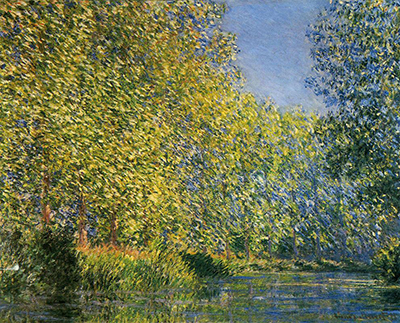
Claude Monet painted Bend in the River Epte in 1888, five years after moving to Giverny. The Philadelphia Museum of Art calls the work Bend in the Epte River near Giverny. It shows a sheltered reach of water surrounded by abundant foliage, with the river's curve drawing the eye towards the right-hand distance. [1] [2]
At a Glance
- Artist Claude Monet
- Date 1888
- Medium Oil on canvas
- Dimensions 73.7 x 92.9 cm
- Collection Philadelphia Museum of Art
- Credit and inventory The William L. Elkins Collection, 1924; E1924-3-16. [1]
Following the bend
The river occupies the lower part of the canvas, but its movement organises the whole scene. The bank begins close to us at the left and recedes across the picture, narrowing towards an opening on the right. We follow that direction even though dense vegetation prevents a clear view of what lies around the bend.
This is a landscape of partial enclosure. Trees spread across much of the upper field, while a wedge of blue sky appears near the top centre. At the right edge, darker foliage frames the lighter distance. The water offers a route into the scene, but there is no road, bridge or human figure to explain where that route leads.
The left bank is especially substantial. Low plants rise from the water's edge, tree trunks emerge behind them, and the canopy hangs across the river. These overlapping forms establish depth without requiring a sharply drawn boundary around every object. The near vegetation feels more dense and tangible than the distant bank.
Looking along the water can suggest the experience of moving through the landscape. That sensation is part of the composition, however, rather than proof that Monet painted this particular canvas from a boat. A convincing pictorial viewpoint and a documented working position are different kinds of evidence.
Leaves, light and contrasting strokes
The foliage is not one uninterrupted green mass. Yellow-green touches catch the light, blue and violet marks suggest cooler intervals, and warm pinkish or ochre-coloured trunks appear through the leaves. The effect is lively without requiring Monet to describe each leaf as a separate botanical form.
Short, slanting marks dominate much of the canopy. Their repeated changes of direction make the surface seem to flicker. Along the bank, longer upright strokes suggest grasses and other low growth. The water introduces a different rhythm through flatter, more horizontal passages.
These contrasts help the eye distinguish materials and positions. Trees, bank and river remain connected through colour, yet their handling is not identical. Reflected forms repeat the colours above them in altered, broken arrangements rather than producing a perfectly symmetrical mirror.
The blue opening in the canopy has a useful structural role as well. It interrupts the dense foliage and allows the surrounding yellow-greens to appear brighter. Its small size makes the scene feel enclosed, while its colour finds echoes in the water below. Light is not confined to one isolated highlight; it is distributed through many adjoining marks.
Giverny before the water garden
Monet's early years at Giverny involved much more than the garden later made famous by the Water Lilies. The Musee des impressionnismes Giverny's study of 1883-1890 describes his exploration of nearby fields, hills, meadows and the banks of the Epte and Seine. He had settled in the village in 1883, but continued to travel in search of subjects. In 1888, those journeys included a lengthy stay at Antibes. [2]
The river landscape belongs to this wider geography of work. Its setting was accessible from Monet's home, but it should not be confused with a view of his later lily pond. The water garden developed after his purchase of additional land in 1893; the Giverny museum explains how a branch of the Epte supplied that new project. [5]
The distinction prevents the later garden from overshadowing everything that came before it. Here the flowing river, its bank and its changing enclosure are the subject. The painting does not need to be treated merely as a preliminary step towards a more famous series. It is a resolved arrangement of space and colour in its own right.
The later Poplars are a comparison, not an identity
Monet returned to the Epte in the celebrated Poplars campaign of 1891. The Metropolitan Museum's account of The Four Trees describes paintings made from the bank as well as from a specially fitted boat. It also records Monet's arrangement with a timber merchant to keep the trees standing until his work was finished. [4]
That later history helps establish the river's continued importance, but it does not identify the precise trees in Bend in the River Epte. Nor does the documented use of a boat in 1891 establish how every earlier river picture was made. The two campaigns should remain distinguishable.
Their pictorial differences are nevertheless revealing. In The Four Trees, tall trunks supply a conspicuous framework reaching towards the top of the canvas. In the 1888 landscape, foliage is more enveloping, and the river's turn is a stronger guide through the scene. The verticals are present, but they are absorbed into a less regular canopy.
Repeated attention to a river could therefore produce markedly different structures. The contrast is not simply between leafy and bare trees, or happiness and melancholy. It concerns the placement of forms and the way those forms direct our looking.
Observation without an instant snapshot
The Philadelphia museum included this painting in the Nature section of its 2019 exhibition The Impressionist's Eye. Its explanation placed the work within the artists' interest in direct observation and the variability of light, colour and atmosphere. Portable equipment and commercially prepared paint helped make outdoor work more practicable. [3]
Those conditions do not mean that every visible mark was made quickly in a single sitting. The lively appearance of the foliage is an effect produced by painting, not a stopwatch record of its execution. We can notice how the strokes accumulate without claiming to know the duration of the work.
This distinction also makes room for the picture's careful organisation. The dark edge at the right, the open sky and the foreground plants are not incidental obstacles to spontaneity. They work together to establish the landscape's particular balance. The freshness of the scene depends on that structure as well as on the broken brushwork.
The Philadelphia collection history
The museum records that Boussod, Valadon & Cie bought the painting from Monet on 31 December 1888. The firm sold it to the Philadelphia collector William L. Elkins on 23 November 1891. It subsequently entered the city's collection through the 1924 bequest identified in the museum's credit line. [1]
These dates distinguish the history of the canvas from the history of its motif. The painting had already left Monet's ownership before the 1891 Poplars campaign. Its place in an American collection reflects the circulation of his work beyond the locations where he painted, rather than a change in the subject itself.
Bend in the River Epte remains compelling because it makes a relatively unassuming stretch of river feel visually complete. There is no dramatic incident to wait for and no distant monument to discover. The bend, the flickering canopy and the broken reflections provide the painting's movement, asking us to look closely at how an ordinary landscape becomes an absorbing image.
Frequently Asked Questions
In 1888. [1]
In the Philadelphia Museum of Art, inventory E1924-3-16. [1]
73.7 x 92.9 cm. [1]
Discussion
Look again at the images and ideas explored in Bend in the River Epte. These editorial prompts invite your observations.
Reader Insights
How does the river's curve guide your attention through the picture?
Which changes in brushwork distinguish foliage from reflected water?
What becomes clearer when you compare this scene with the later Poplars?
Join the Conversation
Share a detail, comparison or question about Bend in the River Epte below.
References
- Philadelphia Museum of Art , Bend in the Epte River near Giverny, object details and provenance, E1924-3-16. View source .
- Musee des impressionnismes Giverny , Before the Water Lilies: Monet discovers Giverny, 1883-1890, 2026 press pack, pp. 3-5 and 9-11. View source .
- Philadelphia Museum of Art , The Impressionist's Eye, 2019 exhibition announcement. View source .
- Metropolitan Museum of Art , The Four Trees, 1891, 29.100.110. View source .
- Musee des impressionnismes Giverny , Le jardin de Monet a Giverny. View source .







