


 by
Tom Gurney
Tom Gurney BSc (Hons) is an art history expert with over 20 years experience
Published on October 6, 2016 / Updated on October 23, 2026
Email:
tomgurney1@gmail.com
/ Phone:
+44 7429 011000
Giverny in Springtime
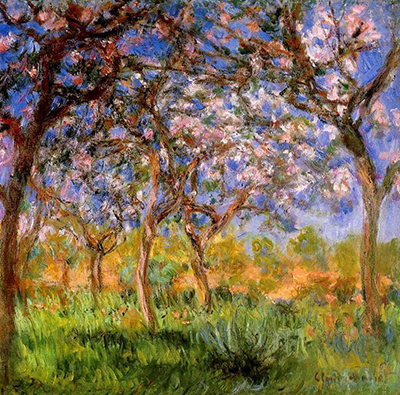
Giverny in Springtime shows a flowering orchard transformed into a dense pattern of branches, blossom, blue sky and green ground. Daniel Wildenstein's catalogue identifies this nearly square oil painting as W1620 and connects it with Monet's garden work of spring 1900. [1] It is an intimate view from among the trees, not a panorama of Giverny village or one of the water-lily pond paintings.
At a Glance
- Artist Claude Monet
- French title Le Printemps, Giverny
- Date c.1900
- Medium Oil on canvas
- Dimensions 90 x92 cm
- Catalogue Wildenstein1620. [1]
Looking from inside the orchard
The nearest trunks rise from the bottom edge, making the viewer feel close to the trees rather than looking towards a distant row. On the left a dark trunk and heavy branches partly enclose the scene. A second prominent tree at the right balances it without making the arrangement symmetrical.
Between them, smaller trunks divide the middle distance into irregular intervals. Some lean, some fork, and others disappear behind a screen of blossoms. There is no single straight avenue through the orchard. The eye moves from gap to gap, finding short passages into depth before meeting another branch or patch of foliage.
This makes the picture quite different from a landscape organised around a far horizon. Much of the upper part is occupied by the canopy, while the lower part is thick with vegetation. Even the sky seems caught between branches rather than spread above them.
The framing also implies continuation. Branches extend beyond the edges, and the ground runs out of sight. The painted square is a selected portion of a larger cultivated environment, not a complete inventory of the garden.
Pink blossom against blue sky
Pink and white marks collect along the branching structure without becoming a row of separately drawn flowers. Their irregular clusters make the canopy appear full, yet they leave enough blue intervals for air and light to remain visible.
The blue is unusually important. It is not merely a background behind the trees: it appears in pockets throughout the upper half, so it becomes part of the surface pattern. The blossoms can be read as growing forms and as pale touches set against stronger colour.
Dark reddish-brown branches keep that pattern from dissolving. They carry the eye across and down, connecting small bright passages with the thicker trunks below. The strongest lines do not coincide with a geometric grid, which helps the orchard retain its uneven, growing character.
The visible marks may suggest freshness and movement, but they do not measure a breeze. Nor do they tell us that the work was completed in one quick session. Monet's handling of paint can remain lively on the finished surface without supplying a timetable of its making.
The rich ground beneath the trees
Green dominates the lower part, but it is far from a uniform carpet. Dark strokes gather near the foreground; lighter greens appear between the trunks; yellow and orange passages run through the middle distance. These changes give the ground a layered appearance rather than a single flat tone.
The lower edge is especially dense. Upright and slanting marks suggest vegetation close to the observer, while the more distant colours are less sharply separated. This transition helps establish depth without requiring a clearly outlined path.
A dark patch beneath the nearer trees brings weight to the foreground. Above it, pink blossom and blue openings seem lighter by comparison. The picture's sense of spring therefore depends on more than flower colour: it also comes from the contrast between the shaded ground and the illuminated canopy.
There are no prominent human figures to establish a scale or supply a story. Instead, the relation between nearby trunks, smaller trees and overlapping plants invites the viewer to imagine a position within the garden. The scene feels inhabited through cultivation, even without a gardener in sight.
Why the painting is dated around 1900
The catalogue's dating rests on more than the general appearance of Monet's late work. Wildenstein records a photograph taken in the second studio in September 1900 that includes the lower part of this canvas and a fragment of another garden painting, W1622. He consequently places their probable execution in May-June of that year. [1]
That is a reasoned dating argument, not an inscription giving the precise month. The canvas is catalogued as signed at the lower right, and the surrounding entries are grouped under 1899-1900. Around 1900 is therefore safer than assigning an unsupported 1903 date. [1]
The photograph is also useful because it puts the work back into a group of paintings rather than leaving it isolated as a decorative spring image. Related canvases could be present in the studio together, available for comparison and further attention.
It would be going too far to reconstruct the number of sessions from that photograph. It establishes the painting's presence by a particular point in time; it does not reveal every stage between the first outdoor observation and the finished canvas.
A cultivated setting at Giverny
Monet lived at Giverny from 1883 until 1926. The Institut de France describes his sustained attention to the garden as part of his life there, rather than a brief diversion from painting. [2]
The National Gallery of Art's garden study explains the practical side of that commitment. Monet arranged plants with attention to colour and height, used different kinds to sustain changing blooms through the seasons, read horticultural publications and employed gardeners as the grounds demanded more work. [3]
Such preparation makes the boundary between nature and composition especially interesting. The orchard contains growing things that change beyond the painter's control, yet the garden was not untouched wilderness. Cultivation helped create the setting in which those changes could be watched.
The trees do not need to be treated as symbols of a particular personal event. Their uneven growth, blossom and changing light already provide a demanding subject. The painting asks how a familiar place can become visually unfamiliar when branches, colours and intervals receive sustained attention.
Blossom and the neighbouring iris pictures
The Artist's Garden at Giverny in the Musee d'Orsay is a separate painting of 1900, dominated by beds of irises. Its inventory is RF1983 6; it should not be confused with the orchard of W1620. [5]
A different garden canvas in Yale's collection, also dated about 1900, was included in the New York Botanical Garden's 2012 exhibition curated by Paul Hayes Tucker. The exhibition described its sweep of purple and violet irises and a path leading into the distance. [4]
These comparisons show the range of subjects available close to Monet's house. An orchard canopy, a flowerbed and a receding path could each establish a different arrangement of colour and space. The repetition lay in returning to the garden, not in mechanically reproducing one scene.
Giverny in Springtime remains distinctive within that broader practice of related paintings . Its darkest branches press close to the observer, while blossom and sky interlock above a richly marked foreground. The result is both an identifiable orchard and a surface that continually asks us to look again.
Frequently Asked Questions
Wildenstein1620, titled Le Printemps, Giverny. [1]
The catalogue instead argues for spring 1900, using a September 1900 studio photograph. The exact month remains a scholarly inference. [1]
No. The subject is a flowering orchard, with trunks and dense ground vegetation.
No. That separate 1900 painting is RF1983 6. [5]
Discussion
Look again at the images and ideas explored in Giverny in Springtime. These editorial prompts invite your observations.
Reader Insights
Do the blue gaps feel like background or part of the blossom pattern?
How do the nearest trunks establish your position in the orchard?
What gives the scene depth when there is no broad horizon?
Join the Conversation
Share a detail, comparison or question about Giverny in Springtime below.
References
- Daniel Wildenstein , Monet, catalogue raisonne,1996, volumeIV, pp.732-733, W1620, WPI original publication. View source .
- Institut de France , Maison et Jardins de Claude Monet:1883-1926 and garden history. View source .
- National Gallery of Art , An Eye for Art, Studying Nature: Monet's designed garden. View source .
- New York Botanical Garden , The Artist in the Garden,2012, Yale garden painting and horticultural documentation. View source .
- Musee d'Orsay , Le Jardin de l'artiste a Giverny,1900, RF1983 6, separate work. View source .







