


 by
Tom Gurney
Tom Gurney BSc (Hons) is an art history expert with over 20 years experience
Written on November 8, 2026 / Updated on November 8, 2026
Email:
tomgurney1@gmail.com
/ Phone:
+44 7429 011000
Morning on the Seine in the Rain
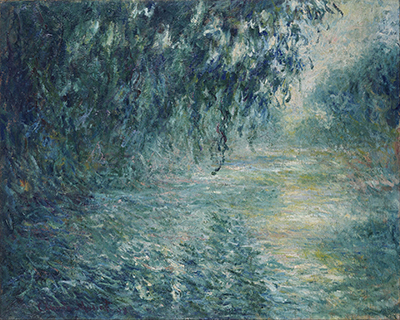
Claude Monet’s Morning on the Seine in the Rain brings the viewer close to willow branches and an unsettled surface of water. Leaves hang across the top, blue-green passages fill much of the scene, and a yellow-green reflection brightens the right. Dated 1898, the painting belongs to the National Museum of Western Art in Tokyo, accession P.1965-0004 and catalogue number W1499. Its close view of vegetation and reflections develops the river subject differently from the broader bank-to-bank compositions associated with Monet’s Mornings on the Seine.[1][2]
At a Glance
Identifying the 1898 painting
The museum records an oil on canvas measuring 73 by 91.5 centimetres. Monet signed and dated it Claude Monet98 at the lower left. The date is important because this particular canvas follows the main 1896–1897 morning river campaign. It provides specific evidence of Monet’s continued engagement with the subject in 1898, rather than requiring every related view to carry the same year.[1][2]
The painting has sometimes circulated on this site under a Morning on the Seine II label. That numeral is a legacy page label, not a documented position in an authoritative sequence. The museum title, accession and Wildenstein number give a firmer identification. They distinguish the Tokyo rain painting from the Orsay river view, the Met’s 1897 canvas and other pictures of the same broad subject.[1][2]
A curtain of willow leaves
The hanging willow foliage creates a boundary across the top of the picture. Its narrow forms descend into the field of water and give the viewer a sense of looking from close to the vegetation. Rather than opening onto a long panorama of both banks, the composition holds attention near the branches and the reflected colours beneath them. The enclosure feels immediate because the leaves occupy the edge closest to our view.
These descending forms establish a rhythm different from the agitation of the water. Some read as individual leaf shapes; others join into denser passages. The eye can follow them downwards and then lose their direction among the marks of the surface. This transition makes it difficult to divide the scene into one simple band of foliage and another of undisturbed reflections.
The willow therefore serves as more than a frame. Its colours and repeated forms participate in the whole image, linking the upper edge to the water below. The vegetation is recognisable, but it also introduces a pattern that can be followed across the canvas. That double role helps explain how a relatively close view can sustain so much visual movement.
Water in motion
Blue and green dominate the broad water field, with changes of tone preventing it from becoming a uniform area. The marks break and cross the reflected shapes, giving the surface an unsettled character. A viewer can recognise water through its relationships of colour and movement without finding a crisp outline for every reflected object. The scene depends on changing boundaries rather than a fixed inventory of forms.
The brighter yellow-green reflection on the right provides a useful counterweight to the cooler passages. It gives the eye a place to pause, then draws attention to smaller related notes elsewhere. The contrast also makes the water’s uneven distribution of light more apparent. Brightness gathers in one area while darker or cooler marks continue around it, keeping the surface varied.
The title identifies rain, and the museum’s interpretation draws attention to the movement of the water and willow. Looking closely, however, we need not assign each individual stroke to a separate drop. The effect emerges across the surface as a whole, through interrupted reflections, shifting colour and the relationship between hanging leaves and the water. This allows the painting to suggest weather through its larger visual organisation.[1]
After the Seine mornings campaign
The National Museum of Western Art places the work in the context of Monet’s 1896–1897 series of morning views on the Seine. That earlier campaign established a sustained interest in the river at changing times and under different atmospheric conditions. The signature’s 1898 date gives this canvas its own position within that continuing interest. It is a later dated work related to the group, not simply another copy of a single 1897 composition.[1][2]
The change of framing is central to its character. Broad views can set one bank against another and use an opening of sky to guide the eye into the distance. Here the hanging vegetation and agitated reflections occupy the main field. The viewer’s attention shifts towards the near surface, where colour and directional marks carry much of the scene’s structure.
Repeated attention to the river did not require Monet to preserve the same distribution of land, water and sky in every painting. A narrower selection could make a familiar setting newly difficult to separate into objects. This canvas shows how the water subject could continue through a different balance of foliage and reflection. The dated object connects that visual change to a specific moment in the artist’s work.[1][2]
Related canvases and visible paint
Wildenstein catalogues this picture as W1499. The adjacent W1500, a separate weeping-willow painting, should not be treated as another title for it. Likewise, records for the 1897 mist and clear-weather river pictures describe their own canvases. The Tokyo rain painting retains its own measurements, signature and collection history even where the subject or appearance invites comparison.[1][2]
The lively surface encourages close attention to brushwork. Marks can be described by their visible direction, colour and relationship to surrounding passages. These qualities help explain the effect of the scene without determining every stage of its making. A finished image can show where one colour meets another, but it cannot by itself establish the drying time, order of work or mixing method behind every passage.[1][2]
A careful description can still say a great deal. The viewer can compare the hanging leaf forms with the broken marks in the water, or note how the brighter right-hand passage changes the balance of the cooler field. These observations concern what the painting presents. They preserve the interest of its surface while keeping the material process open to evidence from an actual technical examination.
Collection history and different records
The museum’s present object record lists Kiichi Mimura of Ashiya in the provenance and gives the acquisition credit as purchased. Its accession is P.1965-0004. These are the museum’s published identifiers and collection statements. The year embedded in an inventory number should not by itself be turned into a complete account of the date or circumstances of a purchase.[1]
Wildenstein’s older catalogue records Majima, Japan, around 1937, and an acquisition in 1966. It also gives the width as 92 centimetres rather than the museum’s current 91.5. These differences belong to the history of the documentation. The records cited here do not establish a family relationship between the names or explain the differing acquisition notation, so no such reconciliation is proposed.[1][2]
The museum’s exhibition history records appearances across several decades, including 1958, 1981, 1986, 1994, 2006, 2013 and 2022, and the 2024–2025 period. This gives the painting a documented public history beyond its place in the collection. Those dated records show past presentations; they do not establish a current display location or make every exhibition in the list an event devoted exclusively to the Seine series.[1]
A close view of a changing surface
The painting’s strength lies in the exchange between hanging vegetation and moving water. The leaves introduce descending forms, the surface breaks their continuity, and the brighter reflection on the right redistributes attention across the blue-green field. There is no need for a distant skyline to organise the view. Monet makes the near relationships of colour and movement sufficient to hold the canvas together.
Its title and date give that experience a particular identity: a rain painting of 1898, held in Tokyo and catalogued as W1499. Those details help place the canvas within Monet’s continuing river studies, while its close framing keeps it visually distinct. The work can be understood both through that larger history and through the immediate encounter it offers with leaves, reflections and an unsettled surface.[1][2]
Frequently Asked Questions
It belongs to the National Museum of Western Art in Tokyo, accession P.1965-0004, with the acquisition credit purchased.[1]
Discussion
Look at the willow leaves and changing water. These editorial prompts invite your observations.
Reader Insights
Follow the hanging leaf forms into the water field.
Compare the bright reflection at right with the cooler blue-green passages.
How does this close framing differ from a river view showing both banks?
Join the Conversation
Share a detail, comparison or question about the Tokyo rain painting below.
References
- National Museum of Western Art, Tokyo — Morning on the Seine in the Rain, P.1965-0004: object record, interpretation, provenance and exhibition history. View source
- Daniel Wildenstein / Wildenstein Plattner Institute — Monet, volume III, 1996, W1499, printed pages 630–631 (digital viewer 274–275): plate, signature and historical collection record. View source







