


 by
Tom Gurney
Tom Gurney BSc (Hons) is an art history expert with over 20 years experience
Published on October 6, 2016 / Updated on October 23, 2026
Email:
tomgurney1@gmail.com
/ Phone:
+44 7429 011000
La Pointe de la Heve at Low Tide
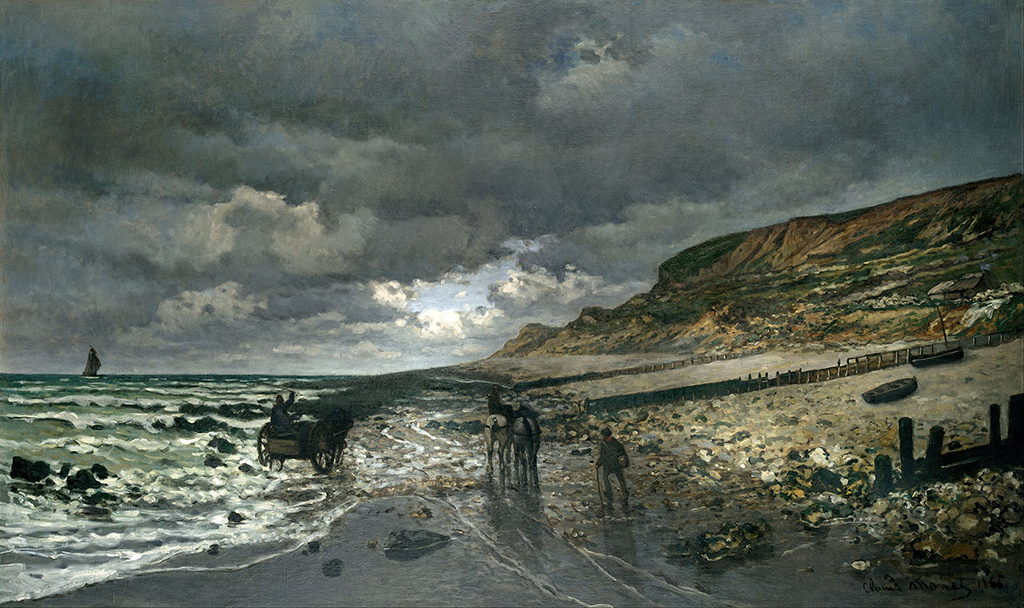
A cart stands in the shallows, horses move along the wet shore and a huge bank of cloud hangs over the coast in Claude Monet's La Pointe de la Heve at Low Tide . Painted in 1865, the canvas belongs to the Kimbell Art Museum in Fort Worth. It was one of the two seascapes with which Monet made his debut at the Paris Salon that year. The subject is the shore at Sainte-Adresse near Le Havre, looking towards the headland of La Heve, rather than the town of Honfleur across the estuary. [1] [4] [5]
At a Glance
The beach as a diagonal
The coast does not run straight across the canvas. It begins close to the viewer at the lower right, curves through the middle distance and narrows towards the headland near the centre. This diagonal arrangement gives the landscape depth without requiring a road, bridge or other obvious route into it.
Water and land meet along a restless edge. White foam reaches across the dark sand, while stones interrupt the advancing and retreating bands. The shoreline is easy to follow in broad terms but difficult to reduce to a single neat contour. That tension makes the low tide feel like a changing condition rather than a fixed division.
The cliff at the right establishes a more substantial boundary. Its broad, sloping face occupies a large area, yet it does not close the view. Its lower edge leads towards the distance, carrying the eye back to the place where sea, land and sky converge.
The wide canvas is important to this experience. There is room for the near shore to be described closely and for the headland to become comparatively small. The painting combines the scale of individual stones with the scale of an extended coast.
Clouds that give the light its force
The sky occupies an imposing part of the picture. Darker cloud masses press down towards the horizon, but their density is interrupted by pale openings. The brightest passage appears above the distant meeting of cliff and water, helping to draw the eye into the composition.
The sea's light is not the same as the sky's. Near the shore, short white crests and patches of foam break against darker water. The light is distributed in a series of separate accents rather than spread as an even glow. Against the broad cloud forms, these smaller marks make the water feel particularly mobile.
The result is dramatic without requiring an exact weather forecast. A threatening sky can be recognised as part of the painting's effect, but the image does not establish when rain began, how strong the wind was or which hour Monet observed. Its structure depends on the visible relationship between darkness and illumination.
Brown, grey and muted green passages give the view weight. The brightest white marks become more striking because they emerge from this restrained field of colour. The landscape is not uniformly gloomy: its darker areas make the scattered light more consequential.
People, horses and the working shore
The figures are small in relation to the sky and cliff, yet they are not incidental decorations. The cart in the water gives the shallows depth and scale. The horses and people nearer the centre establish a route along the beach, while a foreground figure stands apart at the right.
Several of these forms are seen from behind. Instead of inviting us to study expressions, their orientation directs attention along the coast. They look or move into the same landscape that the viewer is entering pictorially.
The wet ground carries dark reflections beneath them. These reflections connect the figures to the beach surface, preventing them from seeming pasted onto the view. They also differ from the broken foam at the left: the shore becomes a place where water can be shallow and reflective as well as turbulent.
The National Gallery's account of the related London canvas notes that the larger Salon painting substitutes a cart, figures and horses for the study's rowing boat, strengthening the impression of a working landscape. The change is therefore more than an enlargement of scale. [2]
From an outdoor study to a Salon painting
The National Gallery holds La Pointe de la Heve, Sainte-Adresse , dated 1864, a smaller oil measuring 41 by 73 centimetres. It describes that picture as probably painted on the spot as a study for the Kimbell canvas. Its boat, lighter shore and different distribution of detail help clarify what Monet changed. [2]
The Kimbell dates the larger picture's development to the first months of 1865 in Monet's Paris studio. This is an important qualification to the apparent immediacy of the scene: a convincing outdoor effect did not necessarily mean that every part was painted outside. [1]
The relationship between the two works also shows why a study need not be treated as an unfinished miniature of the final painting. The smaller canvas has its own concentrated arrangement. In the larger version, the figures, weather effects and beach activity produce a more expansive public statement.
The studio setting does not make the observation less serious. It allowed Monet to develop material gathered on the coast into a composition capable of holding attention at a much larger exhibition. Direct experience and deliberate construction worked together.
The coast Monet already knew
La Heve was not an unfamiliar destination chosen only for a Salon opportunity. The MuMa's account of Monet's youth places the headland among the places he explored with his sketchbooks in 1856. It identifies a drawing of its cliffs dated 3 September that year. [3]
The same museum explains the wooden breakwaters along the shore as structures intended to limit the movement of sand and pebbles. In the painting, their long, dark lines give a measured rhythm to an otherwise irregular beach. [3]
That mixture of natural forms and modest engineering is easy to overlook beneath the dramatic sky. The coast is not represented as untouched wilderness. Barriers, a boat, a cart and human movement show a landscape that people use.
The picture nevertheless gives the beach more space than any single activity upon it. The figures help us understand the environment without supplying a complete narrative. Their presence makes the shore inhabited, but its light, surfaces and distance remain the principal experience.
Two seascapes at the 1865 Salon
The companion to this canvas at Monet's Salon debut was Mouth of the Seine at Honfleur , now in the Norton Simon Museum. That museum describes its harbour scene as another studio painting developed from observations made on site. The two works offered different views of the Normandy coast, not two titles for the same picture. [4]
The Art Institute of Chicago's scholarly catalogue places these ambitious seascapes within Monet's early emphasis on beaches as working environments. It contrasts their subdued, brown-and-grey-inflected appearance with the resort development taking place in Normandy, which the paintings largely downplay. [5]
This is a useful distinction from the more conspicuous leisure setting of his later Sainte-Adresse paintings . Here, neither fashionable visitors nor a terrace dominates the coast. The setting is organised around the shore itself and the people and animals moving through it.
Salon acceptance was an important early success, but it should not be mistaken for permanent approval of everything Monet later painted. The significance of this canvas lies partly in that early moment: a young artist used a recognisable landscape subject to demonstrate substantial compositional ambition.
A seascape between observation and tradition
The Kimbell suggests that Monet developed the picture in response to coastal compositions shown by Charles-Francois Daubigny and his son Karl at the previous year's Salon. This is a proposed artistic context, not proof of a single source for every element. [1]
The canvas's strength is visible in the way its different scales are coordinated. Large cloud shapes do not overwhelm the smaller wave marks; the cliff's continuous mass is interrupted by broken surfaces; the people remain legible without taking over the scene.
Wildenstein catalogues the painting as number 52 and distinguishes it from both the smaller coastal views and the other 1865 Salon seascape. That object identity matters because similar titles can conceal important differences of date, size and composition. [6]
The Kimbell acquired the picture in 1968. [1] Its lasting interest is not limited to its role as an early milestone. The meeting of wet sand, surf, figures and cloud creates a sustained experience of the coast, with enough structure to hold the apparent movement together. It is a carefully developed painting whose vitality depends on more than the illusion of a quickly captured moment.
Frequently Asked Questions
No. The Kimbell describes the large version as developed in Monet's Paris studio from earlier coastal work. [1]
It belongs to the Kimbell Art Museum in Fort Worth, accession AP 1968.07. [1]
Discussion
Look again at the images and ideas explored in La Pointe de la Heve at Low Tide. These editorial prompts invite your observations.
Reader Insights
Follow the diagonal shoreline from the foreground to the headland.
Compare the broad clouds with the short white marks in the water.
Consider how the figures and horses give scale to the coast.
Join the Conversation
Share a detail, comparison or question about La Pointe de la Heve at Low Tide below.
References
- Kimbell Art Museum , La Pointe de la Heve at Low Tide, 1865, AP 1968.07; exact object facts, Salon context, studio development and acquisition. View source .
- National Gallery, London , La Pointe de la Heve, Sainte-Adresse, 1864, NG6565; related smaller canvas, probable study relationship and changes to the figures. View source .
- Musee d'art moderne Andre Malraux, Le Havre , Monet au Havre, 2026 exhibition account; early drawings, coastal setting and wooden breakwaters. View source .
- Norton Simon Museum , Mouth of the Seine at Honfleur, 1865, F.1973.33.2.P; companion Salon picture and studio practice. View source .
- Art Institute of Chicago , Monet Paintings and Drawings, catalogue 13, The Beach at Sainte-Adresse; scholarly context for the two 1865 seascapes and working-coast emphasis. View source .
- Daniel Wildenstein / Wildenstein Plattner Institute , Monet, volume II, 1996, entry 52; exact catalogue identity and related works. View source .







