


 by
Tom Gurney
Tom Gurney BSc (Hons) is an art history expert with over 20 years experience
Published on October 6, 2016 / Updated on October 23, 2026
Email:
tomgurney1@gmail.com
/ Phone:
+44 7429 011000
The Entrance to the Port of Le Havre
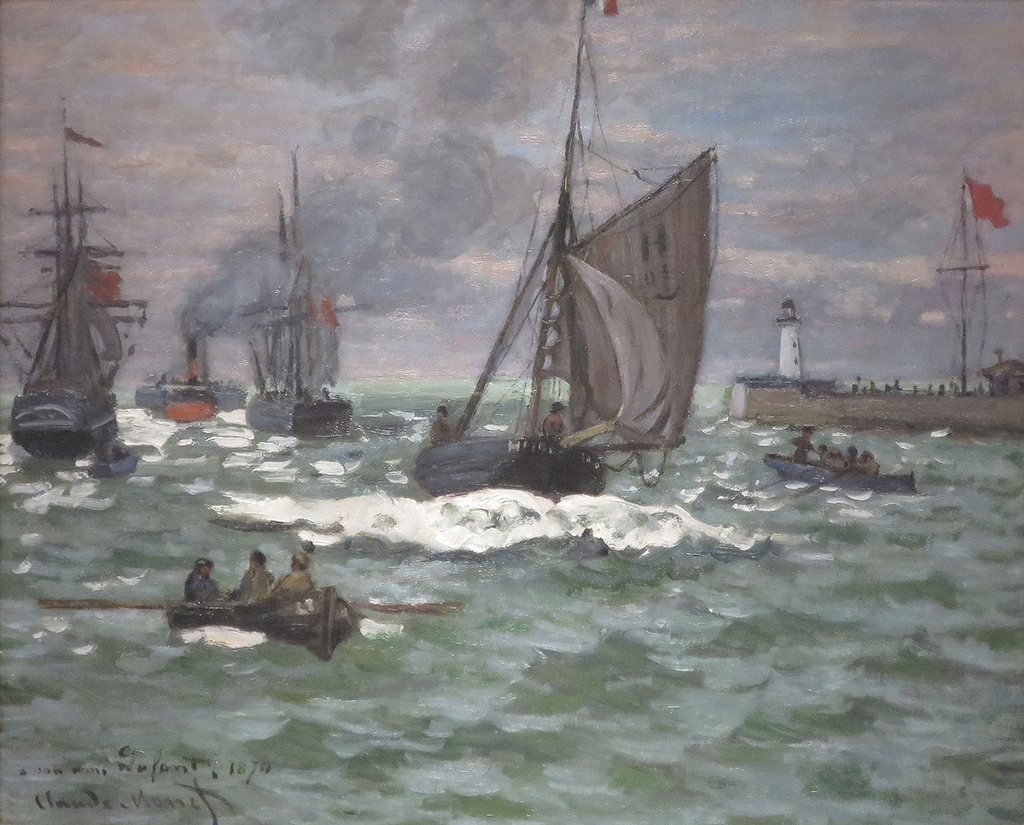
Sailing boats, rowers and a smoking steam vessel share a restless harbour in Claude Monet's The Entrance to the Port of Le Havre . A pale sail rises near the centre, while the white lighthouse and jetty establish the port entrance at the right. The Norton Simon Museum dates the oil to about 1867-1868. Its visible dedication to Lafont, dated 1870, belongs to the painting's later history rather than fixing the moment of execution. [1] [2]
At a Glance
A sail that organises the harbour
The principal boat stands slightly to the right of the centre. Its mast rises almost to the upper edge, while the large pale sail cuts diagonally across the darker sky. Ropes connect the sail to the mast and hull, making a network of finer lines within the broader composition.
The sail is not a uniformly white triangle. Grey and darker passages give it folds and weight, and its curved edge differs from the straightness of the mast. Its lightness is especially effective beside the darker hull beneath it.
Other vessels have less commanding positions. Those on the left overlap, while the small boat at the right sits beneath the jetty. This difference of emphasis makes a crowded harbour readable. The eye can register several forms of activity without having to treat every boat as equally important.
The central vessel's scale also brings us close to the water. This is not a distant panorama seen from well above the port. The low viewpoint makes hulls, waves and people seem part of the same immediate encounter.
White foam over green-grey water
The foreground is dominated by broken wave forms. Light strokes curl over darker passages, and some white areas broaden into irregular patches of foam. The surface seems continuously interrupted rather than organised into a few repeated lines.
The brightest wave lies close to the principal boat. It separates the darker hull from the nearer water, giving the vessel a more forceful position. Smaller light marks continue across the foreground and into the distance, varying in size as the space recedes.
Smarthistory's comparison with Impression, Sunrise draws attention to these green-and-white, churning passages, contrasting them with the more horizontal blue strokes of the later harbour scene. The same general setting could support different ways of describing water. [3]
Here, movement is unusually physical. The rowboats seem surrounded by the water's changes, while the larger vessels rise more firmly above them. A restrained palette can still produce considerable energy when the marks vary so strongly in direction, length and brightness.
Rowers, steam and sail
The nearest rowboat is placed at the lower left. Its occupants are indicated with compact touches, and the oars stretch out across the water. Their horizontal movement contrasts with the tall mast and leaning sail farther back.
A second small boat occupies the right-hand middle distance. Between the two, the principal vessel and the surrounding foam make the harbour feel active on several scales. Large boats and small craft share the same unsettled water.
At the left, a steam vessel introduces a different kind of movement. Its darker plume spreads into the already clouded sky, while a warmer orange-red passage catches attention near the waterline. Sailing and steam traffic belong to the same view rather than being treated as separate historical worlds.
These details do not establish the precise model or purpose of every vessel. The painting provides enough maritime information to differentiate their forms, but its main concern is the relationship between boats, atmosphere and water. Its activity remains comprehensible without a technical inventory.
The lighthouse and the corrected place-name
The white lighthouse provides a small but firm vertical at the right. It stands above the long jetty, where tiny figures establish the scale of the harbour structure. Compared with the nearby sail, the lighthouse seems slender and remote.
The Norton Simon Museum identifies the setting as Le Havre through the jetty and lighthouse. Its current title explicitly notes that the work was formerly called The Entrance to the Port of Honfleur . The distinction matters because both towns appear frequently in Monet's early coastal work. [1]
Wildenstein's 1996 catalogue still uses the older Honfleur title for number 87. [2] The different names therefore belong to the record of one painting, not necessarily to two separate canvases. Dimensions, composition and the Lafont dedication keep its identity secure.
The harbour structures give stability to the moving scene. The jetty holds a steady horizontal position behind the boats, while the lighthouse remains legible above it. These fixed elements make the irregularity of sails, smoke and waves more apparent.
Why the dedication says 1870
The inscription at the lower left is unusually informative. It identifies the gift as being to Monet's friend Lafont and includes the year 1870. The holding museum names the recipient as the journalist Antoine Lafont, who witnessed Monet's marriage in June of that year. [1]
That is not the same kind of date as the museum's circa-1867-1868 dating of the painting. An artist could give and dedicate an existing canvas later. Treating every inscribed year as an execution date would obscure the difference between making a work and passing it to someone else.
The catalogue adds another connection. Wildenstein records a related harbour canvas, number 88, also dedicated to Lafont, and cites a 1900 Durand-Ruel letter describing the pictures as matching works. [2]
This gives the painting a personal history as well as a maritime subject. It does not, however, identify Lafont among the people in the boats. The dedication tells us about the recipient of the canvas, not the identities of its depicted figures.
A sketch and a lost Salon picture
The Norton Simon Museum relates this canvas to a larger, now-lost painting shown at the 1868 Salon. [1] Wildenstein separately catalogues Boats Coming out of the Port of Le Havre as number 89 and records its Salon exhibition. [2]
It is important to preserve that separation. The surviving small canvas is not itself the lost exhibition painting, and the relationship need not mean that every detail of the larger work was identical. A sketch could supply an arrangement, atmosphere or problem for further development.
The visible paintwork is well suited to that role. Boats are established through strong differences of tone; the sky is broadly handled; the wave marks create an immediate impression of movement. Detailed finish is not required for the principal relationships to become clear.
At the same time, the picture is not merely useful as evidence for something absent. Its concentrated arrangement works independently. The central sail, rowers, lighthouse and broken water form a complete encounter with the harbour on this smaller scale.
Le Havre before Impression, Sunrise
Monet returned to Le Havre for the later Impression, Sunrise , dated 1872 by the Musee Marmottan Monet. Its account places that view at the outer harbour, seen from a hotel window, with quays and industrial structures emerging in the morning atmosphere. [4]
The earlier harbour entrance offers a different experience. A large sail is close and tangible, rowers occupy the foreground, and the sea has a more forcefully broken surface. The later picture's more distant silhouettes and restrained horizontal water marks should not be projected backwards onto it.
Nor does the earlier canvas need to be treated only as a step towards a more famous image. It has its own balance of immediacy and structure. The harbour is busy, but the distribution of boats remains clear; the water is rough, but the jetty and lighthouse keep the space anchored.
Within Monet's Le Havre paintings , this work is distinctive for the closeness of its maritime activity. It makes the port entrance an inhabited, moving space, where modern traffic and changing weather can be experienced together.
Frequently Asked Questions
The Norton Simon Museum now identifies Le Havre, while noting the former Honfleur title. [1]
It is Wildenstein 87. [2]
Discussion
Look again at the images and ideas explored in The Entrance to the Port of Le Havre. These editorial prompts invite your observations.
Reader Insights
Compare the tall central sail with the rowboats and their horizontal oars.
Follow the brightest foam marks across the water.
Consider how the lighthouse and jetty stabilise the busy composition.
Join the Conversation
Share a detail, comparison or question about The Entrance to the Port of Le Havre below.
References
- Norton Simon Museum , The Entrance to the Port of Le Havre, formerly The Entrance to the Port of Honfleur, about 1867-1868, M.1999.2.2.P; current object identity, date, dimensions, Lafont dedication and larger Salon work. View source .
- Daniel Wildenstein / Wildenstein Plattner Institute , Monet, volume II, 1996, entries 87-89; older title, dedication, related Lafont canvas and separate Salon painting. View source .
- Smarthistory , Claude Monet, Impression, Sunrise; scholarly comparison of the earlier harbour painting's wave handling with the later Le Havre view. View source .
- Musee Marmottan Monet , Impression, soleil levant, 1872, inventory 4014; separate later harbour painting and its setting. View source .







