


 by
Tom Gurney
Tom Gurney BSc (Hons) is an art history expert with over 20 years experience
Published on October 6, 2016 / Updated on October 23, 2026
Email:
tomgurney1@gmail.com
/ Phone:
+44 7429 011000
Claude Monet in Le Havre
Le Havre was both the city of Claude Monet's childhood and a place to which he returned as a developing painter. Its importance extends beyond the harbour view known as Impression, Sunrise. Drawings, coastal studies, local friendships and patrons connect the city to different stages of his early career. A much later gift to its museum renewed that relationship after he had become internationally recognised. [1] [8]
At a Glance
- Family move 1845, from Paris to Le Havre [1]
- Early drawing evidence Two sketchbooks from summer 1856 [2]
- Early landscape View from Rouelles, 1858 [9]
- Harbour landmark Impression, Sunrise, 1872; Musee Marmottan Monet [4]
- Another port view The Museum at Le Havre, 1873; National Gallery, London [5]
- Later connection Three paintings offered to the city in 1910 [8]
A childhood city, not Monet's birthplace
Monet was born in Paris in 1840. His family moved to Le Havre in 1845, when he was a young child. The distinction matters because the city's role in his biography is one of upbringing and artistic formation, not birth. [1]
A port offers more than an open horizon. It combines ships and stores, trades and family businesses, waterfront streets and routes into the surrounding countryside. Growing up there gave Monet access to several kinds of landscape and social setting.
His early activity also belonged to a community rather than an isolated encounter with nature. Family support, local collectors and fellow artists helped make an artistic career possible.
Le Havre's significance is therefore best understood through connections: between city and coast, observation and training, personal ambition and people willing to encourage it.
The later fame of a single painting can obscure these ordinary but important conditions. Before Monet became associated with Impressionism, he was a young artist finding subjects and an audience in a particular place.
Drawing before the famous harbour paintings
Two surviving sketchbooks from the summer of 1856 show Monet looking closely at the area around Le Havre. MuMa describes dated and localised drawings of boats, houses, countryside and people. These are not simply vague recollections of a youthful interest in art: they preserve a sequence of specific observations. [2]
The pencil studies also complicate the idea that Monet's art began with spontaneous colour and no preparatory discipline. Hatching, outlines and the arrangement of forms were part of his early practice.
A drawing of a boat can examine its structure, while a group of cottages calls for another way of organising space. Such subjects make the young artist's interests broader than the maritime panorama alone.
Caricature offered a different field of attention, concentrating on recognisable people rather than expansive settings. [1] His early drawings thus include both the careful study of places and the exaggeration needed to make a face memorable.
These activities should not be treated as a false start discarded when painting began. They reveal a developing ability to select, emphasise and organise what he saw.
Boudin, Rouelles and a wider landscape
Eugene Boudin encouraged Monet's move towards landscape painting from direct observation. MuMa also places Johan Barthold Jongkind among the important figures in his early development. [1] Boudin was a decisive early guide, but not the sole origin of everything Monet later achieved.
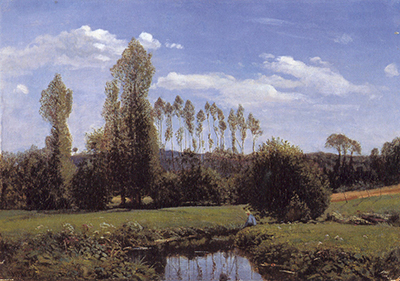
View from Rouelles , dated 1858, is a particularly useful early reference. MuMa's published record identifies a landscape measuring 46 by 65 centimetres, held at the Museum of Modern Art in Saitama on deposit from Marunuma Art Park. [9]
The subject leads away from the dramatic port entrance. It points to the nearby countryside as another working environment, where vegetation, water and the organisation of land could demand attention.
This geographical range is important. The coast was central to Monet's formation, yet his developing practice was not restricted to ships, tides and open sea.
The Monet and Boudin relationship is most revealing when understood as an encouragement to look and work, rather than a formula that supplied every later choice. Monet would continue to adapt observation to very different places.
The harbour entrance before Impression, Sunrise
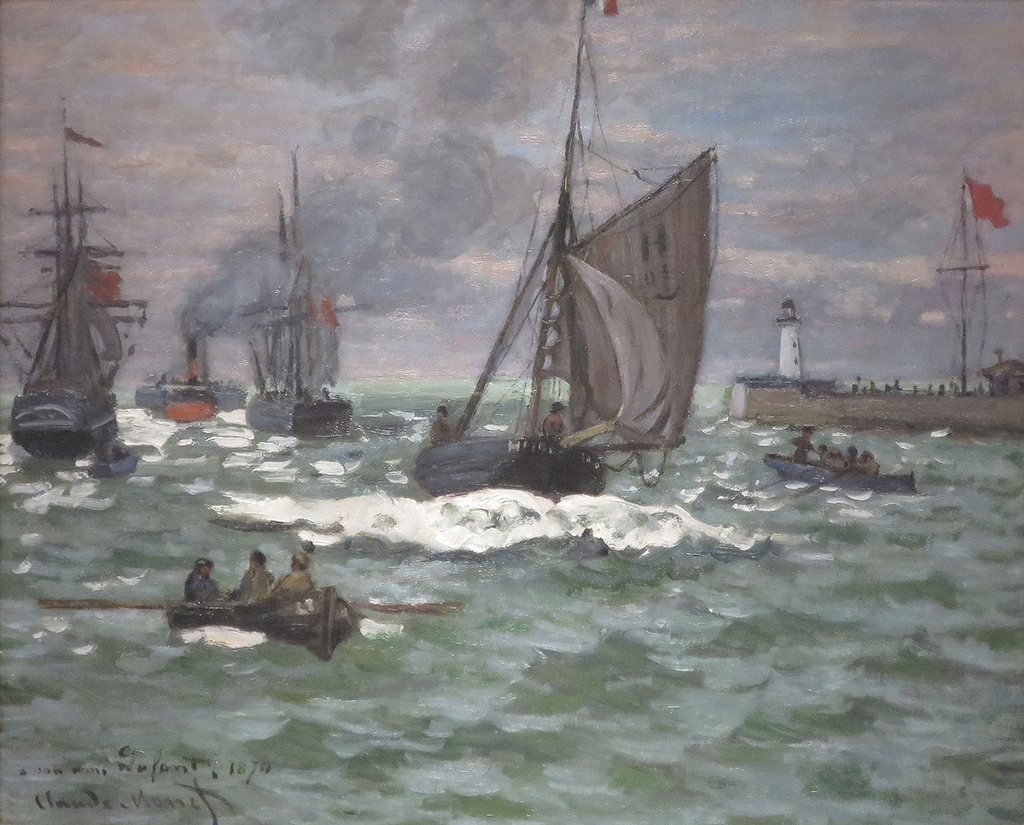
The Norton Simon Museum holds The Entrance to the Port of Le Havre , dated about 1867-68. The painting was formerly identified as a view of Honfleur; the museum's current title places it at Le Havre. [3]
Its account identifies a jetty and lighthouse and connects the canvas with a larger, now-lost painting shown at the Salon in 1868. The small work therefore belongs to a process involving study, enlargement and public exhibition, not simply an isolated sketch.
An inscription dedicates it to Monet's friend Antoine Lafont in 1870. [3] That later date should not displace the museum's dating of the painting itself. A gift inscription and an execution date can record different moments in an object's history.
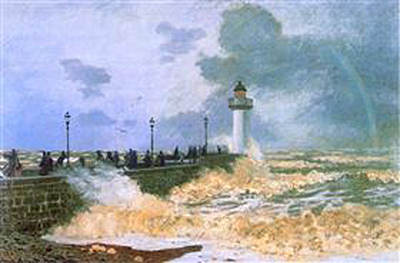
The port entrance offered a distinct pictorial situation: built structures project towards moving water, and the eye passes between fixed landmarks and the open sea.
This earlier work makes clear that Monet's harbour interests did not begin with the celebrated sunrise. It also shows why titles and dates need to remain attached to particular objects.
Impression, Sunrise and its particular viewpoint
The Musee Marmottan Monet dates Impression, Sunrise to 1872 and places its making around November, from a room at the Hotel de l'Amiraute. The view looks towards the southeast of the outer harbour. [4]
Cranes, masts and chimneys belong to an industrial port, even though mist softens their outlines. The foreground boats and orange sun give the image its most immediately legible accents.
The painting works through differences of clarity. Nearer dark shapes are easier to separate, while distant structures merge into the surrounding atmosphere. The sun is a compact form; its reflection breaks into marks across the water.
It is useful to distinguish these visual relationships from a claim to know the exact minute of execution. The holding museum supports the year and approximate season without requiring a precise clock time.
The Impression, Sunrise painting is a specific view, not a generic summary of every Le Havre harbour canvas. Its exceptional reputation should sharpen attention to its particular arrangement rather than make the other works interchangeable.
The museum seen across working water
In The Museum at Le Havre , dated 1873, Monet faced the city's museum and library across the inner harbour. The National Gallery's record connects the building with his own training: its curator, Jacques-Francois Ochard, had given him drawing lessons. [5]
Sails partially obscure the architecture. Their sharp shapes compete with the building's more regular forms, while broken reflections move across the foreground. The title names the museum, but the harbour activity prevents it from becoming a solitary architectural portrait.
The National Gallery identifies four preparatory sketches in which Monet varied the sails while retaining broadly the same viewpoint. [5] The apparently brisk result was therefore supported by decisions about arrangement.
This is an especially telling comparison with the sunrise. Atmosphere remains important, but the relationship between boats, civic architecture and a working waterfront introduces another emphasis.
It also gives drawing a continuing role. The sketchbooks of his adolescence and the preparatory studies for a mature harbour painting belong to different moments, yet neither supports a simple opposition between planning and immediate sensation.
Sainte-Adresse: nearby, but a different setting
The resort of Sainte-Adresse lies near Le Havre and belongs to Monet's coastal story, but its terrace and beach subjects should not be described as if they were all views inside the commercial docks.
The Met's Garden at Sainte-Adresse , dated 1867, shows a sunlit setting of family and leisure. An elevated viewpoint separates terrace, sea and sky into conspicuous bands. The museum identifies Monet's father among the models. [6]
Here the sea is seen from an inhabited garden. Flowers, people and flags establish a foreground social world, while shipping occupies a more distant space.
This arrangement offers a contrast with a harbour entrance or an inner basin crowded by sails. The coast could be a place of family encounter and recreation as well as maritime labour.
The painting's bright composure should not be mistaken for a complete account of the artist's circumstances. What Monet chose to show was a constructed scene, not an unfiltered record of every tension in his private life. [6]
Patrons and the naming of a movement
Le Havre also mattered through people who supported Monet. The Gaudibert family belonged to that local network. Orsay's record of Madame Louis Joachim Gaudibert , dated 1868, documents a commission requested on 3 September of that year. [7]
A full-length portrait requires different decisions from a harbour landscape. Dress, pose and the sitter's place in an interior become central, demonstrating that Monet's early career was not a single uninterrupted pursuit of seascapes.
The public history of Impression, Sunrise took another route. Shown in Paris in 1874, its title became material for Louis Leroy's hostile review in Le Charivari on 25 April. Jules Castagnary soon used the term Impressionists positively. [4]
The label did not create the painters' shared experiments out of nothing. It emerged through an exhibition and competing critical responses to artists already working in varied ways.
Le Havre supplied a crucial painting within that history. Paris supplied the exhibition setting in which its title acquired a wider significance. Keeping those places and events distinct makes the connection more informative than a simple birthplace slogan.
A later gift to the city
In 1910 Monet offered Le Havre three paintings from his later work: a Varengeville cliff scene, a London Parliament canvas and a Water Lilies painting. MuMa presents the gift as an important expression of his lasting attachment to the city. [8]
These were not three early harbour views. Their subjects carried the museum beyond local topography, bringing different parts of his mature career into a city associated with his beginnings.
The distinction between where a painting was made and where it belongs in a collection is useful here. A London subject can be important to Le Havre's cultural history without becoming a picture of Le Havre.
The gift also changes the scale of the relationship. The young artist who sought encouragement from local people had become someone able to shape a public collection through his own generosity.
Taken together, the drawings, harbour works, patronage and later gift make Le Havre more than a preface to Monet's career. It remained a point of connection between his personal history, his subjects and the public life of his art.
Le Havre Painting Pages

Frequently Asked Questions
No. He was born in Paris in 1840; his family moved to Le Havre in 1845. [1]
Yes. The Marmottan record identifies the outer harbour and dates it to 1872. [4]
His 1910 gift comprised other works: Varengeville, London and Water Lilies subjects. [8]
Discussion
Look again at the images and ideas explored in Claude Monet in Le Havre. These editorial prompts invite your observations.
Reader Insights
Compare the port entrance with the museum seen across the inner harbour.
Consider what the early drawings add to Monet's reputation as a painter.
Distinguish a painting's subject from its later place in a museum collection.
Join the Conversation
Share a detail, comparison or question about Claude Monet in Le Havre below.
References
- MuMa Le Havre , Monet in Le Havre, 2026 exhibition overview; family move, training and artistic networks. View source .
- MuMa Le Havre , Monet au Havre, exhibition itinerary; the 1856 sketchbooks and maritime visual culture. View source .
- Norton Simon Museum , The Entrance to the Port of Le Havre, about 1867-68, M.1999.2.2.P; title history, Salon study and later dedication. View source .
- Musee Marmottan Monet , Impression, soleil levant, 1872, inventory 4014; viewpoint and 1874 reception. View source .
- National Gallery, London , The Museum at Le Havre, 1873, NG6527; location, preparatory drawings and composition. View source .
- The Metropolitan Museum of Art , Garden at Sainte-Adresse, 1867, accession 67.241; family, leisure and elevated composition. View source .
- Musee d'Orsay , Madame Louis Joachim Gaudibert, 1868, RF 1951 20; commission and exact object record. View source .
- MuMa Le Havre , Claude Monet au MuMa; the three-painting gift offered in 1910. View source .
- MuMa Le Havre , Monet in Le Havre official press release, 2026; View from Rouelles, 1858, and early development. View source .






