


 by
Tom Gurney
Tom Gurney BSc (Hons) is an art history expert with over 20 years experience
Published on October 6, 2016 / Updated on October 23, 2026
Email:
tomgurney1@gmail.com
/ Phone:
+44 7429 011000
View at Rouelles, Le Havre
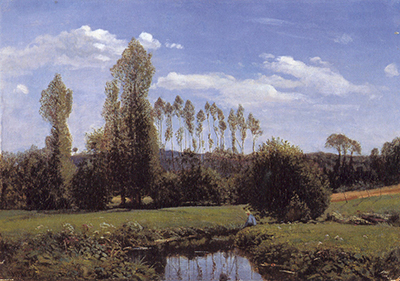
View at Rouelles, Le Havre is an early oil painting by Claude Monet, dated 1858. It belongs to the Marunuma Art Park collection in Japan and is often identified as his first recorded oil landscape. [1] [5] Tall trees, a low stretch of water and a broad blue sky turn an ordinary rural setting near Le Havre into a carefully organised composition.
At a Glance
An early painting, not the whole beginning
The importance of View at Rouelles rests partly on its position near the start of Monet's documented career. The scholarly chronology published for the 2007 Wildenstein exhibition identifies it as his first recorded oil painting and connects it with an exhibition in 1858. [5]
That does not mean Monet had never made an image before. He had already gained local attention through caricatures, and drawings form an important part of his early development. The French Ministry of Culture's account of the 2026 Monet au Havre exhibition highlights sketchbooks from 1856 as well as portraits of local figures. [3]
The canvas therefore marks a change of medium, subject and public opportunity, rather than an artist appearing fully formed from nowhere. Its rural scene can be considered alongside the earlier drawings without assuming that one activity instantly replaced the other.
Boudin and the experience of painting outdoors
Marunuma Art Park's account credits Eugene Boudin with recognising Monet's ability and encouraging him to take a canvas outdoors. The collection places this picture within that early relationship. [1]
The landscape is inland from the port and coast most often associated with Le Havre . Trees, grass and a small watercourse occupy the scene instead of ships and quays. The change of setting is a reminder that Monet's early surroundings offered more than one kind of view.
The connection with Boudin is significant, but it need not be turned into a claim that a teacher supplied every later aspect of Monet's art. Looking outdoors introduced practical problems of light, weather and changing appearances. The younger painter would continue to develop his own solutions over many years.
Nor does outdoor work by itself prove that the entire canvas was completed in a single sitting. A finished picture and the circumstances of observing its subject are related questions, not identical ones.
The tall trees and the open sky
Two large trees dominate the left half of the composition. Their narrow crowns rise against the sky, while a row of slimmer trunks continues towards the centre. The tallest tree is placed left of the midpoint rather than directly in the centre.
That distribution creates a changing rhythm. A single, substantial upright is followed by a lighter procession of smaller trees, allowing the eye to move across the picture instead of stopping at one central object.
The sky supplies a large, open area above the darker vegetation. White clouds pass behind the treetops, and their horizontal extensions contrast with the vertical trunks. The spaces between the smaller trees remain important: they permit pieces of sky to enter the line of foliage.
The right side is lower and more open. A distant pair of rounded trees helps prevent that area from feeling empty, but they do not compete with the tall forms at the left. The landscape's balance comes from unequal parts rather than perfect symmetry.
Water and a small human presence
The foreground contains a dark, irregular band of vegetation surrounding a patch of water. Its uneven edge contrasts with the smoother strip of grass further back. A few pale reflections give the water a different surface from the ground around it.
Near the centre-right, a small figure stands or bends beside the bank. It is too lightly described to establish a detailed identity or occupation. Its scale, however, helps the viewer judge the height of the trees and the breadth of the field.
The figure does not turn the picture into a fully developed narrative. It is one small incident within a larger landscape. The nearby bush is more visually prominent, its dense shape linking the open grass to the darker planting behind.
Looking from the foreground water towards the trees, the eye crosses alternating dark and light areas. Those intervals create depth even though there is no large road or dramatic perspective line leading into the distance.
Colour and handling before the Impressionist exhibitions
The painting's greens range from near-black foliage to brighter grass and scattered lighter leaves. Brownish touches give weight to the banks and undergrowth. The blue sky is comparatively clear, with cloud forms that remain legible rather than dissolving entirely into small marks.
This handling differs from the increasingly fragmented surfaces associated with some of Monet's later paintings. The dark trees have substantial silhouettes, and the landscape is organised through clearly contrasting zones.
It would be misleading to treat the 1858 canvas as though it already embodied every procedure of the group that exhibited in 1874. Its value includes the evidence it offers of an artist learning to organise an observed landscape.
The later Poplars provide a useful comparison because rows of trees again become powerful compositional elements. But a resemblance across decades does not prove that Monet planned the later series when he painted Rouelles. The comparison reveals a recurring visual interest, not a predetermined career.
The first exhibition and its reception
The MuMa's historical account places the Rouelles landscape in the 1858 exhibition of the Societe des amis des Arts at Le Havre, alongside work by Boudin. It records Felix Santallier's notice in the Journal du Havre, which recognised qualities associated with the older painter. [2]
This is a more specific starting point for Monet's public career than a general claim that he immediately became famous. A painting could be exhibited and noticed without establishing a lasting reputation or a secure income.
The Kimbell Art Museum's guide to Monet's early years likewise begins his exhibition history with Rouelles before discussing later Salon successes and rejections. [6] His subsequent reception was uneven. The opportunity in 1858 was a beginning, not a guarantee of the acceptance that would follow much later.
Collection history and a return to Le Havre
The holding collection records the work's loan to the Museum of Modern Art, Saitama. [1] Collection ownership and temporary location should be distinguished: a loan does not make the borrowing museum the owner.
In 2026, the painting returned to Le Havre for Monet au Havre at the MuMa, an exhibition devoted to the formative years of his career. The Ministry of Culture illustrated the exact canvas and its 46 by 65 centimetre dimensions. [3]
A local-government account published after the exhibition's closure identifies it among the show's central early works. The exhibition ran from 5 June to 27 September 2026; it is not an ongoing display. [4]
The return gave viewers an opportunity to connect a small Japanese-held canvas with the landscape and artistic networks of Monet's youth. Its quiet subject remains worth looking at independently: not just as a famous painter's first step, but as a particular arrangement of tall trees, bright sky, water and open ground.
Frequently Asked Questions
Marunuma Art Park, Asaka, Japan, whose record documents a loan to the Museum of Modern Art, Saitama. [1]
Yes. The MuMa places it in the 1858 Societe des amis des Arts exhibition in Le Havre. [2]
Discussion
Look again at the images and ideas explored in View at Rouelles, Le Havre. These editorial prompts invite your observations.
Reader Insights
How do the two tall trees balance the more open right side?
What does the small figure contribute without becoming the main subject?
How does this early handling differ from a later Monet landscape you know?
Join the Conversation
Share a detail, comparison or question about View at Rouelles, Le Havre below.
References
- Marunuma Art Park , Claude Monet, View of Rouelles, holding collection record and loan information. View source .
- MuMa Le Havre , Monet au MuMa, 2017 historical account, 1858 exhibition and Felix Santallier's review. View source .
- French Ministry of Culture , Monet au Havre, 8 June 2026, early career, exact object and collection caption. View source .
- Le Havre Seine Metropole , Monet au Havre and the Rouelles landscape, 13 October 2026, retrospective exhibition account. View source .
- Wildenstein , Claude Monet, 2007 exhibition catalogue, chronology, 1858 and first recorded oil painting, DW 1, Art Institute of Chicago research archive. View source .
- Kimbell Art Museum , Monet: The Early Years, visitor guide, Monet Before the Public. View source .







