


 by
Tom Gurney
Tom Gurney BSc (Hons) is an art history expert with over 20 years experience
Published on October 6, 2016 / Updated on October 23, 2026
Email:
tomgurney1@gmail.com
/ Phone:
+44 7429 011000
The Jetty at Le Havre
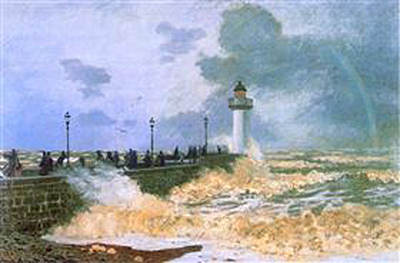
A long jetty projects into rough water in Claude Monet's The Jetty at Le Havre . Small figures and lamps lead towards a white lighthouse, while waves break against the structure and spread across the foreground. Measuring 147 by 226 centimetres, this is a substantial 1868 canvas, catalogued as Wildenstein 109. It is distinct from the smaller painting known as The Jetty of Le Havre in Rough Weather . [1] [2]
At a Glance
A solid structure in unstable water
The jetty enters from the left and narrows towards the lighthouse. Its upper edge is a clear line, reinforced by the small uprights of lamps and people. This measured recession gives the picture a firm spatial framework.
The water refuses the same regularity. Waves advance at different angles, with pale foam spreading over darker and warmer passages. Near the stone wall, spray rises against the structure, briefly softening its otherwise solid edge.
The contrast is more important than either element alone. The jetty makes the sea's movement visible by standing against it; the sea gives the masonry weight by striking and surrounding it. Without the water, the structure would be a much less dramatic subject. Without the structure, the waves would have less resistance against which their force could be judged.
Monet does not place the viewer safely beyond the action. The breaking water occupies the nearest part of the canvas. The jetty offers a route into the scene, but the foreground keeps our attention on the sea immediately below it.
Ochre waves and broken light
The waves are not confined to blue and white. Warm yellow-brown passages move through the foreground and gather beneath the jetty. White highlights brighten them without removing their density.
This makes the sea feel different from a transparent, decorative surface. Water, foam and suspended colour seem to mingle. The larger breakers have weight as well as brightness, while smaller marks carry that activity across the rest of the view.
The sky provides a cooler field above. Pale blue and lilac passages are interrupted by darker cloud at the right. The sea's warmer areas therefore remain especially noticeable, even though the scene as a whole does not depend on brilliant colour.
The lighthouse participates in this balance. Its white shaft catches attention against the more varied sky, but the waves below it are brighter in a less stable way. One light shape stands; the others appear to break, spread and disappear. The eye moves between these different forms of illumination.
People and lamps along the pier
The walkers are small enough to be read initially as a dark line of activity. Looking more closely reveals unequal spacing and varied silhouettes. The figures give the jetty a human scale without turning it into a scene of individual portraits.
The lamps add a second rhythm. Taller and more regularly shaped than the people, they punctuate the structure as it recedes. Their dark uprights connect the horizontal jetty with the open sky above it.
Neither figures nor lamps distract from the sea. Instead, they clarify the conditions under which it is being viewed. The stormy water is experienced beside a public structure, not from an entirely uninhabited shore.
This distinction gives the picture a particular tension. The people occupy a narrow, apparently firm surface, while the sea spreads well beyond it. Their smallness makes the width and movement of the water more apparent. The painting's scale allows these modest silhouettes to remain legible within a much larger environment.
The old Semaphore jetty
Wildenstein identifies the subject as the old Semaphore pier and records that it was destroyed in 1904. The same catalogue places part of the canvas's execution at Le Havre around February 1868. These details distinguish the historical structure from the harbour as it appears today. [2]
The qualification about execution is useful. The painting's forceful outdoor effect does not by itself prove that every part was completed in a single session beside the water. Its large dimensions would have made its development a different undertaking from a portable coastal sketch.
The view also differs from The Entrance to the Port of Le Havre . In that smaller canvas, vessels move close to the viewer and the lighthouse helps locate the harbour entrance. Here, the long pier itself is the main organising form, and the breaking water rather than maritime traffic dominates the foreground.
The repeated port setting therefore does not make the pictures interchangeable. Each selects a different relationship between built structure, human presence and the sea.
The Salon rejection and Zola's response
The 1868 Salon jury rejected The Jetty at Le Havre . The Art Institute of Chicago's scholarly catalogue distinguishes it from Monet's other submission, Boats Coming out of the Port of Le Havre , which was accepted and is now unlocated. [4]
Emile Zola discussed both works in his article of 24 May 1868. In defending the rejected jetty, he drew attention to the narrow structure, lamps, walkers and waves coloured by disturbed mud. He contrasted this forceful treatment with prettified marine painting. [3]
Zola suggested that such unappealing water had alarmed a jury accustomed to more decorative seas. That is his polemical explanation, not a surviving statement from the jurors. It is valuable because it shows what a sympathetic contemporary critic considered distinctive in Monet's work.
His defence also changes the terms on which the painting can be judged. The ochre water need not be regarded as a failure to make a beautiful sea. For Zola, its lack of conventional prettiness was part of its truthfulness. The disagreement concerned what marine painting should be allowed to show.
A different audience in Le Havre
The painting was subsequently included in the 1868 international maritime exhibition at Le Havre as number 855. The MuMa director Annette Haudiquet's account lists it among five Monet paintings in that exhibition and describes a local reception that combined recognition with satire. [5]
This is a useful corrective to a simple story of rejection followed by universal acclaim. Different venues and critics could respond differently, and favourable notices about one of Monet's exhibits should not automatically be transferred to every other canvas.
The work's subject would also have carried a particular immediacy in Le Havre. It represented a recognisable piece of the port, with the sea and public promenade brought into a forceful relationship. That connection does not establish what every local viewer thought, but it helps explain why the setting mattered beyond its usefulness as a general marine motif.
The painting belonged to an early career in which large public exhibitions remained important, even as Monet's treatment of familiar subjects challenged expectations about finish and attractiveness.
Collection history and the surviving canvas
Christie's recorded the painting at its New York sale on 12 May 1993. Its published provenance includes Louis Gaudibert, Jean-Baptiste Faure, Durand-Ruel, Cassirer and the Huntington Hartfords. Those entries document stages in its history without establishing a present owner or current display. [1]
The surviving image is not the lost ship painting accepted at the 1868 Salon. Keeping Wildenstein 109 separate from that work, number 89, preserves both the exhibition history and the identity of this particular composition. [2] [4]
Among Monet's Le Havre paintings , The Jetty stands out for its scale and the direct encounter between stone and water. The long structure brings order to the view, but cannot make the sea orderly.
That unresolved relationship gives the picture its lasting force. People can walk along the pier and lamps can mark its length, yet the breaking waves occupy a wider and less predictable space. The painting holds those two kinds of experience together without making either one disappear.
Frequently Asked Questions
It dates to 1868; the catalogue places part of its execution at Le Havre around February. [2]
No. It was rejected, while Monet's separate Boats Coming out of the Port of Le Havre was accepted. [4]
His article offered a critical explanation centred on the rough, muddy-looking sea, but that is not the same as a documented jury decision. [3]
Discussion
Look again at the images and ideas explored in The Jetty at Le Havre. These editorial prompts invite your observations.
Reader Insights
Follow the lamps and figures as the jetty recedes towards the lighthouse.
Compare the warm wave colours with the cooler sky.
Consider how the pier gives scale and resistance to the breaking water.
Join the Conversation
Share a detail, comparison or question about The Jetty at Le Havre below.
References
- Christie's , La jetee du Havre, 12 May 1993, New York, lot 15; exact dimensions, signature, recorded provenance and exhibition history. View source .
- Daniel Wildenstein / Wildenstein Plattner Institute , Monet, volume II, 1996, entry 109 and continuation; object identity, old Semaphore pier, partial execution at Le Havre and later history. View source .
- Emile Zola , Mon Salon, Les Actualistes, L'Evenement illustre, 24 May 1868, reproduced by Les Cahiers naturalistes; contemporary defence of the rejected jetty. View source .
- Gloria Groom, with Genevieve Westerby, Art Institute of Chicago , Monet Paintings and Drawings, catalogue 14, On the Bank of the Seine, Bennecourt, curatorial entry and note 6; distinction between the rejected W109 and accepted W89. View source .
- Annette Haudiquet / MuMa Le Havre , Autour des six oeuvres de Claude Monet conservees au MuMa, 2017, pages 34-35; the 1868 maritime exhibition and mixed local reception. View source .







