


 by
Tom Gurney
Tom Gurney BSc (Hons) is an art history expert with over 20 years experience
Published on October 6, 2016 / Updated on October 23, 2026
Email:
tomgurney1@gmail.com
/ Phone:
+44 7429 011000
The Jetty of Le Havre in Rough Weather
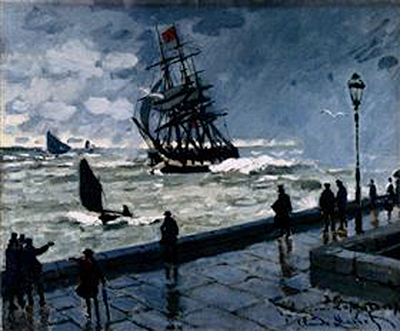
Spectators stand along a wet promenade as a sailing ship moves beyond the jetty in Claude Monet's The Jetty of Le Havre in Rough Weather . Dark figures and a tall lamp frame the restless sea, bringing the viewer onto the paved foreground rather than placing the whole pier at a distance. Wildenstein catalogues this 50 by 61 centimetre oil as number 88, under 1867, while recording its subsequent dedication to Lafont in 1870. [1]
At a Glance
A viewpoint from the promenade
The foreground is not open water. Large paving shapes occupy the lower part of the canvas, their irregular tones suggesting a surface darkened by moisture. The edge of the jetty runs diagonally away, separating this comparatively firm platform from the sea.
That choice gives the viewer a specific position. We seem to stand among the people looking outward, sharing their access to the harbour without being inside one of the boats. The sea's movement is experienced across a boundary.
The paving is not treated as an empty stage. Pale and dark strokes break its surface, and the figures cast or merge with darker passages around their feet. The foreground has its own shifting pattern of light, even though its material is much more stable than the waves beyond it.
The diagonal edge joins these two parts. It leads the eye past the nearest spectators towards smaller figures farther away, then releases attention into the open water. The composition moves between land and sea rather than remaining wholly within either one.
Spectators without a single story
The people vary considerably in scale. Nearer figures at the left appear larger and more closely grouped; a more isolated silhouette stands nearer the middle; others gather by the lamp and continue into the distance. This uneven distribution makes the promenade feel used rather than formally arranged.
Their clothing is indicated largely through dark masses. Heads, shoulders and upright bodies remain readable without detailed faces. The figures establish human presence, but the painting does not identify them as portraits or explain why each person has come to the jetty.
Their stillness contrasts with the sea. They appear to watch or pause while vessels and waves shift beyond them. This does not necessarily make them indifferent to the weather. It simply creates a visual opposition between comparatively stable silhouettes and a restless surface.
The scene contains no need for a dramatic rescue narrative. People can be interested in rough water without witnessing a disaster. The painting's tension comes from looking across the jetty's edge, not from an event whose outcome has been supplied for us.
The leaning ship and the upright lamp
The largest vessel rises in the middle distance, with a dark hull and a complicated structure of masts, spars and rigging. Its principal lines lean, making a strong contrast with the tall lamp at the right.
The lamp provides one of the picture's clearest verticals. Its slender shaft reaches above the spectators and terminates against the sky, where its dark shape remains easy to distinguish. Around it, the architecture of the harbour is reduced to a few necessary lines.
The ship's tilted appearance contributes to the sensation of movement, but it does not prove that the vessel is sinking or about to capsize. A painted angle is not a technical report on stability. The image gives a powerful impression of sea conditions without supplying all the information needed for a maritime diagnosis.
A smaller dark sail nearer the left introduces another direction. Its compact triangle differs from the more elaborate rigging of the principal ship. The boats give the water several points of activity while remaining part of one continuous view.
Broken waves beneath a heavy sky
The sea is built from alternating light and dark passages. White marks cross green-grey water, sometimes forming longer bands and sometimes breaking into scattered highlights. The surface feels uneven across its whole width.
The sky has a different scale of movement. Larger blue-grey cloud masses press above the horizon, while lighter openings appear towards the left. The contrast between broad clouds and smaller wave marks keeps the two surfaces distinct.
The brightest water near the main ship sets its hull apart from the surrounding sea. Elsewhere, the waves are less emphatic, allowing the eye to move between the vessel, the smaller sail and the spectators without losing the wider setting.
Colour remains relatively restrained. The red flag high on the ship is a small but noticeable accent within the darker maritime structure. Its effect depends on its limited area: it catches attention without changing the overall character of the cloudy, rough-water scene.
The 1867 date and the 1870 dedication
The lower-right inscription includes a dedication to Lafont and the year 1870. Wildenstein explicitly distinguishes that later addition from the painting's placement under 1867. The catalogue's documentary material also lists this difference between the inscribed year and the assigned execution date. [1] [3]
The distinction is straightforward but important. A gift date need not be a painting date. Monet could dedicate an already existing canvas when he passed it to a friend.
A related work, The Entrance to the Port of Le Havre , also bears a Lafont dedication. Its holding museum identifies the friend as the journalist Antoine Lafont, a witness at Monet's marriage in 1870. [2]
The shared dedication provides a genuine connection between the canvases. It does not establish that Lafont appears among the spectators here, or that the scene records the day of the gift. The personal history belongs to the object without explaining every detail of the depicted view.
A related canvas, not the large Salon jetty
Wildenstein cites a Durand-Ruel letter of October 1900 describing this painting and the harbour entrance as matching works. Their similar dimensions and common dedication make the comparison useful, while their different viewpoints keep each composition distinct. [1]
The harbour entrance places boats close to the viewer, with a lighthouse and jetty behind them. In Rough Weather , the paved promenade and watching figures occupy the foreground. One brings us towards the traffic on the water; the other emphasises the experience of observing it from land.
This small canvas must also be distinguished from The Jetty at Le Havre , the much larger 1868 painting, Wildenstein 109. That is the work documented as rejected by the Salon jury, not an alternative title for the 50 by 61 centimetre Lafont canvas. [4]
The similar subjects can obscure these differences. Keeping catalogue numbers and proportions in view preserves the separate histories of the large exhibition picture and the smaller, personally dedicated work.
An older pier and a concentrated encounter
The catalogue identifies the scene with the beginning of the old Semaphore pier, later destroyed in 1904. It also records a sale from Madame Lafont's collection at Christie's in London in December 1969. Neither detail establishes the painting's present private owner or display. [1]
The historical setting is therefore more specific than a general storm at sea. The lamps, paving and spectators belong to a port structure from which people could look towards maritime activity. Human use remains visible even when the water is rough.
The canvas's modest size does not prevent it from creating a complex encounter. Near and distant figures, a vertical lamp, diagonal jetty, tilted rigging and broken waves all have different roles. The scene's energy comes from their relationships rather than from a single overwhelming spectacle.
Within Monet's Le Havre paintings , this picture is distinctive for placing the act of looking in the foreground. The spectators become a measure of the sea's scale, while the viewer is invited to share their position at its edge.
Frequently Asked Questions
The Norton Simon Museum identifies the recipient of the related dedication as the journalist Antoine Lafont, a witness at Monet's marriage. [2]
Its strong lean contributes to the picture's movement, but the evidence used here does not establish a sinking or rescue event.
Discussion
Look again at the images and ideas explored in The Jetty of Le Havre in Rough Weather. These editorial prompts invite your observations.
Reader Insights
Compare the upright lamp with the tilted lines of the ship.
Consider how the foreground spectators affect your position as a viewer.
Look at the different marks used for wet paving and moving water.
Join the Conversation
Share a detail, comparison or question about The Jetty of Le Havre in Rough Weather below.
References
- Daniel Wildenstein / Wildenstein Plattner Institute , Monet, volume II, 1996, entries 87-88; exact identity, dimensions, subsequent dedication, related canvas, old Semaphore pier and 1969 sale. View source .
- Norton Simon Museum , The Entrance to the Port of Le Havre, M.1999.2.2.P; separate related canvas and Lafont context. View source .
- Daniel Wildenstein, hosted by the Art Institute of Chicago , 1974 catalogue, letters and documents, table of inscribed and catalogue dates; W88 inscribed 1870, catalogued 1867. View source .
- Christie's , La jetee du Havre, 12 May 1993, lot 15; separate large 1868 canvas, Wildenstein 109. View source .







