


 by
Tom Gurney
Tom Gurney BSc (Hons) is an art history expert with over 20 years experience
Published on October 6, 2016 / Updated on October 23, 2026
Email:
tomgurney1@gmail.com
/ Phone:
+44 7429 011000
Beach in Pourville
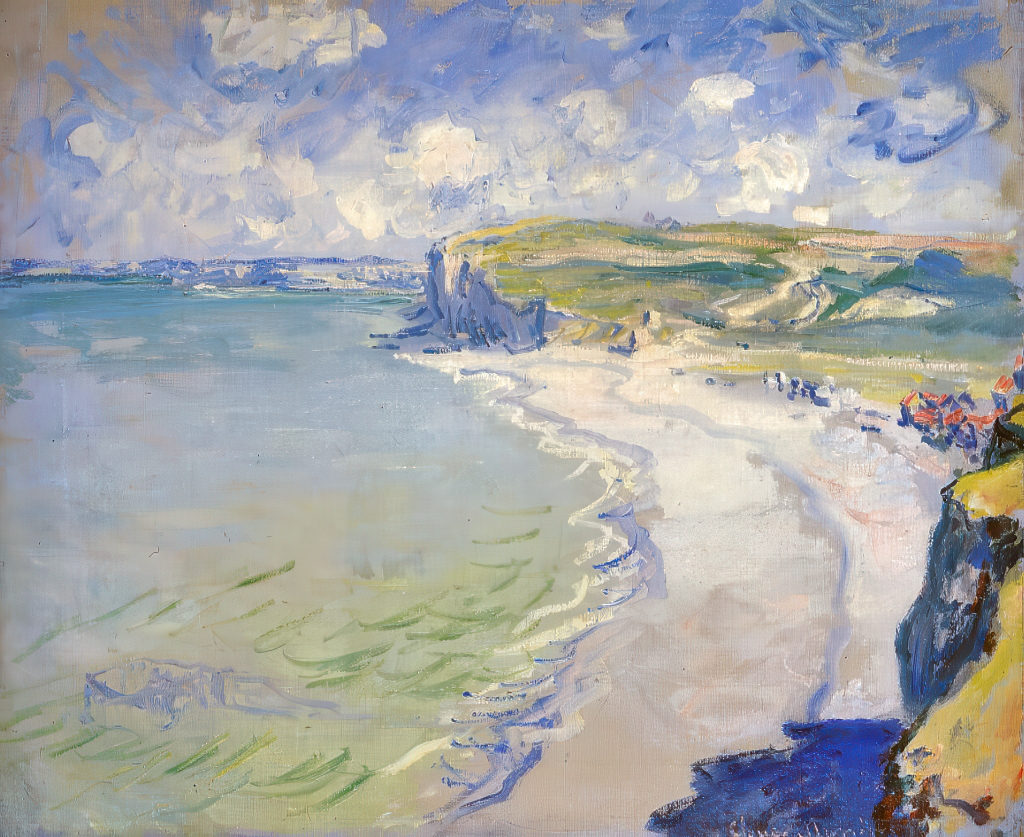
A pale beach curves around blue-green water in Claude Monet's Beach in Pourville . Seen from above, the shore leads towards a distant cliff, while red roofs gather at the right and a strong blue shadow falls across the near sand. The National Museum in Poznan dates this oil to 1882 and gives its dimensions as 60 by 73 centimetres. The canvas is identified as Wildenstein 788 in the catalogue supplement. [1] [5]
At a Glance
Looking down on the curve of the beach
The high viewpoint allows the shore to be seen as a long, continuous shape. Beginning near the lower edge, it bends towards the middle distance before reaching the foot of the distant cliff. Water fills the left side, while land and buildings gather to the right.
This is not a symmetrical division. The beach changes width as it recedes, and the nearest cliff edge interrupts the right-hand side of the view. That cropped foreground gives a sense of standing beside a steep drop rather than looking at the coast from a detached, level position.
The museum describes the viewpoint as being on the cliff near Varengeville, looking towards Pourville and the Amont headland, with the bay of Dieppe beyond. [2] The arrangement is therefore more specific than a generic sea-and-cliff scene.
The eye can follow several distances at once. The strong near shadow establishes the foreground, the red roofs indicate habitation farther away, and the headland carries the view towards the horizon. The shore's curve links these separate stages without making them feel like isolated compartments.
Blue shadow on pale sand
The most concentrated blue appears near the lower right, where a shadow projects from the foreground cliff across the beach. It is darker and more saturated than most of the water, making it a powerful anchor within an otherwise light picture.
The sand around it is not a uniform yellow. Pale pink, cream, lilac and warmer passages shift across the shore. Their relationships make the shadow feel like part of the same illuminated environment rather than an area from which colour has simply been removed.
A narrower dark line follows part of the beach farther away. It contributes to the sense that the ground is uneven and affected by changing light, though the painting does not map every variation as a topographical diagram.
The distant cliff repeats the warm-and-cool relationship on a larger form. Its upper grass is green and yellow, while the exposed face contains cooler violet-blue passages. Light does not eliminate the cliff's mass; it makes different parts of that mass appear differently.
Water described with a few changing marks
The sea is comparatively calm. Thin, curved strokes enter the nearer water, while a series of pale edges marks its meeting with the beach. The surface is active without the forceful white breakers seen in Monet's rougher marine paintings.
The water's colour changes as the eye travels. Greener passages occupy parts of the foreground, with cooler blue-grey farther out. The transitions are not always smoothly blended. Separate strokes remain visible, allowing the surface to be read both as water and as a pattern of paint.
The shoreline is especially economical. A few light and darker curves are sufficient to suggest successive ripples reaching the sand. They also reinforce the larger bend of the beach, so that the detail of the water supports the composition rather than distracting from it.
This quiet handling gives the scene room to open. The eye is not arrested by one great wave or a large nearby boat. It can move along the entire shore and then return through the smaller changes of colour in the foreground.
Roofs, clouds and open canvas
The buildings at the right are compressed into a small area. Red and orange roofs catch attention among cooler marks, making the village perceptible without requiring an architectural inventory. The coast remains the main subject, but it is not entirely uninhabited.
Above it, broad cloud strokes open and overlap across the sky. Some passages are creamy and bright; others are thinner, cooler or more broken. The marks do not produce a polished, uniformly covered surface.
The museum's educational account specifically notes that areas of the support remain visible and contribute to the sand, rock and clouds. [1] Such openings should not automatically be read as later damage or as evidence that the picture was abandoned unfinished. They participate in its light appearance.
The contrast between thin passages and more emphatic touches is important. A red roof or blue shadow has force partly because surrounding areas are less insistent. The painting's brightness depends on this uneven distribution of paint, not simply on the use of pale colours everywhere.
Pourville during Monet's 1882 visits
Monet discovered Pourville during a stay near Dieppe early in 1882 and returned with Alice Hoschede and the children in the summer. The village and neighbouring cliffs provided subjects across more than one visit, rather than a single brief excursion. [1] [6]
The published account of a separate Pourville canvas records the family's summer residence at Villa Juliette from June into early October. It also discusses the repeated sessions involved in developing coastal paintings under changing weather. [6]
This context cautions against treating the Poznan picture as a mechanical record of one instant. Its lively marks suggest responsiveness, but do not establish that every part was painted at exactly the same moment or completed in one uninterrupted sitting.
There is, however, a more material connection with outdoor work. The museum reports finding grains of sand within the paint during examination. [1] That observation supports contact with the coastal environment, while leaving the full sequence of painting and revision more open. It is stronger evidence than merely assuming an outdoor process from a sketch-like appearance.
From the dealers to Poznan
The museum identifies Paul Durand-Ruel as the painting's first owner after Monet and records its arrival in the Poznan collection in 1906. It was acquired from an exhibition of French Impressionist works organised there by Paul Cassirer. [1]
That history places the canvas within the international circulation of Monet's work. A view made on the Normandy coast became part of a museum collection far from the setting it depicts.
The catalogue supplement identifies the painting as number 788 under a title referring to the beach and cliffs at Pourville. [5] This helps distinguish it from other canvases of the same coast, including sunset views and paintings made from lower positions on the shore.
The shared place-name does not make those works versions of one interchangeable image. Here, the high viewpoint, curved beach, bright roofs and strong foreground shadow form a particular arrangement. The painting's individual identity is as important as its place within Monet's broader coastal work.
Theft, recovery and conservation
The painting's theft was discovered in 2000 after the canvas had been cut from its frame and a copy substituted. The Polish police's contemporary account records an investigative breakthrough in late 2009 and an arrest on 12 January 2010. The recovered painting underwent conservation before returning to public exhibition later in 2010. [3]
The dates deserve care: the late-2009 forensic lead and the January-2010 recovery are different stages of the story. The later municipal account also gives 12 January 2010 as the recovery date. [4]
This history has sometimes overshadowed the picture's artistic character. It is important to the survival of the object, but it does not explain the choices Monet made in 1882. The curve of the shore, open paintwork and blue shadow remain the reasons to look closely at the canvas.
Beach in Pourville offers a coastal scene in which lightness is carefully structured. Strong accents are balanced by quieter areas, and the high view joins nearby shadow to distant sea. Its atmosphere is expansive, but the means of creating it are particular and economical.
Frequently Asked Questions
The National Museum in Poznan dates it to 1882. [1]
No. The museum notes that visible areas of the support contribute to the original painted effect. [1]
It is Wildenstein 788, distinct from other Pourville beach and sunset paintings. [5]
Discussion
Look again at the images and ideas explored in Beach in Pourville. These editorial prompts invite your observations.
Reader Insights
Follow the shoreline's curve from the foreground to the distant cliff.
Compare the strong blue shadow with the lighter colours of the sand.
Look at how small roof accents balance the broad areas of water and sky.
Join the Conversation
Share a detail, comparison or question about Beach in Pourville below.
References
- Paulina Koch / National Museum in Poznan , Claude Monet, Plaza w Pourville, 1882; exact object facts, acquisition, visible support and sand found in the paint. View source .
- National Museum in Poznan , Monet powrocil!; interpretation of the high viewpoint, Pourville, Amont and the bay of Dieppe. View source .
- Polish Police , Odzyskany i odrestaurowany obraz Claude'a Moneta, 16 October 2010; contemporary theft, investigation and conservation chronology. View source .
- Kultura Poznan / Wydawnictwo Miejskie Posnania , Plaza w Pourville wrocila!, 2025; municipal account corroborating the January 2010 recovery. View source .
- Daniel Wildenstein / Wildenstein Plattner Institute , Claude Monet, volume V supplement, 1991, entry 788; exact catalogue identity and Poznan collection. View source .
- Christie's , Bord des falaises a Pourville, separate 1882 canvas, Wildenstein 751; source-backed context for the two 1882 visits, Villa Juliette and repeated painting sessions. View source .







