


 by
Tom Gurney
Tom Gurney BSc (Hons) is an art history expert with over 20 years experience
Published on October 6, 2016 / Updated on October 23, 2026
Email:
tomgurney1@gmail.com
/ Phone:
+44 7429 011000
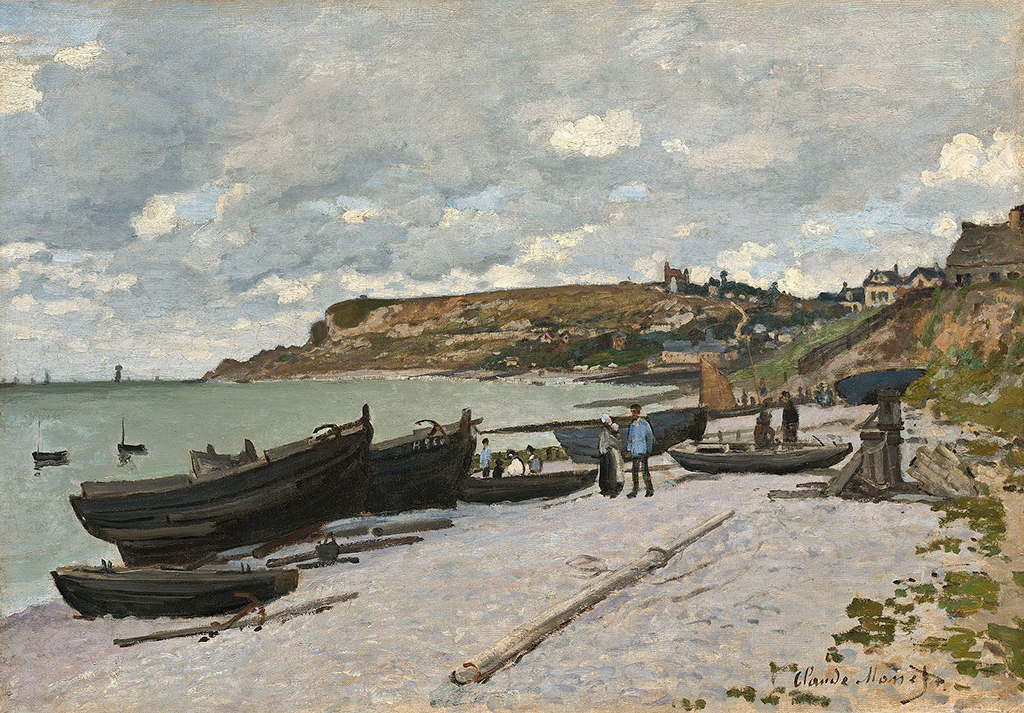
Sainte-Adresse, Fishing Boats on the Shore
Large dark hulls rest on a pale shore beneath a cloud-filled sky. Behind them, people gather beside smaller boats and the coastline curves towards the headland of La Heve. Known descriptively as Sainte-Adresse, Fishing Boats on the Shore , this painting is catalogued by the National Gallery of Art as Sainte-Adresse , 1867. It is an oil on canvas measuring 57 by 80 centimetres, accession 1990.59.1, and Wildenstein 93. [1] [2]
At a Glance
Boats with weight and volume
The largest boats occupy the left foreground. Their overlapping hulls make a concentrated dark mass, much heavier than the tiny craft still floating farther away. Raised ends and curved sides distinguish individual vessels within the group.
Monet does not need to describe every plank. A few horizontal bands and shifts from near-black to green and brown give the hulls a built structure. Their shapes remain legible even where one boat partly conceals another.
The low dinghy at the bottom left changes the scale of the group. It lies nearer the viewer, but is smaller and flatter than the vessels behind it. The space between its rim and the larger boats makes the shore feel occupied by separate objects rather than one continuous dark silhouette.
These are boats at rest, not sails arranged for a race. Their weight is emphasised by the way they meet the ground. Small supporting timbers and pieces of equipment extend the dark forms into the surrounding beach, connecting the vessels with the practical business of bringing them ashore.
A long pole across the foreground
One of the simplest objects is also one of the strongest compositional devices: a long pale pole runs diagonally from near the lower edge towards the middle right. Its direction cuts across the broader sweep of the beach.
At its near end, a darker opening and curved contour make it more than an abstract line. Farther away, it becomes thinner and less emphatic. This change helps establish the distance between the foreground and the people beyond.
Other shorter pieces of wood lie beneath and beside the boats. Their crossing directions interrupt the shore's apparently open surface. The beach is a place where equipment is put down, moved and used, rather than a smooth platform cleared for spectators.
The diagonal also offers a route past the largest hulls. Instead of stopping completely at their dark mass, the eye can travel along the pole towards the standing figures and the more distant curve of the coast. A practical object therefore helps organise the whole view.
People among the vessels
The central standing pair provides a human measure for the boats. A blue shirt, pale upper garment and dark lower clothing separate their bodies with only a few clear patches of colour. Their faces remain abbreviated.
Several smaller figures appear closer to the water and farther along the beach. Some are partly hidden by hulls; others are reduced to narrow vertical strokes. Their varied positions make the shore feel used without turning it into a staged group portrait.
The figures do not dominate by size, yet their presence changes the reading of the equipment around them. Boats, poles and boundaries become parts of an inhabited working environment. No dramatic incident is necessary to give the place a sense of continuing activity.
Nor does every person need a definite name or occupation. Clothing and position may suggest different roles, but the painting does not provide a complete record of individual identities. Its effect depends more on the relation between people, vessels and shore than on a story about one recognisable sitter.
Following the coast towards La Heve
Beyond the grounded boats, the water opens to the left while land rises at the right. The shoreline bends into the distance before reaching the broad, flat-topped headland. The catalogue raisonne identifies this distant feature as the cap of La Heve. [2]
The cape supplies a long, relatively stable shape behind the more irregular foreground. Its upper edge is not perfectly straight, but its low extension across the water contrasts with the steeply raised ends of the boats.
Buildings become smaller and more compressed along the ridge. A few light walls, dark roofs and a vertical tower or chimney are enough to indicate settlement. They do not compete with the foreground objects for the same degree of attention.
The result is a sequence of connected distances. Equipment lies within reach, people stand a little farther away, houses climb the shore, and the headland closes the bay. The coast is spacious, but the painting retains enough intermediate landmarks to prevent that space from becoming empty.
Grey weather without colourlessness
The sky contains large areas of grey, but it is not a uniform covering. Creamy cloud edges, cooler blue-grey passages and small blue openings create different densities across it. The light appears changeable rather than entirely absent.
The beach answers with pale lilac, pink, cream and grey marks. These are quieter than the blue shirt or dark hulls, but they give the ground a varied surface. The shore looks stony and uneven without every pebble receiving an outline.
The water is calmer in colour and handling. Its pale green-grey expanse helps separate the heavy boats from the distant cape. Tiny dark craft remain visible against it with very little paint.
This distribution of colour is selective. Strong darks cluster near the boats, while the sky and beach spread lighter tones across larger areas. The overcast setting does not mean that all parts of the picture receive equal emphasis; Monet uses restrained contrasts to keep the arrangement clear.
Returning to a familiar coastal subject
Monet had already painted the headland before 1867. His earlier Pointe de la Heve at Low Tide was exhibited at the Salon of 1865. The Kimbell Art Museum explains that its large canvas was developed in the studio from a smaller coastal study. [4]
The National Gallery in London also relates its 1864 study to that larger picture. [5] Together, these works show a sustained interest in the shore rather than the sudden discovery of an unfamiliar site.
The 1867 Washington canvas makes the boats and nearby people more prominent within a compact field. It is not simply a repetition of the earlier view. The foreground objects give the beach a more immediate, occupied character.
Monet's coastal work also included the very different Regatta at Sainte-Adresse , where visitors watch bright sails offshore. The Met identifies that scene with sunny high tide. [6] The contrast makes clear how much could change within the same locality through different choices of boats, weather and spectators.
The Washington painting and its identity
The National Gallery of Art records the painting as a gift of Catherine Gamble Curran and her family in honour of the museum's fiftieth anniversary. The gift was partial and promised in 1990, and completed in 2008. [1]
Its concise museum title, Sainte-Adresse , can cause confusion with other canvases of the place. The grounded boats, diagonal foreground pole and distant cape identify this particular arrangement. It is not the Art Institute of Chicago's The Beach at Sainte-Adresse , which has its own composition and technical history. [3]
The Washington painting's quietness is deceptive. Its dark boats, small figures and pale open areas have been carefully balanced. The shore is neither a deserted natural scene nor a display of fashionable leisure. It is a stretch of coast made tangible through objects and ordinary activity, with the weather giving them a shared atmosphere.
Frequently Asked Questions
The National Gallery of Art catalogues it as Sainte-Adresse, dated 1867. [1]
The catalogue identifies it as the cap of La Heve. [2]
The Curran family gift began as a partial and promised gift in 1990 and was completed in 2008. [1]
Discussion
Look again at the images and ideas explored in Sainte-Adresse, Fishing Boats on the Shore. These editorial prompts invite your observations.
Reader Insights
Trace the long foreground pole towards the standing figures.
Compare the weight of the grounded boats with the tiny floating craft.
Look for colour differences within the grey sky and pale beach.
Join the Conversation
Share a detail, comparison or question about Sainte-Adresse, Fishing Boats on the Shore below.
References
- National Gallery of Art , Sainte-Adresse, 1867, accession 1990.59.1; exact object identity, dimensions, current collection and gift chronology. View source .
- Daniel Wildenstein / Wildenstein Plattner Institute , Monet catalogue raisonne, volume II, 1996, entry 93, printed pages 49-50; catalogue identity and distant La Heve headland. View source .
- Gloria Groom and Jill Shaw / Art Institute of Chicago , The Beach at Sainte-Adresse, catalogue 13; separate Chicago object and scholarly context for Monet's coastal paintings. Its technical findings do not describe the Washington canvas. View source .
- Kimbell Art Museum , La Pointe de la Heve at Low Tide, 1865; earlier Salon canvas and study-to-studio process. View source .
- National Gallery, London , La Pointe de la Heve, Sainte-Adresse, 1864, NG6565; earlier coastal study and its relation to the Kimbell painting. View source .
- The Metropolitan Museum of Art , Regatta at Sainte-Adresse, 1867, accession 51.30.4; contrasting sunny high-tide leisure scene. View source .







