


 by
Tom Gurney
Tom Gurney BSc (Hons) is an art history expert with over 20 years experience
Published on October 6, 2016 / Updated on October 23, 2026
Email:
tomgurney1@gmail.com
/ Phone:
+44 7429 011000
The Sea at Sainte-Adresse
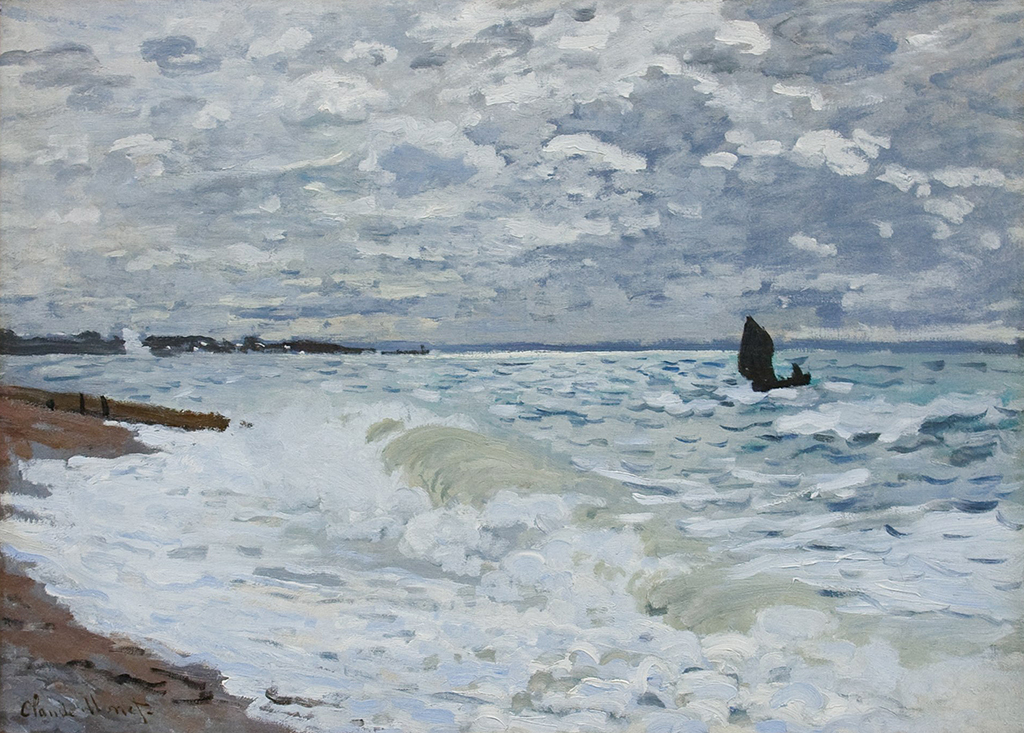
A breaking wave spreads almost to the lower edge of Claude Monet's The Sea at Sainte-Adresse . Behind the pale foam, one dark sail stands out against blue-green water and a restless sky. The painting belongs to Carnegie Museum of Art, Pittsburgh, which catalogues it as The Sea at Le Havre , dated 1868. It is an oil on canvas, accession 53.22, identified as Wildenstein 112. [1] [2]
At a Glance
A wave that fills the foreground
The nearest breaker is the painting's largest event. Its pale green crest lifts across the middle foreground before collapsing into white foam. The advancing water leaves very little quiet space between the viewer and the sea.
Monet gives the crest a different structure from the foam beneath it. Broad, curved passages suggest the translucent body of the wave, while shorter white touches break apart its lower edge. The water seems to rise, fold and spread through these changes of direction.
The foam is not one uninterrupted white shape. Blue-grey intervals and greenish passages enter it, suggesting water beneath the froth. Stronger light touches sit beside softer, less clearly bounded areas. This variation keeps the foreground active even after the eye has recognised the general form of a breaking wave.
At the lower left, a narrow piece of shore remains visible. Its warmer brown and grey marks provide a temporary foothold, but the surf presses closely against it. The scene feels observed from the water's edge rather than from a safe, elevated terrace.
The dark sail beyond the surf
The boat lies well beyond the nearest wave. Its sail forms a compact dark triangle, with a low hull and a few small shapes suggesting the people and equipment aboard. It is sharply different from the surrounding light water.
Its placement is important. The vessel sits to the right of centre, balancing the darker strip of distant land and harbour at the left. Neither dark area takes over the composition, but together they give the sea a scale and direction.
The sail's simplicity makes it immediately visible. There is no elaborate account of rigging or identifying decoration. Against the broken marks of waves and cloud, its comparatively continuous shape briefly steadies the eye.
The boat can suggest the practical demands of being at sea, but the painting does not identify a particular disaster or rescue. Its power comes from the contrast between the small vessel and the large surrounding forces. A narrative of imminent shipwreck would add a certainty that the image itself does not supply.
Shore, harbour and the view towards Le Havre
The catalogue raisonne describes the view as looking towards Le Havre. [2] That direction helps explain why the far left contains a low, dark band of developed shoreline rather than the broad headland seen in several of Monet's northward coastal views.
Posts and a short projecting structure appear near the left-hand shore. They mark human intervention in a setting otherwise dominated by water. Farther away, small pale and dark touches suggest activity along the port, with a plume of light smoke rising above it.
These details remain subordinate. Monet does not turn the distant buildings or harbour equipment into the main subject. Their small scale makes the foreground breaker seem larger and more immediate.
Distance is therefore established without a long sequence of carefully modelled objects. The warm shore at the lower left, the dark sail offshore and the thin harbour strip are enough to locate the viewer within a wide stretch of water. The rest of the space is carried by waves, colour and the horizon.
A sky as active as the water
Clouds occupy a broad upper field. Some marks sweep sideways, while others gather into thick, uneven masses. Pale grey, blue and cream remain distinct enough to reveal the movement of the brush.
The sky is not simply a darker counterpart to the white surf. Light passages open within it, and cooler blue areas emerge between clouds. Near the horizon, a comparatively narrow brighter strip separates sea from sky.
This range of marks gives the upper part of the picture its own rhythm. The cloud shapes are larger than most of the strokes describing offshore waves, yet they are equally unstable in outline. Air and water feel related without being painted identically.
The colour relationship also prevents a straightforward division into threatening darkness above and reassuring brightness below. Both regions contain cool tones and abrupt light accents. The weather is experienced through those shifting relationships, rather than explained by a precisely identifiable meteorological event.
Paint with a physical presence
Carnegie's institutional magazine has drawn attention to the energetic brushwork and almost sculptural appearance of the crashing waves. [3] The observation is especially relevant where the foreground whites form ridges and overlapping curls.
The painted surface does not disappear behind the scene. A stroke can be recognised as a wave edge and still remain a visible movement of paint. The eye repeatedly moves between the illusion of water and the marks that create it.
This is different from an evenly polished marine picture in which every transition is softened. Here, abrupt changes of thickness, direction and tone contribute to the sensation of force. The irregularity is part of the organisation, not evidence that no organisation exists.
At the same time, energetic handling does not reveal every stage of execution. The surface alone cannot establish that the canvas was completed in one sitting, or that every passage was painted outdoors. Its apparent immediacy is an effect to examine, not a complete record of the working process.
Within Monet's early marine painting
Monet's interest in rough water extended across several early canvases. The Clark Art Institute's Seascape, Storm , dated 1866, also uses a dark sail, subdued colours and a strongly divided sea-and-sky arrangement. [4]
The comparison helps show that the Pittsburgh canvas did not emerge in isolation. Monet was repeatedly considering how a small vessel could punctuate a large field of moving water. The details and proportions change from one work to another.
A separate 1868 painting in Lausanne, Sailing Boats at Sea , is accompanied by the museum's discussion of preparatory drawings and the relationship between outdoor observation and studio development. [5] That evidence belongs to the Lausanne work, but it cautions against assuming that every swift-looking marine canvas had an identical method.
The quieter Fishing Boats on the Shore offers another contrast. There, grounded hulls and beach equipment create a solid foreground. Here, almost everything near the viewer is being displaced, broken or carried forward by water.
Two titles for the Carnegie painting
The Sea at Sainte-Adresse follows the title used in the catalogue raisonne, while Carnegie's current record uses The Sea at Le Havre . The museum accession and catalogue number connect the names to this same 1868 canvas. [1] [2]
The catalogue records its acquisition by Carnegie in 1953 after passing through the dealer Sam Salz. [2] Earlier ownership links are less secure and need not be made into an unbroken chain to understand the painting.
Its subject remains unusually concentrated. There is no crowd of spectators, no garden and no panoramic catalogue of the coast. A narrow shore, a distant harbour and one dark sail provide the necessary bearings. Around them, Monet gives water and cloud the dominant roles, turning a recognisable coastal view into a study of movement and painted force.
Frequently Asked Questions
The catalogue describes the beach as looking towards Le Havre. [2]
The sources used here do not identify a specific shipwreck or rescue. The article treats it as a vessel within a rough-water scene.
Discussion
Look again at the images and ideas explored in The Sea at Sainte-Adresse. These editorial prompts invite your observations.
Reader Insights
Compare the continuous dark sail with the broken white foam.
Follow the crest as it curves across the foreground.
Look for changes in brushstroke size between sea and sky.
Join the Conversation
Share a detail, comparison or question about The Sea at Sainte-Adresse below.
References
- Carnegie Museum of Art , The Sea at Le Havre, 1868, accession 53.22; current title, medium, dimensions and collection identity. View source .
- Daniel Wildenstein / Wildenstein Plattner Institute , Monet catalogue raisonne, volume II, 1996, entry 112, printed page 57; La Mer a Sainte-Adresse, direction of view and 1953 acquisition. View source .
- Cristina Rouvalis / Carnegie Magazine , First Impressions, Summer 2012; institutional discussion of the painting's energetic, materially emphatic waves. View source .
- Clark Art Institute , Seascape, Storm, 1866, accession 1955.561; a separate early marine painting used for comparison. View source .
- Musee cantonal des Beaux-Arts, Lausanne , Sailing Boats at Sea, 1868, accession 2006-001; separate painting and documented drawing context, not technical evidence for the Carnegie canvas. View source .







