


 by
Tom Gurney
Tom Gurney BSc (Hons) is an art history expert with over 20 years experience
Published on October 6, 2016 / Updated on October 23, 2026
Email:
tomgurney1@gmail.com
/ Phone:
+44 7429 011000
Taking a Walk on the Cliffs of Sainte-Adresse
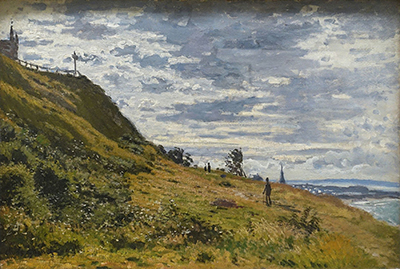
A yellow-green slope occupies most of the foreground in Claude Monet's Taking a Walk on the Cliffs of Sainte-Adresse . Small figures cross the grass while the sea appears beyond the land at the right. This 1867 oil belongs to the Matsuoka Museum of Art, Tokyo, which lists it at 54 by 79.5 centimetres. It is Wildenstein 93a, also known as Cliffs at Sainte-Adresse . [1] [2] [3] [4]
At a Glance
A coastal landscape dominated by grass
Although the title draws attention to the cliffs, the nearest land is not presented as a bare vertical rock face. It is a broad sloping field, thick with small marks of green, yellow, brown and pale paint.
The ground rises steeply towards the upper left. A darker bank breaks its continuity, creating a change in level before the eye reaches the ridge. The slope then falls diagonally towards the lower right, where a glimpse of sea opens beyond it.
This arrangement gives the land a considerable weight. Instead of using a narrow foreground strip to introduce a panoramic marine view, Monet makes the ground itself the principal field of observation. The water is present, but it does not command the largest area.
The grass is unevenly described. Some passages are dense with little flecks, while others are broader or more loosely connected. Their changing density suggests growth, roughness and patches of light without becoming a botanical inventory.
The diagonal that organises the view
The strongest movement runs down from the high left side towards the right. Several smaller directions reinforce or interrupt that descent: the dark edge of the upper bank, a faint track across the middle ground and the land's lower boundary near the sea.
These lines do not converge neatly on one central point. The landscape is built from changing levels, with the viewer apparently standing on or near the sloping ground. It feels traversable, but not smooth or entirely predictable.
The nearest walker helps make that sensation concrete. The small upright form stands against the grass, contrasting with the sweeping diagonal beneath it. Its scale gives an approximate measure of the field without explaining every step of the route.
The composition also balances openness and obstruction. The rising bank closes part of the left side, while the sea and distant coast release space at the right. The eye moves through the hollow between those conditions, rather than looking over an uninterrupted flat plain.
Walkers as measures of distance
The figures are modest in size. One nearer dark figure is more distinct, while others gather around the middle distance and become small touches against the field and buildings. They do not form a carefully posed foreground group.
That distribution helps describe space. The difference between the nearer walker and the more distant marks suggests how far the slope continues before it meets the cluster of structures. Human scale gives the broad patchwork of grass a physical extent.
The figures also introduce the subject of walking without requiring an elaborate story. They occupy the coast as a place to move through, pause in and look across. Their smallness keeps the setting from becoming simply a backdrop for portraiture.
No named identity is needed to understand this effect. The catalogue title describes people on the cliff, but does not establish that a particular silhouette is Monet, a relative or a recognisable visitor. Their importance here is spatial and pictorial before it is biographical.
Looking towards Le Havre
The catalogue raisonne locates the viewpoint partway up the cliffs of the cap of La Heve, facing towards Le Havre and the Seine estuary. It identifies the steeple at the left as that of Saint-Vincent in Le Havre. [3]
This is a useful distinction from Monet's other Sainte-Adresse subjects. The distant church is not the central old church in Street in Sainte-Adresse . The two paintings observe different parts of the surrounding landscape.
Buildings, poles and small vertical forms punctuate the coast, but remain less insistent than the near slope. They allow the setting to register as inhabited without transforming the picture into a topographical survey.
At the right, the sea is compressed into a comparatively narrow opening. Pale bands of surf and blue water give it a different texture from the grass. That glimpse is enough to make the field feel exposed to a larger coastal environment, even though the land occupies most of the foreground.
Cloud, sunlight and changing brushwork
The sky is active with blue-grey and white patches. Cloud forms overlap and break apart, leaving intervals of cooler colour between brighter touches. Their irregular pattern echoes the field's broken surface, but at a larger scale.
The land contains stronger yellow and green notes. These warm passages suggest light falling across parts of the slope, while the bank at the upper left remains darker. The effect is not an even illumination spread equally over every surface.
Pale flecks in the grass can suggest flowers and highlights, though individual species cannot be identified from these marks. Their main visual role is to interrupt the broad green-and-ochre field with small changes of brightness.
Monet varies the size and direction of his strokes to distinguish ground, cloud, buildings and water. The picture has a lively surface, but that does not mean all of its parts were handled in the same way. The variation is what allows its different materials and distances to remain legible.
Part of the varied work of 1867
The Matsuoka museum's account of Monet's early career places this painting within the productive summer he spent at Sainte-Adresse in 1867. It emphasises his growing use of light colour and responsive brushwork in the landscapes of that period. [5]
His interests were not restricted to walking figures. The National Gallery of Art's separate Sainte-Adresse depicts grounded fishing boats, while the Met's Regatta fills the water with pleasure craft. This canvas brings the eye up onto the coastal slope instead. [6]
Earlier coastal drawings, discussed in the Art Institute's scholarly catalogue, show Monet's sustained attention to cliffs and their changing profiles. [7] They provide context for that interest without needing to be declared preparatory studies for this particular oil.
The painting is also distinct from Monet's later cliff views at Pourville. Its date, topography and collection history belong to the 1867 Sainte-Adresse campaign. Similar subjects can recur across his career without being reduced to versions of a single composition.
The canvas in the Matsuoka collection
The catalogue records the painting with Petrides in Paris around 1929 and in two later New York auctions, in 1983 and 1987. Matsuoka acquired it at the Sotheby's sale of 11 May 1987. [3]
Its place in the museum is corroborated by the current collection page and the museum's 2023 exhibition checklist. [1] [2] Those records use a Japanese title referring to the cliffs of Sainte-Adresse, while the catalogue's French title draws attention to the walkers.
The two emphases are complementary. The figures make the landscape a route through which people pass; the slope, cloud and distant water determine the character of that passage. Neither the walkers nor the coast can account for the picture alone.
Its particular achievement is to make a steep patch of grassy land feel expansive. Tiny people, a distant steeple and a narrow view of the sea provide bearings, while the broken colour keeps the near ground alive under changing light.
Frequently Asked Questions
The catalogue identifies the distant steeple at the left as Saint-Vincent in Le Havre. [3]
No. This is the 1867 Sainte-Adresse canvas, Wildenstein 93a. [3]
Discussion
Look again at the images and ideas explored in Taking a Walk on the Cliffs of Sainte-Adresse. These editorial prompts invite your observations.
Reader Insights
Follow the slope's diagonal towards the narrow view of the sea.
Compare the nearer walker with the smaller figures in the middle distance.
Notice how cloud strokes and grassy flecks differ in scale.
Join the Conversation
Share a detail, comparison or question about Taking a Walk on the Cliffs of Sainte-Adresse below.
References
- Matsuoka Museum of Art , Paintings collection, Cliffs at Sainte-Adresse, 1867; current institutional identity and medium. View source .
- Matsuoka Museum of Art , Monet, Renoir: The Light of Impressionism, 2023 checklist, item 3; dimensions 54 x 79.5 cm and medium convention. View source .
- Daniel Wildenstein / Wildenstein Plattner Institute , Monet catalogue raisonne, volume II, 1996, entry 93a, printed page 50; location, Saint-Vincent church, catalogue identity and acquisition history. View source .
- Daniel Wildenstein / Wildenstein Plattner Institute , Claude Monet, volume V supplement, 1991, printed page 4, entry 1992/93bis; earlier supplement entry for the same canvas. View source .
- Matsuoka Museum of Art , Monet, Renoir: The Light of Impressionism, 2023, chapter 2; context for Monet's Sainte-Adresse work in 1867. View source .
- National Gallery of Art , Sainte-Adresse, 1867; separate beach painting and context for the varied coastal campaign. View source .
- Art Institute of Chicago , Cliffs and Sea, Sainte-Adresse, scholarly catalogue 12; early coastal drawing context, not an asserted preparatory sheet for this oil. View source .







