


 by
Tom Gurney
Tom Gurney BSc (Hons) is an art history expert with over 20 years experience
Published on October 6, 2016 / Updated on October 23, 2026
Email:
tomgurney1@gmail.com
/ Phone:
+44 7429 011000
The Beach at Trouville
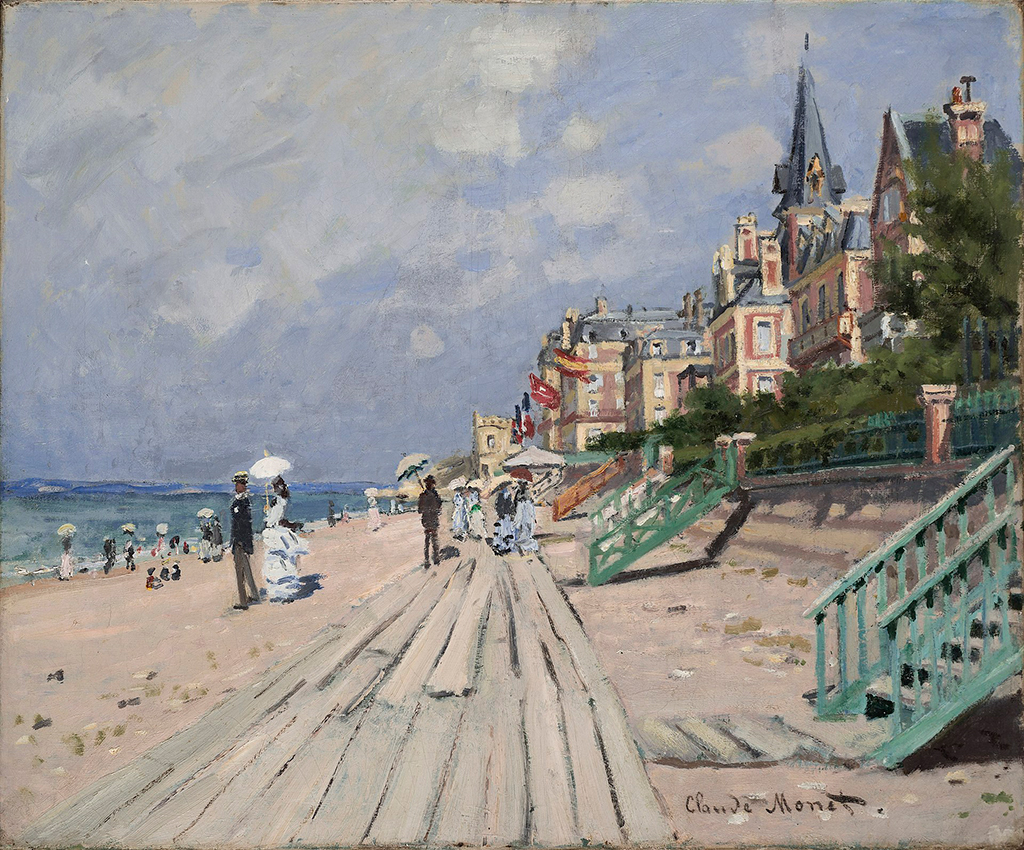
A wooden boardwalk leads straight into a busy seaside scene, with pale sand and blue-green water to the left and elaborate buildings rising to the right. Claude Monet's The Beach at Trouville , painted in 1870, belongs to the Wadsworth Atheneum Museum of Art in Hartford. This oil on canvas measures 53.5 by 65 centimetres and is accession 1948.116, Wildenstein 156. [1] [2]
At a Glance
The boardwalk as the picture's main route
The nearest planks occupy a strikingly large part of the foreground. Their long edges converge towards the people in the middle distance, making the walkway the most direct route into the picture.
Monet does not describe the boards as perfectly regular strips. Some edges are darker, some fade, and changes of grey and brown suggest uneven surfaces. Their broad near ends make the viewer feel close to the ground before they narrow into the distance.
This strong perspective also divides the scene. Sand and open water remain to the left; stairs, terraces and buildings gather at the right. The walkway is a connection between those worlds rather than a neutral line drawn across an otherwise natural beach.
The Kimbell's account of the painting emphasises that these were actual boards laid over sand, practical structures that could be adjusted as tidal conditions required. [3] What looks like a powerful pictorial device also belongs to the daily organisation of a resort. The built surface allows visitors to approach the shore in clothes and shoes more suited to promenading than to working on a fishing beach.
Green stairs and a diagonal shadow
A staircase cuts across the lower right corner. Its green railing is one of the most concentrated colours in the picture, set against pale sand, grey boards and warmer masonry.
Its direction differs from the walkway's long recession. The stairs enter from the right and bring the eye down towards the beach. Other stairways repeat that movement farther away, linking raised properties with the lower promenade.
The nearest stair also casts a strong dark shadow. Its angle stretches across the lighter ground, adding another directional element without needing a solid new object. The structure and the light falling on it become inseparable parts of the composition.
These details make the resort physically convincing. There are changes of level to negotiate, boundaries to cross and different surfaces underfoot. Monet's view is not simply a decorative row of facades beside the sea; it shows how people move between buildings, boardwalk and sand.
The sequence of coloured stairs also prevents the architectural edge from becoming monotonous. Repeated structures are given small differences of angle, tone and emphasis as they recede.
Hotels, roofs and a modern shoreline
The buildings rise sharply at the right. Red and cream walls, slate-coloured roofs, tall chimneys and pointed architectural features create a crowded silhouette against the sky.
Their scale is important. The buildings occupy much more height than the visitors below them, giving the developed seafront a prominent role. The coast is not shown as an untouched refuge from modern life.
Museum Barberini's interpretation notes the attention Monet gives to architecture despite the freedom of his handling. [5] Looking closely confirms the point: light walls, dark windows, roof angles and projecting details remain differentiated even where brushstrokes are abbreviated.
The greenery around the terraces softens the meeting of architecture and beach. Bushes form dark and middle-green patches between railings and walls, but their presence does not hide the resort's construction. Nature has been incorporated into a planned environment.
Small flags add red accents farther along the seafront. Their fluttering forms contrast with the solidity of the buildings and repeat the sense of coastal air already suggested by the open sky and visitors' clothing.
People on display beside the sea
The nearest figures stand to the left of the boardwalk. A dark jacket and grey trousers give one person a narrow upright shape, while a pale dress and parasol create a broader, brighter form beside him.
Farther away, other figures overlap along the promenade. White and blue touches suggest clothing, with small dark marks for hats and faces. At the water's edge, people shrink into a scattered rhythm of light and colour.
This variation gives the beach depth and social activity. Some visitors pause, others seem to walk, and smaller groups occupy the sand. No single interaction becomes a dominant anecdote.
The Wadsworth's educational account draws attention to the conveniences carried into seaside leisure: wooden surfaces for shoes, hats and parasols for protection, and fashionable clothes worn close to the water. [4] The picture makes that mixture visible without supplying every visitor's identity.
The figures are not merely useful scale markers. They explain why such an elaborate frontage and walkway exist. The resort is a place to look at the sea, but also to stroll, gather and be seen by other people.
A beach altered by tourism
Robert L. Herbert uses the painting in his study of Impressionism and modern leisure, under the descriptive title The Boardwalk at Trouville . His discussion situates the Channel resorts within the wider transformation of fishing communities by visitors seeking recreation. [6]
That context helps explain why the architecture is as important as the water. Much of the sea is compressed into a band at the left, while the infrastructure of holidaymaking stretches through the foreground and up the right side.
The scene also differs from Monet's earlier working-shore pictures at Sainte-Adresse. Grounded boats, fishing equipment and rough weather could dominate those canvases. Here, the main traffic consists of people enjoying a developed resort.
This is not a claim that labour had vanished from Trouville, or that every visitor belonged to the same social class. It is a description of what Monet chooses to make conspicuous. The painting selects the promenade and fashionable frontage as a particular face of the town.
The wide, inviting perspective places the viewer within that public space. Looking is not detached from the subject: the picture encourages an imagined movement along the same boards used by its visitors.
Low tide and related Trouville paintings
The catalogue raisonne identifies this view with low tide and the boardwalk in place. A related canvas, Wildenstein 157, shows high tide with the planks removed. [2] The difference is more than a change of water level: it alters how the foreground is organised.
John House's comparison, reproduced in the auction documentation for the other painting, links the two views through that tidal contrast. [8] The Wadsworth canvas's long lines are particularly assertive because the boards remain exposed across the sand.
Monet also painted the seafront in a tall format. The Musee d'Orsay's Hotel des Roches Noires, Trouville emphasises figures beneath flags and an active sky. Its museum account places the work during the summer following Monet's marriage to Camille on 28 June 1870. [7]
The Hartford canvas belongs to that same period but has its own balance. The sea, sand, architecture and walkway converge into a broad horizontal view. Similar titles and the shared locality should not obscure the different proportions and arrangements of the individual paintings.
Light and apparent speed
The sky is built from broad pale blue, grey and white strokes. Rather than describing every cloud with a firm outline, Monet lets overlapping touches suggest an airy expanse above the hard-edged roofs.
The beach and planks are also light, but not uniformly bright. Cooler shadows interrupt warm pink and ochre passages, while small dark touches mark gaps, objects and changes in surface. The green railing gains force from these quieter surroundings.
The handling can feel rapid, especially in the distant people. Yet the underlying arrangement is stable: long board edges, stair diagonals, vertical figures and roof shapes give the eye several connected directions to follow.
Apparent spontaneity is therefore only part of the experience. The scene works because abbreviation and structure coexist. A few marks can stand for a person or a window when their position and relationship to neighbouring forms are clear.
Technical findings from other similarly titled Trouville paintings should not be used to fill gaps in this canvas's history. London's close-up of two seated women is a different object. The evidence and composition discussed here concern the Wadsworth promenade scene.
The painting in Hartford
The Wadsworth acquired the painting in 1948 through the Ella Gallup Sumner and Mary Catlin Sumner Collection Fund. [1] The catalogue records earlier ownership in the Kimball family and a probable purchase from Monet by Durand-Ruel around 1871, with that earliest link remaining qualified. [2]
The museum later featured the picture in Medieval to Monet , its 2012-13 presentation of French paintings. [9] Its appeal within such a collection is not confined to the recognisable name of a seaside resort.
The canvas makes the relationship between leisure and place unusually tangible. A strip of boards, coloured stairs, carefully dressed figures and tall hotels change the way the coast can be inhabited. Light unites those elements, but the modern structures and social activity give it something specific to illuminate.
Frequently Asked Questions
They provide a practical walking surface over sand and create the strongest perspective lines in the painting. [3]
The catalogue describes it as the low-tide version with the planks in place. [2]
No. That frequently cited evidence concerns the National Gallery's separate Trouville painting of seated women, not the Hartford object discussed here.
Discussion
Look again at the images and ideas explored in The Beach at Trouville. These editorial prompts invite your observations.
Reader Insights
Follow the board edges towards the middle-distance figures.
Compare the staircase shadow with the solid green railing.
Notice how much of the composition is devoted to resort buildings rather than open sea.
Join the Conversation
Share a detail, comparison or question about The Beach at Trouville below.
References
- National Gallery, London , Monet and Architecture, 2018 loan record X9376; Wadsworth accession 1948.116, dimensions and Sumner Fund acquisition. View source .
- Daniel Wildenstein / Wildenstein Plattner Institute , Monet catalogue raisonne, volume II, 1996, entry 156, printed page 74; exact identity, low-tide setting and ownership record. View source .
- Kimbell Art Museum , Monet: The Early Years, educator resource, page 24; architecture, boardwalk construction and spatial reading of this Wadsworth canvas. View source .
- Leta Marks / Wadsworth Atheneum Docent Council , Strolling By the Sea, Dialogue, Spring 2013, page 8; seaside dress, facilities and social context. View source .
- Museum Barberini , Monet, Artistic Beginnings; the Wadsworth painting's architectural detail and early-career context. View source .
- Robert L. Herbert / Yale University Press , Impressionism: Art, Leisure, and Parisian Society, 1988, chapter 7, figure 301; exact Wadsworth image under the Boardwalk title and resort context. View source .
- Musee d'Orsay , Hotel des Roches Noires, Trouville, 1870; separate vertical canvas and context for Monet's summer stay. View source .
- Sotheby's , La Plage a Trouville, 2006, lot 9; separate Wildenstein 157 canvas and John House's comparison with the low-tide Wadsworth painting. View source .
- Wadsworth Atheneum Museum of Art , Medieval to Monet, 2012-13; holding-museum exhibition featuring The Beach at Trouville. View source .







