


 by
Tom Gurney
Tom Gurney BSc (Hons) is an art history expert with over 20 years experience
Written on November 7, 2026 / Updated on November 7, 2026
Email:
tomgurney1@gmail.com
/ Phone:
+44 7429 011000
Pyramids at Port-Coton, Rough Sea
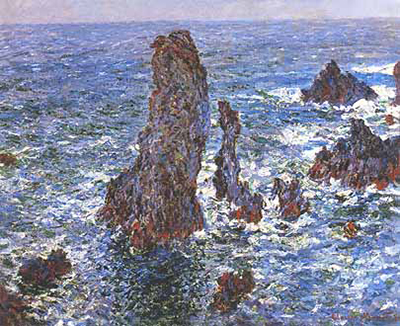
A tall rock rises left of centre from a dense field of blue and green water in Claude Monet’s Pyramids at Port-Coton, Rough Sea. A thinner needle stands beside it, while bright marks gather around their bases and lead towards scattered rocks on the right. This is the 1886 canvas in the Pushkin Museum of Fine Arts, Moscow. Its collection record identifies the work as Belle-Île (Pyramides de Port-Coton, Mer sauvage), inventory Ж-3310; the museum’s conservation project gives the medium as oil on canvas and the dimensions as 65 by 81 centimetres.[1][2]
At a Glance
Which Port-Coton painting is this?
Port-Coton is a place-name shared by several Monet paintings, so a short reproduction title is not enough to identify a particular canvas. Here, the broad upright rock, its narrow neighbour and the sequence of smaller forms at the right make a distinctive arrangement. The Pushkin collection number fixes that visual identification to an individual museum object.[1]
The Arp Museum Bahnhof Rolandseck holds a separate 1886 picture titled The Pyramids of Port-Coton in the Rau Collection for UNICEF. Its stated dimensions, 65.5 by 65.6 centimetres, describe a nearly square canvas. That format and collection record distinguish it from the wider Pushkin painting. A German title such as Die Felspyramiden von Port-Coton can therefore require further object information before it identifies a version.[3]
The Fitzwilliam Museum’s Rocks at Port-Coton, the Lion Rock, Belle-Île is another separate work from 1886, recorded as PD.27-1998. Its title overlaps the same coastal locality, but it has its own object and ownership history. These distinctions matter when comparing images: paintings of the same rocks should not be given one another’s dimensions, collection histories or individual catalogue identities.[5]
The standing rock and the narrow needle
The largest formation occupies much of the left half of the picture without sitting on the central axis. Its upper edge rises sharply against the more distant water. Lower down, its outline widens into an irregular base, so that the form feels both upright and planted within the sea. Small changes along the contour prevent it from becoming a simple geometric column.
The adjacent needle offers a contrasting shape. It is narrower, more pointed and separated from the larger rock by a bright interval. Looking through that opening gives a glimpse of water beyond the nearest forms. The gap is small, but important: it keeps the main cluster from closing into one solid mass and makes the surrounding sea seem continuous.
Other rocks extend towards the right and into the foreground. Their differing sizes and overlaps establish several distances. A low, dark form near the bottom edge brings the scene close to the viewer, while smaller outcrops farther away help carry the eye towards open water. The composition develops through these unequal intervals rather than through a symmetrical arrangement of peaks.
How the water moves through the painting
White and pale strokes are concentrated where water meets rock. Along the right-hand formations, brighter passages bend and break around dark edges. Near the central base, short marks gather into a more tangled surface. They make the water appear to meet resistance, divide and re-form as it passes the outcrops.
Farther to the left, the sea opens into a broader field of smaller blue, green and light touches. Individual marks remain apparent, but their repetition suggests a surface extending beyond the immediate rock group. The viewer can alternate between following a particular stroke and seeing a continuous body of water. That change in attention is part of the painting’s movement.
The bright marks do not become a uniform white outline around every rock. Some edges are sharp; others are interrupted or partly absorbed into surrounding colour. This variation keeps the sea from looking like a diagram of waves. It conveys activity without supplying a literal measurement of wind, wave height or the exact duration of the scene.
A narrow sky and an elevated view
The horizon lies high, leaving only a narrow band of sky. Most of the canvas is given to water, with the rocks rising within it rather than standing beneath a large expanse of air. This balance gives the sea an unusually sustained presence: it surrounds the formations, fills the spaces between them and continues towards the distant edge.
The view allows us to see water around the bases of several rocks, producing an elevated sense of looking down into the scene. Yet the largest upright formation still confronts the viewer almost as a vertical body. The painting combines these two experiences of height. It makes the setting accessible to the eye while keeping the rocks substantial and difficult to pass.
Belle-Île in 1886
The Pushkin conservation account places Monet on Belle-Île from 12 September to 25 November 1886 and associates the painting with that autumn campaign. The Fitzwilliam’s account describes a visit first intended to last only ten days that developed into roughly ten weeks. Together, these records place the work within sustained attention to the island’s coast, rather than a passing encounter with a picturesque rock formation.[2][4]
The Fitzwilliam describes its own Lion Rock picture as one of thirty-nine paintings made during the stay, while the Pushkin account uses the approximate figure of forty for the campaign. Those formulations need not be forced into a disagreement. More useful for this canvas is the evidence of repeated coastal work: Monet had time to test different arrangements and conditions within the same demanding environment.[2][4]
Repetition and related versions
The Pushkin project describes six versions of the Port-Coton pyramids, with the Copenhagen painting in the Ny Carlsberg Glyptotek closest to its own in composition. This group forms part of the wider Belle-Île campaign.[2]
Repeated motifs make small differences more consequential. A change in the width of the view can alter the balance between the principal rock and the surrounding sea. Moving a smaller outcrop closer to an edge can open or interrupt a route through the picture. Such comparisons concern the construction of particular images; repetition alone does not prove that two canvases record successive moments of one precisely documented storm.
A qualified connection with Japanese prints
The Pushkin conservation commentary notes that some scholars have connected Monet’s unusual composition with a woodcut by Utagawa Hiroshige. The Arp Museum also discusses Japanese art when interpreting its separate version. These are qualified curatorial comparisons, useful for thinking about strong silhouettes and the arrangement of forms across a surface. They do not establish a documented act of copying for the Pushkin canvas.[2][3]
Shchukin and the Pushkin collection
According to the museum’s conservation project, this was the first Monet painting to enter Sergei Shchukin’s collection. Its later life as a collected object gives another perspective on the image. A study of an exposed Atlantic coastline became something viewed, compared and preserved within a collection. The present Pushkin record supplies the inventory number Ж-3310 that distinguishes this painting from the related canvases discussed above.[1][2]
Looking between rock and painted surface
A useful way to return to the painting is to follow one edge of the largest rock down towards the white water, then let the eye move sideways across the sea. The difference between solid form and moving surface becomes apparent, but so does the recurrence of small, broken touches across both. The rock is not painted in a wholly separate visual language from the water around it.
Next, compare the narrow interval beside the needle with the wider open area at the left. One is compressed and bright; the other gives the eye space to travel. Their relationship helps make the scene feel expansive despite the crowding of forms. The picture’s force comes from these specific relations of scale, spacing, colour and touch, as well as from the dramatic character of the place.
Frequently Asked Questions
No. The Arp Museum’s 1886 painting is a separate, nearly square canvas measuring 65.5 by 65.6 centimetres.[3]
The museum presents a Hiroshige connection as a scholarly suggestion, not documented proof of copying.[2]
The Pushkin project describes six versions within the wider 1886 Belle-Île campaign.[2]
Discussion
Look again at the rock formations and the water around them. These editorial prompts invite your observations.
Reader Insights
Follow the white marks around the base of the largest rock. Where do they gather or separate?
Compare the narrow gap beside the needle with the open water at the left.
How does the high horizon affect the balance between rocks, sea and sky?
Join the Conversation
Share a detail, comparison or question about Pyramids at Port-Coton, Rough Sea below.
References
- Pushkin Museum of Fine Arts — Belle-Île (Pyramides de Port-Coton, Mer sauvage), collection object 78225, inventory Ж-3310. View source
- Pushkin Museum conservation project — Port-Coton conservation project. View source
- Arp Museum Bahnhof Rolandseck — The Pyramids of Port-Coton, 1886, Rau Collection for UNICEF; a separate 65.5×65.6cm canvas. View source
- Fitzwilliam Museum — Rocks at Port-Coton, the Lion Rock, Belle-Île, 1886; campaign context. View source
- Fitzwilliam Museum collections record — Rocks at Port-Coton, the Lion Rock, Belle Ile, PD.27-1998; separate object identity and provenance. View source







