


 by
Tom Gurney
Tom Gurney BSc (Hons) is an art history expert with over 20 years experience
Written on November 7, 2026 / Updated on November 7, 2026
Email:
tomgurney1@gmail.com
/ Phone:
+44 7429 011000
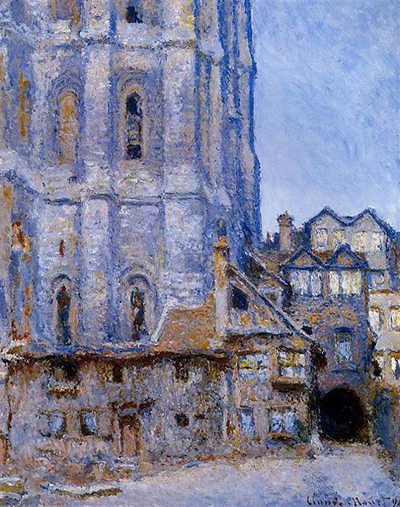
The Cour d’Albane at Rouen
The Cour d’Albane shows Rouen Cathedral beside a cluster of smaller buildings, with a dark passage opening at the lower right. Smith College Museum of Art catalogues this canvas as Cathedral at Rouen (La Cour d’Albane), dated 1892–1894, object SC 1956.24. Its courtyard on the cathedral’s northern flank gives the familiar Rouen subject a different arrangement from the better-known views of the west front.[1]
At a Glance
A cathedral cut by the frame
The cathedral occupies much of the left side and continues beyond the upper edge. We are not offered a complete architectural elevation with a convenient outline against the sky. The crop makes the building feel larger than the view available to us.
Tall openings, narrow divisions and projecting bands establish a vertical rhythm. They remain recognisable as architecture, yet their boundaries are softened by broken touches. A window can be read as a dark recess before its surrounding stonework resolves into a precise shape.
The main mass is slightly off-centre rather than symmetrically presented. Its right edge forms an abrupt meeting with blue sky. This strong boundary helps the eye measure the building’s height even though the top has been excluded from the canvas.
Cropping therefore does more than remove information. It changes the viewer’s relationship to the subject. Instead of surveying a monument from a distance, we face a fragment whose repeated details imply a larger structure extending outside the picture.
Small buildings beside the monument
The lower buildings make the cathedral’s scale tangible. Their roofs, chimneys and comparatively small windows supply another architectural language beside the tall stone mass. The contrast is visual before it is historical: shallow roof slopes meet a structure that rises insistently upwards.
At the right, overlapping gables interrupt the sky with a broken silhouette. Their angular tops differ from the cathedral’s repeated vertical openings. The eye follows a sequence of smaller peaks rather than continuing one uninterrupted ascent along the large building.
A roof crossing the lower part of the composition also creates a diagonal movement. It helps join the cathedral side to the cluster around the passage. The smaller structures are not simply background decoration; they provide routes through the arrangement of shapes.
It is tempting to assign a particular trade or household to every doorway. The image alone cannot do that. What it does show clearly is a meeting of different scales, where a large religious monument shares the painted field with more compact buildings and ordinary openings.
The dark passage and the courtyard
The nearly black opening at the lower right is one of the picture’s strongest accents. Against the lighter walls and ground, it appears to lead into a space we cannot inspect. Its depth is suggested through darkness rather than through a sequence of clearly described interior details.
Other windows repeat this relationship on a smaller scale. They punctuate the painted surfaces, sometimes as narrow vertical marks and sometimes as broader patches. These intervals prevent the architecture from becoming a continuous wall of similarly coloured brushwork.
The ground opens towards the bottom edge, but it does not become a wide, empty stage. Buildings press around it, and the large cathedral remains close. We can sense an accessible courtyard while also feeling how tightly the frame contains its surroundings.
No single human figure commands the scene. The principal exchanges happen between openings, roofs, walls and light. The dark passage attracts attention almost as an event would in a narrative painting, though the canvas does not tell us what lies beyond it.
Stone built from colour
The cathedral is not rendered in one neutral stone colour. Pale cream and pink sit beside cooler blue and violet marks. Their distribution gives the wall both solidity and instability: we recognise masonry while repeatedly noticing the separate touches that make it visible.
Dark windows sharpen the effect of lighter passages around them. Warmer roofs and wall patches below add another contrast without isolating the houses from the cathedral. Similar colours pass across the different structures, connecting forms that remain distinct in size and shape.
The open blue at the upper right matters because so much of the canvas is densely occupied. It gives the eye a broader, quieter area against which the architecture can register. The sky is part of the balance of the composition, not merely leftover space.
These observations describe what the reproduction allows us to see. They do not identify particular pigments, establish the precise hour of day or reconstruct the weather. Colour can support close looking without becoming a substitute for technical examination or documentary evidence.
A courtyard within the Rouen project
The local tourism authority places the Albane courtyard views at the beginning of Monet’s cathedral campaign, in February 1892, before his better-known studies of the west front from rooms across the square. That broad sequence helps explain why the courtyard belongs to the project while looking different from many of its other canvases.[2]
The Smith museum’s date range, 1892–1894, should nevertheless remain attached to this individual object. A chronology for the group does not establish the day on which every part of this canvas was painted. Nor does it justify replacing the museum’s range with an invented exact finishing date.[1]
The Met’s account explains that Monet moved among cathedral canvases as daylight changed and later adjusted them at Giverny, considering the works separately and in relation to one another. The series was an extended undertaking, even when a painting conveys the immediacy of light on a wall.[3]
The broader Rouen Cathedral guide follows that sustained investigation. Here the important distinction is between the history of the project and the specific evidence for this courtyard painting. They illuminate each other without becoming interchangeable accounts.
Comparing the courtyard and the portal
A separate cathedral canvas in the National Gallery of Art, Rouen Cathedral, West Façade, Sunlight, concentrates on the elaborately carved entrance front. Its collection identity and frontal emphasis differ from Smith’s courtyard scene. Similar subject names should not cause one painting’s provenance or visual details to migrate to the other.[4]
In the courtyard, the small buildings actively compete with the cathedral for space. The sky remains a substantial shape, and the lower passage creates a distinct point of depth. A tightly cropped portal view can organise attention around a different relationship between sculpted stone and the frame.
This makes repetition more interesting than simple sameness. Returning to a monument can involve changes of viewpoint and framing as well as changes in illumination. The Cour d’Albane shows why a series should be examined through its individual works rather than remembered as a single generic image.
The Met records the exhibition of twenty cathedral pictures at Durand-Ruel in 1895. That is useful context for the public presentation of the project. It does not, by itself, demonstrate that this particular Smith canvas was among those twenty; an individual exhibition history would be needed for that claim.[3]
Looking near and far
From a distance, the main division between cathedral, sky and houses is easy to grasp. Moving closer to the image brings small marks into view. A wall that first seemed continuous becomes a field of varied strokes, and an apparently firm edge can break into neighbouring colours.
Neither distance cancels the other. The windows remain useful guides when the paint becomes prominent, while the separate touches keep the architecture from settling into the appearance of a measured diagram. Recognition and awareness of the painted surface operate together.
A reproduction has limits in this respect. Its scale, lighting and colour balance affect the relationships we perceive, and a flat screen cannot establish the height of the original paint. The technique guide distinguishes such visual observations from findings that require examination of the object.
The Smith College painting
Smith credits the painting as a gift of Adeline Flint Wing, class of 1898, and Caroline Roberta Wing, class of 1896. The accession number SC 1956.24 fixes the collection identity more securely than the short title Cour d’Albane alone.[1]
In its centennial exhibition, the museum placed Monet beside a Hokusai view of Mount Fuji to invite attention to repeated monuments and transient appearances. That is a curatorial comparison, not proof that a particular Japanese print supplied the design of this courtyard composition.[1]
The painting ultimately rewards a return to its own arrangement: the cathedral cut by the frame, the smaller roofs pressing beneath it, the dark opening and the pale ground. Together these features make a particular place legible while showing how thoroughly that place has been reorganised as a painting.
Frequently Asked Questions
The painting discussed here belongs to Smith College Museum of Art, object SC 1956.24.[1]
Smith dates this canvas to 1892–1894.[1]
It focuses on the Albane courtyard on the northern flank, rather than the better-known west front.[1]
The general exhibition record alone does not establish that; an object-specific exhibition history is required.[3]
Discussion
Look again at the cathedral and the smaller buildings around it. These editorial prompts invite your observations.
Reader Insights
Follow the meeting between the cathedral’s right edge and the open sky.
Compare the large stone openings with the smaller windows and dark passage.
Consider how the courtyard changes your idea of Monet’s cathedral project.
Join the Conversation
Share a detail, comparison or question about The Cour d’Albane below.
References
- Smith College Museum of Art — SCMA Then\Now\Next: Cathedral at Rouen (La Cour d’Albane), 1892–1894, SC 1956.24; object caption, northern courtyard and curatorial comparison. View source
- Rouen Tourisme — The Cathedrals series; the early Albane courtyard views and subsequent west-front campaign. View source
- The Metropolitan Museum of Art — Rouen Cathedral: The Portal (Sunlight), 1894, 30.95.250; a separate painting and the group’s working and exhibition history. View source
- National Gallery of Art — Rouen Cathedral, West Façade, Sunlight, 1894; a distinct portal composition for comparison. View source







