


 by
Tom Gurney
Tom Gurney BSc (Hons) is an art history expert with over 20 years experience
Published on October 6, 2016 / Updated on October 23, 2026
Email:
tomgurney1@gmail.com
/ Phone:
+44 7429 011000
Tulip Fields
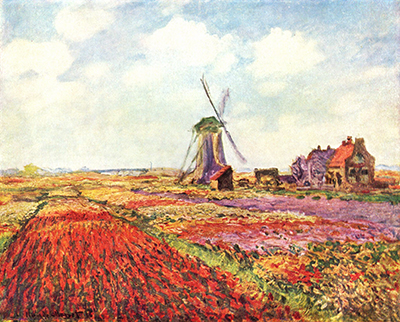
Tulip Fields in Holland is Claude Monet's 1886 landscape of brightly planted fields, a windmill and neighbouring farm buildings. The canvas shown here belongs to the Musee d'Orsay, inventory RF 1944 19. [1] Its rows of flowers combine the regularity of commercial cultivation with a broken, energetic painted surface. The subject is a working landscape, not an arrangement of cut flowers in a vase.
At a Glance
The Dutch visit of 1886
The tulip fields were not Monet's first Dutch subject. Richard Kendall's Clark catalogue essay distinguishes his earlier visits to Zaandam in 1871 and Amsterdam in 1874 from the brief bulb-field campaign of 1886. [3]
On this later journey, the invitation came from Baron d'Estournelles de Constant de Rebecque, a French diplomat based at The Hague. Monet spent about ten days in the region and made five paintings of the flowering fields near Leiden. [3]
The visit offered a different challenge from a harbour or canal. Large areas of planted colour stretched across relatively flat ground. Their brilliance was already organised by cultivation, before the painter made his own choices about framing and brushwork.
Monet's interest in travel was therefore not simply a search for unfamiliar scenery. A new place could present a different relationship between a recognisable subject and the colours available to describe it. Here, the flowers themselves seem almost to compete with paint.
A windmill above the colour beds
The windmill rises near the centre of the view. Its narrow upper structure and long sails break the low horizon, giving the eye a vertical accent above the wide bands of flowers. A group of buildings occupies the right side, while the left remains much more open.
The mill's sails do not form a perfect, evenly balanced cross. Their angles contribute to the impression of a structure observed from a particular position, rather than inserted as a decorative emblem of the Netherlands.
The Wildenstein catalogue places the campaign near Sassenheim, between Leiden and Haarlem, but states that the mill and its neighbouring buildings in this particular painting could not be precisely identified because the area had changed. [2]
That uncertainty does not weaken the composition. It establishes a useful boundary between recognising a Dutch polder landscape and claiming to know an exact surviving address. The mill can be studied as a painted form without assigning it an unsupported local name.
Rows that lead into the distance
The red bed in the lower left is the most insistent foreground shape. Its near edge meets the frame, while its sides converge towards the middle distance. Dark intervals and narrow strips of green separate it from adjacent planting.
Across the right side, paler pink, lilac and yellow beds form a second rhythm. Their rows run at different apparent angles from those nearest the viewer, making the field feel broad rather than like one straight corridor.
This organisation creates depth with relatively few large objects. The flower rows perform work that a winding road might do in another landscape: they carry attention from the lower edge towards the mill and distant horizon.
Yet the fields also remain strong bands of colour on the canvas. The viewer can alternate between reading a receding agricultural space and seeing a flatter pattern of reds, greens and purples. Neither experience needs to replace the other. Their coexistence is one of the painting's most distinctive pleasures.
Regular cultivation and restless brushwork
The planting is regimented, but the handling is not mechanically uniform. Small strokes gather into dense clusters in the foreground. Some suggest stems or individual flowers; others function mainly as changes in colour and direction.
A dark furrow can hold a boundary between beds without becoming an unbroken outline. Red marks spill visually against green ones, while pale touches interrupt the stronger areas. The result feels animated even though the main divisions of the land are clear.
Kendall connects Monet's interest with the commercial bulb-growing landscape west of Leiden, where extensive fields were planted in repeated lines. [3] The painting's pattern is therefore not the design of Monet's own garden. It begins with agricultural organisation, which he translates into an image.
The contrast is worth considering alongside his later Giverny garden . In each case, flowers offer colour and spatial structure, but the circumstances differ. One landscape was encountered while travelling; the other became a place he increasingly shaped and cultivated himself.
The sky and the farmhouse
The large sky prevents the flower fields from occupying the whole picture. Pale clouds move across a light blue ground, creating a quieter and less densely worked area above the intense foreground.
At the right, the farmhouse's roof and walls supply compact shapes between earth and sky. Their warm tones have affinities with the fields, but their firmer edges give them a different character. The buildings are neither the main narrative subject nor an incidental speck. They help establish the scale of the cultivation around them.
The mill and farmhouse are also spaced unequally. A gap of lower structures and open ground separates them, allowing the horizon to continue through the composition. That spacing avoids making the background a single continuous wall.
There is no need to invent a farmer's identity or a specific harvesting incident. The human organisation of the land is already visible in the beds, furrows and buildings. Monet describes a cultivated place without making a figure the centre of attention.
Related tulip paintings, distinct objects
Monet's five Dutch flower-field pictures do not all show this exact arrangement. The Clark's Tulip Fields at Sassenheim, also dated 1886, is a separate, smaller canvas, measuring 59.7 by 73 centimetres. [3]
The Van Gogh Museum displays another related painting under the title Tulip Fields near The Hague. Its gallery text notes that Theo van Gogh sold that work in 1886 and cautiously suggests that Vincent might have seen it. [4]
That is not proof that Vincent saw the Orsay canvas, nor evidence that two contemporaries could not influence one another. It is a documented connection between a particular Monet painting, a dealer and the possibility of an encounter.
Such distinctions matter when comparing Monet's paintings . Similar titles can refer to different compositions, sizes and histories. The visual similarities are useful, but they do not make the objects interchangeable.
Exhibition and collection history
The Orsay record lists this painting in the 1886 international exhibition at Galerie Georges Petit and in the Monet-Rodin exhibition there in 1889. It records Winnaretta Singer's purchase from Monet around July 1886; she later became Princess Edmond de Polignac. Her bequest was formally accepted in 1947, and the canvas was assigned to the Musee d'Orsay in 1986. [1]
The 1886 chronology is important because Monet did not participate in the eighth and final Impressionist group exhibition that year. Instead, he presented recent work at Georges Petit's international exhibition. [5] His public career did not remain confined to the organisation with which his name is most closely associated.
The picture's lasting interest is more specific than a general claim that bright colour was revolutionary. Monet found a subject whose repeated strips of intense colour were already unusual as a landscape. He gave them depth, texture and balance without making them less conspicuous.
Seen close up, the field breaks into many separate touches. Seen as a whole, those touches become rows, distance and a light-filled sky. The painting keeps both scales of experience available to the viewer.
Frequently Asked Questions
It dates to 1886. [1]
The Musee d'Orsay, inventory RF 1944 19. [1]
No. Earlier Dutch campaigns took place in 1871 and 1874. [3]
The catalogue states that the mill and buildings could not be precisely identified because of later changes to the area. [2]
Discussion
Look again at the images and ideas explored in Tulip Fields. These editorial prompts invite your observations.
Reader Insights
Do the flower rows read first as receding space or as bands of colour?
What role does the large sky play against the intense foreground?
How do the mill and farmhouse prevent the horizon from becoming monotonous?
Join the Conversation
Share a detail, comparison or question about Tulip Fields below.
References
- Musee d'Orsay , Champs de tulipes en Hollande, 1886, RF 1944 19, object and provenance record. View source .
- Daniel Wildenstein , Monet catalogue raisonne, volume III, cat. 1067, printed pp. 403-404, Wildenstein Plattner Institute. View source .
- Richard Kendall , Tulip Fields at Sassenheim, Clark Art Institute European paintings catalogue, cat. 227, 1886 Dutch campaign and comparative object. View source .
- Van Gogh Museum , permanent collection gallery texts, Tulip Fields near The Hague, Theo van Gogh and possible viewing by Vincent. View source .
- Wildenstein , Claude Monet, 2007 exhibition catalogue, chronology for 1886, Art Institute of Chicago research archive. View source .







