


 by
Tom Gurney
Tom Gurney BSc (Hons) is an art history expert with over 20 years experience
Written on November 8, 2026 / Updated on November 8, 2026
Email:
tomgurney1@gmail.com
/ Phone:
+44 7429 011000
Vétheuil in the Fog
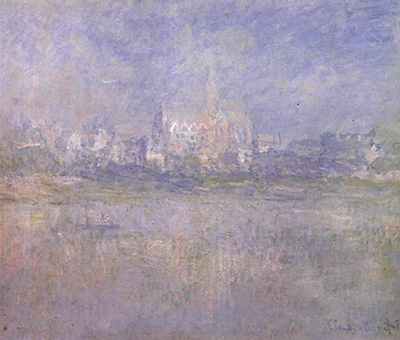
Claude Monet’s Vétheuil in the Fog makes a village seem to emerge gradually from a pale field of colour. Painted in 1879, it is now in the Musée Marmottan Monet in Paris, inventory 5024, and is W518 in the catalogue raisonné. The church and neighbouring buildings remain recognisable, but mist softens their outlines and joins them to their reflections. The image depends as much on uncertain boundaries as on the few features that can still be clearly identified.[1][2]
At a Glance
Identifying the 1879 painting
The catalogue records a canvas measuring 60 by 71 centimetres, signed and dated Claude Monet 79 at the lower right. These details identify a specific painting, not a general group of misty Seine views. The Städel Museum’s exhibition material also identifies it as a work of 1879 from the Musée Marmottan Monet. Its restrained colour and relatively compact format distinguish it from many clearer, wider views of the village.[1][2]
The village does not disappear entirely. A central architectural group rises above a darker horizontal band, and small vertical accents help the eye locate buildings within the haze. Below, the water repeats parts of that structure in a looser, more elongated form. The work therefore remains a view of a particular place even where individual roofs, trees and walls are difficult to separate.
Vétheuil and the Seine
Monet lived at Vétheuil from 1878 to 1881, according to the village’s municipal history. Its position on the Seine offered repeated encounters with the town, its church and the water. The National Gallery of Victoria notes the range of views he painted around the village in 1878 and 1879 as changing months brought different light to the same architecture and landscape.[4][5]
That setting is important to the fog painting because land and water can share the same visual uncertainty. Mist reduces the contrast of the village, while reflection breaks its shapes into colour below. Two different conditions therefore weaken the solidity of the scene at once. Architecture that might organise a clear view becomes something less fixed, encountered through the atmosphere above the river and the movement of its surface.
The canvas does not provide a detailed record of daily life in the village. There is no large foreground figure to explain the setting through an activity or gesture. Instead, the viewer must orient the scene through the relation between buildings, bank and reflection. This makes the act of seeing through haze part of the subject itself, without requiring the landscape to become a literal illustration of Monet’s private feelings.
The village through the mist
The church is the most useful point of recognition, yet its edges do not remain equally firm. Lighter, warmer marks suggest an illuminated architectural face, while neighbouring blue-violet passages make other parts recede. The building is not enclosed by a single dark contour. It seems to gather from the surrounding paint, becoming clearer in some places and almost dissolving in others.
Across the town, the arrangement is mainly horizontal, with occasional upright shapes interrupting it. Those vertical accents prevent the village from becoming a simple stripe. They also create a rhythm that continues downward in the reflection. A small change of direction or tone can suggest a building without supplying all the information that a detailed drawing would require.
The darker bank beneath the buildings has a different role. It provides a relatively continuous division between the village and its reflected image, but it is not a perfectly ruled boundary. Variations in green, blue and muted violet keep it within the same atmosphere as the rest of the painting. It gives enough support for the space to be understood without making the fog appear to end abruptly.
The town’s identity is therefore distributed across several clues. The church alone is not responsible for the entire sense of place, nor does the bank establish depth by itself. Buildings, darker shoreline and repeated reflections work together. The eye moves among them, testing how much can be recognised before the pale surface draws attention back to colour and texture.
Reflections and the painted surface
The water occupies much of the lower part of the canvas, but its reflection is not an exact duplicate of the town. Vertical marks stretch downward, while smaller interruptions loosen their connections to the buildings above. The image below the bank can be read as an echo rather than a second, fully constructed village. This difference keeps the surface of the river visible as water.
Sky and river share pale blues, violets and softened warmer notes. Their similarity reduces the usual contrast between the upper and lower halves of a landscape. The Städel Museum’s interpretation draws attention to this difficulty in distinguishing the motif from its reflection. Even so, the horizontal bank and the different directions of the marks give the viewer ways to recover the arrangement.[2]
The brushwork is varied within that narrow range of colour. Some marks spread sideways, while others stand nearly upright or cross at an angle. Small pink and warmer touches enliven the lower area without separating themselves into a new subject. The painting can feel quiet from a distance and surprisingly active up close, because its pale overall effect is made from many distinct decisions on the surface.
That visible activity should not be used to calculate how quickly Monet painted. A broken edge or short stroke does not establish the duration of a sitting, and a reproduction cannot reveal every stage of revision. Nor does the painting justify a universal rule that Monet excluded black or grey from his palette. Its observable effect lies in the relationships among colours, not in an unverified list of materials.
A reception story and its limits
The catalogue links this painting to an unsuccessful offer to the baritone collector Faure, who reportedly found it too white. Georges Clemenceau retold a related episode in his writing on Monet. In that later account, the collector initially mistakes the misty effect for insufficient painting, then admires the same work at a later visit. The anecdote concerns a disagreement over what counted as a finished picture.[1][3]
Clemenceau’s dialogue is a literary recollection, not a surviving contemporary transcript of Monet speaking. Its chronology is also inconsistent with the canvas’s accepted 1879 date. It can illuminate the way the painting’s pale appearance was remembered and discussed, but it cannot securely establish an exact date for the encounter or every word exchanged. The story should therefore remain attributed rather than silently becoming a factual timetable.[3]
The distinction matters for ownership as well. An offer that was rejected is not a purchase. The catalogue records the painting remaining with Monet and later passing to his son Michel. Faure’s appearance in a story about the canvas does not make him one of its owners. This separates the work’s reception history from the documented line through which it reached the museum.[1][3]
Retained by Monet and later exhibited
According to the catalogue, Michel Monet’s 1966 bequest to the Académie des beaux-arts brought the painting into the collection now associated with the Musée Marmottan Monet. Its inventory number is 5024. That history places the canvas among works retained within the artist’s family, rather than among pictures whose route to a museum passed through a long sequence of public sales.[1]
The catalogue lists the painting in the sixth international exhibition at Georges Petit in 1887, as number 86, but marks it withdrawn. It also records presentations in 1889 at Boussod, Valadon et Cie in Paris and Goupil in London, as well as number 40 in the Paris Monet–Rodin exhibition. A withdrawn listing and a displayed work are not equivalent, so the 1887 qualification remains part of its exhibition history.[1]
Retention by the artist does not mean that a picture was unseen or absent from public discussion. The listed exhibitions and later recollections show different ways in which a work could circulate while remaining in the family’s possession. For this canvas, that combination helps explain why a painting associated with an early rejection could also become an important example in accounts of Monet’s treatment of atmosphere.[1][2][3]
Another view of the same village
The National Gallery of Victoria owns a different Vétheuil, also dated 1879, inventory 406-4. Its record describes a summery effect and gives dimensions of 60 by 81 centimetres. It is not the Marmottan fog painting. The shared town and year make comparison useful, but the Melbourne work’s Felton Bequest provenance must not be transferred to W518.[4]
The contrast shows how much a familiar subject can change when recognisability itself becomes uncertain. In the fog picture, a building can be suggested by a small shift of warmth, while its reflection is interrupted before it becomes fully definite. The emphasis falls on the conditions through which the town is seen. That makes atmosphere a structural part of the view, rather than something added around a finished architectural description.
Looking again at the reflection
Locate the church, then move down through the darker bank into its less definite reflection. Compare the direction of the marks above and below that boundary, and notice where warmer colours briefly stand out. Returning to the whole image makes the uncertainty productive: the village remains present even though Monet does not give every object a firm edge.
Frequently Asked Questions
The painting dates from 1879. It is signed and dated Claude Monet 79 at the lower right and is W518 in the catalogue raisonné.[1]
The catalogue records an unsuccessful offer to Faure, not a purchase. The painting remained with Monet and later passed to Michel Monet.[1]
Discussion
These editorial prompts invite your observations about the village and its reflection.
Reader Insights
Which small feature first makes the village recognisable to you?
Where does the reflected image become most difficult to connect with the town?
Which warmer touch stands out most clearly within the pale blue-violet field?
Join the Conversation
Share an observation or question about Vétheuil in the Fog below.
References
- Wildenstein Plattner Institute — Daniel Wildenstein, Monet, Catalogue Raisonné, volume II, W518, printed pages 203–204. View source
- Städel Museum — Monet and the Birth of Impressionism: Where Is Vétheuil? and artwork caption, Vétheuil in the Fog, 1879. View source
- Georges Clemenceau / University of Illinois Library — Claude Monet: The Water-Lilies and Other Writings on Art, chapter 5, The Public, English translation and notes. View source
- National Gallery of Victoria — Claude Monet, Vétheuil, 1879, 406-4: object record, interpretation and provenance. View source
- Mairie de Vétheuil — Claude Monet, 1840–1926: residence in Vétheuil, 1878–1881. View source







