


 by
Tom Gurney
Tom Gurney BSc (Hons) is an art history expert with over 20 years experience
Published on October 6, 2016 / Updated on October 23, 2026
Email:
tomgurney1@gmail.com
/ Phone:
+44 7429 011000
The Japanese Footbridge, 1899
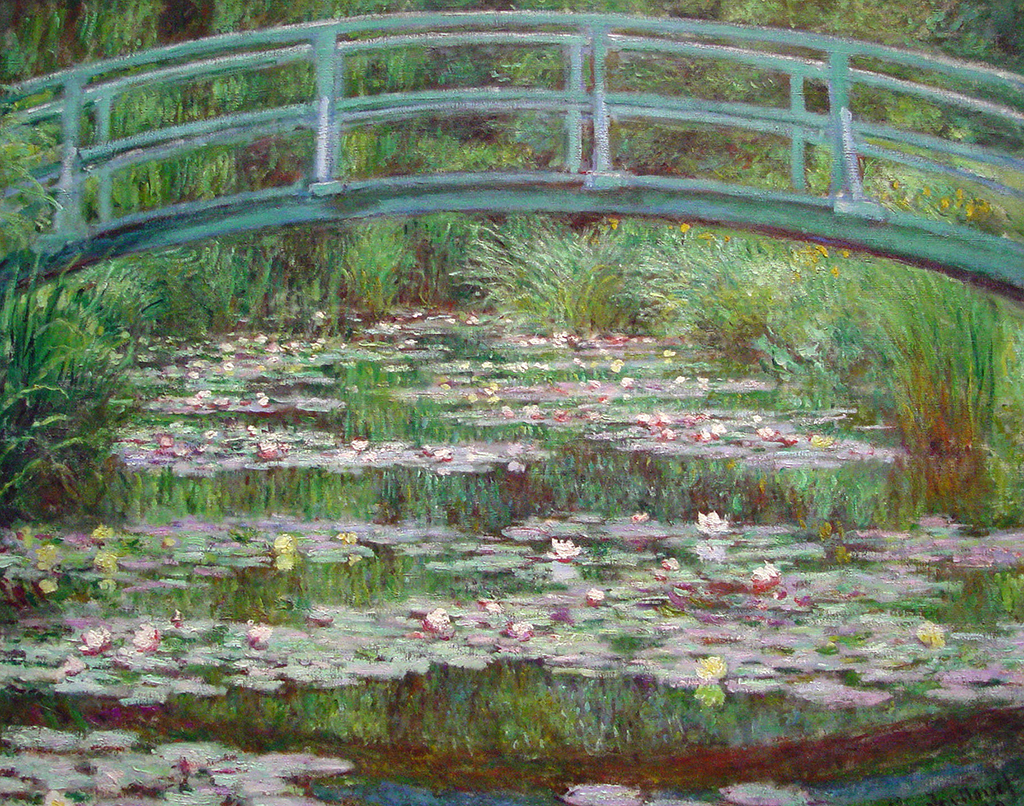
The Japanese Footbridge of 1899 in the National Gallery of Art is a particular, closely cropped view of Monet's Giverny pond. The bridge nearly touches the upper edge, leaving much of the canvas to floating plants and reflections. The Washington painting is accession 1992.9.1, distinct from other similarly titled bridge views. [1]
At a Glance
A bridge pressed against the edge
The high arch gives the picture an immediately recognisable structure, but it does not behave like a road inviting the viewer into a distant landscape. Both ends continue beyond the sides of the canvas.
The railing is seen across its width rather than followed towards a vanishing point. Repeated uprights create a measured rhythm against the less regular growth behind and below.
Its curve also compresses the available space above. Foliage fills the narrow remainder, and there is no broad opening of sky to release the enclosed scene.
The National Gallery's educational guide draws attention to this flattening effect, in which the bridge and foliage keep the eye aware of the painted surface. [2]
That reading does not eliminate depth altogether. The water still seems to recede beneath the arch, while the plants establish nearer and farther positions. The interest lies in the coexistence of those spatial suggestions with the insistent pattern across the canvas.
Bands of lilies and broken reflections
The lily pads are not scattered evenly. They gather in irregular bands, with dark intervals allowing the eye to distinguish one group from another.
Near the bottom, the forms become larger and more emphatic. Farther back, pale flowers and smaller touches make a finer pattern just beneath the bridge.
These horizontal movements contrast with the more vertical marks suggesting reflected vegetation. The pond is therefore read in two directions at once: across its floating surface and into the reflected growth.
Pink and yellow flower accents interrupt the green without overwhelming it. Their brightness depends partly on the darker colours around them.
The bridge's reflection adds another uncertainty. A solid structure above the water becomes a broken, less stable presence within it. The Water Lilies overview follows the wider motif, but this canvas gives the relationship between architecture and water a particularly compact form.
A deliberately made garden
The apparent abundance of the scene was not simply an untouched patch of countryside. Monet acquired the first water-garden land in 1893 and diverted a small watercourse connected with the Epte to supply the pond. [4]
Planting, the bridge and continued maintenance made the place that he observed. The official garden history describes a gardener attending specifically to the water garden.
This history changes the meaning of outdoor painting. Monet was responding to nature, but also to an environment he had helped organise.
The dense vegetation in the painting does not demonstrate neglect, nor establish that the bridge was built mainly to help an elderly artist move around. Its pictorial role and its physical garden function are not the same question.
The Giverny garden article explains the landscape's development. Within this picture, Monet's crop makes that designed setting appear enclosed, concentrated and almost independent of the country beyond.
One view within the 1899 group
The bridge offered a stable motif against which changes in colour, vegetation and reflected light could be explored. Repetition did not require every version to have the same format.
The Met's Bridge over a Pond of Water Lilies , also dated 1899, is notably vertical. At 92.7 by 73.7 centimetres, it distributes the relationship between bridge and water differently from the wider Washington canvas. [3]
The Met's account distinguishes eighteen views begun from twelve completed that summer. Such a distinction is more informative than treating every number attached to the group as a count of identical finished works.
Comparing the paintings can reveal decisions about space. A taller canvas permits a different balance of foliage above, bridge across and water below.
The series discussion considers repetition as sustained investigation. The shared subject does not make the individual works interchangeable or allow their separate collection histories to be combined.
Japanese art without a single borrowed formula
The bridge's form belongs to Monet's engagement with Japanese art, but that connection need not reduce the painting to a copy of one print.
His house contained prints by Hokusai, Hiroshige, Utamaro and other artists. The official account describes a collector who lived among these works without travelling to Japan. [5]
Their presence establishes a continuing visual interest. It does not, on its own, identify the exact source of this canvas's crop or every decision about reflection.
The painted bridge also belongs to a real garden, with living plants and conditions of light that a woodblock print could not prescribe. Collection, garden design and observation meet without becoming one simple cause.
The Japanese Prints guide develops the collecting context. Here, the high arch, truncated sides and enclosed green field can be examined closely without inventing a direct correspondence that the surviving evidence has not established.
Colour and the material surface
The bridge's pale rails stand out from the darker growth, while flowers and small reflections keep the water active. These effects depend on the relationships between colours, not merely on identifying objects.
Surface appearance also has a history. Conservator Michael Swicklik's study of French varnishing practices shows that Monet's approach changed over his career and should not be reduced to a rule that he always, or never, accepted varnish. [6]
The essay relates his later concern with unaltered colour and texture to the series paintings. It also warns that coatings could be applied after a work left an artist's hands.
That broader research is not a laboratory analysis of every mark in this footbridge painting. Its value here is to explain why finish, gloss and later treatment matter to looking.
The technique article distinguishes material evidence from visual inference. A reproduction cannot establish the composition of a pigment or the precise sequence of paint layers.
From Durand-Ruel to Washington
The National Gallery traces the painting from Monet to Durand-Ruel in January 1900. It later entered the Carnegie Institute in Pittsburgh, passed through dealer Sam Salz and the Mudd collection, and reached Washington as a gift in 1992. [1]
This history separates it from other bridge views that travelled through different collections. Even a familiar title does not identify an object without dimensions, a collection record or an accession number.
Its ownership also reminds us that a scene made in a private garden could reach successive public audiences. The physical place depicted remained in France while the canvas acquired a history elsewhere.
A museum label is therefore a beginning rather than a complete account. Date, medium and title locate the work; provenance explains how that particular painted surface moved between people and institutions. Neither should be borrowed from a neighbouring picture merely because the motif looks familiar.
What remains when the bridge is absent
Later pond paintings often dispense with a bridge, banks or visible horizon, leaving water, plants and reflections to occupy the field. Temkin and Lawrence's account of the Water Lilies places this change within a prolonged development, not a single sudden invention. [7]
The 1899 canvas makes an illuminating comparison because its architectural anchor remains so clear. Remove that anchor mentally, and the water's more uncertain space becomes easier to recognise.
Yet this is not a claim that every later work followed one inevitable path. Monet also returned to recognisable garden structures.
The bridge painting deserves attention for its own solution, not only as a preliminary step towards the monumental decorations. Its compact format holds a strong arch, dense growth and discontinuous reflections in active balance. The eye can recognise the place quickly, then spend much longer discovering how the coloured marks keep that place from becoming entirely fixed.
Frequently Asked Questions
The National Gallery of Art's 1899 canvas, accession 1992.9.1. [1]
No. Planting and regular maintenance helped create the setting. [4]
No. Monet's collection is documented, but a specific compositional dependency needs additional evidence. [5]
Discussion
Look again at the images and ideas explored in The Japanese Footbridge, 1899. These editorial prompts invite your observations.
Reader Insights
Follow the rhythm of the bridge uprights and the less regular lily-pad bands.
Compare the water's surface with the reflected space within it.
Consider what changes when a similar motif is painted in a vertical format.
Join the Conversation
Share a detail, comparison or question about The Japanese Footbridge, 1899 below.
References
- National Gallery of Art , The Japanese Footbridge, 1899, 1992.9.1; object record and provenance. View source .
- National Gallery of Art , Picturing France, 1830-1900, page 60; the enclosed garden and spatial interpretation. View source .
- The Met , Bridge over a Pond of Water Lilies, 1899, 29.100.113; a distinct vertical painting and the group chronology. View source .
- Maison et jardins de Claude Monet , Water lily pond; construction, planting and maintenance. View source .
- Maison et jardins de Claude Monet , Les estampes japonaises; the Giverny print collection. View source .
- Michael Swicklik , French Painting and the Use of Varnish, 1750-1900, Studies in the History of Art 41, 1993, especially pages 169-171; broader material-history context. View source .
- Ann Temkin and Nora Lawrence, MoMA , Claude Monet: Water Lilies, 2009, pages 5-7; changing formats and the late decorative project. View source .







