


 by
Tom Gurney
Tom Gurney BSc (Hons) is an art history expert with over 20 years experience
Published on October 6, 2016 / Updated on October 23, 2026
Email:
tomgurney1@gmail.com
/ Phone:
+44 7429 011000
Water Lilies, 1917-1919
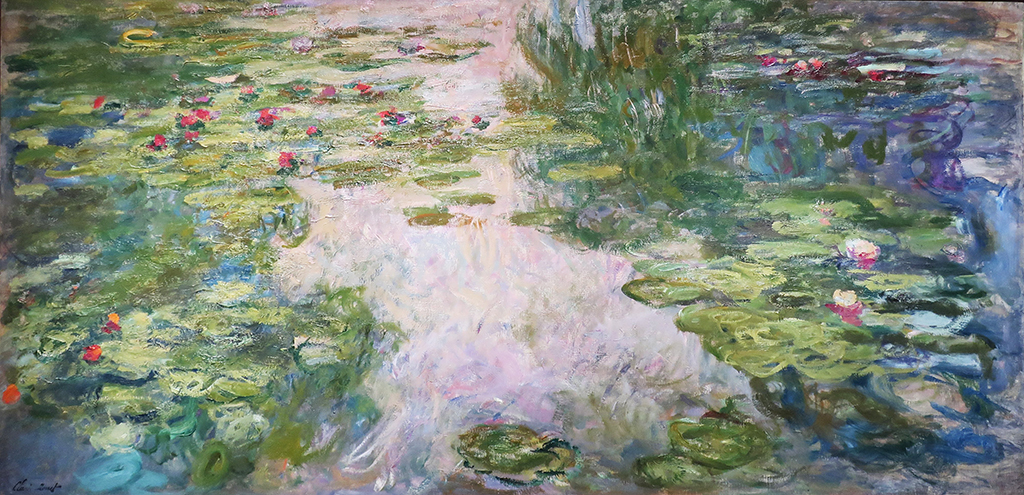
Claude Monet's Water Lilies of 1917-1919 belongs to the Honolulu Museum of Art, where it is recorded as a purchase made in memory of Robert Allerton in 1966. Also known by its French title Nympheas, the painting brings a wide expanse of floating leaves, flowers and reflections close to the viewer. It is a particular canvas within Monet's extensive water-garden work, not a title for the whole series. [1]
At a Glance
An opening made of reflected light
A broad area of pink, lilac and pale grey passes through the middle of the composition. It opens towards the lower edge, separating masses of lily pads without becoming a straight channel. The shape is irregular, crossed by small leaves and disturbed by overlapping brushmarks.
On either side, the water appears cooler and more densely patterned. Blue is especially prominent at the right, while greener passages gather at the left. These differences make the central light seem luminous, even though Monet does not show the sky directly. Its presence is suggested through the water.
The pale opening has a structural role as well as a colouristic one. It gives the eye room to move through an otherwise crowded surface. Large leaves along the lower-right edge lead towards smaller, more scattered forms farther across the pond.
Yet this movement is not a conventional view into a distant landscape. There is no horizon or visible shore to establish a fixed distance. The viewer looks across and down into the scene at once, following a patch of reflected light whose boundaries remain uncertain.
Leaves, flowers and the reflected garden
The lily pads are not identical green discs. Some are broad and rounded, some appear as thin strips, and others overlap until their individual contours become difficult to follow. Darker marks underneath several leaves give them weight and separate them from the reflected colours around them.
Flowers supply smaller, sharper accents. Red and pink notes gather among the greenery, joined by touches of yellow and white. These compact marks attract attention without creating a single dominant bouquet. They are distributed across the width, encouraging the eye to travel rather than settle permanently in one place.
Near the upper centre, dark upright strokes interrupt the horizontal spread. They suggest reflected foliage, not bushes standing in the middle of the water. Their downward movement contrasts with the rounded leaves resting on the surface.
This distinction between a floating object and a reflection is central to the image. A pad belongs to the pond's physical surface; a reflected tree seems to extend beneath it, although the tree itself is outside the picture. Monet lets both occupy the same painted field. The result is spatially ambiguous while remaining rooted in an observable garden.
The wide canvas and its painted surface
The catalogue raisonne records dimensions of about one metre by two metres. [2] That horizontal shape allows several concentrations of lilies to coexist. Instead of placing a central object against a background, Monet spreads the subject across the canvas and lets some forms continue beyond its edges.
A reproduction can make the work look like a delicate arrangement of coloured fragments. The original scale changes the encounter. A small flower in the overall composition may consist of several emphatic touches; an apparently smooth passage of reflected light breaks into separate strokes when examined closely.
Different directions of handling help organise the surface. Long, flatter marks stretch across parts of the water, while curved touches describe leaves. More upright strokes suggest the hanging or reflected forms near the top. Their interaction makes the painting feel mobile without requiring a depicted storm or ripple pattern.
The image remains legible as a pond, but the paint never entirely disappears into the illusion. It is possible to recognise foliage and flowers while also noticing the independent rhythm of pink, green and blue marks. This tension helps explain why the late water paintings can feel close to abstraction without abandoning their natural subject.
A garden cultivated over decades
The setting was Giverny , where Monet had lived since 1883. His water garden developed later: the Metropolitan Museum of Art records his purchase of land with a pond in 1893 and the subsequent creation of the lily garden. Earlier paintings often included the wooden bridge and surrounding vegetation, giving the viewer a more explicit framework for the place. [3]
Here, that architecture has disappeared. The garden is still present, but much of it is represented indirectly, through reflected light and the fragments of vegetation visible on the water. The change is therefore not simply from one subject to another. It concerns how much of a familiar place the artist chooses to reveal.
The Water Lilies were not a uniform sequence of repeated copies. Differences of scale, viewpoint, colour and density produced distinct relationships between the flowers and their surroundings. In this canvas, the broad pale opening and the contrasting masses of pads create a balance that belongs to this particular view.
Late work and the larger decoration
The date range places the Honolulu painting within Monet's renewed large-scale work on the pond during the First World War. The National Gallery's account of a different late canvas explains that his enlarged studio accommodated monumental paintings and that he could work on several canvases over a period of years. That context cautions against treating every late lily picture as a rapidly completed outdoor impression. [4]
Monet's larger decorative ambition eventually led to the paintings installed at the Orangerie in Paris. The museum distinguishes the offer made after the Armistice in November 1918, the formal donation contract of 1922 and the installation after Monet's death in 1927. [5]
Honolulu's painting is not one of those installed compositions. It shares the broader investigation of water, reflection and an enveloping field of colour, while retaining its own history as an independent canvas. Its 1917-1919 dating is also a range assigned to the work, not evidence that Monet invented dated titles to keep otherwise identical pictures apart.
From Giverny to Honolulu
The catalogue traces the painting from Michel Monet at Giverny to the New York dealers Hirschl and Adler around 1966, followed by its acquisition for the Honolulu collection that year. The museum's credit specifies a purchase in Robert Allerton's memory; it does not describe a gift of the canvas by Allerton himself. [1] [2]
Its later exhibition history includes the 2019 Monet: The Late Years presentation at the de Young Museum and the Kimbell Art Museum. In the Honolulu museum's account, curator Katherine Love describes inspecting the surface closely before accompanying the loan, so that any changes during travel could be recognised. [6]
That account is a reminder that this is a substantial painted object, not merely a familiar image reproduced at any size. Its texture, dimensions and physical condition shape the experience of seeing it. The record of a loan also places it among other late works, where similarities of subject need not obscure differences between canvases.
The painting rewards both ways of looking. From farther away, the pink-lit opening draws the surrounding greens and blues into a broad composition. Closer attention reveals flowers, leaf edges and strokes that resist complete stillness. What first appears calm is held together by an active interplay of reflected depth and painted surface.
Frequently Asked Questions
It belongs to the Honolulu Museum of Art, accession 3385.1. [1]
It is the French title commonly translated as Water Lilies. [1]
Discussion
Look again at the images and ideas explored in Water Lilies, 1917-1919. These editorial prompts invite your observations.
Reader Insights
Does the pink central area read first as light, sky or water?
Which shapes appear to float, and which seem to extend beneath the surface?
How might the two-metre width change the experience compared with a small reproduction?
Join the Conversation
Share a detail, comparison or question about Water Lilies, 1917-1919 below.
References
- Honolulu Museum of Art , Katherine Love, HoMA Selects: Claude Monet's Water Lilies, 1917-1919, accession 3385.1. View source .
- Daniel Wildenstein , Monet: Catalogue raisonne, 1996, volume IV, W1895, p. 902, Wildenstein Plattner Institute digital edition. View source .
- The Metropolitan Museum of Art , Claude Monet, Bridge over a Pond of Water Lilies, 1899: the creation of the water garden. View source .
- National Gallery , London, Claude Monet, Water-Lilies, NG6343: late studio practice and the decorative project. View source .
- Musee de l'Orangerie , History of the Water Lilies cycle. View source .
- Honolulu Museum of Art , Have Art, Will Travel, HoMA Magazine, winter 2022-2023, pp. 6-9. View source .







