


 by
Tom Gurney
Tom Gurney BSc (Hons) is an art history expert with over 20 years experience
Published on October 6, 2016 / Updated on October 23, 2026
Email:
tomgurney1@gmail.com
/ Phone:
+44 7429 011000
Waterlily Pond, Harmony in Pink
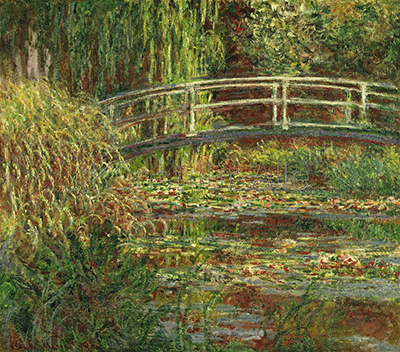
Claude Monet's Waterlily Pond, Harmony in Pink depicts the cultivated water garden at Giverny in 1900. Known in French as Le Bassin aux nympheas, harmonie rose, the painting belongs to the Musee d'Orsay. Its bridge and densely planted banks frame a pond whose flowers and reflections carry warm pink and reddish accents through a predominantly green setting. [1]
At a Glance
- Artist Claude Monet
- Date 1900
- Medium Oil on canvas
- Dimensions 90 x 100.5 cm
- Collection Musee d'Orsay, Paris
- Inventory RF 2005. [1]
An off-centre view of the bridge
The bridge crosses the upper part of the painting, but Monet does not show it as an isolated architectural object. Its left approach is partly hidden by vegetation, and its right end continues beyond the frame. Rather than explaining exactly how to cross the garden, the structure provides a curved band around which plants and water are organised.
Pale rails catch the eye against the deeper greens behind them. Their repeated uprights establish a measured rhythm, while the dark underside of the span separates that rhythm from the more broken reflections below. The bridge is recognisable at once, yet its edges are softened by the surrounding abundance.
The left bank presses forward into the picture. Drooping foliage occupies much of the foreground, creating an asymmetrical balance with the open water towards the right. Above, long hanging branches and upright tree trunks echo one another without forming a regular screen. There is no broad area of sky to release the scene from this enclosure.
The view is therefore both intimate and crowded. We seem close enough to distinguish clusters of leaves and flowers, but are not given a clear position from which every part of the garden can be surveyed. Cropping makes the scene feel like a selected encounter within a larger place.
What makes the harmony pink?
The title does not mean that the whole canvas has been covered in pink. Greens dominate much of the vegetation, and blue or violet passages deepen the shadows and reflections. Pink appears through relationships: small flowers, warm reddish patches and softer notes within the surrounding water.
Those accents are especially effective because they are dispersed. A patch near the centre can be answered by another lower down, drawing the eye through the pond rather than fixing it on one flower. Pale lily pads and brighter touches interrupt darker areas, so warmth and light do not belong exclusively to the bridge or the bank.
The effect depends on differences within a richly worked surface. A single colour name provides a useful entry into the picture, not a complete description of it. Looking for pink soon makes the neighbouring greens, blues and darker reds more noticeable as well.
The brushwork also prevents the scene from settling into an evenly coloured pattern. Short strokes describe floating vegetation; longer marks suggest hanging growth; broader dark passages hold the water together. These changes of direction help distinguish forms without giving every leaf a separate outline.
A landscape cultivated before it was painted
Monet's garden at Giverny was itself a sustained creative undertaking. The Musee des impressionnismes Giverny describes the lower parcel he bought in 1893, his plans for a pond supplied from a branch of the Epte, and the coloured water lilies obtained from the specialist grower Latour-Marliac. The water garden developed alongside the flower garden near the house. [3]
This matters because Harmony in Pink is not simply a record of untouched nature. The bridge, planting and water had already been arranged and maintained. Monet then made further choices in painting them: where the frame would cut the scene, how much bank to include and which colour relationships to emphasise.
A familiar setting could support repeated exploration precisely because it was not visually fixed. Growth, reflected light and the artist's position changed the possibilities. Returning to the pond did not require him to repeat the same composition mechanically, even when the bridge remained an obvious organising feature.
Pink and green are different paintings
The related Waterlily Pond, Green Harmony is a separate canvas from 1899, also in the Musee d'Orsay. Its inventory number is RF 2004, while Harmony in Pink is RF 2005. The green picture is more nearly square, measuring 89.5 x 92.5 cm, and gives the bridge a more central position. [2]
Comparing them shows why a colour change is only part of the difference. The balance of bridge, bank and reflected vegetation also changes. Harmony in Pink places greater pressure on the left-hand foreground and allows the span to carry the eye out towards the right edge. Each picture establishes its own distribution of space.
The National Gallery's account of the related bridge paintings highlights another important tension: we can seem to look down on floating lilies while looking towards, or slightly up at, the bridge. Such shifting cues make the pond oscillate between an expanse of water and a surface covered in paint. The London painting is another distinct work, not an alternative location for either Orsay harmony. [4]
Exhibiting a repeated subject
The bridge-and-pond pictures were presented to a wider public in Monet's 1900 exhibition at Durand-Ruel's Paris gallery. The Art Institute of Chicago's scholarly catalogue describes a reception that was not entirely uniform: some critics admired the radiance of the new water-garden pictures, while others questioned the limited variation in viewpoint. This was a response to the group, not a documented verdict on every individual canvas. [5]
That disagreement identifies a real question raised by the paintings. Is returning to one motif a limitation, or does it reveal differences that a single picture could not make visible? Harmony in Pink offers a concrete answer through its own arrangement. Its off-centre bridge and warm accents make repetition into comparison rather than duplication.
The comparison still interests other painters. In the Musee d'Orsay's Une oeuvre un regard series, Sean Scully selected the green and pink harmonies together. Their pairing remains a way to explore how closely related subjects can produce different pictorial experiences. [7]
From Camondo's collection to the Musee d'Orsay
The museum's provenance records a rapid sequence of ownership in November 1900: Durand-Ruel acquired Harmony in Pink from Monet on the twenty-first, and Isaac de Camondo acquired it the following day. Camondo's bequest brought the painting into the French national collection in 1911. It was assigned to the Musee d'Orsay in 1986, after earlier periods at the Louvre and the Jeu de Paume. [1]
The museum's wider collection history explains the significance of Camondo's gift. The rooms devoted to his collection opened at the Louvre in 1914, allowing Monet and several other still-living Impressionist artists to be represented there. Private collecting helped change the public standing of work that had developed outside the traditional Salon system. [6]
That institutional history should not obscure the picture's immediate appeal. Before it is an example of museum recognition, it is a carefully selected view of a particular garden. Its bridge gives order to the scene, while the dense plants and interrupted reflections keep that order from becoming rigid. The resulting harmony is not uniformity, but a balance sustained between competing colours, directions and depths.
Frequently Asked Questions
In 1900. [1]
It belongs to the Musee d'Orsay in Paris, inventory RF 2005. [1]
The current museum record gives 90 x 100.5 cm. [1]
No. Green Harmony is the separate 1899 painting RF 2004. [2]
Discussion
Look again at the images and ideas explored in Waterlily Pond, Harmony in Pink. These editorial prompts invite your observations.
Reader Insights
How does the cropped bridge affect your sense of the garden continuing beyond the frame?
Which pink or red accents seem most important within the green setting?
What changes most when you compare the pink and green harmonies?
Join the Conversation
Share a detail, comparison or question about Waterlily Pond, Harmony in Pink below.
References
- Musee d'Orsay , Le Bassin aux nympheas, harmonie rose, RF 2005. View source .
- Musee d'Orsay , Le Bassin aux nympheas, harmonie verte, RF 2004. View source .
- Musee des impressionnismes Giverny , Le jardin de Monet a Giverny. View source .
- National Gallery , London, The Water-Lily Pond, NG4240. View source .
- Art Institute of Chicago , Monet Paintings and Drawings: Cat. 37, Water Lily Pond, Exhibiting the Motif. View source .
- Musee d'Orsay , Paintings: A rich, complex legacy. View source .
- Musee d'Orsay , Sean Scully: Le Bassin aux nympheas, harmonie verte et harmonie rose. View source .







