 by Tom Gurney
Tom Gurney BSc (Hons) is an art history expert with over 20 years experience
Published on June 19, 2020 / Updated on October 2, 2026
Email: tomgurney1@gmail.com / Phone: +44 7429 011000
Madonna and Child with Scenes from the Life of Saint Anne by Fra Filippo Lippi
Fra Filippo Lippi’s Madonna and Child with Scenes from the Life of Saint Anne is one of the most original domestic devotional paintings of the early Florentine Renaissance. Painted about 1452–53 and now in the Uffizi Galleries’ Pitti Palace collections, the large circular panel places the Virgin and Child in the foreground while episodes from the life of Mary’s mother, Saint Anne, unfold behind them.[1]
The Uffizi describes the work as one of the most original sacred images of its period. Its originality comes partly from the way Lippi handles time.[1] Mary and Christ are monumental and immediate. Behind them, the Meeting of Joachim and Anne and the Birth of the Virgin belong to an earlier generation and an earlier moment.
Lippi does not separate those stories into independent compartments. He integrates them within one Renaissance domestic interior. The circular format, or tondo, is equally significant. In fifteenth-century Florence, large round sacred images were particularly associated with domestic settings and family devotion. Documents from 1452–53 record Lippi being commissioned to make a tondo for Leonardo Bartolini Salimbeni, and scholars have often connected those records with this painting. The identification is plausible rather than absolutely proven, but the subject and format fit a wealthy family residence remarkably well.
The painting becomes almost a meditation on family continuity. Saint Anne gives birth to Mary; Mary becomes mother of Christ; the foreground Child embodies the culmination of the genealogy unfolding in the background. A pomegranate adds another layer, carrying associations with fertility and Christ’s future Passion. The work is therefore especially valuable for discussing Renaissance family life, female domestic space, childbirth, devotional imagery and the way a circular format can organise several moments of sacred history at once.
At a Glance
- ArtistFra Filippo Lippi
- TitleMadonna and Child with Scenes from the Life of Saint Anne
- Datec. 1452–53
- MediumTempera on wood
- FormatTondo
- Diameterabout 135 cm
- Current locationPitti Palace / Uffizi Galleries, Florence
- Probable patronPossibly Leonardo Bartolini Salimbeni
- Likely functionDomestic devotional image
- ForegroundVirgin Mary and Christ Child
- Background storiesMeeting of Joachim and Anne; Birth of the Virgin
- Key objectPomegranate
- Major themesMotherhood, family continuity, domestic devotion, childbirth, fertility and Passion
Contents
- What Does the Painting Show?
- The Birth of the Virgin
- Leonardo Bartolini Salimbeni
- Architecture
- The Christ Child
- From Masaccio to Domestic Grace
- Sacred Genealogy and Florentine Genealogy
- Why the Tondo Suited Family Devotion
- The Foreground as Devotional Present
- Why the Circular Composition Feels Unified
- FAQs
- References
What Does the Painting Show?
Mary dominates the foreground. She holds the Christ Child close to the front edge of the pictorial space. Their scale is much larger than that of the background figures.
Behind them, architecture opens into a sequence of rooms. The viewer discovers other women and events. One scene shows Joachim and Anne meeting.
Another shows the birth of Mary. The foreground and background therefore represent different generations. Lippi makes chronology visible through scale and space.
Saint Anne. Saint Anne is the traditional mother of the Virgin Mary. Although she is not named in the canonical Gospels, later Christian traditions developed a narrative around Anne and her husband Joachim. Their long childlessness, eventual conception of Mary and role as grandparents of Christ made them especially important in devotional culture concerned with family and fertility.
Anne’s story offered a sacred model of motherhood before Mary herself became a mother. In this tondo, that generational structure is fundamental. The foreground Virgin cannot be separated from the background story of her own birth.
Joachim and Anne. One background episode represents the Meeting of Joachim and Anne. According to later tradition, husband and wife had been separated by grief after their childlessness was treated as a sign of divine disfavour. Angelic messages announce that they will have a child.
They reunite at Jerusalem’s Golden Gate. Artists often represent the meeting as an embrace. The episode became associated with the miraculous conception of Mary. Lippi places it inside the same spatial world as the Virgin and Christ. Past and present coexist.
The Birth of the Virgin
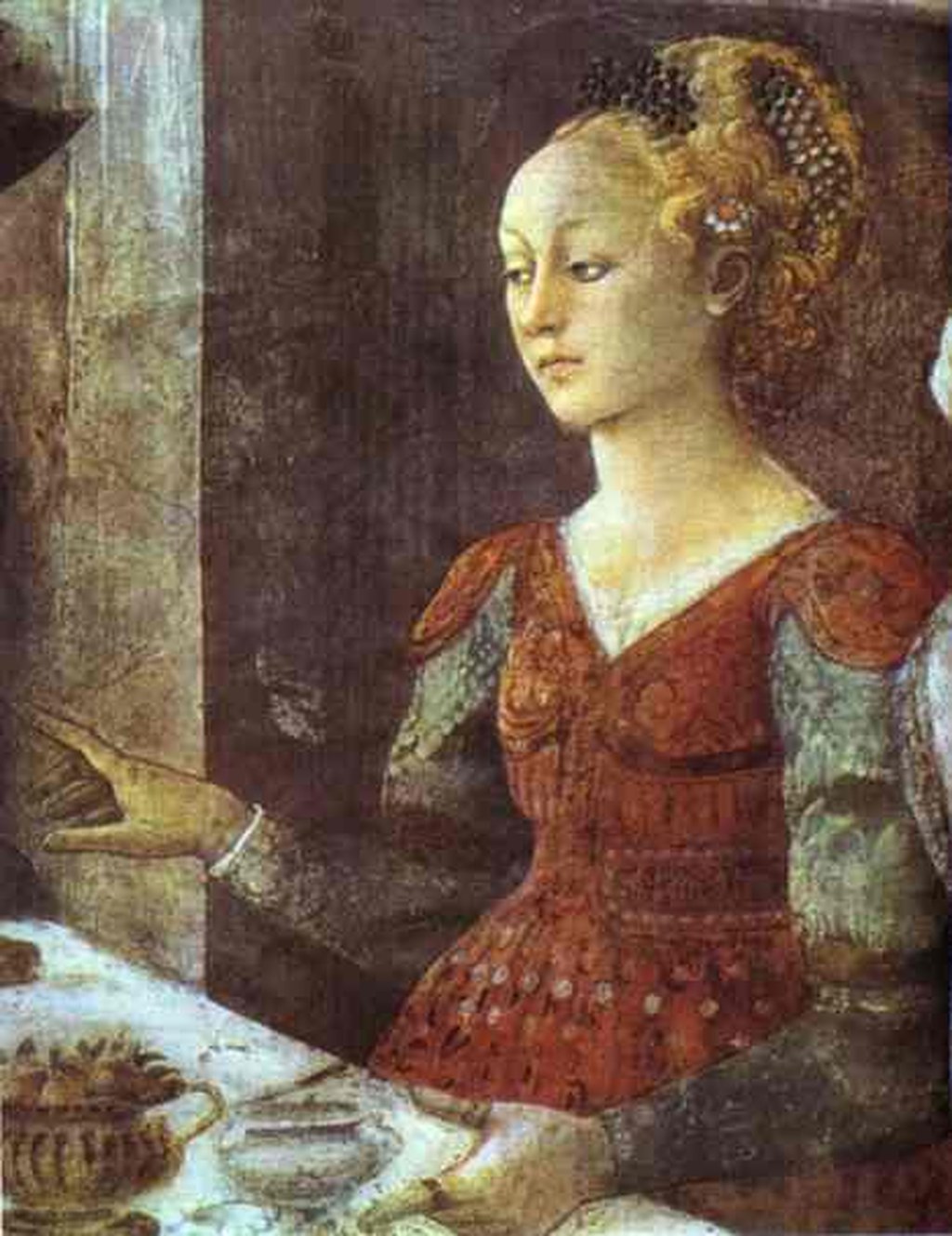
Another background scene shows Anne following the birth of Mary. This is one of the most valuable sections for social history. Lippi translates the sacred birth into an elite fifteenth-century domestic interior.
Women attend the mother and newborn child. Furniture, textiles and household activity make the scene recognisable to Florentine viewers. The Uffizi highlights precisely this unusually rich representation of female domestic life.[1] Sacred history becomes a lens onto contemporary experience.
Women and the Domestic Interior. Many monumental Renaissance paintings are dominated by public male spaces: courts, churches, streets and civic assemblies. This tondo gives unusual prominence to the female household. Birth, childcare and women’s attendance structure the background.
For a domestic patron, that would have made the image particularly immediate. The sacred genealogy unfolds through acts familiar to family life. The painting should not be read as a literal documentary photograph of childbirth. Its environment is idealised. Nevertheless, it preserves valuable evidence about how elite Florentine viewers imagined domestic femininity.
The Tondo. The round format is essential to the painting’s meaning. Tondi became highly popular in fifteenth-century Florence, especially for devotional images associated with households. The circle lacks a conventional top-left-to-bottom-right reading path.
Lippi therefore has to organise narrative through curves, layers and receding architecture. Mary and Christ occupy the strongest foreground arc. The background scenes then wrap around and behind them. The circular boundary helps hold several episodes together. Rather than feeling like three separate pictures, they become one family history.
Leonardo Bartolini Salimbeni
Documents from 1452–53 record Lippi receiving a commission for a tondo from Leonardo Bartolini Salimbeni. The Uffizi notes that scholars tend to connect those records with this painting.[1] The association makes sense.
The date fits. The format fits. The domestic character of the subject also suits a residence.
But the wording should remain cautious. The document does not describe every visual detail needed to identify the surviving panel beyond doubt. The painting was *probably* connected with the Bartolini Salimbeni commission.
Domestic Devotion. A large household tondo could function as more than decoration. It brought sacred figures into the daily environment of a family. Prayer did not occur only in churches.
Wealthy households maintained devotional routines and sacred images. The imagery in this panel is particularly suited to family identity. It does not simply show Mary and Christ.
It shows generations. The patron’s household could contemplate its own births, marriages and continuity through a sacred genealogy. That does not reduce the painting to family propaganda. Its devotional meaning and domestic resonance reinforce one another.
Scale and Time. One of Lippi’s most intelligent devices is the changing size of the figures. Mary and Christ are huge compared with the background actors. This is partly ordinary perspective: nearer figures appear larger.
But the Uffizi also interprets the changing scale as expressive of temporal distance.[1] The background belongs to the past. The foreground belongs to the devotional present.
Space therefore becomes time. The viewer understands historical sequence without needing captions. This is a sophisticated solution to continuous narrative.
Architecture
Architecture unifies the episodes. Walls, openings and rooms divide events without turning them into separate framed compartments. This gives the tondo Renaissance coherence.
Earlier narrative art often used explicit divisions. Lippi creates one believable environment in which several times coexist. Architecture tells the viewer where to look next. It also creates a plausible elite household. Form and social content become inseparable.
The Pomegranate. The pomegranate is one of the painting’s most memorable objects. Its many seeds made it a natural symbol of fertility. That meaning fits a picture centred on generations of mothers and children.
Christian imagery also associated the fruit’s red interior with Christ’s future Passion. The pomegranate therefore joins beginning and end. It can suggest abundant life while pointing towards death. In the hands of the Christ Child or close to him, the symbol allows the peaceful domestic scene to contain foreknowledge. Renaissance devotional images often work through this kind of double meaning.
Motherhood. Motherhood is the conceptual core of the panel. Anne becomes mother of Mary. Mary becomes mother of Christ.
The viewer encounters those relationships simultaneously. This makes the painting unusually rich compared with a standard Madonna and Child. Mary is not only mother.
She is also daughter. The background restores her own family history. For female viewers in particular, the chain of generations could offer a powerful devotional framework.
Childbirth. The Birth of the Virgin background scene is valuable because childbirth itself was a major concern in Renaissance family life. Maternal and infant mortality were real dangers. Religious images connected with Anne, Mary and childbirth could therefore carry intense emotional relevance.
The tondo should not be simplistically labelled a “birth charm”. But its subject clearly intersects with hopes around fertility, safe delivery and family continuity. The pomegranate reinforces that field of meaning.
The Christ Child
Christ remains the theological culmination of the entire family story. His body dominates the foreground with Mary. The background events lead genealogically towards him.
The viewer therefore reads backwards and forwards. Anne’s miraculous motherhood anticipates Mary. Mary’s motherhood produces Christ. Christ’s future Passion is hinted at through objects such as the pomegranate. The panel holds salvation history within family history.
Mary. Mary appears both as the central sacred woman and as the child whose birth is shown behind her. This doubled identity is one of the painting’s intellectual pleasures. She is simultaneously daughter and mother.
The composition encourages viewers to understand sanctity through biography rather than through a single frozen icon. Lippi’s large foreground Madonna has the physical presence associated with his mature work. Yet her meaning depends on the small narrative scenes around her.
Renaissance Family Identity. Florentine elite families placed enormous value on lineage. Marriage, inheritance and children connected private life to social continuity. A painting centred on sacred generations could resonate strongly in that culture.
The likely Bartolini Salimbeni context strengthens the point. A household tondo does not need to contain literal family portraits to speak to dynastic concerns. Sacred genealogy could provide the model. The Christian family becomes the framework through which an earthly family understands itself.
Colour and Surface. Lippi’s tempera technique supports both monumental figures and minute domestic detail. The foreground needs broad visual clarity. The background rewards close inspection.
This difference in scale allows colour and line to operate at two levels. Mary and Christ remain legible from across a room. The small women, textiles and architecture invite the viewer nearer. The tondo therefore changes character with distance.
From Masaccio to Domestic Grace
Lippi’s figures retain physical solidity inherited from the early Florentine Renaissance. Yet this work is less austere than Masaccio. The architectural clarity supports a world full of textiles, household objects and human interaction.
Lippi’s mature contribution is to join spatial intelligence with grace and intimacy. That combination would prove enormously influential. It forms part of the bridge towards Botticelli’s later Florentine style.
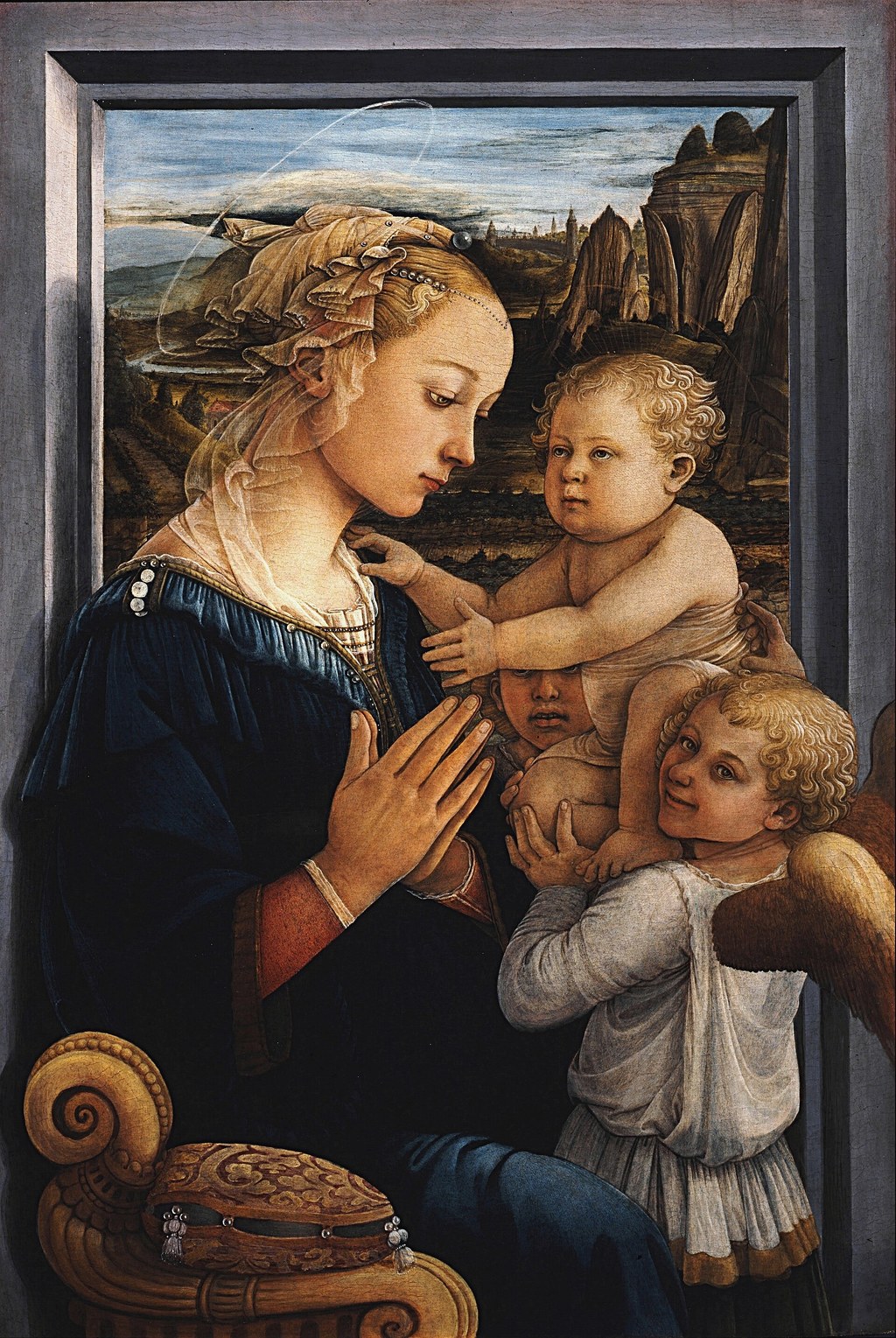
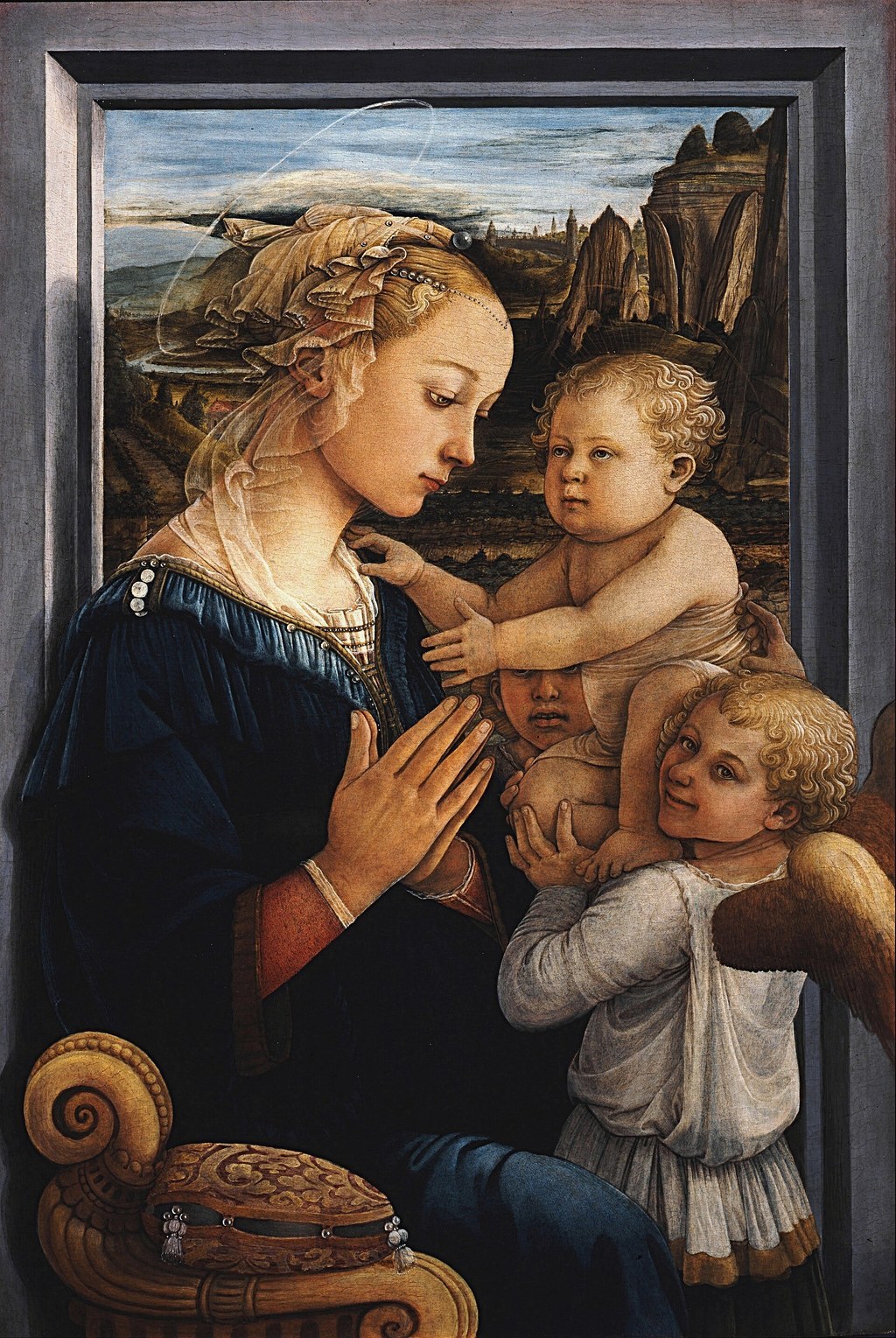
Comparison with the Lippina. The Uffizi Madonna and Child with Two Angels offers an excellent comparison.[1] Both paintings bring sacred motherhood close to contemporary Florentine experience. But their methods differ.
The Lippina strips the composition down to Mary, Christ, two angels and landscape. The Saint Anne tondo expands outward into genealogy and domestic narrative. One is concentrated. The other is layered. Together they demonstrate Lippi’s range within the Madonna subject.
Comparison with the Washington Adoration Tondo. The huge Washington Adoration of the Magi also uses a circular format. There, the circle accommodates a vast procession of more than one hundred people. Here, it accommodates family generations.
The comparison makes clear that a tondo was not a fixed compositional recipe. Its circularity could support spectacle or intimacy. Lippi and his collaborators adapted the form to subject and patronage.
A Family Story Told Backwards. The first thing a viewer sees is not Anne. It is Mary and Christ. Only after looking farther into the picture does the earlier family history emerge.
This means the narrative is encountered backwards. The result is intellectually effective because the viewer begins with the outcome and then discovers its ancestry. Christ leads to Mary.
Mary leads to Anne and Joachim. The image therefore behaves almost like a visual genealogy. That structure would have been particularly resonant in a culture intensely concerned with lineage.
Sacred Genealogy and Florentine Genealogy
Elite Florentine families preserved their own histories through names, marriages, wills and property. The sacred family offered an idealised genealogy against which such concerns could be understood. Anne’s story was especially useful because it widened the Holy Family beyond Mary, Joseph and Christ.
It introduced grandparents. That made Christian history look more like the extended family networks familiar to Renaissance households. A tondo displayed in a family residence could therefore connect private continuity to sacred continuity. The parallel should not be turned into a claim that the patrons saw themselves literally as the Holy Family. Its power lies in analogy.
Childbirth as Social Event. The Birth of the Virgin is not represented as a solitary medical event. Women gather. Care is collective.
This matters because elite childbirth occurred within female social networks of relatives, attendants and servants. Men could have powerful legal and dynastic interests in the result, but the immediate space of childbirth was heavily female. Lippi makes that female world visible. It gives the painting a type of social content absent from many public religious commissions. The room becomes a sacred history of care.
The Domestic Interior as Evidence. Furniture and architecture do not need to correspond to one literal Bartolini Salimbeni room to be historically useful. They tell us how Lippi expected a refined household to look. The visual vocabulary includes ordered rooms, valuable textiles and a separation of spaces.
Sacred events are not placed in archaeological Palestine. They are translated into an idealised fifteenth-century domestic world. That translation encourages identification. Viewers could imagine holy family life through environments that resembled their own.
Why the Tondo Suited Family Devotion
The circle carries practical as well as symbolic advantages. It has no harsh directional emphasis. Its continuous edge gives a sense of enclosure.
For a family image, that visual unity is especially appropriate. The format can make figures appear gathered within one coherent field. Florentine workshops produced tondi in painting and sculpture, and the form became strongly associated with household devotion.
Lippi’s panel is particularly ambitious because it turns the domestic tondo into a narrative machine. It does not simply frame one sacred group. It contains generations.
The Bartolini Salimbeni Documents. The documentary connection deserves careful explanation because it is exactly the sort of evidence that can become overstated through repetition. Records show that Leonardo Bartolini Salimbeni commissioned a tondo from Lippi in 1452–53. The surviving painting dates convincingly to the same period.
Its circular format and household-oriented subject are compatible with that commission. These correspondences make the identification attractive. But no surviving statement says, in modern terms, “this exact panel now in the Pitti Palace”.
The association is therefore best described as probable rather than certain. This is stronger than saying the patron is unknown. It is more accurate than saying the identification is certain.
Pomegranate: Fertility and Passion Together. The pomegranate is particularly effective in this painting because its two main interpretive fields pull in different temporal directions. Fertility concerns birth and abundance. The Passion concerns Christ’s future suffering and death.
The fruit therefore mirrors the structure of the tondo. The background looks backward to the births that made Christ’s incarnation possible. The pomegranate points forward to what his life will become. A small object binds genealogy to salvation.
The Foreground as Devotional Present
Mary and Christ are not simply the latest episode in a historical sequence. Their enormous scale changes their status. They function as the devotional present.
Anne’s story happened “then”. Mary and Christ are encountered “now” by the viewer. This distinction helps explain why strict perspective is not the only reason for the scale difference. Lippi manipulates spatial logic to establish theological hierarchy. The sacred figures available to prayer become larger than the history that produced them.
Female Viewers. It is tempting to assign the tondo exclusively to female viewers because of its childbirth imagery. That would go beyond the evidence. A household image could be seen by men, women and children.
Nevertheless, the themes would have had particular relevance to women navigating marriage, fertility, pregnancy and childcare. The painting therefore offers an unusually valuable opportunity to consider gender without claiming a single exclusive audience. The same image could mean different things to different members of one family.
Why the Painting Matters. Madonna and Child with Scenes from the Life of Saint Anne matters because it makes family history into sacred structure. Lippi gives Mary a past. He surrounds the familiar Madonna and Child with the story of the generation that produced the Virgin herself.
The result is unusually rich in social as well as theological meaning. Birth, motherhood, female domestic labour and household architecture all become worthy of sacred representation. The circular format binds them together.
The changing scale turns spatial recession into historical time. The likely connection with a documented 1452–53 domestic tondo commission gives the work further importance for understanding how such images were used. The painting also demonstrates why Lippi’s repeated Madonna subjects should not be mistaken for repetition of idea. This is not “another Virgin and Child”. It is a sophisticated narrative image about generations, domestic devotion and the continuity of sacred family.
Why the Circular Composition Feels Unified
Despite the multiple episodes, the picture does not feel like an illustrated strip. Lippi prevents fragmentation by allowing architecture, colour and repeated human relationships to connect the zones. Mothers bend towards children.
Women gather around other women. Openings lead the eye from one room to another. The circular perimeter then contains these movements within a single visual field.
The result is narrative without hard borders. That achievement helps explain why the Uffizi describes the work as unusually original: Lippi compresses a sequence of family history into one harmonious domestic environment without sacrificing the commanding devotional presence of Mary and Christ.[1]
From Private Household to Public Museum. The painting’s present museum setting changes the balance of its imagery. In a household, the domestic rooms painted behind Mary could have echoed the real rooms around the object. The viewer would encounter a sacred family inside an actual family environment. In the museum, that correspondence disappears.
The tondo becomes an example of Renaissance art history rather than an active component of domestic devotion. Reconstructing likely household use therefore does more than add background information. It restores one of the conditions that made Lippi’s choice of subject, scale and circular format meaningful.
A Useful Benchmark for Lippi’s Domestic Painting. Because the work combines strong museum documentation, a plausible documentary commission and unusually distinctive iconography, it is an especially useful benchmark for Lippi’s domestic devotional production.
FAQs
Discussion
What stands out to you most about Madonna and Child with Scenes from Life of Saint Anne in relation to Filippo Lippi's wider career?
Reader Insights
Notice how the page connects close visual detail with patronage, workshop practice and the wider Renaissance setting.
Which comparison elsewhere in the cluster helps clarify this work or theme most strongly?
Join the Conversation
Have a thought or observation about Madonna and Child with Scenes from Life of Saint Anne? Share it below. Thoughtful responses may be added to this section.
References
- Uffizi Galleries, “Madonna with the Child and Scenes from the Life of St Anne,” collection entry. View Source.
- Uffizi Galleries, Italian collection entry and commission discussion.
- Jeffrey Ruda, Fra Filippo Lippi: Life and Work with a Complete Catalogue, 1993.
- Megan Holmes, Fra Filippo Lippi: The Carmelite Painter, Yale University Press, 1999.