 by Tom Gurney
Tom Gurney BSc (Hons) is an art history expert with over 20 years experience
Published on June 19, 2020 / Updated on October 2, 2026
Email: tomgurney1@gmail.com / Phone: +44 7429 011000
Saint Bernard's Vision of the Virgin by Fra Filippo Lippi
Fra Filippo Lippi’s Saint Bernard’s Vision of the Virgin, painted in 1447 and now in the National Gallery in London, is a compact but unusually rich devotional painting. It shows the twelfth-century Cistercian theologian Bernard of Clairvaux encountering a miraculous apparition of the Virgin Mary.[1] The National Gallery suggests that Mary may be dictating or communicating words to Bernard, an interpretation made clearer by a later painting of the same subject by Fra Filippo’s son, Filippino Lippi. The father-and-son comparison gives the work unusual historical value.[1]
The panel is also important because its probable original location was civic rather than monastic. Scholarship has connected it with the Palazzo Vecchio in Florence, where Saint Bernard held particular significance. The sacred encounter takes place in a rocky, secluded landscape. Bernard sits or kneels with books and writing materials, while Mary appears before him as an answer to contemplation.
The scene therefore combines scholarship and vision. Bernard is not represented during public preaching or dramatic miracle-working. He is a thinker confronted by the supernatural presence about which he writes. The painting’s worn condition adds another layer. The National Gallery notes significant damage and abrasion, reminding viewers that interpretation must distinguish Lippi’s surviving design from losses accumulated over centuries.[1]
At a Glance
- ArtistFra Filippo Lippi
- TitleSaint Bernard’s Vision of the Virgin
- Date1447
- MediumEgg tempera on wood
- Dimensionsapproximately 94.3 × 106 cm
- Current locationNational Gallery, London
- Collection numberNG248
- SubjectSaint Bernard of Clairvaux receiving a vision of the Virgin Mary
- Probable original settingConnected by scholarship with Palazzo Vecchio, Florence
- Key themesMonastic contemplation, authorship, Marian devotion, vision and civic religion
- Important comparisonFilippino Lippi’s later Vision of Saint Bernard
- ConditionSurface is significantly worn
Contents
- Who Was Saint Bernard?
- Palazzo Vecchio
- Marian Devotion
- What Wear Can Hide
- Comparison with the Adoration in the Forest
- Bernard as a Model of Learned Devotion
- Solitude and Concentration
- Why Saint Bernard's Vision Matters
- A Rare Subject with High Comparative Value
- FAQs
- References
Who Was Saint Bernard?
Bernard of Clairvaux was one of the most influential monastic figures of the twelfth century. He entered the Cistercian order and became abbot of Clairvaux. His writings shaped medieval spirituality and Marian devotion.
Bernard valued contemplation but also became deeply involved in church politics and preaching. For artists, his intellectual identity made books and writing appropriate attributes. A vision of the Virgin therefore joins theological thought with mystical experience.
What Does the Painting Show? Bernard is shown in an isolated landscape. Books and writing connect him to scholarship. Mary appears before him.
The encounter interrupts or fulfils the saint’s intellectual labour. Unlike a large public miracle, the vision is private. The landscape reinforces withdrawal. Rock, vegetation and solitude separate Bernard from ordinary social activity. The viewer becomes a witness to something not meant for a crowd.
Vision and Writing. The relationship between what Bernard sees and what he writes is central. The National Gallery notes that Lippi’s son Filippino later painted the same subject with Mary clearly dictating to Bernard.[1] That later image helps illuminate the possibility that Fra Filippo’s panel represents a similar exchange.
Mary becomes source. Bernard becomes recipient and recorder. The painting therefore offers a visual theory of sacred authorship. Human writing depends upon divine revelation.
Why Bernard Mattered in Florence. Bernard was not only a distant French monk. He acquired specific civic associations in Florence. This helps explain why a panel representing his vision could belong in a governmental environment.
Renaissance civic religion often joined patron saints, monastic figures and political institutions. The sacred did not occupy a sphere separate from government. Images could protect, instruct and legitimise civic spaces. The probable Palazzo Vecchio context should therefore shape interpretation.
Palazzo Vecchio
If the panel was indeed made for Palazzo Vecchio, the setting creates an intriguing contrast. The painting depicts solitude. Its audience occupied the centre of Florentine public life.
A quiet monastic vision would be encountered amid administration, politics and civic power. That contrast may have been productive. Bernard offered a model of spiritual wisdom within a worldly institution. A civic viewer could be reminded that authority required contemplation and moral judgement.
The Rocky Landscape. The landscape is not merely a backdrop. Its roughness creates an environment suited to ascetic withdrawal. Rocks imply separation from cultivated urban life.
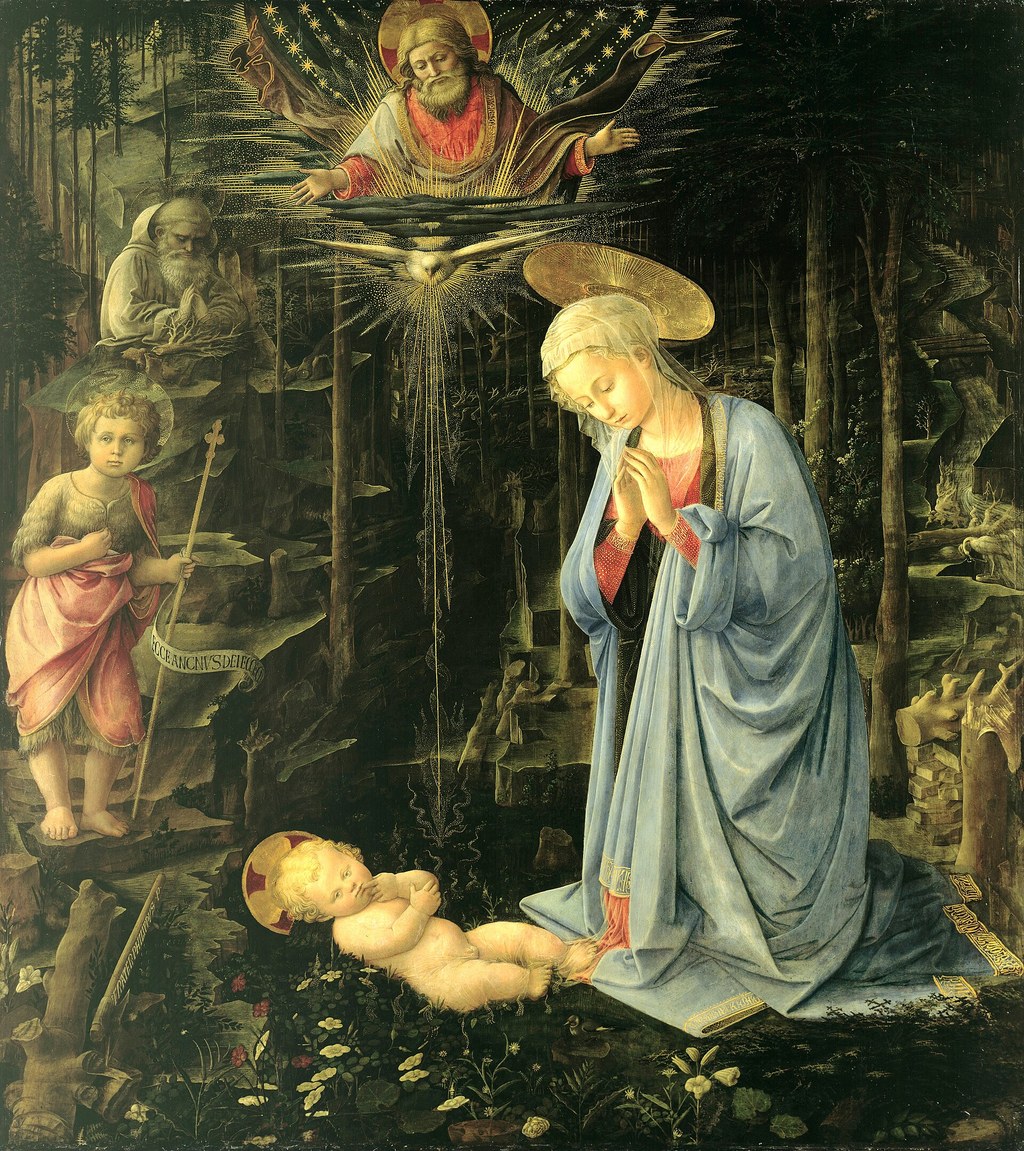
Vegetation provides enough natural detail to keep the setting believable. Lippi repeatedly uses landscape to shape spiritual mood. The Berlin Adoration in the Forest offers a later and more elaborate example. Both works turn withdrawal into a visible geography.
Books. Books are essential to Bernard’s identity. They mark him as theologian rather than generic monk. The painted object also bridges the sacred vision and the historical viewer.
Bernard’s writings survived. The book therefore represents both activity within the scene and the textual tradition through which later Christians knew him. Lippi places intellectual labour inside devotional imagery. That is particularly appropriate to a saint famous for thought.
Mary. The Virgin appears as an active participant. She is not simply an image before which Bernard prays. She manifests.
If the dictation interpretation is correct, she communicates. This gives Mary authority. Bernard’s status as theologian does not put him above revelation. The scholar learns from the sacred figure. The hierarchy is important.
Marian Devotion
Bernard became strongly associated with devotion to Mary. Later tradition amplified stories of his special relationship with the Virgin. Artists could therefore represent him in miraculous encounters that visualised his theological devotion.
Lippi’s painting belongs to that tradition while retaining unusual restraint. Mary’s presence is extraordinary, but the scene remains intimate. The miracle is quiet.
The Date 1447. The secure date places the painting in the same year Lippi completed the Coronation of the Virgin for Sant’Ambrogio. The comparison is striking. The Coronation is huge, crowded and public.
Saint Bernard’s Vision is compact and solitary. Both centre on Mary. The contrast demonstrates how radically Lippi adapted Marian imagery to function. One addresses a Benedictine high altar. The other probably a civic palace.
Egg Tempera. The National Gallery identifies the medium as egg tempera on wood.[1] The method supports precise line and detail. In a small devotional panel, those qualities encourage close viewing.
Books, faces and landscape can be carefully articulated. The current worn surface means some of that subtlety has been lost. Technical description should therefore be cautious about assuming every faint passage reflects Lippi’s intended finish.
Condition and Loss. The National Gallery notes that the painting is badly worn.[1] This matters interpretively. Colour relationships may be weakened.
Modelling can become flatter. Fine details can disappear. The temptation is to judge the present surface as if it were the artist’s final state.
Conservation history reminds us otherwise. A Renaissance panel is an ageing object. Its present appearance combines original paint with abrasion, cleaning, restoration and material change.
What Wear Can Hide
Loss is not always evenly distributed. Thin glazes and delicate details may disappear before stronger underlayers. This can alter expression.
A subtle fold, highlight or facial transition might once have made a figure feel more dimensional. Technical interpretation should therefore rely on secure surviving evidence and comparisons rather than over-reading damaged areas. Condition becomes part of methodology.
Comparison with Filippino Lippi. The most important comparison is Filippino Lippi’s later Vision of Saint Bernard. Filippino’s version is much more famous and dramatically elaborate. The Virgin appears with attendants in a complex rocky setting.
The connection is not merely subject matter. Filippino was Fra Filippo’s son and inherited an artistic world shaped partly by his father. Comparing the paintings shows how one unusual theme changed across a generation.
Father and Son. It would be tempting to treat Filippino’s later version as direct homage. That relationship requires evidence rather than assumption. What can be said securely is that both artists painted the unusual subject.
The later work clarifies the dictation interpretation and offers a powerful compositional comparison. The two paintings reward direct comparison in both directions: the father’s work provides an earlier precedent, while the son’s clarifies how the subject changed across a generation. Fra Filippo’s painting gains a later afterlife through Filippino’s treatment of the same subject. Filippino’s painting, in turn, gains an important earlier precedent.
Comparison with the Adoration in the Forest
The Berlin Adoration in the Forest also places religious experience in a secluded natural environment. There, the forest supports Nativity, Trinity and monastic contemplation. Here, rocky wilderness isolates Bernard’s intellectual encounter. Lippi therefore repeatedly used uncultivated landscape as a spiritual device. Nature becomes a place where ordinary social structures fall away.
Comparison with the Coronation of the Virgin. Both works date from the mid-1440s and centre on Marian devotion, but their scales are opposite. The Uffizi Coronation overwhelms through population and ceremony. Saint Bernard’s vision persuades through silence. The comparison is useful because it prevents a one-dimensional idea of Lippi as simply a painter of graceful Madonnas. He could construct both heavenly court and private mystical encounter.
The Viewer as Witness. The painting gives the viewer a privileged position. Bernard’s vision is private, yet we are permitted to see it. This is a common devotional strategy.
The spectator becomes witness to sanctity. That imagined access can encourage meditation. If Bernard responds correctly to revelation, the viewer is invited to respond to the painted revelation in turn.
The work therefore creates two acts of seeing. Bernard sees Mary. We see Bernard seeing Mary.
Writing, Image and Authority. The subject also raises a fascinating issue for Renaissance culture. A text-based theologian is represented through an image. Bernard’s authority came largely through words.
Lippi translates that authority into visual form. If Mary dictates to him, the painting argues that sacred writing and sacred vision share one source. The image does not compete with text. It explains its origin. This makes the panel especially useful for discussing the relationship between literacy and visual devotion.
Bernard as a Model of Learned Devotion
Bernard’s combination of intellect and piety made him particularly useful to Renaissance audiences. He was not presented as someone who had to choose between thought and faith. His writing emerged from devotion.
The vision subject makes that relationship visible. The books do not block access to Mary. They prepare the context in which revelation occurs. For educated Florentine viewers, especially those working in civic administration, the model could be powerful. Learning becomes valuable when ordered towards moral and spiritual truth.
A Civic Image of a Monastic Saint. The probable Palazzo Vecchio context creates a productive tension between monastery and government. Bernard withdrew from worldly ambition, while the Florentine palace was a centre of political decision-making. Placing his image there could introduce a counter-ideal into civic space.
Government required action. Bernard represents contemplation. A healthy political culture, the image might imply, needs both judgement and spiritual orientation. This interpretation should remain contextual rather than claimed as a documented programme, but the juxtaposition is historically meaningful.
The Visual Logic of Apparition. Lippi must persuade the viewer that Mary belongs both to the scene and beyond ordinary reality. He does not need spectacular clouds or a violent break in nature. The distinction is achieved through encounter.
Bernard behaves as someone seeing what normally cannot be seen. Mary’s presence is physically legible enough to be painted, yet narratively miraculous. This quiet solution suits Lippi.
He repeatedly humanises sacred figures without erasing their supernatural status. The Lippina does it through maternal intimacy. Here he does it through conversational proximity.
Solitude and Concentration
The landscape isolates Bernard from distraction. That isolation can be understood as an external version of mental concentration. The physical wilderness corresponds to interior withdrawal.
This gives the painting a useful connection with monastic practices of contemplation. The setting does not need to reproduce Clairvaux or another literal site. Its purpose is psychological and devotional. Lippi makes solitude visible.
A Painting About Receiving Knowledge. The possible dictation motif makes this one of the most interesting Lippi works for discussing knowledge. Bernard does not generate sacred truth entirely from himself. He receives.
That distinction reflects a medieval and Renaissance hierarchy in which human reason and scholarship remained subordinate to divine revelation. The image therefore gives authorship a theological structure. Mary transmits.
Bernard records. The viewer encounters the result through painting. Three forms of communication—vision, writing and image—overlap.
Comparing Father and Son Without Collapsing Them. Because Filippino’s later Vision of Saint Bernard is more elaborate and better known, there is a temptation to treat Fra Filippo’s panel as a simple precursor. That would undersell the father’s painting. Fra Filippo’s restraint is meaningful.
Its sparse environment and worn quietness create a contemplative experience fundamentally different from Filippino’s richer late-Quattrocento vocabulary. The comparison should therefore ask how the same subject changes across generation, patronage and style. It should not assume artistic progress means greater complexity.
Conservation as Historical Evidence. A worn painting can frustrate visual analysis, but wear also records a history. The panel has been handled, cleaned, moved and exposed to changing environments. Some of those events are invisible in written provenance.
Material condition becomes another archive. The challenge is that loss can mimic style. A face stripped of modelling may appear deliberately severe. A faded landscape may seem intentionally sparse. Responsible interpretation must keep that uncertainty visible.
Why Saint Bernard's Vision Matters
Saint Bernard’s Vision of the Virgin matters because it condenses several important Renaissance themes into a relatively modest panel. It joins monastic scholarship with mystical experience. It probably carried private-looking devotion into a civic Florentine environment.
Its landscape turns solitude into place. Its books make intellectual work visible. Its worn surface reminds us that conservation conditions interpretation.
And its subject creates one of the strongest possible bridges from Fra Filippo to his son Filippino. The painting also demonstrates Lippi’s range. In the same decade he could produce monumental public altarpieces and quiet visionary scenes.
The work is therefore not secondary simply because it is smaller. Its value lies in concentration. Historically, the painting functions as a hinge between Fra Filippo’s career and Filippino’s later treatment of the same subject.
Saint Bernard and the Power of the Word. Bernard’s fame depended upon sermons, letters and theological writing, which makes the painted book particularly resonant. The object reminds viewers that saints could shape Christian culture through language as well as martyrdom or miracle. Lippi’s choice of a writing saint also broadens the types of holiness represented across his work.
Saint Stephen dies publicly. John the Baptist preaches and is executed. Bernard studies and receives. Across Lippi’s works, different saints embody different models of sanctity rather than a generic sacred type.
The 1447 Context. Placing the panel beside Lippi’s other work of 1447 helps sharpen its importance. The Maringhi Coronation represents a large institutional commission requiring assistants, expensive materials and a complex assembly of figures. The Bernard panel demonstrates the opposite scale of artistic problem.
Its success depends on concentration, landscape, books and two principal actors. This coexistence tells us something about a successful Florentine workshop. Lippi did not progress linearly from “small” to “large” art. Different commissions demanded different solutions at the same moment in his career.
A Rare Subject with High Comparative Value
Although the panel is less famous than Lippi’s best-known Madonnas, its unusual subject increases its historical value. Its rare iconography raises questions that a generic biography cannot address. Who was Bernard? Why does Mary appear to him? Why are books central? Why did Filippino return to the subject? Those questions give the painting a distinctive place in Lippi studies and make it a valuable bridge to Filippino’s later work.
FAQs
Discussion
What stands out to you most about Saint Bernards Vision of the Virgin in relation to Filippo Lippi's wider career?
Reader Insights
Notice how the page connects close visual detail with patronage, workshop practice and the wider Renaissance setting.
Which comparison elsewhere in the cluster helps clarify this work or theme most strongly?
Join the Conversation
Have a thought or observation about Saint Bernards Vision of the Virgin? Share it below. Thoughtful responses may be added to this section.
References
- National Gallery, London, Fra Filippo Lippi, Saint Bernard’s Vision of the Virgin, NG248. View Source
- Dillian Gordon, National Gallery Catalogues: The Fifteenth Century Italian Paintings, vol. 1.
- Jeffrey Ruda, Fra Filippo Lippi: Life and Work with a Complete Catalogue, 1993.
- Megan Holmes, Fra Filippo Lippi: The Carmelite Painter, 1999.