 by Tom Gurney
Tom Gurney BSc (Hons) is an art history expert with over 20 years experience
Published on June 19, 2020 / Updated on October 2, 2026
Email: tomgurney1@gmail.com / Phone: +44 7429 011000
Vision of Saint Bernard by Filippino Lippi
Filippino Lippi’s Vision of Saint Bernard, painted probably between 1482 and 1486 and now in the Badia Fiorentina in Florence, is one of the defining panel paintings of his career. The Metropolitan Museum has described it as his greatest panel painting of the mid-1480s, a work in which reflective religious meaning, warm colour, subtle chiaroscuro and a northern European interest in landscape and descriptive detail come together.[2]
The subject is unusual. Saint Bernard of Clairvaux, one of the most important monastic writers of the Middle Ages, is interrupted while writing in a rocky wilderness when the Virgin Mary appears before him accompanied by angels. Filippino turns this quiet theological theme into an image full of movement and unexpected detail. Mary does not float remotely in a separate heavenly zone. She approaches Bernard almost physically, while the angels gather behind her and the saint twists away from his writing desk to respond.
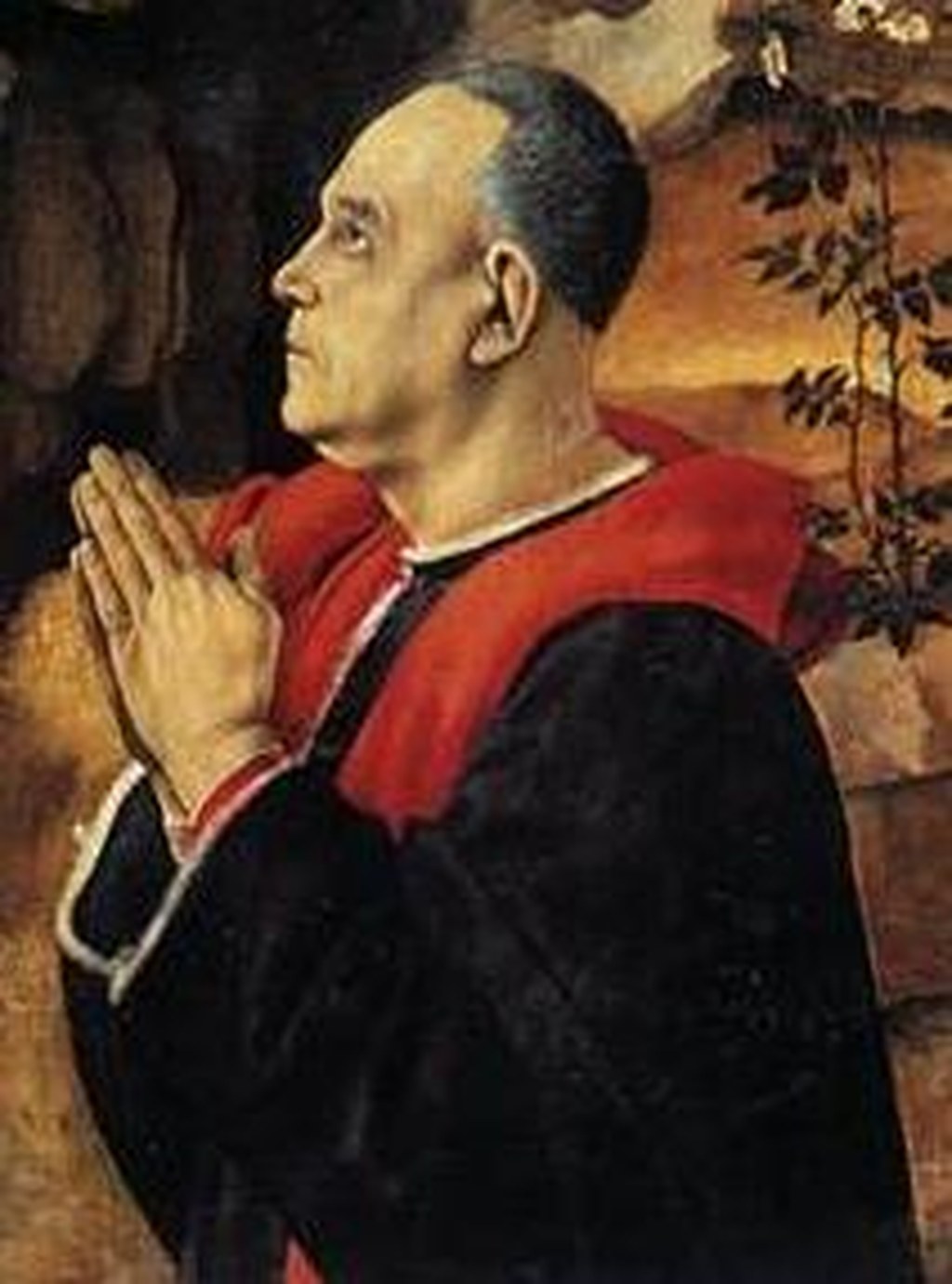
The landscape is equally active. Rocks, tree roots, books, plants and architectural fragments create a world that seems almost alive. A small demon bites or struggles against chains behind Bernard, providing a vivid reminder that the vision belongs within a larger spiritual conflict. The painting was commissioned by Piero di Francesco del Pugliese for his family chapel at the monastery of Santa Maria delle Campora outside Florence. The Del Pugliese family became important patrons of Filippino, and Piero himself appears at the lower right as a kneeling donor.
The original church was vulnerable during the siege of Florence in 1529–30, and the painting was transferred to the Badia Fiorentina. Its survival there gives the work a historical connection with the Benedictine institution on which the Campora monastery depended.[1] The panel is also one of the best works through which to compare Filippino with his father. Fra Filippo Lippi painted the same rare subject in 1447. The two paintings reveal a generational shift from concentrated early Renaissance monumentality towards a more animated, psychologically complex and richly descriptive late-fifteenth-century language.
At a Glance
- ArtistFilippino Lippi
- TitleVision of Saint Bernard / Apparition of the Virgin to Saint Bernard
- Dateprobably c. 1482–86
- MediumPanel painting; museum and scholarly descriptions commonly identify oil-based technique
- Current locationBadia Fiorentina, Florence
- Original locationDel Pugliese family chapel, Santa Maria delle Campora, near Florence
- PatronPiero di Francesco del Pugliese
- Donor portraitPiero del Pugliese kneeling at lower right
- SubjectSaint Bernard of Clairvaux receiving a vision of the Virgin Mary
- Distinctive detailchained demon behind the saint
- Major comparisonFra Filippo Lippi’s 1447 Saint Bernard’s Vision of the Virgin
- Research significancemajor mid-career panel showing Netherlandish detail, expressive movement and psychological narrative
Contents
- Who Was Saint Bernard?
- The Act of Writing
- The Rocky Landscape
- Piero di Francesco del Pugliese
- Transfer to the Badia Fiorentina
- Before Rome
- Books and Material Detail
- Was Filippino Copying His Father?
- Landscape as Spiritual Geography
- Possible Family Portraits
- From Campora to Florence: Changing Audiences
- Reception and Reputation
- Frequently Asked Questions
- References
Who Was Saint Bernard?
Bernard of Clairvaux was a twelfth-century Cistercian monk, abbot and theologian whose writings shaped medieval Christian spirituality. He became particularly associated with devotion to the Virgin Mary. Bernard’s reputation combined intellectual authority with monastic withdrawal. He wrote extensively, preached, advised church leaders and became one of the most influential religious figures of his age.
Artists could therefore identify him through books, writing materials and monastic dress. The vision represented by Filippino belongs to a broader devotional tradition in which Mary appears to Bernard while he is engaged in writing or contemplation. The subject offered painters an unusual challenge because its essential event is not physical action but revelation. Filippino had to make an inward spiritual experience visible.
What Does the Painting Show? Bernard sits or kneels at a makeshift writing desk embedded within a rugged landscape. Books and writing materials surround him. The Virgin appears from the left, accompanied by a group of youthful angels.
Bernard turns sharply towards her. This movement is central to the composition. The saint is not calmly posing beside Mary. He has been interrupted.
Filippino therefore gives the miracle a sense of suddenness. The Virgin’s group moves towards the saint while his body twists away from the activity that had absorbed him. At the lower right, the donor Piero del Pugliese kneels in prayer.
His smaller, separate presence establishes another level of viewing. Bernard sees Mary. Piero witnesses or venerates the sacred event. The modern spectator then sees both. The painting creates several layers of devotion inside one image.
The Act of Writing
Bernard’s writing is essential rather than incidental. His historical fame depended heavily on texts. By showing him working, Filippino makes intellectual labour visible.
The miracle therefore occurs in relation to scholarship. Bernard is not simply wandering through wilderness when Mary appears. He is producing words.
This opens an important theological idea: sacred knowledge is not presented as entirely self-generated human thought. The Virgin’s appearance can be understood as revelation entering the process of writing. The painting therefore connects vision, text and image.
Mary inspires. Bernard writes. Filippino paints the encounter. The viewer reads the picture.
Mary as an Active Presence. The Virgin is unusually dynamic. She does not sit enthroned. She approaches.
Her body and gesture belong to the same physical world as Bernard even though her presence is miraculous. This is one of Filippino’s characteristic achievements. The supernatural is not separated from ordinary space through a gold background or abstract cloud.
It enters a landscape. Mary’s movement makes the apparition emotionally accessible. Bernard’s response becomes understandable because she seems genuinely present before him. The painting therefore turns theological vision into interpersonal encounter.
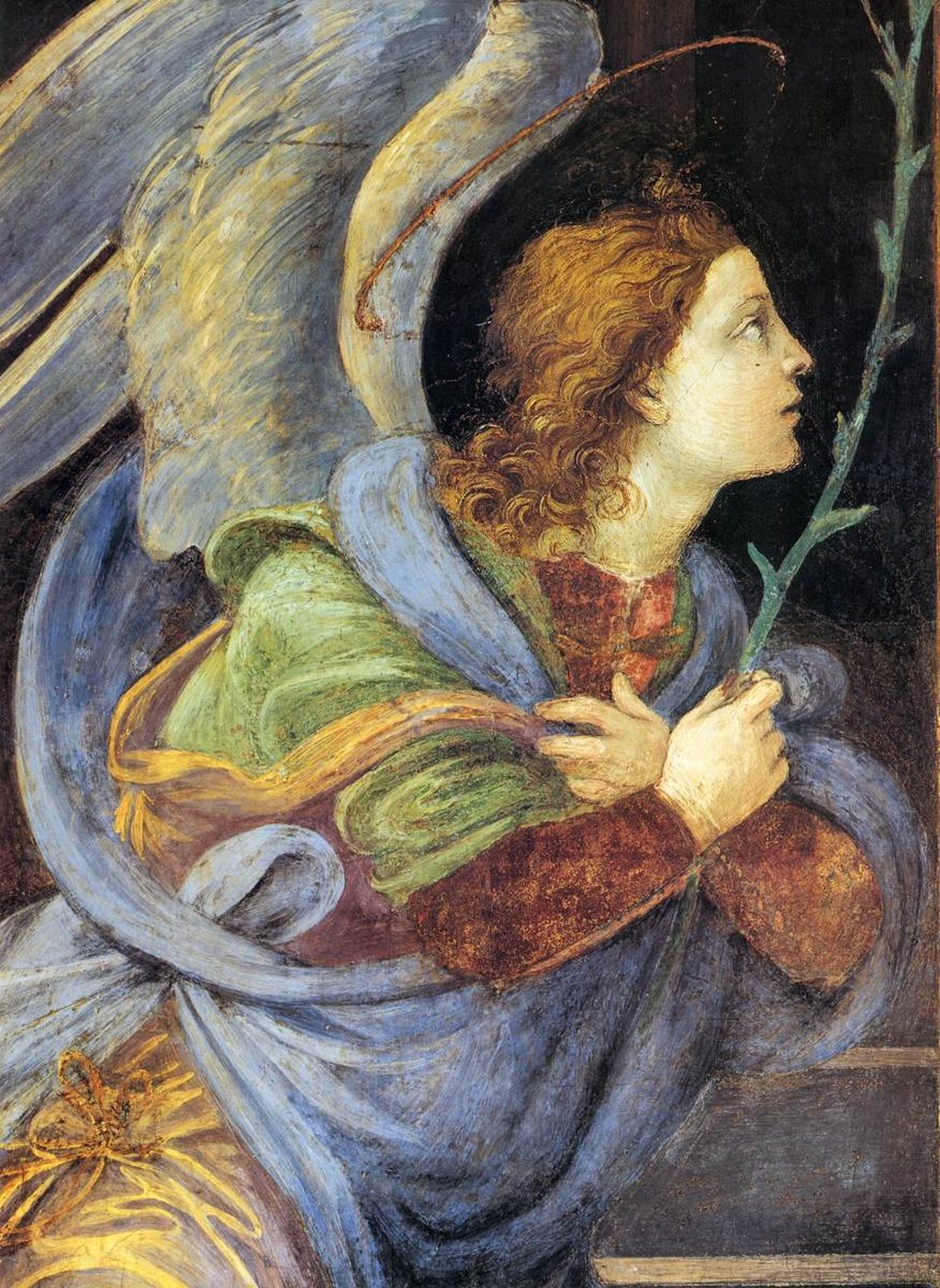
The Angels. The angels behind Mary introduce variety and movement. They are youthful, elegant and closely related to the visual tradition Filippino inherited from Botticelli and Fra Filippo. Yet they do not simply decorate the apparition.
Their grouped bodies make Mary’s entrance feel collective. Heaven arrives as a small community. Some faces appear curious or attentive, and the overlapping figures create a sense that the apparition extends beyond the immediate foreground. The angelic group also balances the isolated Bernard. He is one man confronted by an entire sacred presence.
The Rocky Landscape
The setting is among the painting’s most memorable features. Bernard occupies a rocky wilderness filled with roots, plants and irregular surfaces. The landscape suits Cistercian ideals of withdrawal and contemplation.
It also reflects Filippino’s increasing fascination with nature and descriptive detail. The rocks are not neutral scenery. They organise the composition.
Bernard’s desk seems to emerge from the landscape itself. Books sit against stone. Roots and trunks create directional lines. The setting therefore makes spiritual withdrawal physically visible. The saint has left ordinary urban society for a place of concentration.
The Demon. Behind Bernard is one of the painting’s strangest details: a small demon associated with chains. The figure introduces spiritual conflict into the vision. A peaceful reading of the scene would focus only on Mary’s appearance and Bernard’s devotion.
The demon complicates that interpretation. The apparition becomes part of victory over temptation, sin or evil. Later interpretive traditions connect the chained demon with Marian power and the release of humanity from sin.
The detail is effective even without a viewer knowing the precise theological source. It makes the landscape morally charged. There are forces in the wilderness beyond the Virgin and saint. The sacred vision suppresses something hostile.
The Inscription and Moral Discipline. The painting has also been associated with the Stoic phrase “sustine et abstine” — endure and abstain — linked to Epictetus. The presence of such a maxim would fit Bernard’s ascetic identity and the intellectual culture of Filippino’s patronage. It joins classical ethical language with Christian monastic discipline.
This combination is significant because Filippino’s interest in antiquity did not suddenly begin when he travelled to Rome. Florentine patrons already inhabited a humanist culture in which ancient authors could be read alongside Christian texts. The Vision of Saint Bernard therefore belongs to a world where classical and Christian learning could reinforce one another.
Piero di Francesco del Pugliese
The patron Piero del Pugliese appears kneeling at the lower right. His inclusion is an important part of the painting’s meaning. A donor portrait places a real contemporary person in visual relation to sacred history.
Piero does not become part of the apparition on equal terms. His smaller position and prayerful pose maintain hierarchy. Yet his presence permanently associates the family with the sacred event.
The painting was made for the Del Pugliese family chapel. It therefore served both devotional and commemorative functions. The patron could pray before an image in which he was already represented praying. The real and painted acts of devotion mirrored one another.
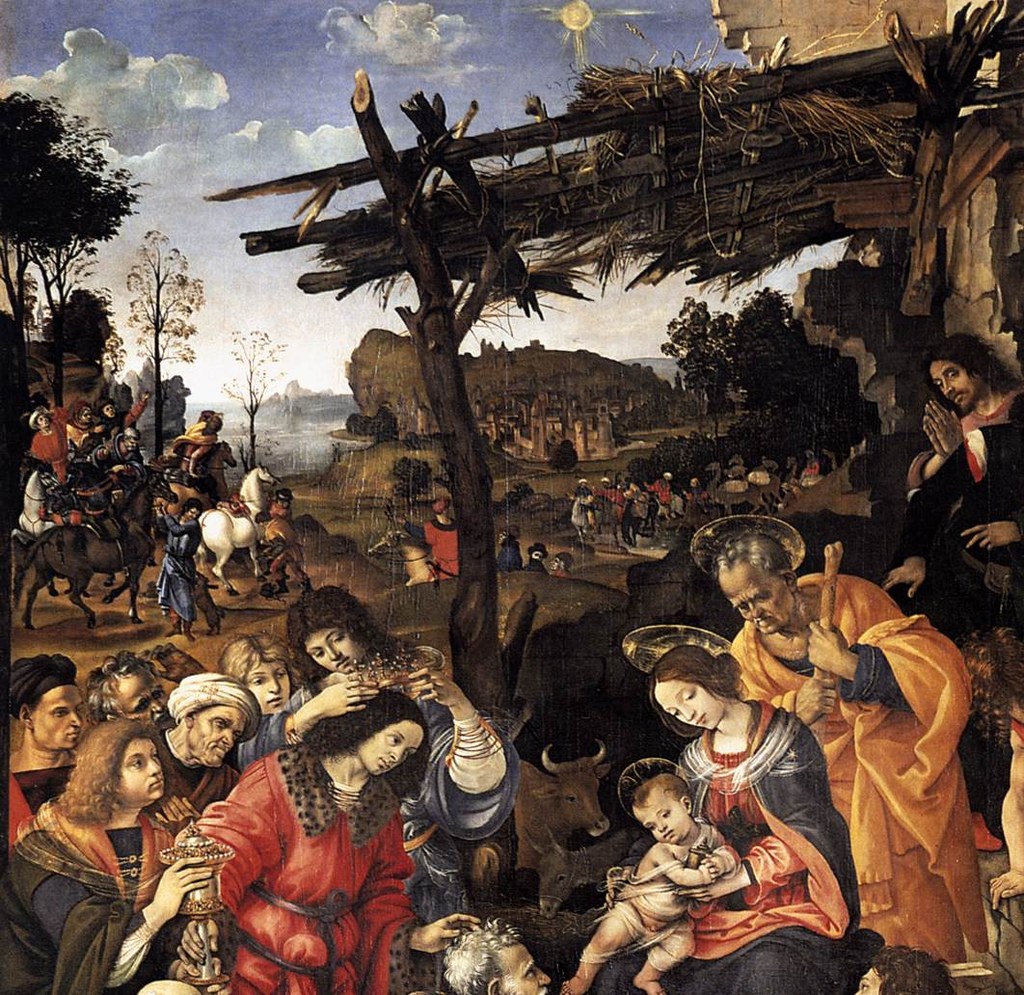
The Del Pugliese Family. Filippino’s relationship with the Del Pugliese family extended beyond this one commission. The National Gallery connects its Adoration of the Kings with Francesco del Pugliese, whose testament refers explicitly to an Adoration by Filippino.[4] That relationship makes the family one of the important patronal networks of Filippino’s early independent career.
The Del Pugliese were wealthy Florentine merchants with strong religious interests. Later members of the family were associated with the spiritual climate surrounding Savonarola. Their commissions therefore offer a useful contrast with Medici and Strozzi patronage. Filippino did not work for one ideological faction. His adaptability allowed him to serve patrons with different social and religious identities.
Santa Maria delle Campora. The Badia Fiorentina states that the Vision of Saint Bernard was originally made for the Del Pugliese family chapel in the monastery of Santa Maria delle Campora at Marignolle, outside Florence.[1] The monastery depended on the monks of the Badia Fiorentina.[1] This institutional connection helps explain the painting’s later movement.
Its first setting was not an ordinary parish church. The monastic environment suited a subject centred on Bernard’s contemplation. The rugged painted landscape would have echoed ideals of withdrawal embodied by the religious setting itself. Original location therefore deepens the iconography. The painting is about a monk experiencing revelation and was made for a monastic environment.
Transfer to the Badia Fiorentina
The painting did not remain permanently at the Campora monastery. The conflict surrounding the siege of Florence in 1529–30 threatened religious sites outside the city. The panel was moved to the Badia Fiorentina for safety.[1]
This relocation preserved it but changed its spatial context. The work now hangs within one of Florence’s oldest religious foundations. That setting remains historically meaningful because the Campora monastery had been dependent on the Badia. The transfer was therefore not a completely arbitrary museum-style displacement. The painting moved within an institutional relationship.
The Badia Fiorentina Today. The Badia remains the painting’s home. Its institutional website lists Filippino’s Apparition of the Virgin to Saint Bernard among the church’s major works and dates it probably between 1482 and 1486. The painting can therefore still be encountered inside a religious building rather than a modern gallery.
This matters. Lighting, scale, surrounding architecture and devotional atmosphere affect how the panel is experienced. The work was not designed as an isolated rectangle on a white museum wall. Its present setting, although not the original chapel, preserves a degree of sacred context.
When Was It Painted? Dating has varied in older literature. The Badia Fiorentina currently gives a probable range of 1482–86.[1] The Metropolitan Museum places the work broadly in the mid-1480s.[2]
This range fits Filippino’s developing independent style before his Roman period. It also places the painting close to other major commissions associated with Filippo Strozzi and the period surrounding the Brancacci Chapel. The date is important because the Vision shows an artist already moving substantially beyond Botticelli’s workshop language before Rome transformed his decorative vocabulary. The painting is therefore a mature pre-Roman masterpiece.
Before Rome
The Vision of Saint Bernard provides one of the best benchmarks for understanding what Filippino was like before 1488. There are no overwhelming grotesques. Ancient architectural fragments do not dominate the composition.
The psychological complexity comes through landscape, gesture and unusual details rather than through archaeological fantasy. This makes comparison with the Carafa and Strozzi chapels especially revealing. Rome did not create Filippino’s imagination. The Vision proves that. What Rome did was provide a new visual repertory through which that imagination could expand.
Netherlandish Influence. The Metropolitan Museum specifically identifies a Netherlandish interest in genre detail and landscape in Filippino’s work of the mid-1480s.[2] The Vision of Saint Bernard is one of the clearest examples. Small objects matter.
Landscape is not simply a backdrop. Light creates subtle transitions. The sacred event takes place in a world filled with things that can be inspected closely.
Florentine artists encountered northern European painting through trade, imported works and collecting. They did not need to travel to Flanders personally to respond to its visual language. Filippino combines this descriptive attention with Florentine line and compositional movement. The result is hybrid rather than imitative.
Warm Colour and Chiaroscuro. The Met also emphasises Filippino’s warm colour and subtle chiaroscuro in this phase.[2] These qualities help distinguish him from the clearer linearity of his earliest Botticellian works. Colour gives the figures emotional warmth.
Chiaroscuro allows bodies and landscape to emerge more gradually from their surroundings. The effect suits a visionary subject. Nothing needs to become violently supernatural. The miracle appears through a shift in ordinary reality. This understated visual transition contributes strongly to the painting’s poetic character.
Books and Material Detail
The books around Bernard reward close viewing. They establish his identity as a scholar. They also make the sacred vision materially credible.
Books have weight. Pages open. The writing desk occupies awkward physical space among the rocks.
Such details keep the saint’s intellectual activity from becoming an abstract symbol. Bernard is doing something recognisable. The miracle interrupts work. That concreteness makes the apparition more persuasive.
The Painting as a Psychological Event. Filippino’s greatest achievement may be psychological. The composition captures transition. One moment Bernard is writing.
The next he is looking at Mary. The image contains both states. His body still belongs to the act he has abandoned, while his attention has shifted completely.
This creates tension. Renaissance painters often represented visions as static meetings between saint and holy figure. Filippino makes this one feel like an interruption. The viewer can imagine the instant before and the instant after. That narrative elasticity is one reason the work feels unusually alive.
Comparison with Fra Filippo Lippi. Fra Filippo Lippi painted Saint Bernard’s Vision of the Virgin in 1447, now in the National Gallery.[4] The father’s version is smaller and more restrained. Bernard is isolated in a rocky setting.
Mary appears to him with far less accompanying spectacle. Filippino takes the same rare subject and amplifies it. The landscape becomes denser.
The Virgin’s group becomes larger. Gesture becomes more animated. Secondary details multiply.
The comparison gives an unusually clear measure of stylistic change across one artistic family. Fra Filippo makes contemplation intimate. Filippino makes contemplation dramatically psychological.
Was Filippino Copying His Father?
There is no need to assume direct copying. The subject belonged to a wider devotional tradition. What matters is that Filippino knew an artistic world shaped by his father and returned to a theme Fra Filippo had treated.
Similarity of subject creates a legitimate comparison without proving one-to-one dependence. The differences are more revealing than the similarities. Filippino’s version belongs to another generation. It reflects Botticelli, northern detail, a different patron and a different stage of Florentine painting.
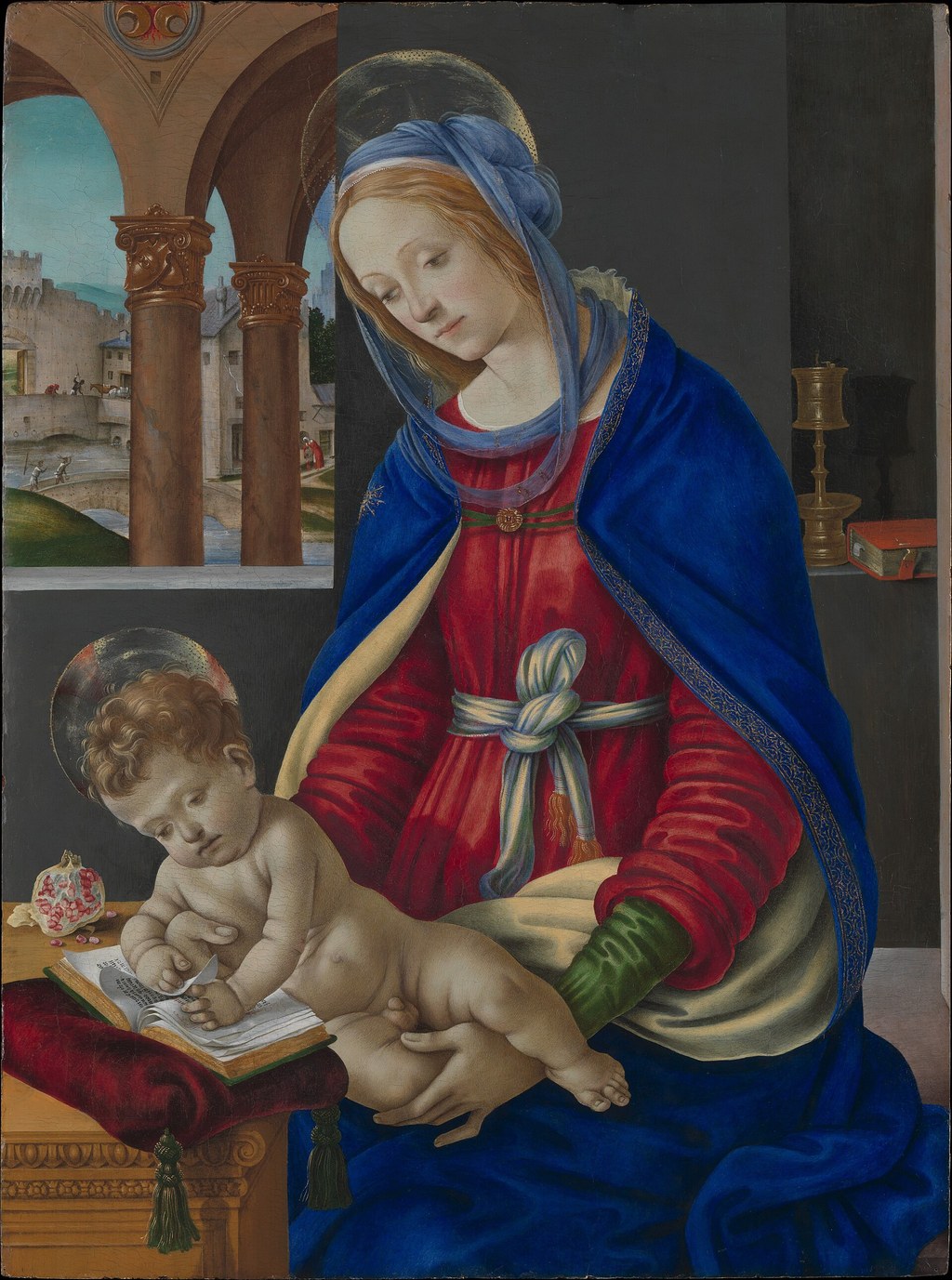
Comparison with the Met Madonna and Child. The Met groups the Vision of Saint Bernard with Filippino’s Madonna and Child of around 1483–84.[2] Both paintings share warm colour, reflective mood, subtle lighting and an interest in descriptive detail. The Madonna takes place in an elite domestic interior.
The Bernard vision takes place in wilderness. The contrast demonstrates Filippino’s flexibility. The same mature visual language could serve private family devotion and monastic vision. Patronage and subject alter the setting without erasing artistic identity.
Comparison with the Adoration of the Kings. The National Gallery’s Adoration of the Kings also has Del Pugliese connections and a strong landscape component.[4] Hermit saints populate the background. Rocky terrain dominates the biblical scene.
Together with the Vision, the painting suggests that landscape and ascetic spirituality were important within this patronal network. The Adoration disperses many small sacred narratives through the landscape. The Vision concentrates the spiritual event around Bernard. The two paintings therefore explore related concerns at different narrative scales.
Landscape as Spiritual Geography
Filippino’s landscape should not be treated simply as natural scenery. It tells us what kind of spiritual experience is occurring. Rocky wilderness signals retreat.
The absence of ordinary urban society creates a space in which contemplation becomes possible. At the same time, the setting contains danger. The chained demon reminds us that solitude is not automatically peaceful.
The wilderness can contain temptation as well as revelation. This gives the landscape moral structure. Bernard has withdrawn from the world but not from struggle.
Humanism and Monasticism. The painting also complicates the common separation between Renaissance humanism and medieval monastic spirituality. Bernard belongs to the twelfth century. The moral maxim associated with Epictetus belongs to ancient Stoic philosophy.
The patron belongs to fifteenth-century Florentine mercantile culture. Filippino brings these worlds together. Classical ethical language can reinforce Christian discipline.
A medieval saint can become meaningful to a Renaissance merchant. A contemporary artist can represent both through a sophisticated naturalistic style. The Renaissance here is not replacement of the medieval. It is accumulation.
Donor Portraiture. Piero del Pugliese’s portrait is modest in scale but conceptually important. He does not look out at us proudly. He prays.
This establishes the desired relationship between wealth and devotion. The patron has paid for the painting and chapel, yet the image represents him as subordinate. His status comes from proximity to the sacred event rather than equality with it.
The device also gives the painting a historical anchor. Bernard and Mary belong to sacred history. Piero belongs to fifteenth-century Florence. Their coexistence makes the image serve memory as well as prayer.
Possible Family Portraits
Later traditions have sometimes suggested that the Virgin and angels contain portraits of members of the donor’s family. Such identifications are attractive because the faces possess individuality. However, they should remain qualified.
Renaissance artists regularly created distinctive ideal faces without requiring a specific sitter. Unless documentary evidence identifies a figure, resemblance alone is insufficient. The donor portrait of Piero is much more securely understood because his role and placement follow established conventions. The other proposed identifications belong to interpretation rather than fact.
Filippino’s Increasing Independence. The Vision of Saint Bernard is particularly useful for demonstrating why Filippino should not remain trapped beneath Botticelli’s name. The early workshop relationship is visible in grace and line. But the painting’s mood is distinctly his own.
Botticelli’s great mythological and devotional works often organise figures through elegant rhythmic contour. Filippino increasingly lets environments participate in emotion. Rocks, roots and minor figures add psychological tension. The sacred event grows less idealised and more strange. This tendency would become far stronger after Rome.
A Painting Made for Close Looking. Although the panel is large enough to command attention, many of its most important effects reward close inspection. The demon can be missed at first. Books and small natural forms require time to discover.
The donor is spatially separate from the main apparition. This structure creates stages of looking. The viewer first recognises the central miracle.
Then the landscape begins to disclose secondary meanings. Such gradual discovery suits a devotional image made for repeated use. A person praying before the painting did not need to absorb everything at once. The work could become more complex through familiarity. This is another reason the descriptive detail associated with northern European painting matters. Small observed things become part of spiritual meditation rather than mere technical display.
From Campora to Florence: Changing Audiences
The painting’s transfer from Santa Maria delle Campora to the Badia also changed its audience. At Campora, it belonged to a specific family chapel within a monastic setting closely tied to the Del Pugliese commission. The donor portrait would have been especially legible to people who knew the family and chapel history.
At the Badia, the work became part of a broader Florentine religious environment. Later viewers could admire Filippino’s painting without sharing the original patronal context. This change helps explain how devotional objects gradually acquire art-historical identities in addition to religious ones.
The panel began as a commissioned sacred image. It later became recognised as one of Filippino’s masterpieces. Both identities remain valid.
The Vision and Filippino’s Career Narrative. The painting occupies a particularly useful place between Filippino’s beginnings and his Roman transformation. Behind it lies Botticelli’s workshop and the early domestic Madonnas. Ahead lie the Carafa Chapel, classical grotesques and the increasingly elaborate architecture of the Strozzi Chapel.
The Vision of Saint Bernard therefore demonstrates that Filippino’s mature imagination was already independent before antiquity became such an obvious part of his vocabulary. Its strangeness comes from roots, rocks, a chained demon, abrupt gesture and the collision between writing and apparition. Rome would give him additional material with which to intensify those instincts. It did not invent them. This chronological position makes the painting one of the best works through which to understand development rather than simply style.
Reception and Reputation
The painting has long occupied a prominent place in accounts of Filippino’s career. Modern museum scholarship repeatedly uses it to define the reflective, poetic side of his work in the 1480s. That reputation is useful because Filippino’s later frescoes can make him seem primarily a painter of restless ornament and crowded invention.
The Vision provides the necessary counterweight. Its complexity is real, but its emotional core remains concentrated on one person receiving revelation. Filippino could be strange without becoming noisy. The painting’s lasting appeal lies in precisely that balance.
Why the Vision of Saint Bernard Matters. The Vision of Saint Bernard matters because it captures Filippino at the moment his independent artistic identity is fully established but before Rome changes his visual language. It combines an unusual subject with exceptionally rich patronage and location history. It reveals his interest in landscape, books, spiritual psychology and small narrative detail.
It creates one of the strongest direct comparisons with Fra Filippo Lippi. It also belongs to the Del Pugliese network that shaped several important early commissions. Most importantly, the painting demonstrates how Filippino could transform contemplation into movement.
A saint writing alone becomes the centre of a sudden supernatural encounter. The quiet act of scholarship opens into vision. That transition is expressed through body, landscape and gaze rather than through theatrical special effects. For that reason, the painting deserves its reputation as one of Filippino Lippi’s greatest panel works.
Frequently Asked Questions
Discussion
What stands out to you most about Vision of Saint Bernard in relation to Filippino Lippi's wider career?
Reader Insights
Notice how the page connects close visual detail with patronage, workshop practice and the wider Renaissance setting.
Which comparison elsewhere in the cluster helps clarify this work or theme most strongly?
Join the Conversation
Have a thought or observation about Vision of Saint Bernard? Share it below. Thoughtful responses may be added to this section.
References
- Badia Fiorentina, “Le Opere,” institutional account of Filippino Lippi’s Apparition of the Virgin to Saint Bernard. View Source
- Metropolitan Museum of Art, George R. Goldner, “Filippino Lippi (ca. 1457–1504),” Heilbrunn Timeline of Art History. View Source
- Metropolitan Museum of Art, The Drawings of Filippino Lippi and His Circle, exhibition catalogue, 1997. View Source
- National Gallery, London, Fra Filippo Lippi, Saint Bernard’s Vision of the Virgin, collection record and comparison with Filippino. View Source
- National Gallery, London, Filippino Lippi, The Adoration of the Kings, collection record and Del Pugliese patronage history. View Source
- Musei Capitolini, Filippo e Filippino Lippi. Ingegno e bizzarrie nell’arte del Rinascimento, institutional exhibition material.