 by Tom Gurney
Tom Gurney BSc (Hons) is an art history expert with over 20 years experience
Published on June 19, 2020 / Updated on October 2, 2026
Email: tomgurney1@gmail.com / Phone: +44 7429 011000
Adoration of the Magi by Filippino Lippi
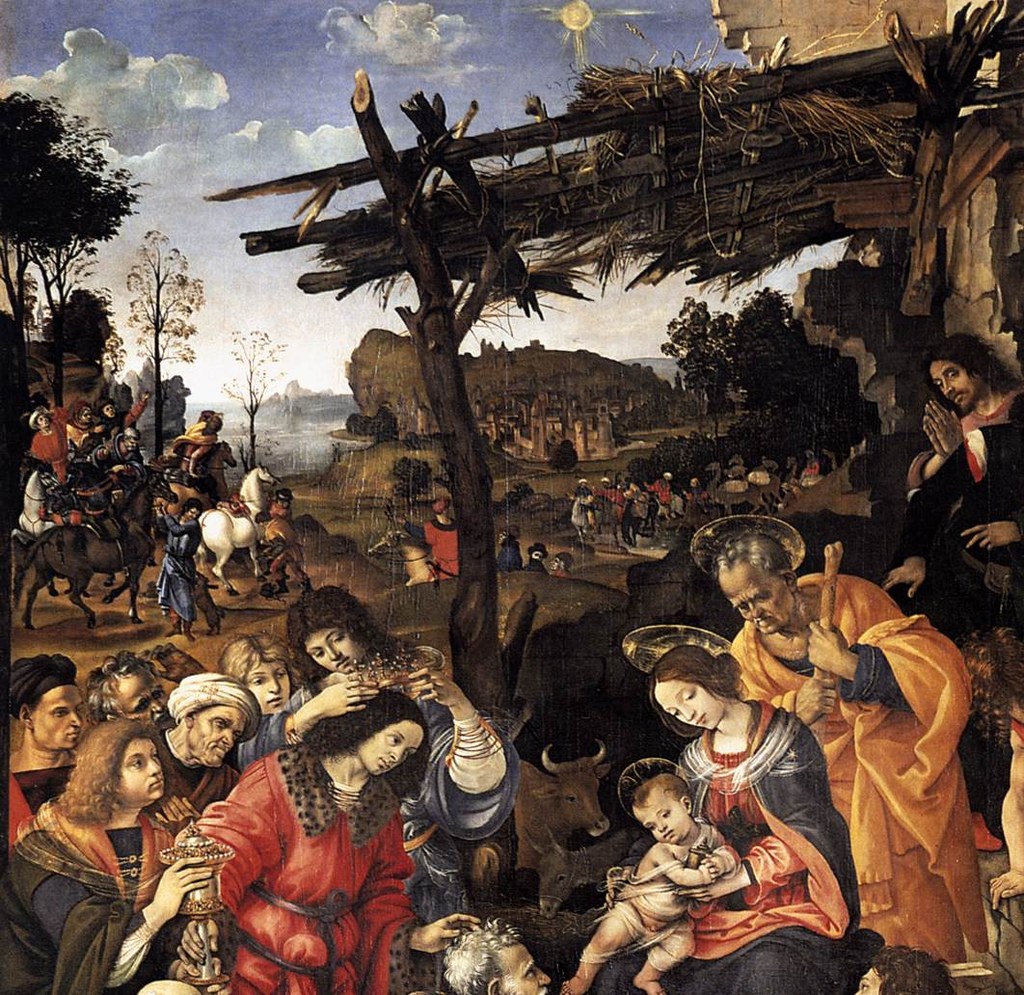
Filippino Lippi’s Adoration of the Magi, painted for the high altar of San Donato a Scopeto and now in the Uffizi Galleries, is one of the best-documented and most historically charged paintings of his career. The panel is signed and dated on the reverse: “Filippus me pinsit de Lipis florentinus addi 29 di marzo 1496” — Filippino Lippi of Florence painted me on 29 March 1496.[1]
That precision immediately makes the work an important chronological anchor. It also places the painting in a remarkable chain of artistic history because San Donato had originally commissioned an Adoration of the Magi from Leonardo da Vinci. Leonardo left his panel unfinished when he departed Florence, and years later the Augustinian community commissioned Filippino to provide the completed high-altarpiece they still needed.
The result is not an imitation of Leonardo’s unfinished painting. Filippino approaches the same subject through a dense, brilliantly coloured crowd filled with portraits, costly garments, jewels, vessels, animals and incidents from the Magi’s journey. The Uffizi emphasises how difficult it can initially be to identify the three kings amid the abundance of figures. That visual density is deliberate. The painting expands a relatively simple biblical episode into a social and political panorama.[1]
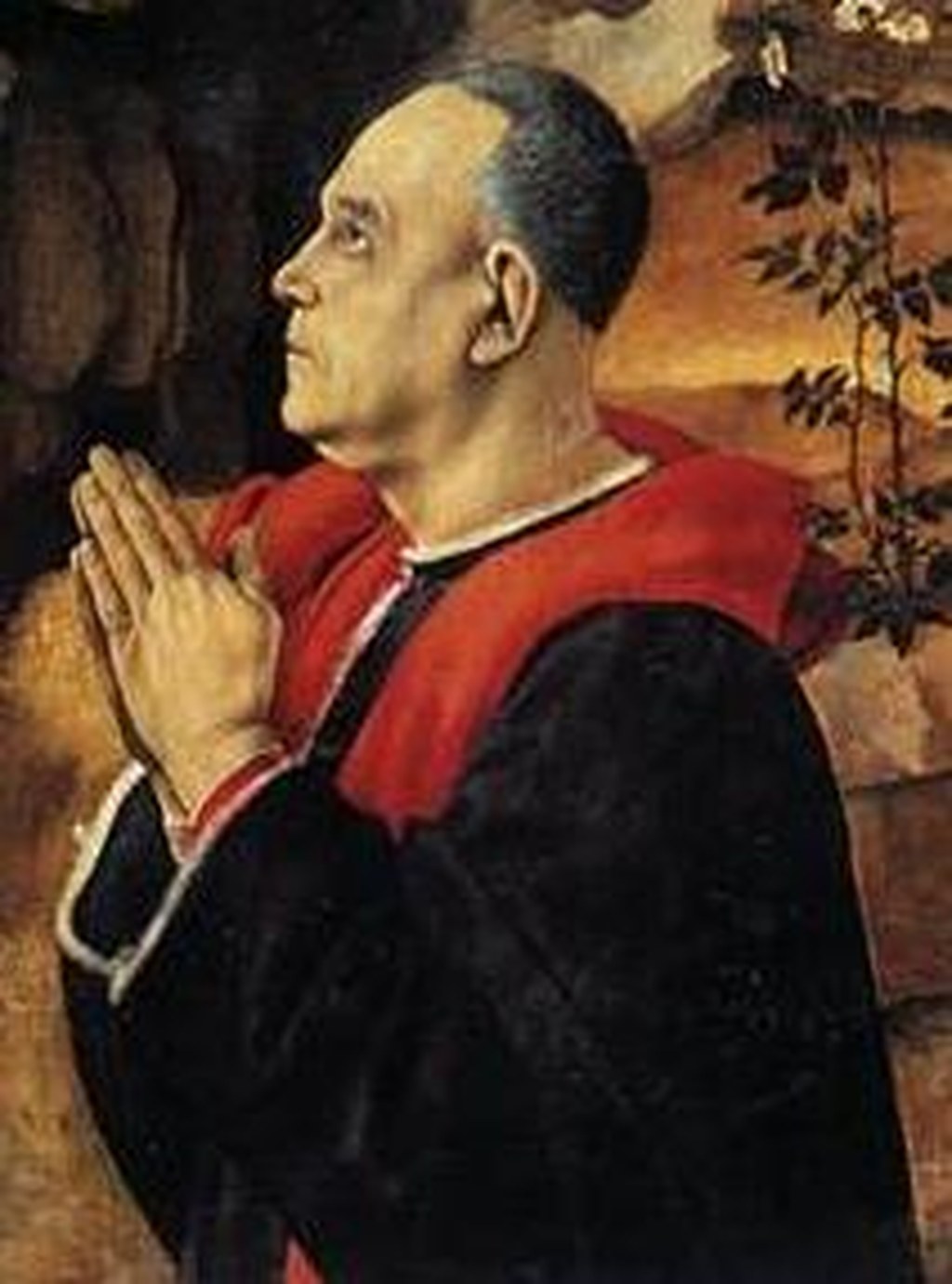
Probable members of the Medici family appear among the retinue. Pierfrancesco de’ Medici is thought to be represented as a kneeling figure in a sumptuous yellow fur-lined robe carrying an astrolabe, while his sons Lorenzo and Giovanni may appear nearby. Those identifications place the painting within the complex politics of Florence after the expulsion of the main Medici branch in 1494. Filippino’s biblical kings therefore exist in a visual world charged with contemporary family identity.
The painting is also valuable as a late-career comparison. By 1496 Filippino had already experienced the Brancacci Chapel, the Vision of Saint Bernard, major Strozzi patronage and his transformative Roman period. The Adoration brings many of those strands together in a single monumental panel.
At a Glance
- ArtistFilippino Lippi
- TitleAdoration of the Magi
- Date29 March 1496
- MediumTempera grassa on wood
- Dimensions258 × 243 cm
- Current locationUffizi Galleries, Florence
- Original locationHigh altar of San Donato a Scopeto, Florence
- CommissionerAugustinian friars/canons of San Donato a Scopeto
- Preceding commissionLeonardo da Vinci’s unfinished Adoration of the Magi
- Signature“Filippus me pinsit de Lipis florentinus addi 29 di marzo 1496”
- Probable portraitsPierfrancesco de’ Medici and sons Lorenzo and Giovanni
- Distinctive objectAstrolabe held by the probable Pierfrancesco figure
- Background narrativeEpisodes from the Magi’s journey, including sighting the star and passage through Herod’s palace
Contents
- The Biblical Story
- The Signed Date
- Filippino Was Not Completing Leonardo
- The Precious Gifts
- The Medici After 1494
- The Star
- The Stable
- Portraiture inside Sacred History
- After Rome
- From San Donato to the Uffizi
- A Crowd Organised by Looking
- Looking at Leonardo and Filippino Together Today
- Why the Adoration of the Magi Matters
- Frequently Asked Questions
- References
The Biblical Story
The Adoration of the Magi comes from the Gospel of Matthew. Wise men from the East see a star and travel in search of the newborn “King of the Jews”. They reach Jerusalem, where their questions disturb King Herod.
After consulting religious authorities, Herod sends them towards Bethlehem while secretly hoping to learn the child’s location. The star leads the Magi to Christ. They kneel before the child and offer gifts of gold, frankincense and myrrh.
Later Christian tradition transformed the Magi into three kings and developed elaborate identities around them. For Renaissance painters, the subject offered exceptional visual opportunities. A simple act of worship could be expanded into procession, landscape, exotic costume, animals, architecture and portraiture. Filippino uses nearly all of those possibilities.
What Does the Painting Show? The Virgin Mary sits with the Christ Child while Joseph stands nearby. The oldest Magus kneels before the child and offers the first precious vessel. Christ reaches towards or holds the gift.
The second and third kings occupy the surrounding crowd, but Filippino’s abundance of figures means they are not isolated with the clarity found in simpler Adoration compositions. Instead, the sacred group is surrounded by a large retinue. Courtiers, travellers and possible portraits gather across the panel.
The Uffizi explicitly notes that the composition is so rich in characters that the three kings can initially be difficult to distinguish.[1] This density produces two kinds of viewing. From a distance, the painting reads as a great ceremonial gathering. At close range, it becomes a field of individual faces, objects and stories.
The Signed Date
The inscription on the reverse is one of the painting’s most valuable historical features. It does not merely give a year. It gives a precise day: 29 March 1496.
Secure dates are essential when reconstructing an artist’s career. Filippino’s style changed substantially between his Botticellian beginnings, Roman period and late Florentine works. A precisely dated painting therefore allows nearby undated works to be compared against a firm reference point.
The inscription also asserts authorship. “Filippus me pinsit” — Filippo painted me — makes the object speak in the first person. The formula transforms the panel into a witness to its own making.
San Donato a Scopeto. The painting was created for the main altar of San Donato a Scopeto, an Augustinian house outside Florence. The original setting matters because this was not a decorative household picture. It was a monumental liturgical image intended for a high altar.
Its scale reflects that function. At 258 by 243 centimetres, the panel had to communicate across architectural space. The crowded composition therefore operated differently from Filippino’s small domestic Madonnas. Bright colour, strong silhouettes and prominent sacred figures had to remain legible at distance. Closer viewing then disclosed the detailed portraits and objects.
Leonardo’s Unfinished Commission. The most famous part of the commission history is its connection with Leonardo da Vinci. San Donato had commissioned Leonardo to paint an Adoration of the Magi in 1481. Leonardo developed an extraordinarily ambitious composition but left Florence before completing it.
The unfinished panel survived. Years later the community still needed a finished altarpiece and commissioned Filippino. This sequence creates one of the most compelling direct comparisons in Renaissance painting.
Two major Florentine artists addressed the same subject for the same institution. One painting remained unfinished. The other fulfilled the commission.
Filippino Was Not Completing Leonardo
It is important to distinguish replacement from completion. Filippino did not finish Leonardo’s panel. He created a new work.
That difference matters because their compositional approaches are radically different. Leonardo’s unfinished painting is dominated by restless drawing, spiralling movement and a mysterious field of figures around the Virgin and Child. Filippino’s version is more ceremonially structured and fully coloured.
Portraiture and costume become especially prominent. Background episodes narrate the journey more explicitly. The comparison therefore gives us two independent solutions to one commission rather than a master and later finisher.
Why the Augustinians Chose Filippino. By the 1490s Filippino was one of Florence’s most successful painters. He had already been trusted to complete the Brancacci Chapel. He had major relationships with the Strozzi family.
Lorenzo de’ Medici had recommended him for Cardinal Carafa’s Roman chapel. He had returned from Rome with an expanded reputation and visual vocabulary. Choosing him for San Donato therefore makes practical sense. The community needed an artist capable of handling a prestigious large altarpiece. Filippino had already demonstrated precisely that ability.
The Three Magi. The oldest king kneels closest to Christ. His position establishes the act of homage. The other two kings are embedded more fully in the surrounding retinue.
Traditionally, the three Magi represented different ages and, increasingly, different parts of the known world. Their variety allowed artists to evoke the universal reach of Christianity. Filippino does not reduce them to isolated symbolic types.
They belong to a complicated courtly gathering. This makes the act of kneeling especially meaningful. Royal magnificence ultimately submits to the child.
The Precious Gifts
The kings offer their gifts in elaborate vessels. The Uffizi calls attention to their elegant workmanship.[1] Such objects allowed Renaissance painters to display knowledge of luxury metalwork and courtly taste.
They also reinforce the status of the visitors. Gold, frankincense and myrrh were interpreted symbolically in Christian tradition, commonly relating to kingship, divinity and future death. Filippino therefore joins theological meaning with the visual pleasure of expensive objects. The painted gifts would have resonated strongly in a society where precious vessels were markers of wealth and ceremonial importance.
Pierfrancesco de’ Medici. The Uffizi identifies the kneeling man on the left in a fur-lined yellow robe, carrying an astrolabe, as probably Pierfrancesco de’ Medici.[1] Pierfrancesco had died in 1476, two decades before the painting. If the identification is correct, the figure is commemorative rather than a live portrait sitting.
The Augustinian patrons may have wished to honour him or his branch of the Medici family. That possibility adds another layer to the painting’s function. The biblical court becomes a space where Florentine family memory can be represented.
Lorenzo and Giovanni de’ Medici. Pierfrancesco’s sons Lorenzo and Giovanni are also tentatively identified within the crowd. The Uffizi suggests that Lorenzo may be the king being crowned, while Giovanni may be the blond young man beside him holding a vessel.[1] These identifications should remain qualified.
The museum itself uses cautious language. Yet even as proposals they are historically important because of the political situation in 1496. The main Medici branch had been expelled from Florence in 1494. Lorenzo di Pierfrancesco and Giovanni belonged to a different branch whose position within the republic had changed. Their possible representation in a scene of kings therefore carried obvious political resonance.
The Medici After 1494
Florence in 1496 was not the Florence of Lorenzo the Magnificent. The political order had changed dramatically. Piero de’ Medici had been expelled.
Republican government had returned. Savonarola exerted enormous religious and political influence. Within this environment, Medici imagery required careful negotiation.
The possible prominence given to Lorenzo di Pierfrancesco is therefore striking. The painting does not need to function as straightforward political propaganda for the family to have political meaning. Portraits inside sacred narratives inevitably bring contemporary identity into the biblical event.
The Astrolabe. The astrolabe carried by the probable Pierfrancesco figure is one of the most distinctive objects in the painting. The Uffizi connects it with the astrological knowledge traditionally associated with the Magi.[1] The object therefore performs several functions at once.
It helps identify the figure with the learned travellers. It introduces scientific and astronomical culture. It also provides a visually precise luxury object.
The Magi followed a star. An instrument associated with observing or understanding the heavens is therefore particularly appropriate. The detail makes intellectual knowledge part of the journey towards Christ.
Astronomy and the Magi. Renaissance viewers did not draw the same sharp boundary between astronomy and astrology familiar today. The Magi were traditionally imagined as learned observers of the heavens. Their recognition of the star demonstrated both knowledge and divine guidance.
Filippino’s astrolabe turns that intellectual tradition into a tangible object. The instrument is not merely decorative. It explains something about the Magi. They are kings, but they are also interpreters of signs. This gives their journey a learned dimension that would have appealed strongly in Renaissance Florence.
The Star
The star appears above the stable. It provides the supernatural guide around which the entire narrative is organised. In the background, Filippino includes episodes from the journey beginning with the sighting of the star.
This creates continuous narrative. The central foreground shows the destination. The background explains how the travellers arrived.
Space therefore becomes time. The farther scenes belong to earlier moments. The foreground belongs to the devotional present.
Herod’s Palace. The Uffizi notes that the background journey includes the Magi’s passage through Herod’s palace.[1] This is important because the Adoration story contains an element of political danger. Herod is threatened by the idea of another king.
The Magi’s journey therefore passes through worldly power before reaching Christ. Filippino’s inclusion of the episode expands the theological contrast. Herod represents anxious earthly kingship.
The Magi represent rulers willing to kneel. Christ represents a kingship of another order. For viewers in politically unstable Florence, that contrast could carry particular force.
Landscape. The main scene takes place in a broad country landscape. The stable occupies the sacred centre while distant routes allow the Magi’s procession to unfold. Filippino had long been interested in landscape.
His Vision of Saint Bernard and earlier Adoration of the Kings already demonstrate how terrain could carry narrative and spiritual meaning. In the 1496 panel the landscape becomes more public and processional. It accommodates movement. Roads and architecture give the huge retinue a plausible world through which to travel. The painting therefore balances crowd and distance.
The Stable
The stable provides the architectural focus of the Nativity. It contrasts with the costly clothing and vessels of the visitors. This opposition is traditional but powerful.
Kings arrive in magnificence. Christ receives them in humility. The building’s simplicity reinforces the reversal of worldly hierarchy. Filippino’s crowd may be visually sumptuous, but the theological centre remains a child in modest surroundings.
Costume. The retinue gives Filippino enormous opportunity for costume. Fur, bright textiles, hats, crowns and jewellery distinguish individuals. These clothes are not archaeological reconstructions of the first century.
They translate biblical magnificence into late-fifteenth-century visual language. This made the Magi immediate to Renaissance viewers. The sacred journey could resemble the elite processions they knew. Contemporary dress also made portrait insertion easier. Real Florentines could inhabit biblical history without looking visually out of place.
Jewellery. The Uffizi has included the painting in its research on jewels represented in art.[1] Jewellery adds both material splendour and social information. Crowns, gems and precious vessels help establish rank.
They also create points of light across the crowded surface. In a large altarpiece, such details would have responded differently according to distance and illumination. Close inspection reveals craftsmanship. From farther away, the bright accents contribute to ceremonial richness.
A “Moor” in the Painting. The Uffizi’s own video commentary highlights the presence of a Black figure who had already intrigued Giorgio Vasari.[1] This detail belongs to the broader history of how Renaissance artists represented geographic and ethnic difference within Magi processions. The Adoration subject increasingly encouraged a vision of Christianity reaching beyond Europe.
Black attendants and sometimes a Black Magus could signal the imagined breadth of the known world. At the same time, modern interpretation should avoid turning these figures into generic symbols without attending to the actual social presence of Africans in Renaissance Italy. Filippino’s painting exists within both iconographic and historical realities.
Portraiture inside Sacred History
The probable Medici portraits demonstrate one of the Renaissance Adoration’s most flexible characteristics. The subject could absorb contemporary people. This did not necessarily imply that patrons imagined themselves literally present at Bethlehem.
Rather, sacred history provided a devotional framework into which living or remembered individuals could be inserted. The device connected family identity with worship. It also created historical prestige. To be represented among the Magi’s retinue was to join a model of correct elite behaviour: wealth brought before Christ.
Filippino and Botticelli’s Adorations. Botticelli had produced celebrated Adoration compositions involving Medici portraiture earlier in the century. Filippino knew that tradition intimately. He had trained in Botticelli’s workshop.
Comparison therefore reveals both inheritance and difference. Botticelli’s famous Uffizi Adoration concentrates attention on a tightly organised group around the Holy Family.[1] Filippino expands the world outward.
Landscape and processional abundance become stronger. The crowd is more difficult to resolve immediately. This difference reflects Filippino’s mature taste for visual complexity.
Filippino and Leonardo. The Leonardo comparison is unavoidable because both paintings were made for San Donato. Yet it should not become a simplistic contest over which artist solved the subject better. Leonardo’s unfinished state gives modern viewers privileged access to drawing and compositional experimentation.
Filippino’s finished work demonstrates how a functioning high-altarpiece had to operate. One reveals process. The other fulfilled liturgical purpose.
Their differences tell us about artistic personality but also about object status. Leonardo’s panel became famous partly because it remained unfinished. Filippino’s succeeded historically because it was completed.
After Rome
The painting also needs to be understood after Filippino’s Roman experience. By 1496 he had studied antique fragments intensely. His mature decorative vocabulary had expanded.
Although the Adoration does not resemble the Carafa Chapel mechanically, the density of invention belongs to the same artist. Multiple figures, objects and architectural incidents compete for attention. The surface feels abundant. Filippino’s late style is not about reducing the world to perfect balance. It is about organising richness without eliminating complexity.
Tempera Grassa. The Uffizi identifies the medium as tempera grassa on wood.[1] Tempera grassa uses an emulsion containing egg and oil, allowing properties associated with both traditional tempera and oil-rich media. The technical designation is significant because late-fifteenth-century Florentine painting was materially more varied than a simple “tempera versus oil” division suggests.
Filippino could achieve saturated colour, precise detail and subtle transitions within this mixed practice. The large wooden support also required substantial workshop preparation. A high-altarpiece of this scale was both painting and constructed object.
Size and Physical Presence. The panel measures 258 by 243 centimetres. Digital reproduction makes it easy to forget this scale. The work is nearly square and monumental.
Figures that appear small on a screen would be physically substantial in front of the viewer. The original high-altarpiece setting magnified that effect. This is another reason the composition can sustain so many people.
The panel had enough physical area for the crowd to remain legible. Its visual density is not miniature detail enlarged artificially. It was designed at architectural scale.
From San Donato to the Uffizi
The destruction or alteration of original religious settings changed the fate of many Florentine altarpieces. Filippino’s painting eventually entered the Uffizi collection.[1] Museum display allows extremely close study but removes the high-altarpiece context for which the work was designed.
Today it is encountered beside other masterpieces, including Leonardo’s unfinished San Donato Adoration. That museum relationship produces a comparison the original patrons could never have experienced. The two competing solutions now exist within the same collection. Art history has effectively reunited a commission that fifteenth-century Florence experienced sequentially.
A Painting of Political Transition. The date 1496 gives the painting an unusually sharp political context. Florence had recently expelled the Medici. Savonarola’s influence was at its height.
Republican identity was being renegotiated. The probable portraits of the Pierfrancesco branch therefore belong to a moment of unstable family and civic status. This does not mean every crown or gesture encodes a precise political programme. But the painting’s contemporary faces make politics impossible to exclude entirely. Biblical kingship and Florentine power occupy the same visual field.
The Replacement Commission as Institutional History. The San Donato story is especially valuable because it shifts attention from individual genius to institutional need. Leonardo’s unfinished panel is now celebrated precisely because its exposed underdrawing reveals his process. For the Augustinians, however, an unfinished masterpiece did not solve the practical problem of furnishing a high altar.
Their community required a completed devotional object. Filippino’s commission therefore records a different measure of artistic success. He delivered.
This distinction helps explain Renaissance patronage more clearly than a simple comparison of famous names. Artists worked within contracts, liturgical programmes and deadlines. A patron could admire invention while still needing a usable finished work. Filippino’s 1496 panel fulfilled that requirement more than a decade after Leonardo had left it unresolved.
A Crowd Organised by Looking
Although the composition appears overwhelming at first, Filippino controls it through gaze and gesture. Several figures direct attention towards Christ. Others look at the gifts, the kings or one another.
These small visual connections create pathways through the crowd. The viewer does not need to identify every person immediately. Instead, attention is repeatedly redirected towards the sacred centre.
This is a sophisticated solution to abundance. Filippino allows the painting to feel socially crowded without losing its devotional hierarchy. The Magi and their retinue may dominate the surface numerically, but Christ remains the reason everyone has gathered.
Ceremony and Recognition. The Adoration subject is fundamentally about recognition. The Magi recognise significance in the star. They recognise the child as king.
They respond by kneeling and giving. Herod, by contrast, recognises a political threat. Filippino’s possible Medici portraits introduce a third level.
Contemporary viewers may have recognised familiar Florentine faces inside the sacred story. The painting therefore depends upon different acts of seeing and identifying. Astronomical signs, divine kingship and family portraiture all require interpretation. That makes the abundance intellectually coherent as well as decorative.
The Painting and Memory. If Pierfrancesco de’ Medici is indeed represented despite having died twenty years earlier, the panel also becomes an instrument of family memory. Renaissance portraiture did not require the sitter to be alive at the moment of painting. Earlier likenesses, family knowledge and established visual types could support commemorative representation.
The possibility of a deceased family member appearing among the Magi’s retinue would fit the broader devotional role of altarpieces as places where memory and prayer intersected. It would also connect generations of the Pierfrancesco branch within one image. The older father and living sons could be understood together beneath the sacred narrative of kingship and homage. The identification remains tentative, but the commemorative logic is historically plausible.
Looking at Leonardo and Filippino Together Today
The Uffizi now makes a comparison possible that the Augustinians never intended.[1] Leonardo’s unfinished panel and Filippino’s completed replacement survive within the same museum collection. One exposes the making of a picture.
The other shows the completed ceremonial object. Leonardo’s brown underpainting encourages modern viewers to study thought, revision and unresolved movement. Filippino’s colour, costume and finish restore the social and liturgical function of an Adoration altarpiece. Neither object needs to diminish the other. Together they reveal two very different histories of Renaissance painting: invention interrupted and commission fulfilled.
Why the Adoration of the Magi Matters
Filippino Lippi’s Adoration of the Magi matters first because it is a magnificent late Renaissance altarpiece. It matters equally because its history is unusually dense. The exact date is known.
The original high altar is known. The preceding Leonardo commission is known. The Augustinian patrons are known.
Probable Medici portraits connect the picture to immediate Florentine politics. Objects such as the astrolabe reveal the intellectual identity of the Magi. Background scenes turn the panel into a narrative of journey as well as worship.
The painting therefore offers far more than a crowded Nativity. It is a record of how one institution responded to Leonardo’s failure to complete a commission, how Filippino established himself as a dependable major master, and how contemporary family identity could enter sacred history. Most importantly, it shows Filippino at full maturity.
The Botticellian pupil of the 1470s has disappeared. In his place is an artist capable of organising monumental scale, political portraiture, narrative landscape and ceremonial abundance into one of the most ambitious Florentine altarpieces of the 1490s.
Frequently Asked Questions
Discussion
What stands out to you most about Adoration of the Magi Uffizi in relation to Filippino Lippi's wider career?
Reader Insights
Notice how the page connects close visual detail with patronage, workshop practice and the wider Renaissance setting.
Which comparison elsewhere in the cluster helps clarify this work or theme most strongly?
Join the Conversation
Have a thought or observation about Adoration of the Magi Uffizi? Share it below. Thoughtful responses may be added to this section.
References
- Uffizi Galleries, “Adoration of the Magi,” Filippino Lippi, collection entry by Daniela Parenti. View Source
- Uffizi Galleries, “Jewels in the Uffizi: The Secrets of Depicted Gems,” online exhibition. View Source
- Uffizi Galleries, video commentary on Filippino Lippi’s Adoration of the Magi. View Source
- Uffizi Galleries, Leonardo da Vinci, Adoration of the Magi (San Donato in Scopeto), collection entry. View Source
- Metropolitan Museum of Art, The Drawings of Filippino Lippi and His Circle, 1997. View Source
- National Gallery, London, Filippino Lippi artist biography and chronology. View Source