 by Tom Gurney
Tom Gurney BSc (Hons) is an art history expert with over 20 years experience
Published on June 19, 2020 / Updated on October 2, 2026
Email: tomgurney1@gmail.com / Phone: +44 7429 011000
The Coronation of the Virgin by Filippino Lippi
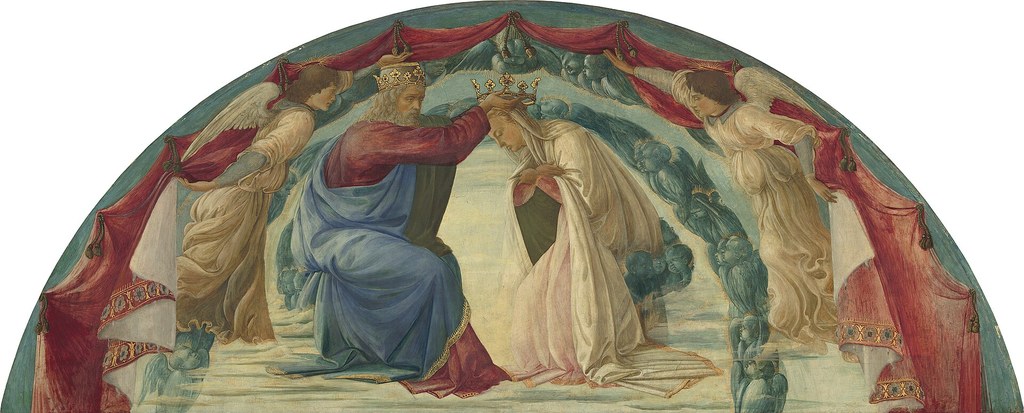
Filippino Lippi’s Coronation of the Virgin in the National Gallery of Art, Washington, painted around 1475, is one of the earliest surviving works associated with him. The broad arched panel shows God the Father crowning the Virgin Mary on clouds while two angels hold a rich red cloth behind them and winged cherub heads form a heavenly arch.[1]
The NGA dates the painting to about 1475 and identifies the medium as tempera and oil on poplar panel. At 90.5 by 222.9 centimetres, it is unusually wide.[1] That combination of early date and large horizontal format makes the picture particularly important for reconstructing Filippino’s beginnings. He would have been only about eighteen years old.
Fra Filippo Lippi had died six years earlier. Filippino was developing within the artistic environment of Sandro Botticelli, his father’s former pupil. The panel therefore belongs to the most difficult part of the career to disentangle stylistically: the moment when workshop inheritance remains stronger than individual fame.
The subject also creates an important family comparison because Fra Filippo Lippi had painted major Coronations of the Virgin, including the celebrated Uffizi altarpiece.[4] Filippino’s early treatment is much more compressed and simple, but the recurrence of the subject gives us a valuable way to think about artistic inheritance across generations.
At a Glance
- ArtistFilippino Lippi
- TitleThe Coronation of the Virgin
- Datec. 1475
- MediumTempera and oil on poplar panel
- Dimensions90.5 × 222.9 cm
- Current locationNational Gallery of Art, Washington
- Accession number1943.4.36
- Credit lineSamuel H. Kress Collection
- Principal figuresGod the Father, Virgin Mary and two angels
- Heavenly detailwinged cherub heads and rays
- Distinctive featuretwo angels holding a large red textile with gold tassels
- Career significanceamong Filippino’s earliest surviving works
Contents
- The Coronation Theme
- The Red Cloth
- Why the Panel Is So Wide
- Comparison with Fra Filippo’s Coronation
- Tempera and Oil
- From Coronation to Brancacci
- Duveen and Kress
- The Unknown Original Setting
- God’s Crown and Mary’s Crown
- Fra Filippo’s Marian Legacy
- Technical Transition
- Newbattle Abbey
- Frequently Asked Questions
- References
The Coronation Theme
The Coronation of the Virgin does not come directly from one Gospel episode. It developed through later Christian theology, devotional literature and liturgical tradition. Mary is represented in heaven receiving a crown. The image celebrates her exalted status after earthly life. For Renaissance viewers, the subject connected Marian devotion with ideas of heavenly reward, intercession and triumph.
God the Father. God the Father sits at the left and places the crown on Mary. He wears his own crown, establishing divine kingship. The gesture creates a transfer of honour.
Mary does not crown herself. Her status is bestowed. This keeps the hierarchy clear even while celebrating her extraordinary elevation.
The Virgin Mary. Mary bows her head and crosses her wrists over her chest. The posture suggests humility and acceptance. This is important because the subject could easily become triumphalist.
Filippino presents the Virgin as exalted but not self-assertive. The same humility associated with the Annunciation continues into heavenly glory. Her white cloak gives the figure unusual visual purity.
White Cloak. The NGA visual description emphasises the large white mantle lined with green.[1] White immediately distinguishes Mary from God the Father’s stronger colours and the red textile behind. The garment also creates broad folds that give her body monumental presence. At this early stage, Filippino is already attentive to the expressive weight of drapery.
The Red Cloth
Two angels hold a large raspberry-red textile behind the sacred pair. Gold tassels hang from it. The cloth creates a ceremonial backdrop almost like a canopy.
This makes the coronation feel courtly. Heaven is represented through visual language familiar from earthly ceremony. The device also concentrates colour behind the main figures, making the broad composition easier to read.
The Angels. The angels stand to either side and support the cloth. Their role is architectural as much as devotional. They frame the central event.
The arrangement demonstrates how Renaissance painters could use figures to build composition. The angels are not simply added witnesses. Their raised arms create the structure holding the heavenly stage together.
Cherub Heads. Winged infant heads surrounded by gold rays form an arch behind the figures. These cherubim emphasise the supernatural setting. They also echo the physical arch of the panel itself. Painted heaven therefore responds to object shape. This relationship between image and support is especially important in an unusually broad arched work.
Clouds. God and Mary sit on clouds. The cloud removes them from ordinary terrestrial space. Unlike Filippino’s later landscapes, there is no complex world of architecture or terrain.
The scene is deliberately abstracted. Heaven needs no city. The simplicity suits the subject and the artist’s early style.
Why the Panel Is So Wide
The overall width is more than twice the height. This suggests that the panel was designed for a specific architectural position rather than as a standard upright altarpiece. Its original function is not securely established in the NGA object record.[1]
The shape should therefore be described without inventing a precise location. What is clear is that the format governs composition. Figures spread laterally beneath the arch. The red cloth unifies the width.
Around 1475. The date makes this painting one of the earliest chronological anchors in Filippino’s surviving career. Around 1475, he was still a teenager or very young adult. Any strong resemblance to Botticelli or Fra Filippo is therefore unsurprising. The work is valuable precisely because individuality has not yet become fully separated from training. It shows artistic formation rather than mature self-definition.
After Fra Filippo’s Death. Fra Filippo died in 1469. Filippino was still young. He could not simply inherit a fully developed paternal workshop as an adult master.
Instead, Botticelli became central to his training. The Coronation therefore belongs to a period of continuity through workshop rather than direct father-son teaching alone. This distinction is essential when describing artistic inheritance.
Botticelli’s Role. Botticelli had trained with Fra Filippo. He carried aspects of the older painter’s line, figure types and Marian imagery into his own workshop. Filippino then absorbed those forms from Botticelli.
The result is a layered transmission. Fra Filippo influences Botticelli. Botticelli teaches Filippino. The son receives part of his father’s artistic legacy through another artist.
Comparison with Fra Filippo’s Coronation
Fra Filippo’s great Uffizi Coronation of the Virgin is much larger and more crowded.[4] Saints, angels and donors populate an elaborate celestial court. Filippino’s early panel reduces the theme dramatically.
God, Mary and two angels dominate. This difference may reflect function, scale and chronology rather than deliberate rejection. The comparison is nevertheless instructive. The son inherits a family subject but solves it with a much simpler structure.
Family Subjects without Family Copying. Recurring subjects do not prove that Filippino copied a particular work by his father. Coronations were common in Florentine religious art. The safer conclusion is that the subject belonged to the shared devotional and workshop culture both painters inhabited. Comparison remains valuable because it reveals generational difference without requiring direct dependence.
Early Drapery. The broad folds of the garments are among the painting’s strongest visual features. Mary’s cloak pools around her. God’s robes create heavy coloured masses.
The angels’ white garments echo Mary’s. Filippino would later become famous for animated drapery. Here the movement is calmer. The early work shows the foundation before later complexity.
Colour. The palette is clear and relatively simple. White, pink, blue, green and red organise the composition. The brilliant cloth provides the strongest background accent. Gold appears in tassels, halos or rays. This combination retains aspects of traditional sacred splendour while moving within a naturalistic painted heaven.
Tempera and Oil
The NGA identifies both tempera and oil on poplar.[1] This mixed medium is notable at such an early date. Florentine painters were increasingly exploring oil alongside traditional tempera practice. The panel therefore records technical transition as well as artistic apprenticeship. Filippino’s later works would make even more varied use of oil-rich effects.
Poplar Support. Poplar was common for Italian panel painting. A support more than two metres wide required careful construction and preparation. This reminds us that even an early painting involved workshop labour beyond the named artist.
Carpenters prepared panels. Assistants could apply grounds. The final image depended upon a material production system.
The Young Artist and Large Scale. The painting is important partly because of its width. A very young Filippino was already working at a scale far larger than a private Madonna. This suggests early exposure to substantial commissions or workshop responsibilities. One should not assume he executed every preparatory step alone. But the attribution places him within ambitious production from the beginning.
Simplicity before Complexity. Filippino’s late reputation rests heavily on complexity. The Coronation offers the opposite. The main event is immediately legible.
There is no narrative landscape. No grotesque ornament competes for attention. No portraits crowd the margins. The early work therefore gives a clean baseline from which later development can be measured.
From Coronation to Brancacci
Within less than a decade, Filippino would take on the Brancacci Chapel. That jump is extraordinary. The Coronation belongs to training and early independent activity. Brancacci requires historical sensitivity to Masaccio and monumental fresco narrative. The rapid development helps explain why Filippino became one of Florence’s leading painters while still young.
From Coronation to Rome. The distance between this panel and the Carafa Chapel is even greater. Around 1475, heaven is represented through cloud, cloth and cherubim. By the Roman period, sacred space becomes filled with antique architecture, allegory and grotesque ornament. The comparison makes Filippino’s transformation almost startling.
Provenance: Florence to Scotland. The painting is documented in Florence by around 1860 in the hands of William Blundell Spence. In 1861 it was sold to the Marquess of Lothian and entered the collection at Newbattle Abbey in Scotland. This nineteenth-century movement reflects the international market for Italian Renaissance painting. Large religious panels could leave Italy and enter aristocratic country-house collections.
Lothian Collection. The painting remained with successive Marquesses of Lothian for decades. Such aristocratic collections played an important role in preserving and displaying Renaissance art before the expansion of public museums. They also removed works from original religious and civic contexts. The Coronation became an Old Master possession rather than a functioning sacred furnishing.
Duveen and Kress
After the death of the eleventh Marquess of Lothian, the painting passed through Duveen Brothers and was sold to the Samuel H. Kress Foundation in 1940. Kress gave it to the National Gallery of Art in 1943.[1] This trajectory parallels the Tobias and Pietà panels in the same museum. Together they show how American public collections were built through European private holdings and international dealers.
Current Museum Context. At the NGA, the painting can be compared with several other Filippino works spanning his career.[1] This creates a new chronological function. An object once designed for an unknown sacred setting now helps visitors understand artistic development. Museum context therefore changes meaning but can generate valuable comparison.
The Problem of an Early Attribution. Works from an artist’s youth are often the hardest to attribute. Filippino around 1475 was still embedded in a workshop culture shaped by Botticelli and ultimately by Fra Filippo. Individual style had not yet separated cleanly. This means the Coronation is valuable not because every feature is uniquely “Filippino” but because it shows the visual language from which his later identity emerged.
Workshop Production. A panel of more than two metres width would almost certainly involve workshop organisation. The named artist might design and execute important passages while assistants contributed to preparation or secondary areas. This was normal rather than exceptional. Renaissance authorship should therefore not be imagined as one person performing every material action alone. The Coronation belongs to a collaborative production culture.
The Unknown Original Setting
The painting’s original location has not been securely recovered in the NGA record.[1] That loss should be stated rather than filled with speculation. Its unusual dimensions strongly imply a particular architectural role. Perhaps it belonged above another structure or within a broad chapel arrangement, but without documentary evidence the exact placement remains uncertain. The format itself is the surviving clue.
Shape and Composition. The arched top and extreme width force the figures into a shallow celestial stage. Filippino does not attempt deep perspective. He spreads the event laterally.
The angels holding the cloth are essential because they make the width feel intentional. Without them, God and Mary would seem lost inside the broad support. The textile therefore solves a compositional problem as well as creating splendour.
Textile as Court Ceremony. The red cloth resembles the kinds of rich textiles used in elite ceremony. Sacred events in Renaissance art were often imagined through the visual language of contemporary courts. This made heavenly kingship legible. A viewer understood honour through fabric, canopy, crown and attendants. Filippino translates celestial status into familiar ceremonial form.
Mary’s Crossed Hands. Mary’s crossed wrists intensify humility. The posture closes her body inward even as she receives the highest honour. This contrast is central to Marian theology. The woman celebrated as Queen of Heaven remains the humble servant of the Annunciation. Filippino makes exaltation and submission coexist.
God’s Crown and Mary’s Crown
Two crowns appear conceptually. God already possesses kingship. Mary receives it.
The distinction matters. Her authority is derivative from divine grace rather than independent sovereignty. The image therefore avoids placing God and Mary on equal theological terms even though they occupy similar scale.
Cherubim and Gold Rays. The ring of winged heads creates another visual crown around the event. Gold rays turn the abstract heaven into radiant presence. Such devices preserve aspects of older sacred art within an increasingly naturalistic Renaissance style. Filippino’s early panel sits at precisely this intersection. Clouds and bodies become volumetric, but gold still marks holiness materially.
Heavenly Space without Earth. Unlike almost every later Filippino masterpiece, there is no earthly setting. No Florence. No rocky wilderness.
No architecture. No Roman ruin. This absence makes the work especially useful chronologically. Filippino’s later career would increasingly make environment active. The Coronation belongs to a phase when sacred figures can still carry almost the entire meaning alone.
Early Monumentality. Despite the lack of landscape, the figures have significant bodily presence. Heavy drapery gives weight. This may reflect the wider Florentine inheritance of Masaccio mediated through Fra Filippo. Even before Filippino worked directly in the Brancacci Chapel, monumental figure culture was part of the artistic environment he inherited.
Fra Filippo’s Marian Legacy
Fra Filippo’s career was dominated by Marian commissions. His Madonnas and Coronations established an influential balance between sacred dignity and human accessibility. Filippino inherited not one fixed formula but a family association with Marian imagery. The early Coronation demonstrates how deeply that subject matter surrounded his formation.
The Uffizi Coronation by Fra Filippo. Comparing the Washington panel with Fra Filippo’s Uffizi Coronation is especially productive because the father’s work is expansive and populated.[4] The elder Lippi creates a celestial court. Filippino’s version is almost emblematic by comparison. This could reflect different patronal requirements more than artistic philosophy. Still, the contrast makes generational change visible.
Botticelli between Father and Son. Botticelli is the crucial intermediary. He absorbed Fra Filippo’s elegant line and figure types. Filippino then absorbed Botticelli’s adaptation.
The Coronation therefore reminds us that artistic inheritance rarely travels directly. Teachers reinterpret what they receive. The son inherits a transformed version of his father’s language.
From White Angels to Later Angels. The two white-robed angels are restrained compared with the dancing musicians of the Carafa Chapel decades later. This comparison is almost a miniature history of Filippino’s career. Early angels frame.
Late angels perform. Early sacred movement is controlled. Late sacred movement becomes theatrical. The underlying fascination with graceful bodies remains.
Technical Transition
The use of both tempera and oil is also historically revealing. Florentine painting around 1475 was changing materially. Oil techniques associated strongly with northern European art were increasingly entering Italian practice. The panel therefore belongs to technological as well as stylistic transition. Filippino’s later Met and Cleveland paintings would exploit mixed media with much greater sophistication.
Gold and Pigment. The gold accents should not be dismissed as remnants of a medieval past. Precious material still carried devotional force. Gold responds to light differently from pigment. It catches and reflects rather than merely imitates. In a sacred setting, that material radiance helped distinguish heaven from ordinary painted matter.
The Wide Panel as Public Object. Its width suggests visibility mattered. Even without knowing the exact setting, this was not a tiny household Madonna. The work addressed viewers across some distance.
The simplified central action and bold textile are therefore practical. Filippino’s composition communicates immediately. The young painter already understood how scale changes pictorial strategy.
Nineteenth-Century Collection History. By the nineteenth century, the panel had become detached from its sacred function and was circulating as an Italian Old Master. William Blundell Spence, based in Florence, handled many works entering foreign collections. The sale to the Marquess of Lothian moved the panel into a Scottish aristocratic setting. This change reflects the enormous nineteenth-century transfer of Italian church art into private collections abroad.
Newbattle Abbey
At Newbattle Abbey, the Coronation became part of a family collection rather than a devotional ensemble. Its broad shape may have made it impressive as decorative Old Master display. The shift is historically important. A sacred object can survive while its use changes completely. The image remains Christian, but the principal activity around it becomes collecting and connoisseurship.
Kress and American Museum Building. The Kress Foundation’s acquisition belonged to a major programme of bringing European art into American public collections. When the panel entered the National Gallery of Art, its meaning changed again.[1] It became an educational example of early Filippino and Florentine Renaissance painting. The museum gives it a chronological role that the original patron could never have imagined.
An Early Anchor for Filippino’s Career. Within Filippino’s chronology, the work performs an unusually important historical function. It tells us where to begin. Around 1475, he is still young, workshop-formed and relatively restrained.
By 1480, narrative landscape grows stronger. By 1485, the Vision of Saint Bernard reveals mature independence. By 1488, Rome changes everything. The Coronation makes that arc measurable.
Why the Coronation of the Virgin Matters. The Coronation of the Virgin matters above all because of its early date. It gives Filippino’s surviving career a firm starting point around 1475. The young painter is still deeply embedded within the artistic legacy of Fra Filippo and Botticelli.
His later interests in complex landscape, psychological narrative and Roman antiquity are not yet dominant. That makes the work unusually useful. Development needs a beginning.
Without early paintings, mature style appears as a fixed personality. The Coronation shows that Filippino became Filippino gradually. It also enriches the father-son comparison.
Fra Filippo had treated the same theme on monumental terms. The son’s early panel is simpler, broader and more concentrated. The relationship is one of shared devotional culture rather than mere repetition. For a career defined by transformation, this modest heavenly scene provides an essential first chapter.
Frequently Asked Questions
Discussion
What stands out to you most about Coronation of the Virgin in relation to Filippino Lippi's wider career?
Reader Insights
Notice how the page connects close visual detail with patronage, workshop practice and the wider Renaissance setting.
Which comparison elsewhere in the cluster helps clarify this work or theme most strongly?
Join the Conversation
Have a thought or observation about Coronation of the Virgin? Share it below. Thoughtful responses may be added to this section.
References
- National Gallery of Art, Washington, Filippino Lippi, The Coronation of the Virgin, 1943.4.36. View Source
- National Gallery of Art, provenance and bibliography for The Coronation of the Virgin. View Source
- Metropolitan Museum of Art, The Drawings of Filippino Lippi and His Circle, 1997. View Source
- Uffizi Galleries, Fra Filippo Lippi, Coronation of the Virgin, for father-son comparison. View Source