 by Tom Gurney
Tom Gurney BSc (Hons) is an art history expert with over 20 years experience
Published on June 19, 2020 / Updated on October 2, 2026
Email: tomgurney1@gmail.com / Phone: +44 7429 011000
Strozzi Chapel by Filippino Lippi
The Strozzi Chapel in Santa Maria Novella is the final great fresco cycle of Filippino Lippi’s career and one of the richest surviving examples of his mature style. Begun in the late 1480s for the Florentine banker Filippo Strozzi the Elder and completed around 1502, the chapel records an extraordinary transformation because Filippino left the project unfinished when he travelled to Rome and returned to it only after his encounter with ancient art.[1]
The result is almost a career in miniature. The commission begins in Florence before the Carafa Chapel. Rome intervenes.
Filippino returns with a radically expanded vocabulary of antique architecture, grotesque ornament, allegorical sculpture and dramatic narrative. Santa Maria Novella identifies the frescoes as the last series of paintings Filippino completed. That gives the chapel unusual importance within his chronology. It is both the fulfilment of a long-standing Strozzi commission and the culmination of the Roman transformation that began more than a decade earlier.[1]
The chapel had previously been dedicated to Saint John the Evangelist. Filippo Strozzi’s patronage added Saint Philip the Apostle, whose name corresponded with the patron’s own. The resulting programme therefore combines inherited chapel identity with personal dynastic devotion. Filippino painted episodes from the lives of both saints. The vault carries Old Testament patriarchs. The back wall is organised around a triumphal architectural structure with allegorical figures of Faith and Charity. Even the stained-glass window was designed by Filippino. The chapel should therefore be understood as a complete environment rather than a set of independent narrative scenes.
At a Glance
- ArtistFilippino Lippi
- PatronFilippo Strozzi the Elder
- LocationSanta Maria Novella, Florence
- Commissionbegun after Strozzi acquired chapel patronage around 1486
- Executionlate 1480s to c. 1502
- StatusFilippino’s final fresco cycle
- Principal saintsSaint Philip the Apostle and Saint John the Evangelist
- Vault figuresAdam, Noah, Abraham and Jacob
- Back walltriumphal arch and allegorical statues of Faith and Charity
- Stained glassdesigned by Filippino, with Madonna and Child, Saint John and Saint Philip
- Patronal tombFilippo Strozzi’s red porphyry tomb by Benedetto da Maiano
- Major significanceclearest Florentine evidence of how Filippino’s Roman experience transformed his later style
Contents
- Filippo Strozzi the Elder
- Why Saint John?
- Saint Philip before the Temple of Mars
- Saint John and Drusiana
- The Back Wall as Fulcrum
- Designing a Total Space
- A Different Kind of Renaissance Classicism
- The Strozzi Bust
- Comparison with the Carafa Chapel
- The Temple of Mars as a Late Renaissance Stage
- Mourning and Hope
- The Met Madonna as a Pre-Roman Benchmark
- The Window and Natural Light
- Old Testament and New Testament Time
- Slow Production as Historical Evidence
- The Chapel as a Final Synthesis
- Why the Strozzi Chapel Matters
- Frequently Asked Questions
- References
Filippo Strozzi the Elder
Filippo Strozzi was one of the most important Florentine bankers and patrons of the later fifteenth century. His family had suffered political exile because of conflict with the Medici, but Strozzi eventually returned to Florence and rebuilt the family’s position through banking, property and patronage. His most famous architectural project was Palazzo Strozzi, one of the largest and most imposing private palaces in Florence.
The chapel at Santa Maria Novella belonged to the same broader programme of family memory and prestige.[1] Santa Maria Novella records that Strozzi acquired patronage rights from the Boni family around 1486 and shortly afterwards contracted Filippino.[1] The commission therefore begins at a moment when Strozzi was actively transforming family status into durable architecture and art.
A Funerary Chapel. The chapel was not simply decorative. It functioned as a funerary and memorial space. Behind the altar stands Filippo Strozzi’s red porphyry tomb, carved by Benedetto da Maiano.
A marble Madonna and Child relief and surrounding angels complete the monument. The tomb changes the meaning of the frescoes. The patron’s body and memory occupy the same sacred environment as the stories of saints. This creates a direct relationship between commemoration and salvation. The chapel asks viewers to remember Strozzi while contemplating sacred models of faith, martyrdom and miraculous power.
Why Saint Philip? Saint Philip the Apostle was chosen partly because of the patron’s name. Name saints were important in Renaissance devotion. A person named Filippo had a natural relationship with Saint Philip.
The saint could function as heavenly protector, moral model and marker of personal identity. Strozzi’s decision to place Philip within the programme therefore links family identity to sacred history without requiring the patron to appear in every scene. The saint becomes an indirect spiritual portrait of the commissioner.
Why Saint John?
Saint John the Evangelist belonged to the chapel’s earlier dedication. Filippino therefore inherited rather than invented his presence. This gave the programme a dual structure.
Saint Philip represented the new patron. Saint John represented the existing sacred identity of the space. The two stories had to coexist. That coexistence makes the chapel a good example of how Renaissance commissions often adapted existing architecture and devotion rather than starting from a blank slate.
The Long Delay. The project proceeded slowly. Santa Maria Novella identifies Filippino’s lengthy Roman stay as the principal reason.[1] Soon after receiving the Strozzi commission, Filippino left Florence to work for Cardinal Oliviero Carafa in Santa Maria sopra Minerva.
This delay would ordinarily be a practical inconvenience. Artistically, it became decisive. The painter who returned from Rome had encountered a new world of antique fragments, grotesques, architecture and decorative systems. Those discoveries entered the Strozzi Chapel. The interruption therefore became a source of transformation.
Before Rome and After Rome. Few Renaissance commissions allow stylistic change to be understood so clearly within one long project. Filippino began as a mature Florentine painter shaped by Botticelli, the Brancacci Chapel and his own pre-Roman works. He returned after years in Rome with a radically expanded visual vocabulary.
The Strozzi Chapel therefore belongs to both phases. Even where exact sequencing of individual passages remains a specialist question, the overall transformation is unmistakable. The later decorative environment would be difficult to imagine without Carafa. Rome does not simply add motifs. It changes the kind of space Filippino wants to create.
Saint Philip before the Temple of Mars
One of the most memorable Strozzi scenes shows Saint Philip confronting pagan worship at the Temple of Mars. The setting allows Filippino to turn Roman antiquity into the subject of Christian drama. Ancient-looking architecture, sculpture and decorative forms establish a pagan world.
Within it, Philip represents Christian truth. The scene therefore extends a problem already explored in the Carafa Chapel: how can Christian painting admire ancient form while rejecting pagan religion? Filippino’s solution is highly theatrical. The temple is visually fascinating even as its spiritual order is challenged. Beauty and error coexist.
The Monster and the Temple. Later descriptions of the chapel have drawn attention to the strange monster or dragon-like creature associated with the Temple of Mars scene. Its grotesque presence is entirely characteristic of Filippino’s late imagination. The creature makes pagan error physical.
Poisonous or threatening force becomes visible. At the same time, the monster reflects Filippino’s delight in bizarre forms. His late sacred painting is willing to use ugliness, fantasy and hybrid bodies as part of serious theological narrative. This is one reason the Strozzi Chapel can feel surprisingly far from the elegant serenity associated with Botticelli.
Martyrdom of Saint Philip. The cycle also includes the martyrdom of Saint Philip. The saint’s death completes the narrative arc from preaching to sacrifice. For a funerary chapel, martyrdom carried obvious resonance.
The patron’s tomb sits within a visual programme in which death is interpreted through Christian endurance and hope. The saint’s body suffers, but sacred history gives the suffering meaning. This does not mean the fresco was a literal allegory of Strozzi’s own death. Rather, martyrdom provided the broader devotional framework within which a Christian burial could be understood.
Saint John and Drusiana
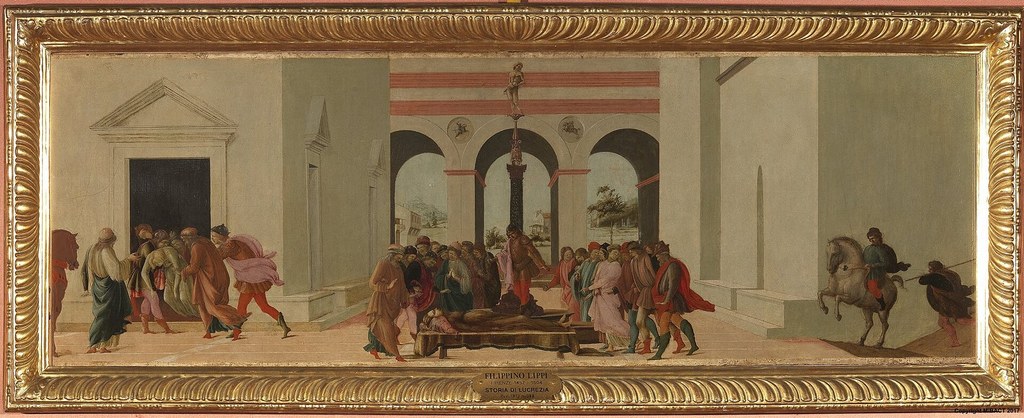
The cycle of Saint John includes the resurrection of Drusiana. Santa Maria Novella identifies this miracle specifically within Filippino’s programme.[1] The subject is especially appropriate to a funerary chapel.
John restores a dead woman to life. The visual drama therefore turns death into reversal. Within a chapel containing the patron’s tomb, resurrection imagery has immediate theological relevance. The miracle reassures the viewer that death is not final. Filippino’s narrative power makes the doctrine physical through gesture, crowd response and the reanimated body.
Narrative Crowds. Filippino’s late frescoes are populated by varied groups. Figures do not simply stand as spectators. They react.
Some turn towards the miracle. Others gesture or converse. Costumes differentiate social roles.
This crowd psychology had roots in his earlier work, including the Brancacci Chapel and the Adoration of the Magi. In the Strozzi Chapel it becomes more intense because architecture and ornament compete for attention as well. Filippino manages multiple layers of narrative information simultaneously.
The Four Patriarchs. Adam, Noah, Abraham and Jacob occupy the vault. These Old Testament patriarchs connect the stories of the apostles with the deeper history of salvation. Their placement above the narrative walls creates chronology in architecture.
The ancient fathers of biblical history oversee later Christian events. This vertical relationship helps unify the chapel. Saint Philip and Saint John are not isolated heroes. They belong within a continuum stretching back through scripture. The vault therefore provides theological ancestry.
The Back Wall as Fulcrum
Santa Maria Novella describes the back wall as the fulcrum of the pictorial decoration.[1] Filippino designed it around a triumphal arch. The architectural choice is highly significant.
A Roman form associated with victory becomes part of a Christian funerary chapel. The triumphal language can therefore be read through several overlapping ideas: sacred victory, family memory and the Christian conquest of death. Filippino’s use of antique form is again transformative rather than archaeological. The Roman arch becomes a Christian visual structure.
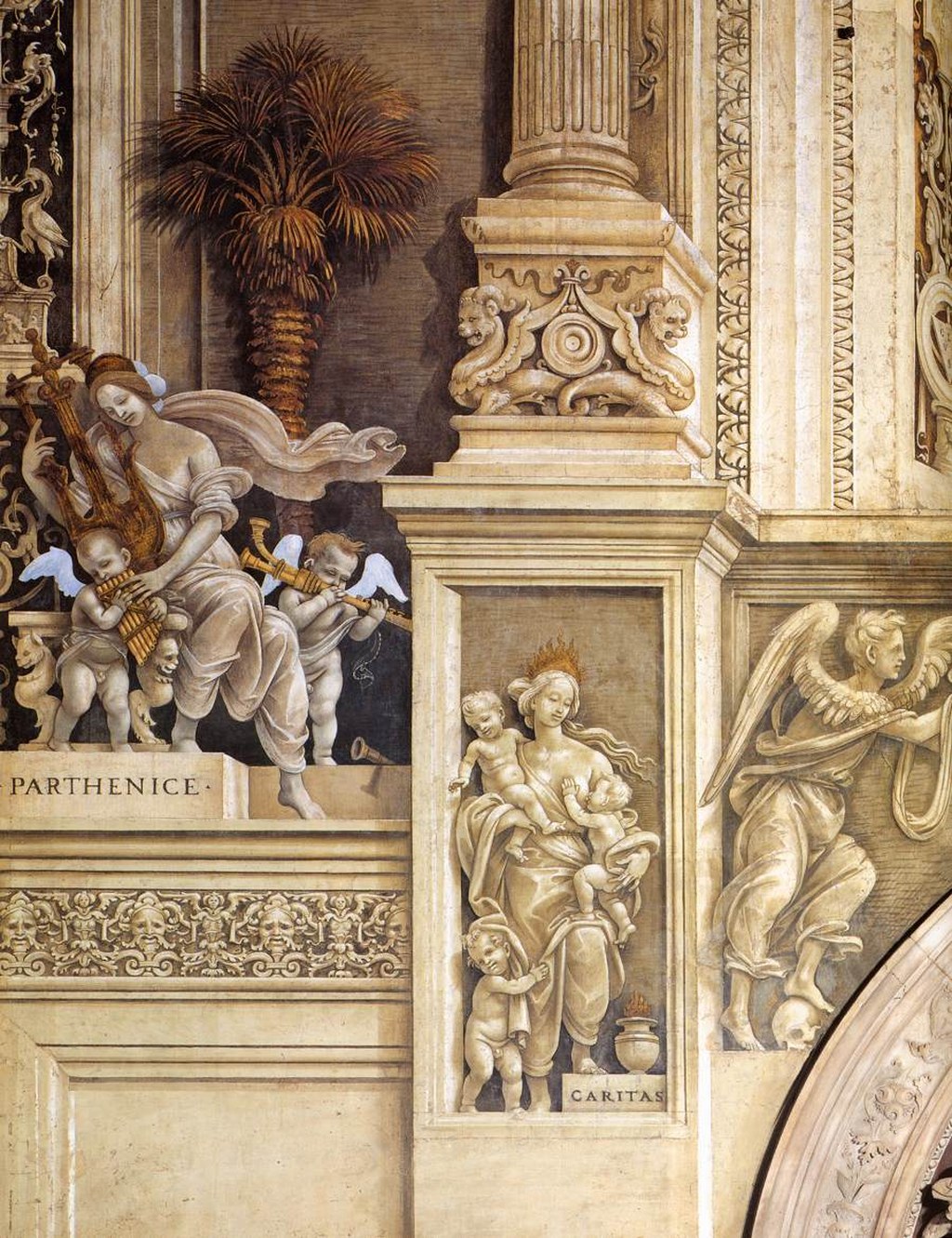
Faith and Charity. Allegorical statues of Faith and Charity accompany the back-wall design. These personifications extend the intellectual language Filippino developed in Rome. Abstract virtues become bodies.
Their placement turns architectural decoration into moral argument. A funerary chapel is therefore surrounded not only by narratives of saints but by virtues expected of Christian life. Faith and Charity also carry obvious relevance to salvation and commemoration. The patron’s monument exists beneath a visual statement about how life should be ordered.
The Stained Glass. Filippino designed the chapel’s lancet window as well as the fresco programme. Santa Maria Novella describes a Madonna and Child above, with Saints John the Evangelist and Philip below.[1] This is important because it demonstrates how comprehensively Filippino approached the chapel.
He did not treat stained glass as an unrelated furnishing. The same two saints governing the wall narratives reappear in the window. Light therefore passes through imagery tied directly to the programme. The chapel becomes an integrated environment across media.
Designing a Total Space
The combination of fresco, window, tomb and architectural illusion makes the chapel more than a sequence of pictures. Different artists contributed to the physical environment, especially Benedetto da Maiano’s tomb. Yet Filippino’s pictorial design responds to those conditions.
The viewer sees painted triumphal architecture behind a real funerary monument. Light enters through Filippino-designed glass. The vault and walls create different chronological layers. This integration is one of the greatest achievements of the commission.
Antiquity after Carafa. The Strozzi Chapel provides the clearest evidence that Filippino’s Roman discoveries remained active after his return to Florence. Classical architecture is everywhere. Yet it is rarely calm.
Figures, statues and ornaments crowd the spaces. Ancient forms seem animated by Christian drama. This distinguishes Filippino’s classicism from the more measured harmony associated with later High Renaissance art. He treats antiquity as a source of invention rather than a system of rules. The result is learned and strange at the same time.
Grotesques and Fantasy. The late decorative vocabulary includes grotesque and hybrid forms that would have been impossible to explain through Botticelli alone. Rome had exposed Filippino to ancient painted decoration in which human, animal and vegetal motifs combine freely. In Florence he pushes that freedom further.
Decorative forms begin to participate in the emotional atmosphere of the narratives. Architecture can feel unstable or alive. The sacred world becomes visually charged. This “bizarre” quality later contributed to Filippino’s distinctive reputation.
A Different Kind of Renaissance Classicism
The Strozzi Chapel is especially important because it challenges the idea that Renaissance engagement with antiquity always led towards simplicity and balance. Filippino had studied ancient Rome intensely. The result was greater complexity.
He discovered fragments and turned them into fantasy. This represents another valid Renaissance response to antiquity. Raphael and later classicists would often seek coherence. Filippino emphasises abundance. Understanding this difference prevents the final decades of the fifteenth century from being judged only by the standards of what came next.
Filippo Strozzi’s Death. Filippo Strozzi died in 1491, before Filippino completed the fresco cycle. This gives the long commission another layer of poignancy. The patron commissioned his funerary chapel but did not live to see the final programme.
The tomb and frescoes therefore became genuinely posthumous memorials rather than anticipated ones. Completion continued the family’s intentions across death. The chapel thus demonstrates how Renaissance patronage could outlive the person who initiated it.
Benedetto da Maiano’s Tomb. The red porphyry tomb behind the altar was carved by Benedetto da Maiano. Porphyry carried associations of antiquity and elite status. Its deep colour creates a strong material presence within the chapel.
Above it, a marble Madonna and Child surrounded by roses and flying angels provides a sculptural devotional focus. The tomb therefore introduces another major Renaissance artist into the environment. Filippino’s frescoes and Benedetto’s sculpture operate together. The chapel is collaborative even though Filippino dominates its visual identity.
The Strozzi Bust
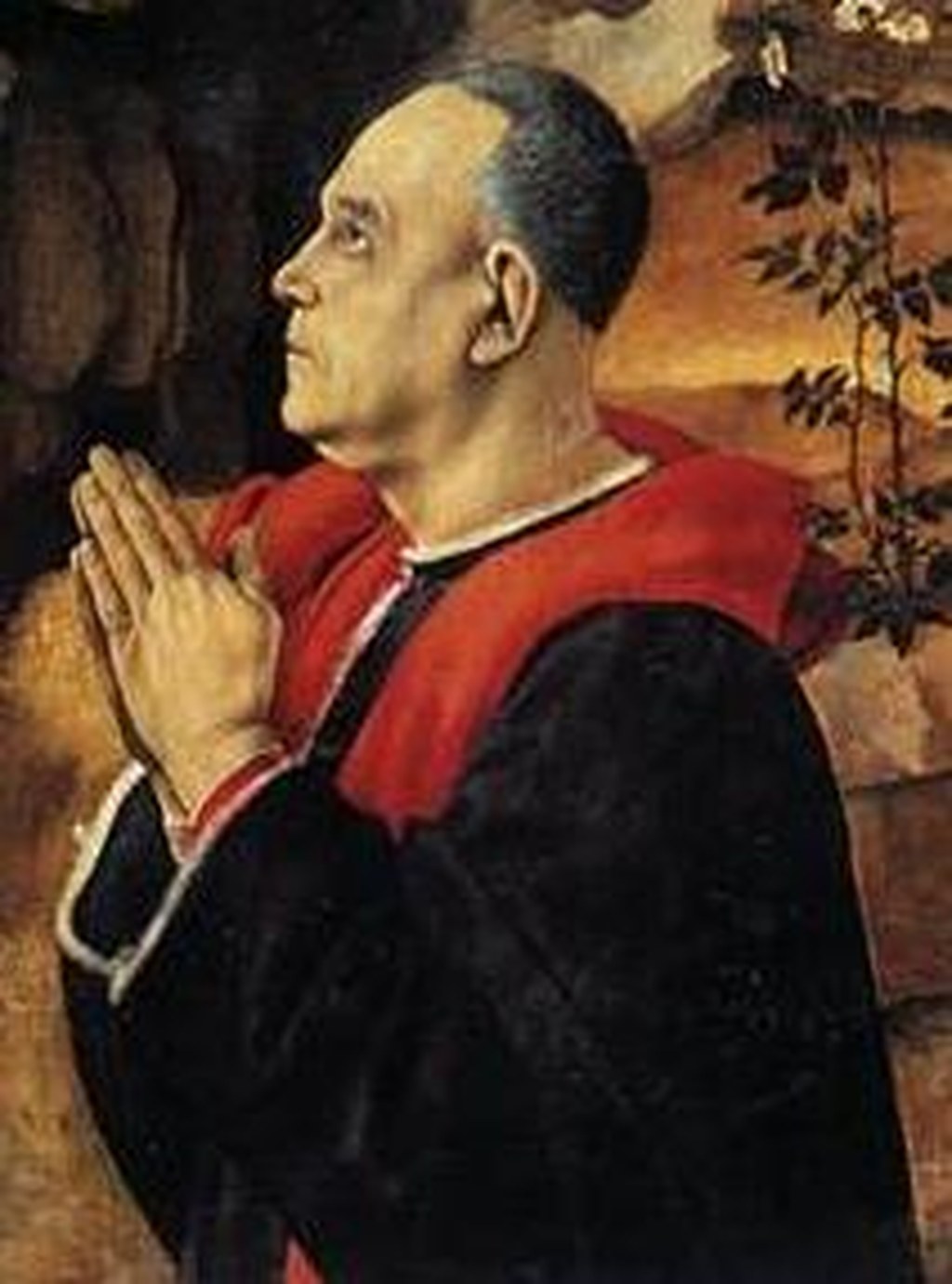
Benedetto also carved a portrait bust of Filippo Strozzi. Santa Maria Novella notes that the family retained it in Palazzo Strozzi until 1878, when it was sold to the Louvre.[1] The bust provides a useful comparison with the chapel’s memorial function.
One object preserves the patron’s individual likeness. The chapel preserves his dynastic and devotional programme. Portrait and sacred environment therefore performed different kinds of memory. The separation of the bust from Florence also demonstrates how family collections changed in the nineteenth century.
Conservation Problems. The Strozzi Chapel has required specialist conservation. Santa Maria Novella’s restoration reporting describes problems caused by water infiltration, salt crystallisation, exfoliation and powdering of painted surfaces.[1] These are not merely technical footnotes.
They affect how much of Filippino’s original colour and detail survives. Moisture moves salts through plaster. Crystallisation can push paint layers apart. Powdering weakens pigment adhesion. The visible frescoes are therefore active conservation objects rather than untouched Renaissance surfaces.
Restoration and Monitoring. Modern conservation has involved diagnosis, treatment and continuing monitoring. This long-term approach is especially important in mural painting because the artwork cannot be separated easily from the building causing environmental stress. Roofing, masonry and humidity all matter.
Conservators therefore have to treat architecture and painting together. This is another way in which chapel frescoes differ fundamentally from portable panels. The building is part of the artwork’s material condition.
How Loss Changes Interpretation. Surface deterioration can alter our perception of style. If modelling disappears, a face may seem flatter than Filippino intended. If decorative detail is lost, architecture may appear calmer.
If colours fade, the scene may seem more austere. Conservation awareness is therefore essential when describing the late style. What looks visually restrained today may once have been far richer. The chapel’s reputation for complexity should be understood despite centuries of material change, not because the present surface preserves every original effect.
Comparison with the Carafa Chapel
Carafa and Strozzi are the most important paired monuments of Filippino’s mature career. The Roman chapel introduces the new antique vocabulary. The Florentine chapel absorbs and transforms it.
Carafa is Dominican, theological and cardinalatial. Strozzi is funerary, familial and Florentine. Both use allegory.
Both integrate architecture and sacred narrative. Both show Filippino treating antiquity imaginatively. The differences demonstrate that Rome did not give him one formula. It gave him new possibilities.
Comparison with the Brancacci Chapel. The Brancacci Chapel reveals a very different Filippino. There he had to respect Masaccio’s existing monumentality. The architecture is controlled by continuity with an earlier cycle.
At Strozzi, Filippino has much greater freedom. The difference between the two commissions measures his career. The young independent painter proves he can adapt to Masaccio. The late master constructs a world unmistakably his own.
Late Style. By around 1502 Filippino’s style had become more animated, elaborate and psychologically intense than in the early 1480s. This does not mean he abandoned coherence. The Strozzi Chapel remains carefully organised.
But order is achieved through density rather than reduction. Narrative groups, ornament and architecture interact constantly. The late style invites prolonged looking. It rewards viewers who discover one episode or strange detail after another.
Filippino’s Final Fresco Cycle. Santa Maria Novella identifies the Strozzi Chapel as Filippino’s last series of paintings.[1] That status gives it retrospective importance. Themes from across the career converge.
Botticellian figure grace survives inside more restless bodies. Brancacci narrative experience informs the crowds. Roman antiquity dominates the architecture.
Patronage remains central. Drawing and decorative invention reach exceptional complexity. The chapel therefore acts as a final synthesis rather than a sudden late departure.
The Temple of Mars as a Late Renaissance Stage
The Temple of Mars scene is especially revealing because Filippino turns a pagan sanctuary into an almost theatrical environment. The saint’s preaching is not isolated against neutral architecture. He confronts a fully imagined religious system.
Statues, architectural ornament, worshippers and the monstrous creature all give pagan belief visual substance. This allows the Christian miracle to feel like a genuine contest between systems rather than a simple sermon. The scene’s power therefore depends on Filippino making pagan antiquity compelling enough to be worth defeating. That paradox lies at the heart of his late classicism. He admires the forms he is using to represent error.
Pagan Beauty and Christian Victory. Filippino’s late work repeatedly treats antiquity through this double perspective. Classical art is beautiful, learned and authoritative. Christianity is spiritually superior.
The tension is productive rather than embarrassing. A viewer can admire the painted temple while understanding that Saint Philip’s message overturns its religious meaning. The visual pleasure of antiquity therefore survives its theological defeat. This is one reason the Strozzi Chapel is so useful for understanding Renaissance humanism. Admiration for ancient culture did not require a return to ancient religion.
The Resurrection of Drusiana as Counterpoint. The miracle of Drusiana creates a very different emotional register from the Temple of Mars. The Saint Philip cycle involves confrontation, idolatry and martyrdom. Saint John’s miracle centres on restoration.
A dead woman returns to life. The contrast broadens the chapel’s theology. Christian power can defeat false worship and overcome death.
Within a funerary chapel, the second claim is particularly important. The viewer moves between images of death and resurrection while standing near the patron’s tomb. This is not accidental juxtaposition. It gives the entire environment eschatological meaning.
Mourning and Hope
A funerary chapel must negotiate grief. The Strozzi programme does not deny death. Saint Philip is martyred.
Filippo Strozzi is buried below. Drusiana dies. Yet the sacred narratives continually redirect death towards continuity.
Saints survive through faith and memory. Drusiana rises. Patriarchs and apostles belong to one long history. The chapel therefore turns mourning into a structured Christian hope rather than simple lamentation.
Family Memory without Constant Portraiture. The Strozzi identity is visible even where Filippo himself does not appear. Saint Philip carries the patron’s name. The tomb carries his body and heraldic memory.
The chapel’s scale testifies to family resources. The commission itself becomes a dynastic monument. This is important because Renaissance family representation did not always depend upon literal portraits. Names, saints, arms, burial sites and patronage rights could represent lineage indirectly. The Strozzi Chapel is therefore a family portrait built from architecture and devotion.
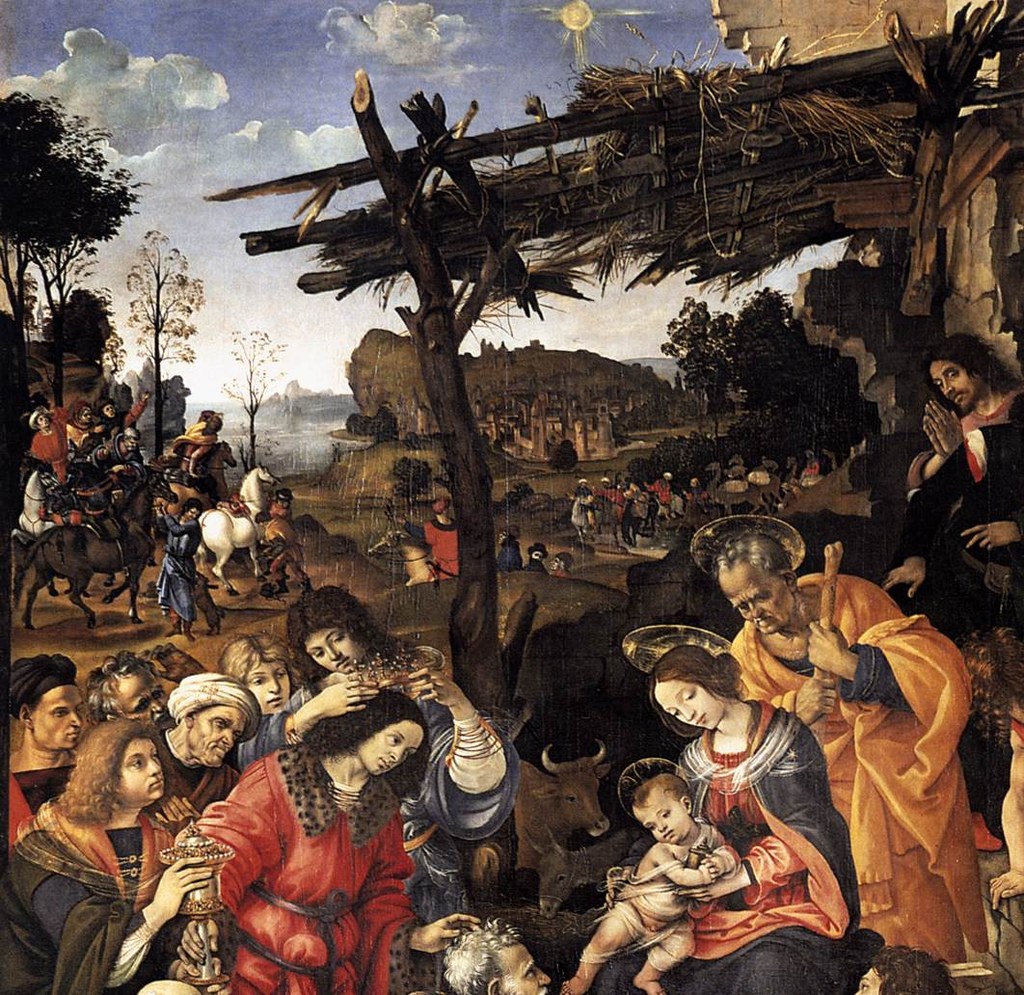
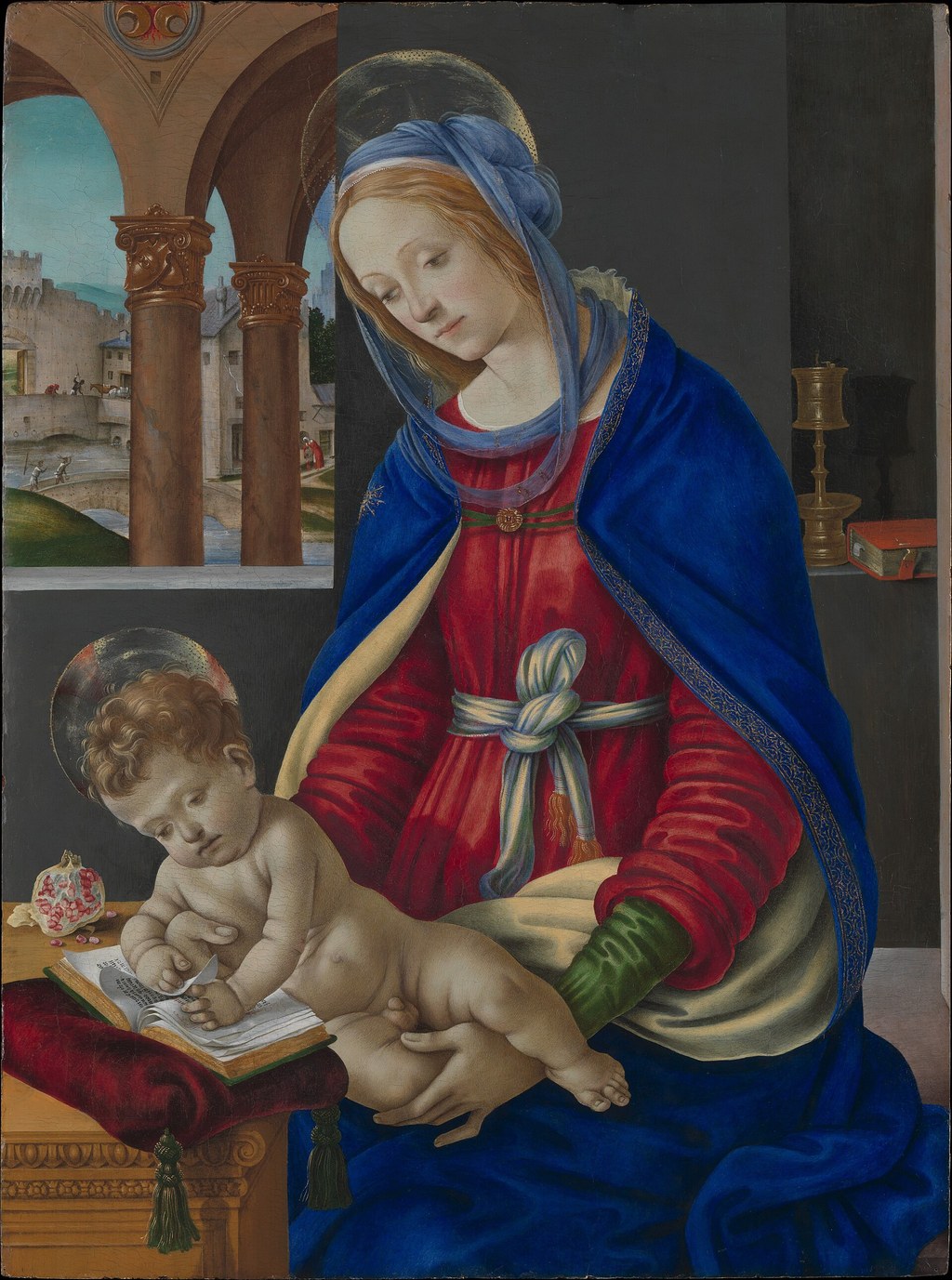
Strozzi Patronage Beyond the Chapel. Filippino’s relationship with Filippo Strozzi was not confined to Santa Maria Novella.[1] The Metropolitan Museum’s Madonna and Child of around 1483–84 was also commissioned by Strozzi.[3] That earlier painting provides a valuable private counterpart to the chapel.
The Met panel is intimate, domestic and richly detailed.[3] The chapel is monumental, funerary and public-facing. Together they show how one patron could employ the same artist across very different functions. The relationship also spans Filippino’s pre-Roman and post-Roman development. Strozzi patronage therefore becomes one of the best threads through which to trace change in the artist’s career.
The Met Madonna as a Pre-Roman Benchmark
The Strozzi Madonna and Child is particularly useful because its date precedes the Roman campaign. Its loggia, landscape, costly colour and refined household detail show Filippino already operating at a highly sophisticated level. Comparing that panel with the completed chapel demonstrates exactly what Rome added.
The difference is not simply “better” or “more mature”. The visual priorities change. The Madonna is controlled and contemplative. The chapel is theatrical and archaeologically imaginative. The comparison therefore isolates transformation without reducing the pre-Roman style to immaturity.
The Triumph of the Back Wall. The triumphal arch on the back wall deserves particular attention because it joins ancient imperial form with Christian funerary meaning. Roman triumphal arches commemorated victory and public authority. Inside the Strozzi Chapel, that language is redirected.
Victory becomes spiritual. Faith and Charity occupy the architectural programme. The patron’s tomb sits below. The implied triumph is therefore not military conquest but Christian hope over death. Filippino’s Roman research gives the architecture historical authority while the chapel gives it a new theological purpose.
Architecture as Memory. The painted architecture also helps transform the chapel into a memory environment. Real and fictive structures overlap. Benedetto da Maiano’s actual tomb exists beneath Filippino’s invented triumphal forms.
The viewer has to negotiate both. This blurring of physical and painted architecture makes the chapel feel more immersive. The patron is remembered not through one isolated inscription but through an entire constructed world.
The Window and Natural Light
The stained-glass window introduces real light through Filippino’s design. This gives the chapel an effect no reproduction can capture fully. Painted colour is illuminated by actual daylight filtered through sacred figures.
The window also occupies the upper part of the back wall, so light participates in the vertical hierarchy of the programme. Madonna and Child, Saint John and Saint Philip become part of the chapel’s illumination literally as well as iconographically. The relationship between fresco and glass would change throughout the day as sunlight shifted. The chapel was therefore never visually static.
Saint Philip as Patronal Mirror. The choice of Saint Philip allowed Filippo Strozzi to identify with a sacred namesake without claiming equality with him. The saint’s courage, preaching and martyrdom supplied virtues the patron could admire. At the same time, the connection guaranteed that Strozzi’s own name remained embedded in the chapel’s sacred programme.
Every retelling of Saint Philip’s story also recalled Filippo Strozzi. Name saint and patron became permanently linked. This is a subtle but powerful form of commemoration.
Saint John as Inherited Memory. Saint John’s presence performs a different memorial task. He preserves the chapel’s identity before Strozzi ownership. By retaining him, the new patron acknowledges continuity rather than erasing the earlier sacred dedication.
This demonstrates how patronage could be additive. A Renaissance commissioner often inherited obligations to existing saints, altars and traditions. Filippino’s programme succeeds because it makes that inherited material work with the new patronal agenda.
Old Testament and New Testament Time
The four patriarchs on the vault create another chronological layer. Adam, Noah, Abraham and Jacob belong to biblical history before Christ. Saint Philip and Saint John belong to the apostolic age after Christ.
The chapel therefore spans enormous sacred time. The patron’s tomb occupies the contemporary present. Architecture binds all three levels together. This structure allows the chapel to place one Florentine family within universal salvation history without making an explicit claim of equivalence.
The Strozzi Chapel and Florentine Politics. The Strozzi family’s relationship with the Medici adds another historical dimension. Filippo Strozzi had lived through exile and eventual reintegration into Florentine elite life. His great building and artistic projects therefore carried social and political weight.
A magnificent chapel in Santa Maria Novella demonstrated restored status.[1] Yet the commission should not be reduced to political revenge or competition. Religious devotion, burial, family memory and prestige could all operate simultaneously. The chapel’s power comes from precisely that overlap.
The Artist Who Returned. When Filippino came back from Rome, he was not simply resuming an old job. He had changed. This human fact helps explain the visual history of the project.
Long-running commissions create opportunities for artists to outgrow their original plans. Filippino’s return required negotiation between earlier design commitments and new possibilities. The chapel’s richness can therefore be understood partly as the product of temporal distance. The work contains the memory of an earlier Filippino and the inventions of a later one.
Slow Production as Historical Evidence
Modern viewers often treat delays as administrative trivia. Here the delay is art history. Had Filippino completed the chapel quickly before Rome, it would have looked fundamentally different. The patron’s patience, the artist’s absence and the survival of the unfinished commission created the conditions for a unique late work. Time became a material in the project.
The Final Years. Completion around 1502 places the Strozzi Chapel only about two years before Filippino’s death. The cycle therefore belongs genuinely to his final phase. It shows no retreat from experimentation.
If anything, the architecture and ornament become more audacious. This matters because late careers are sometimes narrated as decline. Filippino’s final monumental work suggests continued invention. He remained capable of complex design almost to the end.
Florence on the Eve of the High Renaissance. The date also places the chapel in a city on the verge of dramatic artistic change. Leonardo had returned to Florence. Michelangelo was emerging as a major figure.
Raphael would soon arrive. Filippino’s late decorative classicism therefore existed beside new approaches centred increasingly on monumental anatomy, unified composition and High Renaissance balance. The chapel should not be judged as a failed attempt to anticipate those developments. It represents a different endpoint for fifteenth-century experimentation.
A Monument That Refuses Simplicity. The Strozzi Chapel’s difficulty is part of its value. It does not reduce itself to one iconic scene. It rewards repeated looking.
Saints, architecture, allegories, monsters, tomb and glass all compete for attention. This makes the chapel less immediately reproducible than a single famous panel but more revealing as an environment. Its richness helps explain why Filippino deserves study beyond individual masterpieces. His greatest late achievement is spatial and cumulative.
The Chapel as a Final Synthesis
Seen across Filippino’s whole career, the Strozzi Chapel gathers together nearly every major strand of his artistic development. Botticellian grace survives in the figures. Brancacci experience informs monumental storytelling. The Strozzi relationship supplies patronal continuity. Rome contributes antique architecture, allegory and grotesque invention. Drawing underpins the elaborate designs, while the funerary setting gives the whole programme emotional purpose.
No single element explains the chapel by itself. Its importance lies in synthesis. Filippino had spent decades learning how to make sacred history inhabit increasingly complex spaces, and at Santa Maria Novella those experiments converge. The final cycle is therefore not merely “late Filippino”; it is the point at which early training, mature patronage and Roman discovery become inseparable.[1]
The chapel also preserves an important lesson about Renaissance authorship: great works could develop across years of interruption, collaboration and changing intention. Their final form was not always fixed at the moment of contract. In Filippino’s case, absence from Florence became part of the creative history, and the completed chapel records both continuity with an earlier plan and the artist’s willingness to transform it. Its long gestation is therefore historically meaningful.
Why the Strozzi Chapel Matters
The Strozzi Chapel matters because it records artistic change over time inside one commission. Filippino began the project as a major Florentine painter before Rome. He completed it after one of the most transformative encounters of his career.
The chapel therefore preserves not merely a mature style but a history of interruption and return. It also joins sacred narrative with Strozzi family identity, burial and architecture. Saint Philip reflects the patron’s name.
Saint John preserves the chapel’s earlier dedication. The tomb anchors the space to Filippo Strozzi’s death. Faith and Charity turn architectural illusion into moral allegory.
The window, frescoes and sculpture form one funerary environment. Most importantly, the chapel offers an alternative vision of Renaissance classicism. Filippino studies antiquity but does not become calmer.
He becomes more inventive. Ancient fragments generate monsters, statues, triumphal structures and fantastic ornament. Christian history unfolds inside a visual world where the past has been broken apart and rebuilt. That quality makes the Strozzi Chapel one of the most distinctive monuments of late-fifteenth-century Florence and an essential final chapter in Filippino Lippi’s career.
Frequently Asked Questions
Discussion
What stands out to you most about Strozzi Chapel in relation to Filippino Lippi's wider career?
Reader Insights
Notice how the page connects close visual detail with patronage, workshop practice and the wider Renaissance setting.
Which comparison elsewhere in the cluster helps clarify this work or theme most strongly?
Join the Conversation
Have a thought or observation about Strozzi Chapel? Share it below. Thoughtful responses may be added to this section.
References
- Santa Maria Novella, “The Strozzi Chapel,” institutional artwork history. View Source
- Santa Maria Novella, restoration and conservation reporting on the Strozzi Chapel. View Source
- Metropolitan Museum of Art, Filippino Lippi, Heilbrunn Timeline of Art History.
- Metropolitan Museum of Art, The Drawings of Filippino Lippi and His Circle, 1997. View Source
- Cleveland Museum of Art, Filippino Lippi and Rome, 2025–26. View Source
- Metropolitan Museum of Art, A Renaissance Masterpiece Revealed: Filippino Lippi’s Madonna and Child, Strozzi patronage resources. View Source