 by Tom Gurney
Tom Gurney BSc (Hons) is an art history expert with over 20 years experience
Published on June 19, 2020 / Updated on October 2, 2026
Email: tomgurney1@gmail.com / Phone: +44 7429 011000
Filippino Lippi and the Brancacci Chapel
Filippino Lippi’s work in the Brancacci Chapel at Santa Maria del Carmine in Florence is one of the most important acts of artistic completion in Renaissance history. When he was called to finish the fresco cycle in the early 1480s, the chapel already contained paintings by Masolino and Masaccio that had transformed Florentine art more than half a century earlier.
The challenge was extraordinary. Filippino was not decorating an empty chapel. He was entering a monument that had already acquired enormous artistic authority. Masaccio had died in 1428, leaving parts of the cycle unfinished. Masolino had also departed. The frescoes remained incomplete for decades while the Brancacci family’s political fortunes changed and the chapel itself passed through a difficult history.
Florence’s official museum service dates Filippino’s restoration and completion campaign to about 1481–83. The National Gallery of Art gives 1483 or 1484 for the assignment, reflecting small differences in the chronology used by modern sources.[5] What matters is the historical distance. Filippino was completing paintings begun roughly sixty years earlier. He had to make new work coexist with an older visual language without becoming either invisible or disruptive.
The Comune di Firenze describes his intervention as sober and respectful, harmonised with his predecessors to such a degree that the chapel retains an unusual stylistic unity.[1] That judgement captures the central achievement. Filippino did not imitate Masaccio mechanically. He adapted.
The resulting chapel is now officially presented as the work of three masters: Masolino, Masaccio and Filippino Lippi. That shared attribution is crucial. Filippino is not an appendix to the Brancacci Chapel. He is part of its finished historical identity. The commission also creates one of the most remarkable chains of artistic inheritance in Florence. Masaccio’s frescoes influenced Fra Filippo Lippi. Fra Filippo trained Botticelli. Botticelli trained Filippino. Filippino then returned to the very chapel that had helped shape his father’s artistic world and completed it. Few monuments make the transmission of Renaissance style across generations so visible.
At a Glance
- Artist completing the cycleFilippino Lippi
- Earlier paintersMasolino and Masaccio
- LocationBrancacci Chapel, Santa Maria del Carmine, Florence
- Original patronFelice Brancacci
- SubjectStories of Saint Peter
- Original campaignbegun in the 1420s
- Filippino campaignapproximately 1481–83, with some sources using 1483–84
- Major Filippino sceneDisputation with Simon Magus and Crucifixion of Saint Peter
- Joint sceneRaising of the Son of Theophilus and Saint Peter Enthroned, begun by Masaccio and completed by Filippino
- Distinctive featureFilippino adapted his late-fifteenth-century style to an early-fifteenth-century monument
- Possible self-portraitFilippino is traditionally identified among the figures in the Disputation with Simon Magus
- Possible Botticelli portraitMUS.E notes that Filippino included both his own likeness and that of his teacher Botticelli
- Modern conservationmajor monitoring and restoration campaign in the 2020s
Contents
- Santa Maria del Carmine
- Half a Century of Incompletion
- Raising of the Son of Theophilus
- Simon Magus
- Botticelli in the Chapel
- Respectful Difference
- The Carmelite Context
- Filippino and Medici Florence
- BrancacciPOV
- Comparison with the Strozzi Chapel
- A Young Painter Facing an Old Master
- Figure Scale
- A Composite Masterpiece
- Why the Brancacci Chapel Matters
- Frequently Asked Questions
- References
Santa Maria del Carmine
The Brancacci Chapel is inside the Carmelite church of Santa Maria del Carmine in Florence. The location has special significance for the Lippi family. Fra Filippo Lippi grew up in the Carmelite community there.
He would have known Masaccio and Masolino’s frescoes as part of his immediate visual environment. Those paintings helped shape his understanding of bodily weight, perspective and monumental narrative. Decades later, Fra Filippo’s son returned to the same church as an established painter. The chapel therefore links father and son through place even though they never worked there together.
Felice Brancacci and the Original Commission. The chapel belonged to the Brancacci family. Florence’s official cultural service records that Felice Brancacci commissioned the Saint Peter frescoes in 1423. Masolino and Masaccio worked together on the cycle.
Their collaboration produced some of the defining images of the early Renaissance. The stories centre on Saint Peter, whose life and miracles suited both family devotion and Carmelite concerns. The programme also had strong civic resonance. Peter represented apostolic authority, charity and the origins of the Church.
Why the Cycle Was Left Unfinished. The original campaign did not reach completion. Masolino left Florence for Hungary.[5] Masaccio later departed for Rome and died young.
By 1427 the frescoes remained unfinished. Political problems then complicated the chapel’s history. The Brancacci family fell out of favour in Medici Florence.
Felice Brancacci was exiled. His family’s identity within the chapel became politically sensitive. The incomplete cycle therefore remained caught between artistic interruption and political change.
Half a Century of Incompletion
The long gap before Filippino’s intervention is one of the most important facts about the project. A few years of delay would have allowed a painter from the same workshop generation to continue relatively easily. More than fifty years changed everything.
Florentine painting had moved on. Perspective, portraiture, colour, landscape and decorative style had all developed. Filippino himself had been trained in Botticelli’s elegant late-fifteenth-century environment. He therefore faced a historical problem rather than merely a technical one. How could a painter of the 1480s work convincingly beside Masaccio?
Why Filippino? By the early 1480s Filippino had emerged from Botticelli’s workshop as a highly capable independent painter. He also possessed an unusual family relationship to the artistic legacy of the Carmine. His father had been deeply shaped by Masaccio.
This did not make Filippino the only possible choice, but it gave him a compelling place within the history of Florentine painting. The commission demanded technical skill, stylistic sensitivity and prestige. Filippino offered all three. The Met describes the Brancacci completion as his first major project.[6] That status shows how important the commission was to his emergence as an independent master.
Completing Masaccio without Disappearing. The Comune di Firenze characterises Filippino’s intervention as sober, respectful and harmonised with the earlier frescoes.[1] This does not mean his work is indistinguishable under close study. Filippino’s figures, faces and gestures belong to another generation.
But he restrained aspects of his normal visual vocabulary. The later painter who would fill the Strozzi Chapel with antique fantasy does not behave that way here. The chapel required deference. Filippino demonstrates maturity by limiting himself. Adaptation becomes a form of authorship.
Raising of the Son of Theophilus
One of the clearest examples of cross-generational collaboration is the Raising of the Son of Theophilus and Saint Peter Enthroned. Masaccio had begun the scene. Filippino completed it decades later.
This creates a work with two historical moments embedded in one surface. The subject tells of Saint Peter miraculously restoring a dead child to life. The miracle confirms Peter’s divine authority and leads to recognition of his role. The scene also includes Saint Peter enthroned. For art historians, the fresco is doubly important because the narrative itself concerns restoration while the painting was literally restored to completion by another artist.
Working inside Another Painter’s Composition. Completing a partially painted scene differs fundamentally from designing a new one. Filippino inherited existing figures, architecture and compositional logic. His additions had to respect positions already fixed on the wall.
This constraint limits invention but makes judgement more important. A new gesture or face could disrupt the balance. Colour could clash.
Scale could reveal the chronological break. Filippino therefore had to understand Masaccio structurally. He was not merely copying surfaces. He had to infer the logic of an unfinished composition and continue it.
Disputation with Simon Magus. Filippino’s Disputation with Simon Magus and Crucifixion of Saint Peter is among his major independent contributions to the chapel. The scene combines episodes concerning Peter’s confrontation with Simon Magus and the apostle’s martyrdom. Simon Magus appears in Christian tradition as a false wonder-worker and rival to apostolic authority.
Peter exposes or defeats his false power. The narrative therefore centres on truth against deception. This theme would later resonate with Filippino’s Roman interest in intellectual and spiritual contest, especially in the Carafa Chapel.
Simon Magus
Simon Magus was associated with the attempt to purchase spiritual power and with false miracles. The word “simony” derives from his name. His confrontation with Peter offered artists a dramatic opposition between legitimate apostolic authority and counterfeit spiritual power.
Filippino uses the story to create a public dispute. Figures gather around the protagonists. The miracle or argument becomes social. Truth is established before witnesses. This crowd setting gave Filippino an opportunity to include contemporary-looking faces.
Crucifixion of Saint Peter. The fresco also represents Peter’s crucifixion. According to tradition, Peter asked to be crucified upside down because he considered himself unworthy to die in the same manner as Christ. The martyrdom provides the emotional culmination of the apostle’s story.
Within the chapel, Peter is therefore shown performing miracles, teaching, exercising authority and finally dying for faith. The cycle constructs a complete model of apostolic life. Filippino’s late contribution had to preserve that broader narrative unity.
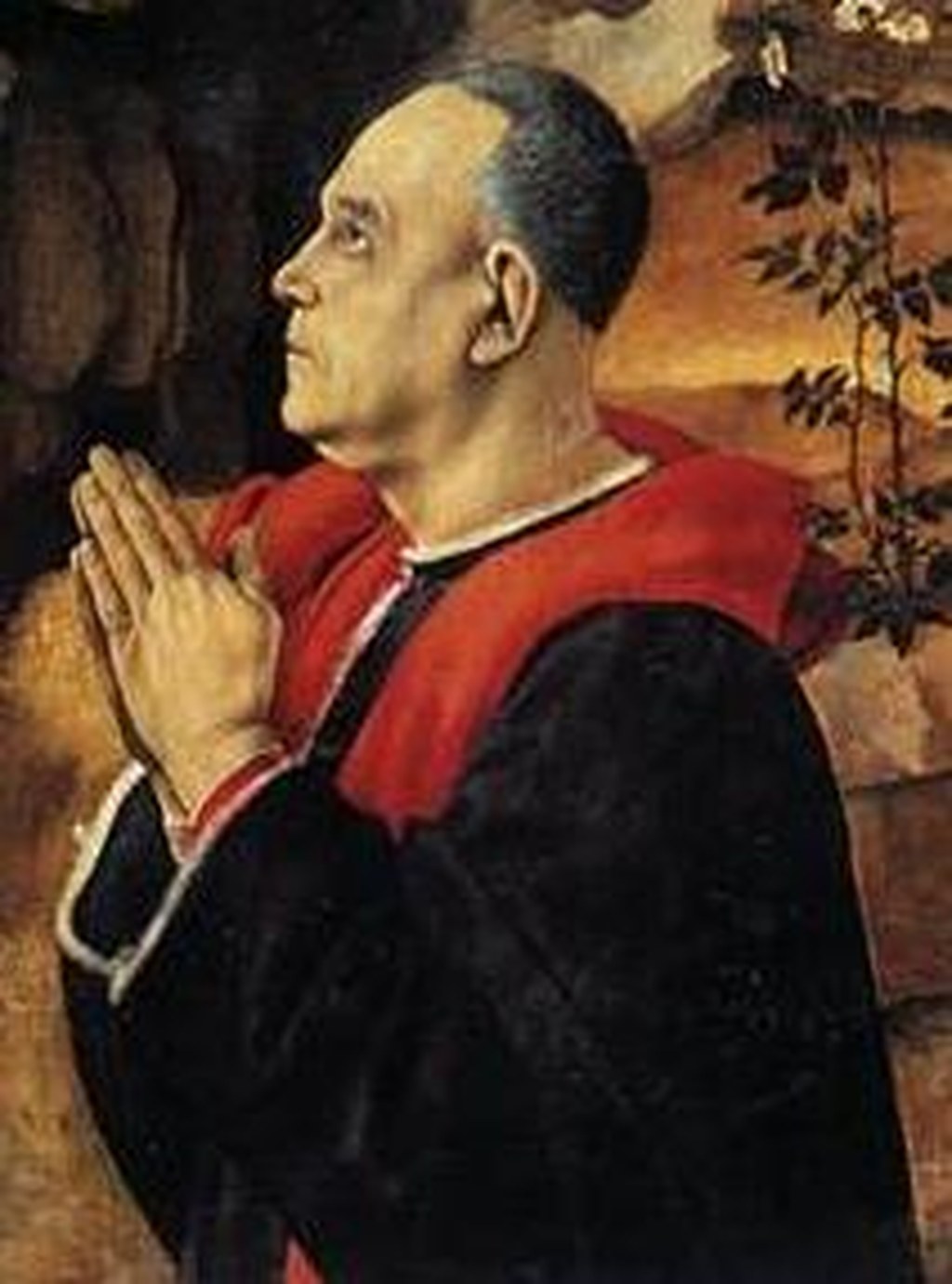
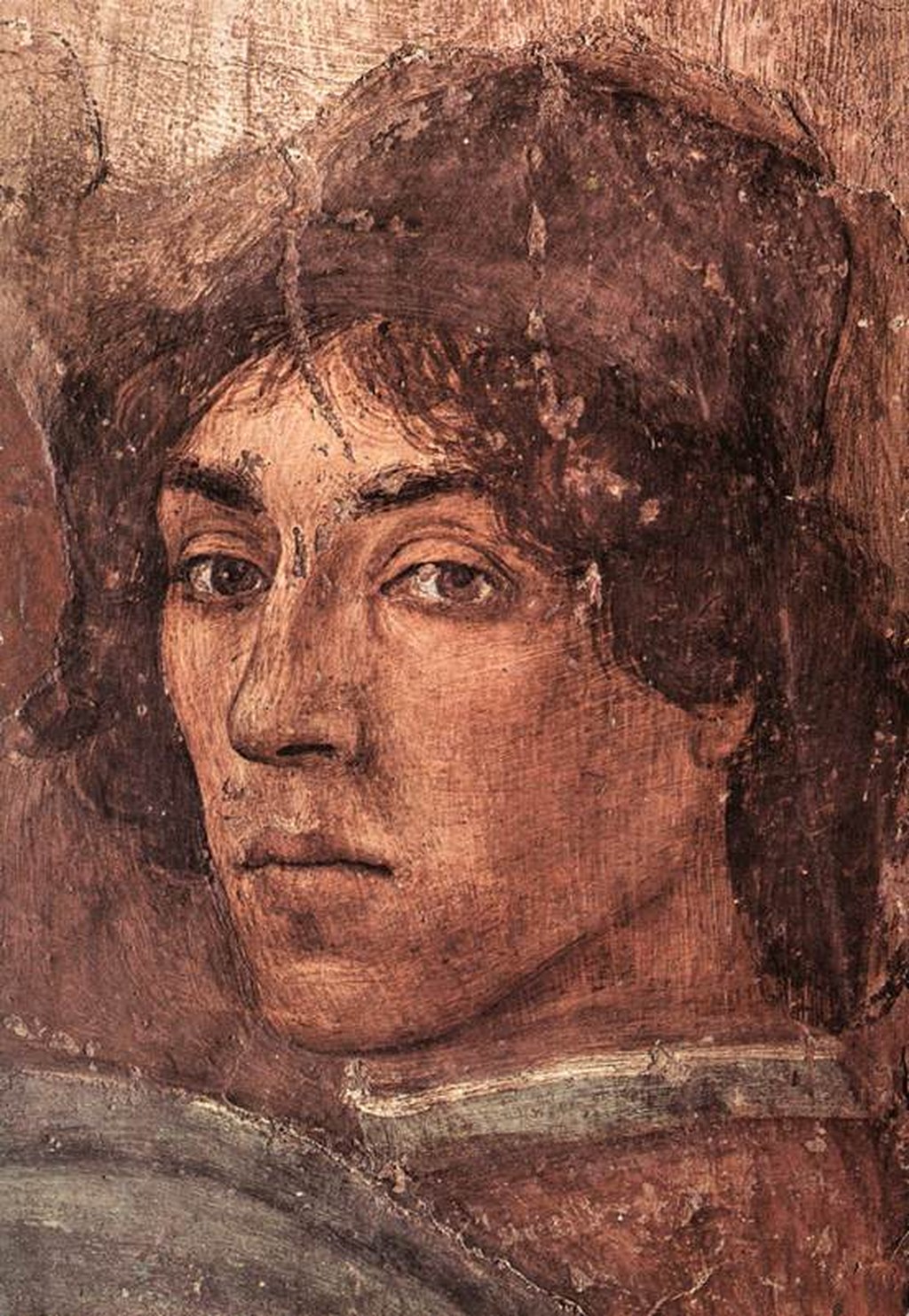
Filippino’s Self-Portrait. MUS.E notes that Filippino included his own portrait within the frescoes.[3] He is traditionally identified among the figures in the Disputation with Simon Magus. The inclusion has strong historical meaning.
Filippino places himself inside the monument he has been asked to complete. The device creates a kind of signature in human form. He becomes witness to Saint Peter’s story while also marking his authorship. Unlike a written signature, a self-portrait allows the artist to join the social world of the fresco.
Botticelli in the Chapel
MUS.E also states that Filippino included a likeness of his teacher Sandro Botticelli.[3] If the identification is accepted, the gesture is especially resonant. Filippino was working in a chapel connected with Masaccio, the painter who had influenced his father.
He inserts Botticelli, the artist who trained him after his father’s death. The fresco therefore gathers artistic ancestry within a sacred crowd. Masaccio is present through the older painted surface.
Botticelli is present through portraiture. Filippino is present as both painter and figure. The chapel becomes a visual genealogy of Florentine art.
Portraiture and Contemporary Florence. Filippino’s faces make the biblical scenes feel socially immediate. Renaissance painters often used contemporary types or portraits within sacred histories. This did not necessarily mean viewers believed the represented Florentines had literally attended Saint Peter’s life.
The device collapsed historical distance. Biblical events became relevant to the city that viewed them. In the Brancacci Chapel, this strategy also helps Filippino connect his own generation with Masaccio’s. Contemporary likeness becomes a bridge across time.
Style beside Masaccio. Masaccio’s style is famous for bodily weight, simplified form, unified light and convincing space. Filippino’s natural tendencies were different. He preferred more animated contours, expressive faces and increasingly elaborate detail.
At Brancacci, he suppresses some of that complexity. Figures become more monumental. Narrative remains clear.
Architecture supports rather than overwhelms. This is not evidence that Filippino became Masaccio. It shows that he understood context.
Respectful Difference
The best way to describe Filippino’s achievement is respectful difference. If he had imitated Masaccio perfectly, his intervention would amount to historical camouflage. If he had painted entirely in his own mature manner, the chapel might fracture stylistically.
Instead, he occupies a middle ground. The work belongs to the 1480s but does not fight the 1420s. This balance is why the Comune di Firenze can emphasise the chapel’s stylistic homogeneity despite its multiple authors.[1]
The Brancacci Chapel as a School. The chapel became one of Florence’s most important places of artistic study. Later artists came to examine Masaccio’s figures and compositions. Michelangelo is traditionally associated with intensive study there.
Filippino therefore did more than complete an old commission. He helped preserve a monument that continued to educate the next generation. His own frescoes became part of what later visitors saw. The chapel’s influence therefore extended through a composite surface. Students learned from Masaccio in a room also containing Filippino.
From Masaccio to Michelangelo. This creates an extraordinary historical sequence. Masaccio transformed Florentine figure painting in the 1420s. Fra Filippo absorbed those lessons.
Filippino completed the chapel in the 1480s. Michelangelo and other young artists then studied the finished monument. The chapel therefore acts as a relay station across generations.
Filippino stands in the middle of that relay. His role is not simply that of a late addition. He helped transmit the monument forward.
The Carmelite Context
The chapel belonged to a Carmelite church. This matters because Saint Peter’s stories were not selected only for art-historical innovation. They had devotional meaning within the religious community.
MUS.E connects Peter with active charity and the memory of the early Church, especially within the poor and populous Oltrarno district surrounding the Carmine.[3] The cycle therefore addressed local social realities as well as theological history. Masaccio’s famous distribution-of-alms imagery is especially powerful in that context. Filippino inherited a programme already tied to neighbourhood and religious identity.
Oltrarno. Santa Maria del Carmine stands in the Oltrarno, across the Arno from the political centre around Palazzo Vecchio. The area had a strong artisan and working population. The chapel’s sacred stories were therefore experienced in a living neighbourhood rather than an isolated elite museum setting.
This helps explain the force of Peter as a saint of active charity and communal identity. The Brancacci family’s patronage, Carmelite devotion and local social environment all intersected. Filippino’s completion restored not merely an artwork but a functioning sacred space.
Political Memory. The Brancacci family’s exile complicated the chapel’s identity. Patronal imagery could become dangerous when the patron fell from favour. The long delay before completion therefore reflects political history as well as artistic circumstance.
By Filippino’s time, conditions had changed enough for the cycle to be completed. This meant negotiating not only an old visual style but an old family memory. The chapel is thus evidence of how politics can interrupt art for generations.
Filippino and Medici Florence
Filippino’s own career developed within Medici networks. Lorenzo de’ Medici later recommended him for the Carafa Chapel. This creates an intriguing contrast with the Brancacci commission, whose family history had been shaped by Medici political dominance.
Filippino could work inside a chapel associated with one political past while succeeding within the cultural networks of another. Renaissance patronage was rarely ideologically simple. Artists moved across families and institutions.
The 1771 Fire. Santa Maria del Carmine suffered a major fire in 1771. The Brancacci Chapel survived, but the church around it was heavily affected. The survival contributed enormously to the chapel’s later fame.
Historical photographs and restoration records also reveal how the frescoes’ condition changed over time. The fire reminds us how easily the entire cycle could have been lost. Filippino’s intervention survived not only centuries but catastrophe.
Conservation in the Twenty-First Century. Recent monitoring identified conservation concerns including local plaster detachments, losses of cohesion and surface deposits. Florence initiated a major study and restoration programme in the 2020s. The work involved the Comune di Firenze, the Soprintendenza, CNR-ISPC, the Opificio delle Pietre Dure and Friends of Florence.[1] This collaborative conservation effort reflects the chapel’s exceptional importance. Modern science now studies a surface already produced through collaboration across centuries.
Restoration as Research. Conservation is not merely repair. The recent Brancacci campaign has generated new research. Scaffolding allowed specialists to inspect the frescoes at close range.
Material analysis, imaging and condition mapping can clarify execution and later intervention. This is especially valuable in a multi-author cycle. Technical evidence may help distinguish phases or understand where Filippino restored, completed or adjusted older work. The chapel therefore continues to produce new knowledge.
BrancacciPOV
Florence has also developed BrancacciPOV, a digital research and exploration prototype based on an open-source framework. The project allows collaborative exploration of the fresco cycle. This is particularly appropriate for a chapel whose complexity depends on relationships between scenes and painters.
Digital viewing cannot replace the original architecture. It can, however, make comparisons easier. Details by Masaccio, Masolino and Filippino can be examined in relation to one another. The technology extends the chapel’s historical role as a place of study.
The Problem of Attribution. A multi-generational fresco cycle inevitably creates attribution questions. Some scenes were begun by one artist and completed by another. Restoration history complicates surfaces further.
The Comune di Firenze explicitly notes that the stylistic unity can make individual contributions difficult to identify with complete certainty.[1] This is important. Attribution should not be treated as a colour-coded diagram in which every centimetre can always be assigned confidently. The chapel is a collaborative historical object. Uncertainty belongs to its reality.
Shared Authorship. Modern viewers are accustomed to single-name masterpieces. The Brancacci Chapel resists that model. Masolino, Masaccio and Filippino all matter.
Different moments matter. Political interruption matters. Restoration matters.
The final monument is therefore larger than any one artist. Filippino’s achievement was to accept that condition rather than attempt to dominate it. His success is visible precisely in the fact that the chapel still feels coherent.
Comparison with the Carafa Chapel. The difference between Brancacci and Carafa measures Filippino’s growth. At Brancacci, he restrains himself to preserve continuity. At Carafa, he is free to invent.
The Roman chapel explodes with grotesques, allegory and antique architecture. The Florentine chapel remains comparatively sober. These differences should not be read as early weakness and mature strength. They demonstrate contextual intelligence. Filippino could adapt style to architectural history and patronal need.
Comparison with the Strozzi Chapel
The contrast with the Strozzi Chapel is even more dramatic. Strozzi is Filippino’s final fresco cycle. Its architecture and ornament are unmistakably late.
Brancacci belongs to the beginning of his independent monumental career. The comparison therefore spans roughly two decades. One chapel requires historical humility. The other becomes a personal late-style statement. Together they give the clearest possible measure of his development as a fresco painter.
Filippino and Fra Filippo. Fra Filippo never worked on the Brancacci frescoes, but the chapel had shaped his formation. This makes Filippino’s later completion especially resonant. The son physically works inside a visual environment important to the father.
Masaccio’s influence passes through generations. The relationship is indirect but historically powerful. It also prevents the Lippi family story from becoming merely biological. Artistic inheritance operates through places and paintings as well as family.
Filippino and Botticelli. Botticelli’s presence in the chapel, if the traditional portrait identification is accepted, adds another layer. Botticelli trained Filippino. Filippino honours him within a work conditioned by Masaccio.
This creates a chain of mentorship that the fresco itself may preserve visually. Even without the portrait, the historical relationship remains essential. Filippino brought Botticellian training into a Masaccian environment and found a way to make the two coexist.
The Chapel as a Time Machine. Few artworks contain such visible chronological depth. The 1420s survive beside the 1480s. Later restorations preserve or alter both.
Modern conservation adds another layer of knowledge. The chapel therefore allows viewers to stand inside multiple Florences simultaneously. Masaccio’s republican city, Filippino’s Medici-era city and the modern museum city all meet. This temporal complexity is one of the monument’s greatest values.
A Young Painter Facing an Old Master
The psychological dimension of the commission is worth considering even though documents cannot tell us exactly how Filippino felt. He was still establishing himself independently. Masaccio’s reputation already carried enormous authority.
Filippino therefore entered the chapel under conditions very different from those of a normal new commission. The existing wall judged every addition. Scale, lighting and gesture could be compared immediately with a master who had been dead for decades.
That situation helps explain why restraint itself becomes evidence of confidence. Filippino did not need to advertise novelty in order to establish authorship. He showed that he could understand another painter deeply enough to work beside him.
Completion versus Restoration. Modern language can blur two distinct activities in Filippino’s campaign. He completed missing or unfinished scenes. He also worked in a chapel whose earlier decoration had already experienced decades of change.
The Comune di Firenze describes his role through both restoration and completion.[1] This makes his intervention more complex than simply filling blank wall space. He participated in the preservation of an existing monument while adding new painting. That dual role is surprisingly modern in concept. Filippino had to be creator and caretaker at the same time.
The Problem of Colour Matching. Colour presents one of the hardest practical issues in a delayed fresco completion. Pigments on a wall change with time. Surfaces accumulate dirt.
Earlier passages may have been cleaned or damaged. A painter arriving decades later cannot simply reproduce a recipe and expect identical appearance. Filippino therefore had to judge visually how his fresh work would sit beside aged fresco. The apparent harmony praised by modern museum interpretation suggests that he solved this sensitively. Even where materials differed, the overall effect remained coherent.
Figure Scale
Masaccio’s monumental bodies established another non-negotiable standard. A late-fifteenth-century painter accustomed to slender Botticellian figures might easily have produced bodies that looked too delicate beside them. Filippino adjusts.
His Brancacci figures have greater solidity than much of his small panel work. This does not erase his style. Faces and gestures remain more animated. But bodily scale responds to the room. The frescoes therefore demonstrate how medium and neighbouring art can reshape an artist’s normal proportions.
Light across Generations. Masaccio’s frescoes are famous for their coherent treatment of light. A later completion had to respect that visual environment. Filippino could not introduce arbitrary illumination without breaking the sense that figures shared one chapel space.
This requirement again pushed him towards structural understanding rather than superficial imitation. The problem was not simply to paint a “Masaccio-looking” face. It was to make new bodies inhabit the same fictive world.
Saint Peter as the Unifying Subject. The continuity of the Saint Peter programme helped Filippino integrate his work conceptually. Even if style changed, subject remained stable. Peter appears as healer, preacher, authority figure and martyr.
Different artists contribute different chapters to one sacred biography. This narrative unity helps the chapel absorb chronological discontinuity. The viewer follows Peter rather than the history of the painters. Filippino’s additions succeed partly because they respect that priority.
Artist Portraits as Historical Consciousness. The inclusion of Filippino and Botticelli among the fresco figures, as identified by MUS.E, suggests a remarkable awareness of artistic lineage.[3] These portraits are not labels pasted onto the wall. They are embedded within sacred history.
Filippino effectively records the people of his own artistic world inside a monument inherited from an earlier generation. The chapel therefore becomes self-conscious about continuity. The later painter does not conceal the fact that history has moved forward. He acknowledges his own time while respecting Masaccio’s.
A Composite Masterpiece
The Brancacci Chapel is sometimes discussed as though Filippino’s role must be separated out before the “real” masterpiece can be understood. The surviving object argues against that approach. Its greatness is composite.
Masolino matters. Masaccio matters. Filippino matters.
Political interruption matters. Later conservation matters. The chapel’s identity emerged through accumulation. Recognising this does not diminish Masaccio’s revolutionary importance. It gives the monument a richer history.
The Chapel as Evidence of Renaissance Continuity. Filippino’s intervention also undermines the idea that artistic periods replace one another cleanly. Early Renaissance painting remained physically present and authoritative in the 1480s. Younger artists did not merely supersede it; they studied, preserved and negotiated with it. The Brancacci Chapel therefore shows tradition as an active material presence rather than a chapter already closed. The result is historical continuity made visible on plaster, across generations of Florentine painters, patrons, monks, restorers, scholars and modern museum viewers.
Why the Brancacci Chapel Matters for Filippino. The Brancacci Chapel matters for Filippino because it proves his independence through restraint. A lesser painter might have copied Masaccio awkwardly or imposed a fashionable 1480s style that broke the cycle apart. Filippino did neither.
He understood the monument well enough to participate in it. The commission also established him publicly. The Met calls it his first major project.[6]
Its successful completion helped demonstrate that the son of Fra Filippo and pupil of Botticelli could handle one of Florence’s most prestigious artistic responsibilities. The chapel therefore stands at the beginning of the career that would later lead to Carafa and Strozzi.
Why the Brancacci Chapel Matters
The Brancacci Chapel matters because it is not simply an early Renaissance monument frozen at Masaccio’s death. Its history continued. Filippino Lippi gave that unfinished history a new phase.
He completed missing scenes roughly half a century later, adapted his own style to a revered predecessor and helped create the visual unity modern viewers still experience. His contribution also gives the chapel extraordinary genealogical depth. Masaccio influenced Fra Filippo.
Fra Filippo trained Botticelli. Botticelli trained Filippino. Filippino completed Masaccio.
Later artists then studied the finished chapel. The cycle therefore acts almost like a physical map of Florentine artistic transmission. For Filippino himself, the project is foundational.
It proves that his first major monumental challenge was not to invent a spectacular new style but to understand another artist’s masterpiece deeply enough to continue it. That kind of intelligence is easy to overlook because successful adaptation can appear invisible. At Brancacci, invisibility is partly the achievement.
Frequently Asked Questions
Discussion
What stands out to you most about Brancacci Chapel in relation to Filippino Lippi's wider career?
Reader Insights
Notice how the page connects close visual detail with patronage, workshop practice and the wider Renaissance setting.
Which comparison elsewhere in the cluster helps clarify this work or theme most strongly?
Join the Conversation
Have a thought or observation about Brancacci Chapel? Share it below. Thoughtful responses may be added to this section.
References
- Comune di Firenze, “Cappella Brancacci in Santa Maria del Carmine,” official museum history. View Source
- Comune di Firenze, “Visita il museo,” Brancacci Chapel guide and artist attribution. View Source
- MUS.E, “Visita in Santa Maria del Carmine,” visitor and educational resources.
- MUS.E, “5 cose che non sapevi sulla Cappella Brancacci,” artist portrait and chapel context. View Source
- National Gallery of Art, Washington, Filippino Lippi Portrait of a Youth, chronology noting the Brancacci assignment.
- Metropolitan Museum of Art, George R. Goldner, “Filippino Lippi (ca. 1457–1504),” identifying Brancacci as his first major project. View Source
- Comune di Firenze and conservation partners, recent Brancacci restoration, monitoring and BrancacciPOV research resources.