 by Tom Gurney
Tom Gurney BSc (Hons) is an art history expert with over 20 years experience
Published on June 19, 2020 / Updated on October 2, 2026
Email: tomgurney1@gmail.com / Phone: +44 7429 011000
Carafa Chapel by Filippino Lippi
The Carafa Chapel in Santa Maria sopra Minerva in Rome is one of Filippino Lippi’s greatest achievements and the decisive monument of his Roman period. Painted between 1488 and 1493 for Cardinal Oliviero Carafa, the chapel transformed Filippino’s relationship with classical antiquity and permanently altered the visual language of his later career.[1]
The commission came at the recommendation of Lorenzo de’ Medici. That fact alone places the chapel within an important network connecting Florentine artistic prestige, Medici diplomacy and Roman ecclesiastical power. Carafa was a Neapolitan cardinal, statesman and senior churchman with a particular devotion to Saint Thomas Aquinas. He chose Santa Maria sopra Minerva, the principal Dominican church in Rome, as the setting for a chapel dedicated to the great Dominican theologian.[1]
Filippino therefore had to satisfy several overlapping demands. The chapel needed to honour the Virgin, celebrate Thomas Aquinas, represent Carafa’s personal devotion, express Dominican intellectual identity and operate within one of Rome’s most important churches. Rome added another dimension. Filippino encountered ancient sculpture, architecture, fragments of wall painting and decorative ornament throughout the city. Cleveland’s recent exhibition argues that this experience changed both his style and iconography.[2]
The Carafa Chapel is where that transformation becomes monumental. Classical forms appear everywhere, but they are never neutral archaeological quotations. Triumphal architecture, grotesques, Sibyls, allegorical figures and antique-looking ornaments are absorbed into a Christian programme centred on revelation, wisdom and doctrinal authority. The result is one of the most intellectually ambitious fresco cycles of the late fifteenth century.
At a Glance
- ArtistFilippino Lippi
- PatronCardinal Oliviero Carafa
- Date1488–93
- LocationSanta Maria sopra Minerva, Rome
- DedicationSaint Thomas Aquinas
- RecommendationFilippino was engaged on the advice of Lorenzo de’ Medici
- Principal Marian scenesAnnunciation and Assumption of the Virgin
- Principal Dominican subjectSaint Thomas Aquinas
- VaultFour Sibyls and Carafa family arms
- Additional imageryPhilosophy, Theology, Dialectic and Grammar; virtues and vices; grotesques; antique architectural motifs
- Patron portraitCardinal Carafa presented to the Virgin by Saint Thomas
- Major significancedecisive evidence for Filippino’s transformation through direct study of ancient Rome
- Research anchorCleveland Museum of Art’s 2025–26 Filippino Lippi and Rome exhibition and catalogue
Contents
- Cardinal Oliviero Carafa
- Santa Maria sopra Minerva
- Carafa’s Donor Portrait
- The Sibyls
- Thomas Enthroned
- Grotesques
- The City as a Research Library
- Cardinal Carafa as Humanist Patron
- A Chapel of Movement
- The Chapel and Filippino’s Reputation
- The Annunciation and Patronal Humility
- The Language of Allegory
- The Roman Fragment as Creative Trigger
- Carafa’s Political Identity
- The Chapel and the Holy Family Tondo
- A Roman Turning Point Preserved in Place
- Frequently Asked Questions
- References
Cardinal Oliviero Carafa
Oliviero Carafa was born in 1430 into a powerful Neapolitan family. He became one of the most prominent ecclesiastical and political figures of his generation. His career included senior church offices and extensive involvement in diplomacy and papal politics.
The chapel therefore belonged to a patron accustomed to representing authority on a large scale. Yet its programme is not simply self-celebration. Carafa’s devotion to Saint Thomas Aquinas is central.
Santa Maria sopra Minerva’s own institutional description states that he admired Thomas so deeply that he built and decorated the chapel in his honour.[1] That dedication suited the church perfectly. The Minerva was Dominican. Thomas was the order’s greatest theologian. The chapel therefore joined private patronage with institutional identity.
Lorenzo de’ Medici and the Commission. The basilica and Cleveland both preserve the important tradition that Filippino received the commission on Lorenzo the Magnificent’s recommendation.[2] This demonstrates the reach of Medici cultural influence beyond Florence. Lorenzo did not need to commission the chapel himself to shape its artistic history.
Recommendation could function as patronage. Filippino arrived in Rome carrying the authority of Florence’s most powerful cultural network. The commission also tells us something about his reputation by 1488.
Carafa was not taking a chance on an obscure young painter. Filippino had already completed important work in Florence, including portions of the Brancacci Chapel and major panel paintings. He had become a master suitable for one of Rome’s most visible intellectual patrons.
Santa Maria sopra Minerva
Santa Maria sopra Minerva is one of Rome’s most important Dominican churches.[1] Its location near the ancient Pantheon and its association with Dominican learning made it an especially appropriate site for Carafa’s Thomas Aquinas programme. The building also placed Filippino physically inside a city saturated with antique remains.
Every movement between workshop, church and street exposed him to fragments of ancient visual culture. The Carafa Chapel therefore cannot be understood apart from Rome itself. Its classical vocabulary is not imported abstractly from books. It emerges from direct encounter with the city.
Why Thomas Aquinas? Thomas Aquinas combined theology, philosophy and disciplined argument in a way that made him central to Dominican intellectual identity. By the late fifteenth century, he represented the power of Christian wisdom to absorb, organise and surpass other systems of knowledge. That theme is visible throughout the chapel.
Thomas appears not merely as a saint who performs miracles. He appears as an intellectual victor. Philosophy, theology, dialectic and grammar are personified around him.
Error and vice are defeated. Scriptural phrases emphasise wisdom overcoming false knowledge. For Carafa, this was a powerful devotional programme. It presented religious faith as intellectually triumphant.
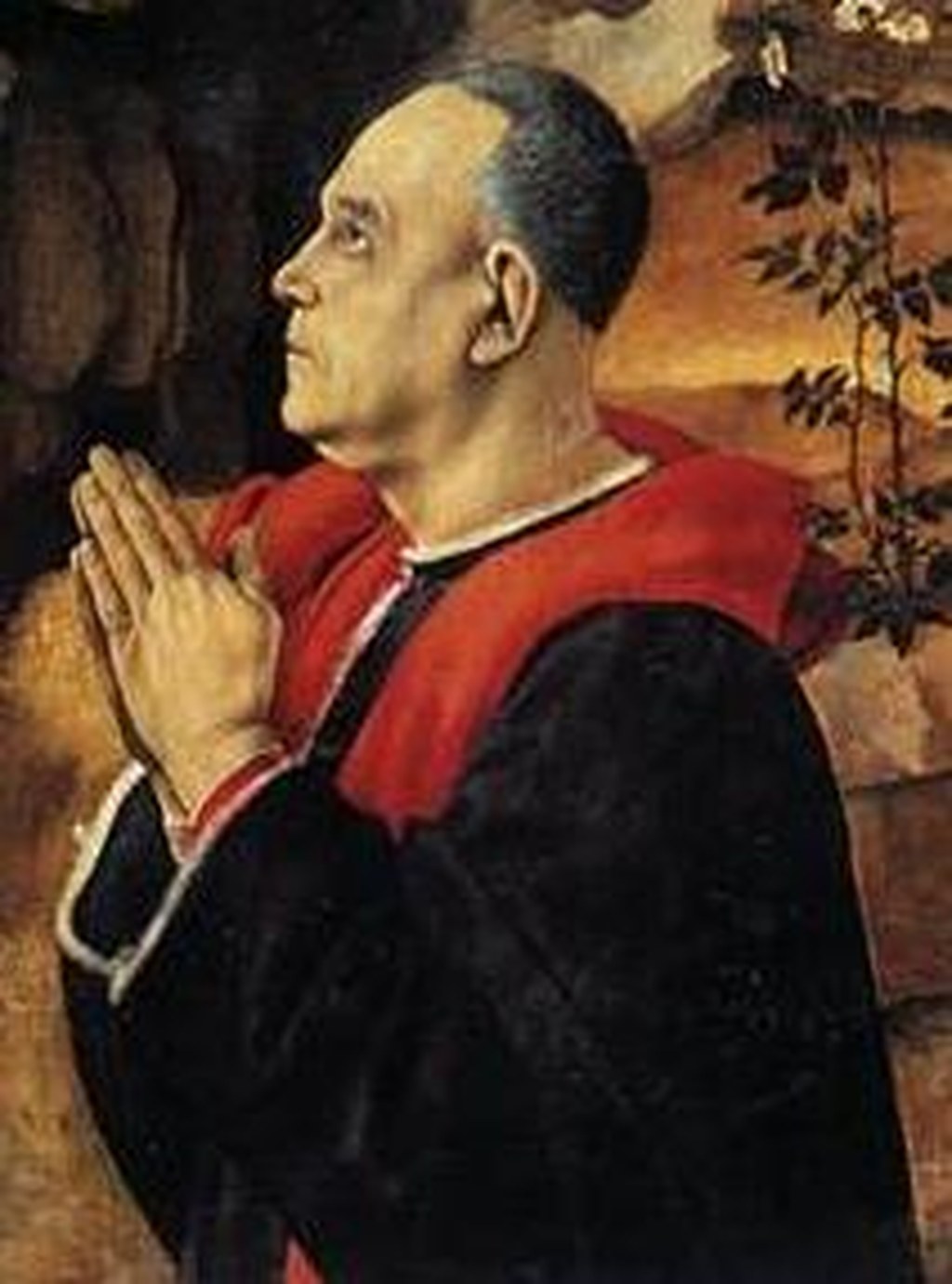
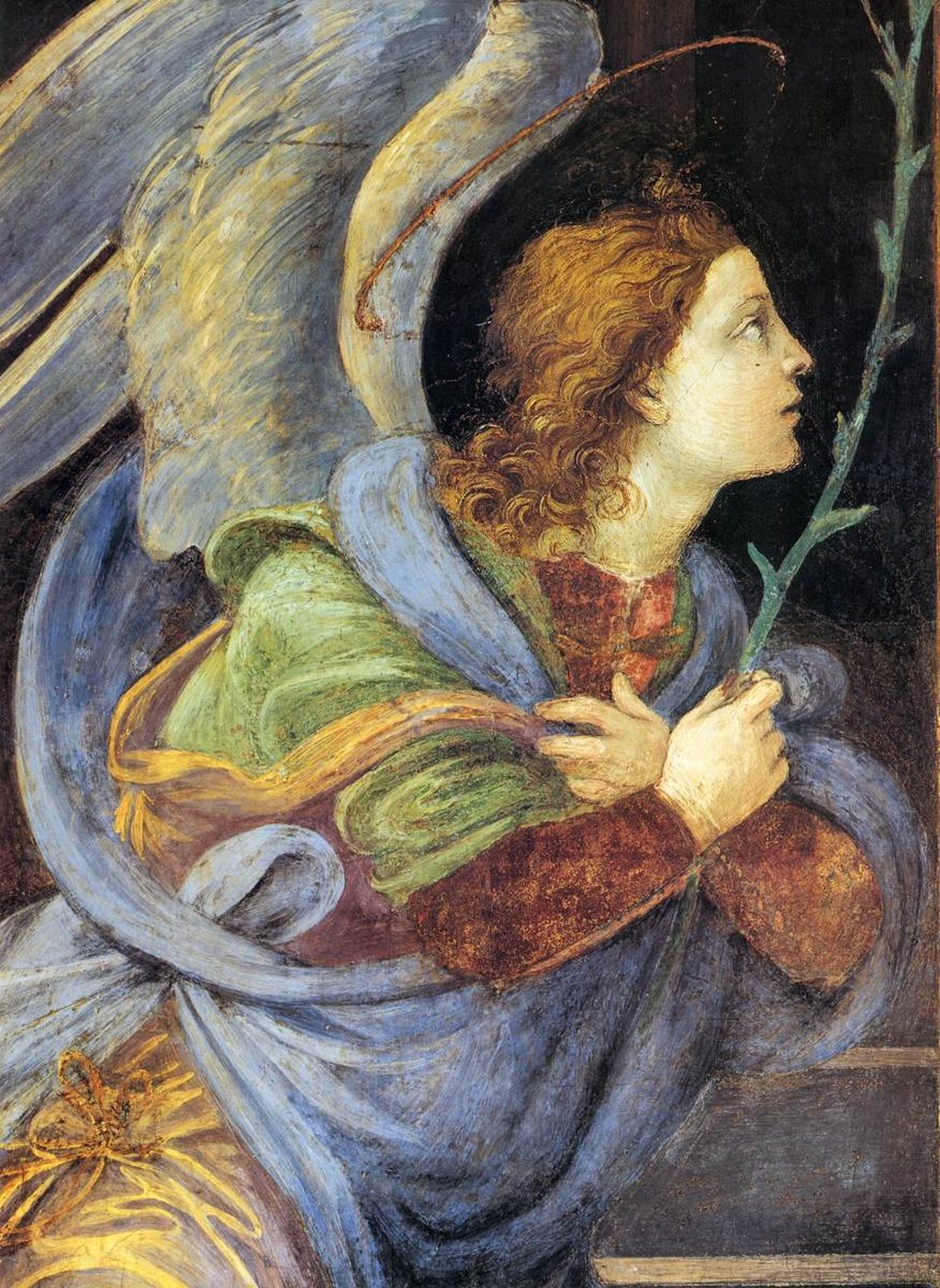
The Annunciation. The central wall includes the Annunciation. Gabriel approaches the Virgin while Carafa himself is introduced into the sacred scene by Saint Thomas Aquinas. The patron therefore appears inside one of Christianity’s foundational mysteries.
He does not stand alone before Mary. Thomas presents him. This creates a hierarchy of mediation.
Carafa depends upon his patron saint. Thomas directs him towards the Virgin. Mary receives the divine message. The entire composition becomes a chain of spiritual authority.
Carafa’s Donor Portrait
Carafa’s portrait is crucial because it connects the eternal biblical event with a specific contemporary person. Renaissance donor portraits often show patrons kneeling at the edge of sacred scenes. Filippino makes the relationship more explicit by giving Thomas an active presenting role.
The cardinal’s status is therefore acknowledged but controlled. He is powerful in Rome. Inside the chapel he kneels. The visual message is not that ecclesiastical authority equals divine authority. It is that earthly authority should submit to it.
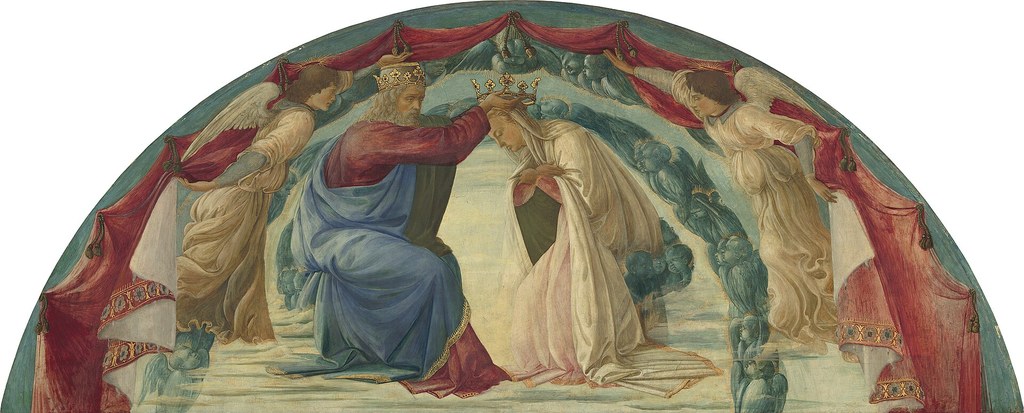
The Assumption of the Virgin. Above the Annunciation is the Assumption. The Virgin rises while a ring of angels surrounds her. Santa Maria sopra Minerva describes the angels as seeming to dance around Mary, each holding a different musical instrument.[1]
This creates one of the most joyous passages in the chapel. Music transforms the Assumption into celestial celebration. The vertical arrangement also creates theological progression.
The Annunciation below marks the beginning of Mary’s role in the Incarnation. The Assumption above marks her exaltation. Earthly obedience leads towards heavenly glory.
Musical Angels. The angels form what the basilica calls an inventory of contemporary musical instruments. This makes the fresco valuable beyond art history. It preserves evidence for musical culture.
Different instruments give individual angels distinct actions and silhouettes. Sound is represented through gesture. The viewer cannot hear the music, but the variety of instruments encourages the imagination of a complex heavenly performance. Filippino thus turns static fresco into implied sound.
The Sibyls
Four Sibyls occupy the vault. Sibyls were pagan prophetesses from ancient tradition. Christian interpreters increasingly treated them as figures who had foretold aspects of Christ’s coming.
Their inclusion therefore allowed pagan antiquity to become a witness to Christian revelation. This is especially appropriate in Filippino’s Roman work. He was studying the surviving material culture of pagan Rome while painting a Christian chapel.
The Sibyls embody the same transformation conceptually. Antiquity is not rejected. It is reinterpreted as preparation for Christianity.
The Carafa Arms. At the centre of the vault appear the Carafa family arms. Heraldry anchors the chapel to its patron. Even as Sibyls and sacred figures expand the programme across history, the family device reminds the viewer who funded the space.
This combination of devotion and family identity was normal in Renaissance chapel patronage. A chapel could seek salvation, preserve memory and display lineage simultaneously. The Carafa arms make that social function explicit.
Saint Thomas and the Crucifix. On the right wall, Filippino represents episodes from the life and legend of Thomas Aquinas. One scene includes the miracle in which the crucified Christ addresses Thomas, praising his writing and asking what reward he desires. Thomas replies that he wants nothing but the Lord.
The episode is perfectly suited to Carafa’s chapel. Thomas is praised for intellectual achievement but rejects worldly reward. Knowledge therefore culminates in devotion rather than prestige. For a powerful cardinal patron, that message carried obvious moral force.
Thomas Enthroned
In another major section, Thomas sits enthroned holding a book. The basilica records the inscription “Sapientiam sapientum perdam” — “I will destroy the wisdom of the wise”, drawn from Saint Paul. The saint is represented as the centre of an intellectual order.
Around him appear personifications of Philosophy, Theology, Dialectic and Grammar. This is not simply a portrait of a scholar. It is a diagram of knowledge. Thomas sits where disciplines converge. Christian theology governs the system.
Wisdom Conquers Evil. Before Thomas appears an unpleasant defeated figure associated with vice or false wisdom. An inscription reads “Sapientia vincit malitiam” — wisdom conquers evil. The basilica explicitly connects the imagery with Dominican spirituality and the search for truth against vice and error.
This provides an unusually clear institutional interpretation. The chapel’s intellectual content is not decorative humanism detached from religion. Learning is represented as spiritual combat. Falsehood can be defeated. Truth has moral consequences.
Philosophy, Theology, Dialectic and Grammar. The female personifications around Thomas embody disciplines of knowledge. Their presence recalls medieval educational structures as well as Renaissance humanist interest in allegory. Filippino gives abstract ideas bodies.
This is one of the central visual strategies of the chapel. Concepts become people. Wisdom becomes hierarchy.
Error becomes a defeated figure. Theology becomes an ordered court. Such personification allowed complicated intellectual ideas to be understood visually.
The Lost Left Wall. Not all of Filippino’s programme survives. The basilica states that frescoes on the left wall representing vices and virtues were destroyed to make way for the tomb of Pope Paul IV. This loss matters because modern viewers encounter an incomplete chapel.
The surviving imagery can make the programme seem weighted differently from Filippino’s original design. A whole section of moral allegory has disappeared. The later papal tomb also demonstrates how churches change over time.
One patron’s monument can displace another artist’s work. The chapel is therefore not a frozen Renaissance interior. It is a layered historical space.
Grotesques
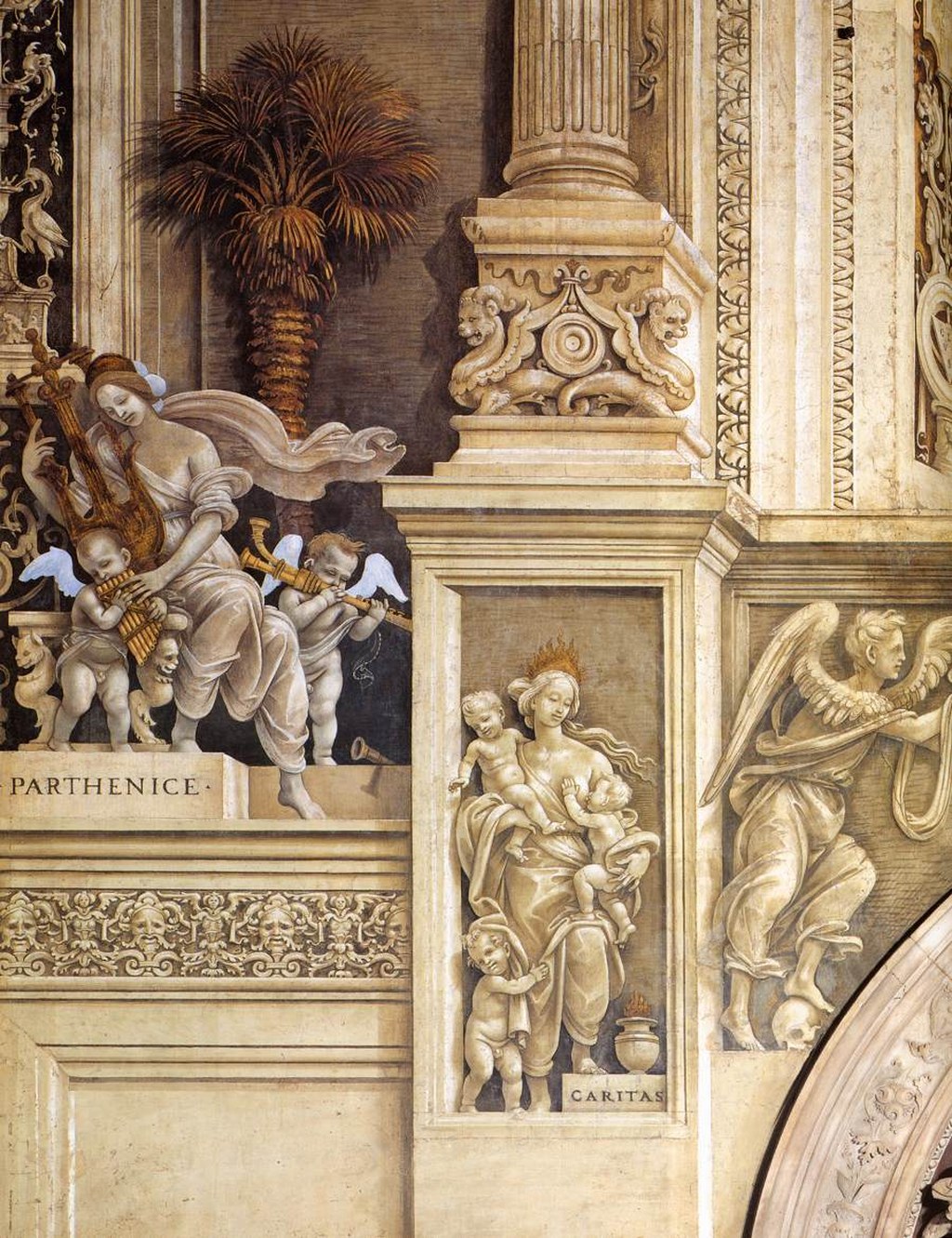
The grotesque decoration is among the most important consequences of Filippino’s Roman experience. The term refers to ornamental forms inspired by ancient painted decoration rediscovered in subterranean Roman spaces. Figures, plants, masks, hybrid creatures and architectural fantasies could combine freely.
For Filippino, grotesques were not marginal border decoration. They became part of his mature visual imagination. The basilica itself highlights the chapel’s “grottesche” among its most remarkable details. Cleveland’s exhibition similarly places antique fragments at the centre of understanding Filippino’s Roman transformation.[2]
Discovering Ancient Decoration. Late-fifteenth-century Rome was witnessing renewed fascination with ancient painted interiors. Artists entered buried or partially buried spaces and encountered decoration unlike the monumental sculpture traditionally associated with classical art. The forms could be light, strange, hybrid and playful.
This suited Filippino’s imagination exceptionally well. He already enjoyed animated line and unusual ornament. Ancient decorative fragments gave those instincts historical authority and a new vocabulary. The result was not sober classicism. It was experimental classicism.
Architecture. Architecture in the Carafa Chapel behaves differently from the calm perspectival spaces associated with much earlier Florentine painting. It can appear triumphal, archaeological and theatrical. Classical motifs establish Rome as an imagined historical environment even when the subject is Christian.
Filippino uses architecture to connect sacred narrative with the city surrounding the chapel. The Christian present seems to grow directly from antique fragments. This is especially appropriate in Rome, where actual churches and palaces physically incorporated ancient ruins and materials.
The City as a Research Library
Filippino’s drawings reveal how actively he studied Rome. The city functioned almost like an open-air research library. Sculptures supplied poses.
Reliefs supplied gestures. Architecture supplied ornaments and structural forms. Wall paintings supplied decorative vocabularies.
Yet none of these sources had to be copied intact. A fragment could be detached from its original meaning and reused in a Christian scene. This process is central to Filippino’s originality. He learned from ruins by reinventing them.
Drawing and the Carafa Chapel. The unusually large surviving body of Filippino drawings makes the chapel especially valuable for studying process. Preparatory sheets preserve figure studies, drapery ideas, antique observations and compositional experiments. The Met’s 1997 catalogue places these drawings at the centre of Filippino’s achievement.[4]
They show that the frescoes did not emerge from one fixed idea. Design developed through repeated acts of drawing. A pose might shift.
An ancient source might be modified. A decorative motif might migrate between studies. The finished chapel is therefore the endpoint of a highly fluid design process.
Roman Antiquity and Christian Meaning. The chapel raises a fundamental Renaissance question: how could Christian art use pagan forms? Filippino’s answer is pragmatic and imaginative. Ancient beauty is not denied.
It is redirected. Sibyls become witnesses to Christ. Classical architecture frames Christian miracles.
Grotesques decorate a Dominican theological programme. Allegorical personifications support Aquinas. Pagan visual language becomes subordinate to Christian interpretation. This is not a contradiction the chapel tries to hide. It is one of its principal intellectual pleasures.
Cardinal Carafa as Humanist Patron
Carafa’s programme required a patron comfortable with complex intellectual imagery. His devotion to Aquinas did not prevent engagement with classical culture. Instead, the chapel treats Christian wisdom as capable of encompassing it.
The patron therefore appears both devout and learned. This dual identity was highly appropriate for a Renaissance cardinal. Ecclesiastical authority could be expressed through theological seriousness and cultural sophistication at the same time. Filippino gave that identity visual form.
Before and After Rome. Cleveland’s 2025–26 exhibition was structured specifically to compare Filippino before, during and after Rome.[2] That framework is extremely useful. Before Rome, works such as the Vision of Saint Bernard already show psychological complexity, landscape interest and unusual details.
In Rome, classical fragments supply a radically expanded vocabulary. After Rome, Filippino continues using those inventions in Florence. The Carafa Chapel therefore does not represent a temporary Roman experiment. It is the hinge of the career.
The Strozzi Chapel After Rome. The clearest evidence for the Carafa Chapel’s lasting impact is the Strozzi Chapel at Santa Maria Novella.[6] Filippino had begun that Florentine project before leaving for Rome. He completed it later.
The late Strozzi frescoes teem with antique-looking architecture, allegorical sculpture and decorative fantasy. Rome has been absorbed completely. The comparison effectively gives us a before-and-after experiment within one career. The Carafa Chapel supplied the experience that changed the second half of the Strozzi commission.
A Chapel of Movement
Despite the intellectual density, the Carafa Chapel is not static. Angels dance. Gabriel approaches Mary.
Carafa kneels. Thomas teaches and triumphs. Figures turn, present and respond.
Filippino translates doctrine into action. This makes the programme accessible beyond learned viewers who could decode every inscription. Even without understanding Latin, a spectator can perceive hierarchy, defeat, revelation and celebration. Movement carries meaning.
Colour. Colour helps organise the dense programme. Bright garments separate figures from architecture. The Virgin and angels remain visible within elaborate surroundings.
Filippino’s mature preference for warm and varied colour prevents the antique ornament from overwhelming human actors. This balance is crucial. The chapel contains enormous decorative information. Colour helps preserve narrative legibility.
Workshop Collaboration. A monumental fresco campaign required assistants. The master designed, organised and executed key passages, but preparation of plaster, transfer of designs and secondary execution could involve a workshop. Filippino’s large drawing corpus and known circle remind us that authorship operated through such collaborative structures. The exact division of hands remains a specialist question. The chapel should nevertheless be understood as a Filippino Lippi project rather than the product of one isolated brush working alone for five years.
1488–93. Cleveland dates the Roman fresco campaign between 1488 and 1493.[2] That relatively long span reflects the scale and complexity of the commission. It also places the chapel at the centre of Filippino’s mature career.
He arrived in Rome around thirty years old. He returned to Florence with more than a decade of professional activity still ahead. The Roman period was therefore not a late epilogue. It divided the career almost exactly at its most consequential point.
The Chapel and Filippino’s Reputation
The commission strengthened Filippino’s status beyond Florence. Working for a powerful cardinal in a major Roman church established him within a wider Italian artistic network. The project demonstrated that a Florentine painter trained in Botticelli’s environment could respond successfully to Roman scale, theology and antiquarian culture. Its later fame contributed to Filippino’s reputation for imaginative invention. The chapel remains one of the strongest reasons modern scholarship treats him as much more than a derivative Botticellian painter.
What Has Been Lost. The destruction of the left-wall frescoes is the most obvious loss, but time has affected the entire ensemble. Fresco surfaces age. Architectural settings change.
Lighting changes. Tombs and later furnishings alter sightlines. Modern viewers therefore encounter a historical survivor rather than Filippino’s untouched 1493 chapel. Recognising that fact prevents interpretation from treating present asymmetries as original design. Conservation history belongs to the work’s meaning.
Seeing the Chapel Today. The greatest advantage of the Carafa Chapel is that it remains in its architectural setting. Visitors can experience the relationship between walls, vault, altar and surrounding church. This distinguishes it from portable panels removed to museums.
Scale becomes immediately understandable. The viewer must move eyes and body. The Assumption is above.
Thomas occupies another wall. The Sibyls inhabit the vault. The programme cannot be understood fully from one frontal reproduction because it was designed as a room.
Entering the Chapel as a Viewer. The Carafa Chapel was designed to be experienced bodily rather than as a sequence of isolated reproductions. A visitor enters a confined architectural space in which the walls and vault carry different parts of one programme. The eye moves upward to the Sibyls and Carafa arms.
It moves across to Thomas and the intellectual allegories. It returns to the Virgin and the kneeling patron. This movement matters because meaning is distributed around the room.
The chapel does not offer one privileged picture that explains everything. Instead, theology is encountered through sequence. A viewer has to look, turn and compare.
That spatial demand makes the chapel itself part of the composition. Filippino was not merely painting onto architecture. He was designing with architecture.
The Annunciation and Patronal Humility
The Annunciation is particularly effective as the location of Carafa’s donor portrait because it centres on submission to divine will. Mary accepts a message that changes the course of sacred history. Carafa appears within that same visual field in a posture of dependence.
The cardinal’s ecclesiastical rank is obvious through dress and heraldry, yet his body remains lower than the sacred figures. The arrangement prevents patronage from becoming self-deification. Carafa is important because he funded the chapel.
The image makes equally clear that his importance remains secondary to revelation. This tension between prestige and humility is one of the defining problems of Renaissance donor imagery. Filippino handles it with unusual clarity.
Thomas Aquinas as Intercessor and Intellectual Model. Thomas serves two related roles. He presents Carafa to Mary, acting as intercessor. He also dominates the intellectual scenes, acting as model theologian.
These roles reinforce one another. Carafa’s devotion is not directed towards an abstract reputation. Thomas is useful precisely because his learning leads towards sacred truth.
The saint therefore legitimises both prayer and scholarship. For a cardinal involved in administration, diplomacy and church politics, that combination had special resonance. The ideal churchman is not merely powerful. He is disciplined by truth.
Aquinas and the Dominican Order. Within Santa Maria sopra Minerva, Thomas carried institutional significance beyond Carafa’s personal devotion.[1] The Dominican order had long defined itself through preaching, study and theological argument. A chapel celebrating Aquinas therefore reinforced the church’s own identity.
This helps explain why allegories of knowledge occupy such a prominent place. Theology is not an ornamental subject added to impress educated visitors. It belongs to the order’s mission. The chapel visually stages the Dominican claim that intellectual discipline can serve salvation. That institutional context makes the programme considerably more coherent than it appears when individual scenes are reproduced separately.
The Language of Allegory
Filippino’s personifications of Philosophy, Theology, Dialectic and Grammar belong to a long medieval and Renaissance tradition of giving abstract disciplines human form. Allegory solved a practical visual problem. Knowledge has no body.
Painting requires bodies. By representing disciplines as women, Filippino makes the invisible structure of learning visible. Their relationship to Thomas shows order and hierarchy rather than narrative time.
No historical meeting is being represented. Instead, the image says what Thomas means. He is surrounded by the fields of knowledge that his theology commands and integrates. This makes the fresco closer to a visual argument than a conventional saint’s-life episode.
Inscription as Image. Words play an unusually important role in the chapel. Books and inscriptions identify ideas that figures alone cannot fully specify. “Wisdom conquers evil” gives the defeated figure a moral meaning.
The Pauline text held by Thomas connects the image to scripture. The crucifix miracle depends upon remembered speech. Filippino therefore combines textual and visual authority.
A literate viewer could read the inscriptions directly. A less literate viewer could still understand the hierarchy through posture and placement. The chapel works on multiple levels of education at once.
The Crucifix Miracle and the Value of Study. The episode in which Christ praises Thomas’s writing is particularly revealing for a chapel devoted to learned religion. Thomas is rewarded because he has written well. His answer refuses material compensation.
The story therefore validates scholarship while guarding against pride. Writing can become a form of devotion. Intellectual excellence becomes spiritually valuable when it is not pursued for worldly reward. This message would have suited both Dominican ideals and Carafa’s self-presentation as an educated churchman. The fresco celebrates learning without allowing learning to become self-sufficient.
The Roman Fragment as Creative Trigger
Filippino’s use of antiquity becomes easier to understand if we think in terms of fragments rather than complete monuments. A broken relief might preserve one torso. A ruined cornice might preserve one ornamental rhythm.
A buried painted room might preserve a hybrid creature or vine. Such fragments do not dictate one correct reconstruction. They invite invention.
Filippino seems to have responded precisely to that freedom. He could extract a motif and give it a new context. The ancient object becomes a trigger rather than a template. This helps explain why his Roman classicism is so unlike later academic archaeology. He is interested in possibility, not restoration.
Grotesques and the Pleasure of the Strange. Grotesque ornament could combine human, animal, vegetal and architectural forms in ways that ignored ordinary physical logic. That freedom appealed strongly to Filippino. His late work repeatedly shows a taste for the unexpected.
Masks emerge from decoration. Bodies merge with ornament. Architectural structures become almost animate.
The Carafa Chapel therefore reveals another side of Renaissance engagement with antiquity. Classical art did not only teach proportion and order. It also offered strangeness. Filippino absorbed both.
Antiquity and Authority. Classical motifs carried prestige because they belonged to the ancient world admired by humanists and patrons. In Rome, that authority had special force. Filippino could use antique-looking architecture to make the chapel feel intellectually and geographically rooted in the city.
Yet the imagery also insists that Christian revelation supersedes pagan culture. The Sibyls predict. Thomas interprets.
The Virgin fulfils. Ancient visual authority is therefore welcomed but subordinated. The chapel does not merely decorate Christianity with pagan beauty. It constructs a historical hierarchy in which antiquity points towards Christian truth.
Carafa’s Political Identity
Carafa was not only a theologian’s admirer. He was a political actor. His career involved Naples, Rome and the wider diplomatic world of the Italian states.
A richly decorated chapel in a major Roman church inevitably functioned as a monument to that public status. Heraldry, portraiture and artistic expense communicated family prestige. The devotional programme ensured that such prestige was framed through piety.
Renaissance church patronage frequently operated through this dual logic. Personal memory and spiritual aspiration were not mutually exclusive. The chapel could serve both.
Naples, Florence and Rome. The commission also connects three major cultural centres. Carafa was Neapolitan. Filippino was Florentine.
The chapel was Roman. Lorenzo de’ Medici’s recommendation links the whole project to Florentine political networks. This geography is a useful reminder that Renaissance art did not develop in isolated city-states.
Artists, patrons and recommendations travelled. A Florentine style could be transformed by Roman antiquity while serving a Neapolitan cardinal. The Carafa Chapel is therefore Italian rather than merely Roman or Florentine in its network of production.
Filippino’s Adaptability. The Carafa commission required Filippino to work in a Dominican environment far removed from the private Madonnas of his early career. He had to move from small panel to monumental fresco, from domestic devotion to institutional theology, from Botticellian grace to Roman archaeological fantasy. His success demonstrates adaptability.
The same artist who could paint a quiet Vision of Saint Bernard could also organise a chapel crowded with allegory, inscriptions, music and antique decoration. This range helps explain his contemporary reputation. Patrons could trust him with complicated programmes.
The Chapel and the Holy Family Tondo
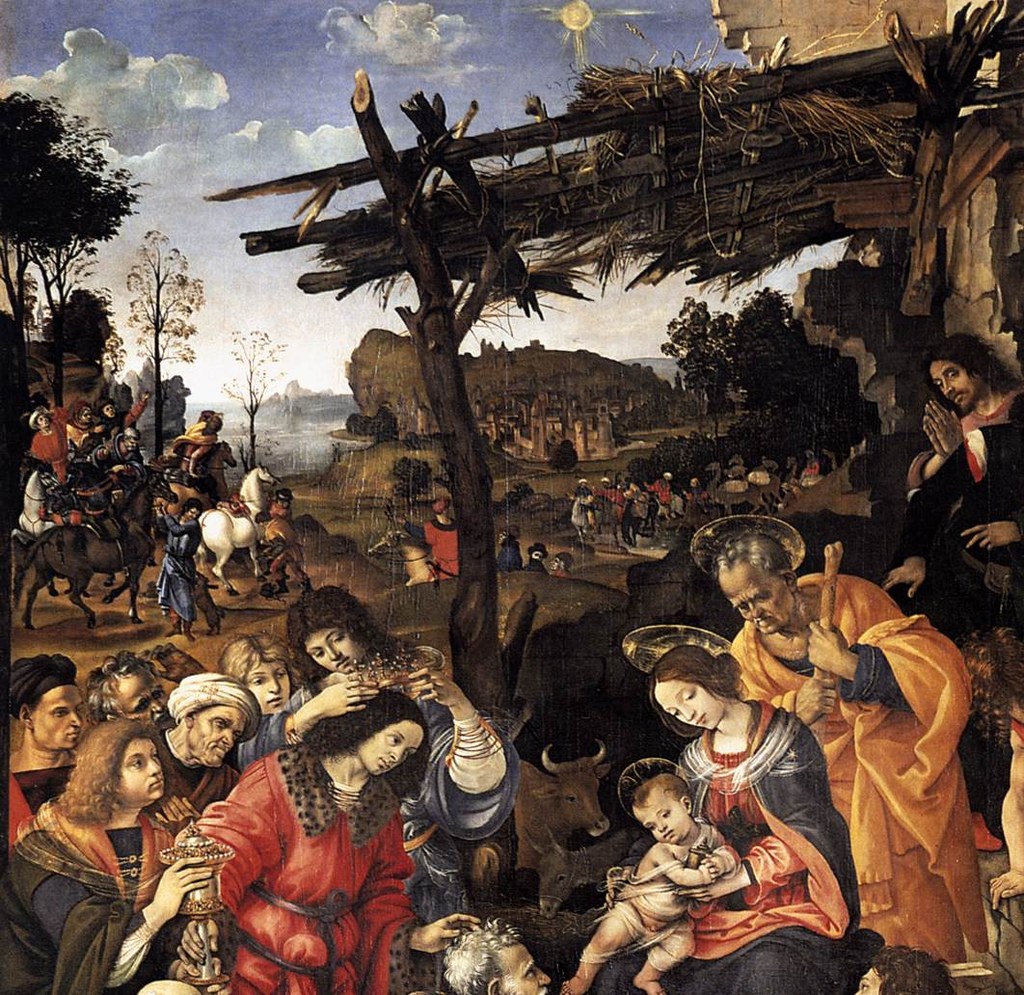
The Cleveland Holy Family with Saint John the Baptist and Saint Margaret offers an unusually close companion to the frescoes because Carafa commissioned it while Filippino was working in Rome.[2] The tondo shows what the same Roman visual research looked like in a portable panel. Ancient sculpture influences the pose of Saint Margaret.
Weathered architecture enters the background. Technical imaging reveals repeated revision. The two works therefore allow comparison across media.
Fresco records monumental programme. Panel records intimate design experimentation. Together they define Filippino’s Roman period more clearly than either could alone.
From Carafa to Strozzi. When Filippino returned to Florence, he did not discard his Roman vocabulary. The later Strozzi Chapel demonstrates continuity. Antique architecture becomes even more fantastic.
Decorative sculpture fills the spaces. Narrative crowds move through settings that feel both ancient and invented. The Strozzi work therefore acts almost like a memory of Rome rebuilt in Florence. This is why the Carafa Chapel is the hinge of the career rather than simply the Roman chapter. Its effects continue until Filippino’s death.
Why the Chapel Still Feels Unusual. Many Renaissance monuments use antiquity to create balance and dignity. The Carafa Chapel often uses antiquity to create complexity. That distinction helps explain why Filippino can feel less immediately “classical” than Raphael despite his intense study of Rome.
He is interested in hybrid forms, crowded surfaces and intellectual density. The chapel does not resolve every element into calm harmony. It invites prolonged looking. This makes it an essential alternative model of Renaissance classicism. The ancient world could generate fantasy as well as order.
A Roman Turning Point Preserved in Place
Unlike many portable paintings, the Carafa Chapel still allows Filippino’s Roman transformation to be encountered within the architecture that generated it. That continuity gives the monument unusual evidential value: scale, position, vault, wall sequence and surrounding Dominican setting remain part of the work rather than reconstructed background.
Why the Carafa Chapel Matters. The Carafa Chapel matters because it is the place where Filippino Lippi’s career changes visibly. It records a Florentine painter encountering Rome and refusing simply to imitate it. Classical fragments are transformed into Christian architecture and ornament.
Pagan Sibyls become witnesses to revelation. Ancient decorative forms serve Dominican theology. Cardinal Carafa’s portrait joins private devotion with institutional prestige.
Thomas Aquinas becomes the centre of an elaborate visual argument about wisdom, truth and error. The chapel also explains Filippino’s later work. Without Rome, the Strozzi Chapel looks difficult to understand.
With the Carafa experience in mind, its strange architecture and ornament become part of a continuing experiment. This makes the chapel more than one important commission among many. It is the hinge between Filippino’s Florentine formation and his late mature language. For that reason, it deserves to stand beside the Brancacci and Strozzi chapels as one of the three great monumental pillars of his career.
Frequently Asked Questions
Discussion
What stands out to you most about Carafa Chapel in relation to Filippino Lippi's wider career?
Reader Insights
Notice how the page connects close visual detail with patronage, workshop practice and the wider Renaissance setting.
Which comparison elsewhere in the cluster helps clarify this work or theme most strongly?
Join the Conversation
Have a thought or observation about Carafa Chapel? Share it below. Thoughtful responses may be added to this section.
References
- Basilica of Santa Maria sopra Minerva, “Carafa Chapel (San Tommaso d’Aquino),” institutional chapel guide. View Source
- Cleveland Museum of Art, Filippino Lippi and Rome, exhibition, 2025–26. View Source
- Alexander J. Noelle et al., Filippino Lippi and Rome, Cleveland Museum of Art, 2025. View Source
- Metropolitan Museum of Art, The Drawings of Filippino Lippi and His Circle, 1997. View Source
- George R. Goldner, “Filippino Lippi (ca. 1457–1504),” Heilbrunn Timeline of Art History, Metropolitan Museum of Art. View Source
- Santa Maria Novella, institutional account of the Strozzi Chapel, for comparison with Filippino’s post-Roman work. View Source