 by Tom Gurney
Tom Gurney BSc (Hons) is an art history expert with over 20 years experience
Published on June 19, 2020 / Updated on October 2, 2026
Email: tomgurney1@gmail.com / Phone: +44 7429 011000
Nerli Altarpiece by Filippino Lippi
Filippino Lippi’s Nerli Altarpiece in the Basilica of Santo Spirito in Florence is one of the most important surviving examples of a Renaissance painting still preserved on the family altar for which it was made. Commissioned by Tanai de’ Nerli and now generally dated around 1485–88, the work belongs to the mature phase immediately before Filippino’s transformative journey to Rome.[1]
That chronology gives the altarpiece unusual value. It allows viewers to see what Filippino had achieved before the Carafa Chapel introduced a new world of antique architecture, grotesque ornament and archaeological fantasy into his work. The painting represents the Virgin and Child with the young Saint John the Baptist, Saint Martin of Tours and Saint Catherine of Alexandria. The patrons Tanai Nerli and his wife Nanna are also represented, while angels display the Nerli family arms.
The basilica describes the altarpiece as one of the most significant works of late-fifteenth-century Florentine painting. Its importance is strengthened by context. The painting has not become an isolated museum object. It remains within Brunelleschi’s Santo Spirito, surrounded by the architecture and chapel system that originally shaped its function.[1] The dating has generated debate because some scholars saw classical details that seemed to imply knowledge of Rome. Recent archival research cited by Santo Spirito instead supports execution before Filippino’s Roman journey, between 1485 and 1488.[1]
That makes the painting especially revealing. It shows that architectural sophistication and classical interest were already present before Rome, while the comparison with Carafa and Strozzi demonstrates how much more radical those tendencies would later become.
At a Glance
- ArtistFilippino Lippi
- TitleNerli Altarpiece / Pala Nerli
- Datec. 1485–88
- LocationNerli Chapel, Basilica of Santo Spirito, Florence
- PatronTanai de’ Nerli
- Patron’s wifeNanna
- Principal figuresVirgin and Child, young Saint John the Baptist, Saint Martin, Saint Catherine of Alexandria
- Donor portraitsTanai and Nanna Nerli
- HeraldryNerli family arms supported by angels
- Original settingstill on the family altar for which it was commissioned
- Chronological significancemajor pre-Roman benchmark in Filippino’s career
Contents
- Santo Spirito
- The Virgin and Child
- Heraldry
- Why the Date Matters
- Patronage and Civic Service
- Comparison with the Strozzi Chapel
- Sacred Conversation
- The Altarpiece and Brunelleschi’s Architecture
- Gender and Devotional Models
- The Work as Family Archive
- Comparison with the Rucellai Altarpiece
- Why Original Context Changes Interpretation
- Frequently Asked Questions
- References
Santo Spirito
Santo Spirito is one of the defining churches of Renaissance Florence.[1] Its architecture is associated with Filippo Brunelleschi and the transformation of church design through measured proportion, repeated bays and classical vocabulary. This setting matters for Filippino’s altarpiece.
The painting was not designed as an autonomous rectangle. It belonged to a chapel within a highly ordered architectural system. Scale, sightline and surrounding stonework all affected its appearance. The survival of the panel in situ therefore preserves evidence that museum display usually removes.
The Nerli Family. The Nerli were a prominent Florentine family with connections to civic and political life. Tanai de’ Nerli commissioned the painting for the family altar. His inclusion inside the image demonstrates how patronage could make family identity part of sacred space.
Nanna, his wife, appears as well. The paired donor portraits transform the altarpiece into a dynastic object as much as a devotional one. The family is remembered through prayer, heraldry and physical burial-space identity.
Tanai and Nanna. The two donors occupy subordinate positions in relation to the holy figures. This hierarchy matters. The patrons paid for the painting, but the image does not represent them as equals of Mary or the saints.
They appear in prayerful relation to the sacred group. Renaissance donor portraits often operate through this tension between social prestige and religious humility. Tanai and Nanna are visually important because they identify the commission. They are spiritually secondary because the painting’s purpose is devotion.
The Virgin and Child
Mary occupies the central sacred position. The Christ Child creates the theological and emotional focus. Filippino’s family background made Marian imagery especially important to his career.
His father, Fra Filippo Lippi, had transformed Florentine Madonna painting through emotional intimacy and recognisable human gesture. Filippino inherits that tradition while placing it within a more complex altarpiece structure. The Virgin remains accessible, but she belongs to a public chapel rather than a private household interior.
Saint John the Baptist. The young Saint John carries special significance in Florence. John was the city’s patron saint. His presence therefore gives the altarpiece a civic as well as devotional resonance.
As Christ’s cousin and forerunner, he also links childhood intimacy with future sacred history. The child who appears near Christ will later announce his public ministry. Filippino repeatedly used the young Baptist in domestic and devotional images. At Santo Spirito, his role becomes part of a larger saintly assembly.[1]
Saint Martin. Saint Martin of Tours was celebrated for charity, especially the famous episode in which he divided his cloak with a beggar. His presence may relate to family devotion or chapel identity. As a bishop saint, Martin also introduces ecclesiastical authority into the group. His mature male figure balances the female martyr Catherine. Filippino uses saints not simply as attributes around Mary but as distinct devotional personalities.
Saint Catherine of Alexandria. Saint Catherine was one of the most popular female saints of the Renaissance. Tradition celebrated her learning, chastity, confrontation with pagan philosophers and martyrdom. Her presence adds intellectual and virginal ideals to the altarpiece.
She also provides a female sacred counterpart to Nanna Nerli. The relationship should not be reduced to a one-to-one portrait identification. But donor and saint occupy a shared devotional environment in which sacred exemplars could structure family prayer.
Heraldry
Angels display the Nerli coats of arms in the central arches. Heraldry makes patronal identity permanent. A family member entering the chapel could recognise the space as belonging to the Nerli even without reading an inscription. The device also makes the altarpiece part of the architecture. Arms placed within painted arches echo the real family ownership of the chapel itself.
Original Location. The survival of the painting in its original chapel is one of its greatest strengths as historical evidence. Portable panels often lose the spatial relationships that shaped their design. At Santo Spirito, the Nerli altarpiece can still be understood in relation to altar, chapel and church.[1]
This affects interpretation. The dimensions of the figures, the direction of prayer and the overall hierarchy were calculated for this environment. The work still participates in the architecture that once surrounded its first viewers.
Why In-Situ Survival Matters. An in-situ altarpiece preserves more than location. It preserves function. The altar remains recognisable as an altar rather than becoming a display wall.
The viewer can understand that Mass, private prayer and family commemoration once occurred directly before the image. Museum lighting may reveal paint more evenly, but the church setting reveals purpose. For the Nerli Altarpiece, that purpose is inseparable from meaning.
Dating Debate. The chronology of the painting has been debated for many years. Some scholars interpreted classical details in the architecture as evidence that Filippino must already have visited Rome. This would push the picture later than 1488.
Other scholars argued for an earlier date based on style and comparison with other Florentine commissions. Santo Spirito’s current institutional account cites recent archival research supporting the pre-Roman date of 1485–88.[1] This is the most useful working chronology while acknowledging the older disagreement.
Why the Date Matters
Dating is not a minor catalogue issue here. The whole interpretation of Filippino’s development changes depending on whether the altarpiece comes before or after Rome. If pre-Roman, classical-looking architecture demonstrates that he already possessed an antiquarian vocabulary before direct Roman study.
Rome then intensifies rather than creates that interest. If post-Roman, the architecture becomes evidence of what he brought back. The current pre-Roman dating therefore makes the painting more historically interesting. It demonstrates continuity across the Roman turning point.
Architectural Detail. Filippino’s architecture is sophisticated but not yet as fantastical as the Carafa or Strozzi chapels. This provides a useful stylistic baseline. Classical forms are present as part of the broader Florentine Renaissance language.
Brunelleschi’s Santo Spirito itself surrounded the painting with classical proportion and architectural clarity.[1] Filippino therefore did not need Rome to encounter classicising design. The city was already full of it.
Florence before Rome. The Nerli Altarpiece helps correct an overly dramatic story in which Filippino is supposedly Botticellian before 1488 and suddenly “classical” afterwards. His development was more gradual. Before Rome he had already worked in the Brancacci Chapel, painted the Vision of Saint Bernard, served sophisticated patrons and experimented with architecture and landscape. Rome supplied new sources and new intensity. It did not create artistic maturity from nothing.
The Diplomatic Context. Santo Spirito’s Italian account connects the altarpiece’s iconography and dating with an episode in Tanai Nerli’s diplomatic career involving negotiations with Charles VIII during the French king’s descent into Italy.[1] This interpretation has contributed to later dating proposals. Because the chronology remains contested in older scholarship, such political readings require care. The strongest institutional position currently favours 1485–88. The diplomatic association is therefore useful as part of the history of interpretation rather than a reason to overturn the current archival dating without stronger evidence.
Patronage and Civic Service
Tanai’s public life nevertheless matters. Renaissance patrons did not separate family devotion cleanly from civic identity. A man active in republican diplomacy could also commission a family altarpiece. Political service, lineage and salvation existed within one social world. The painting therefore reflects the values of an elite household whose status depended upon both private wealth and public participation.
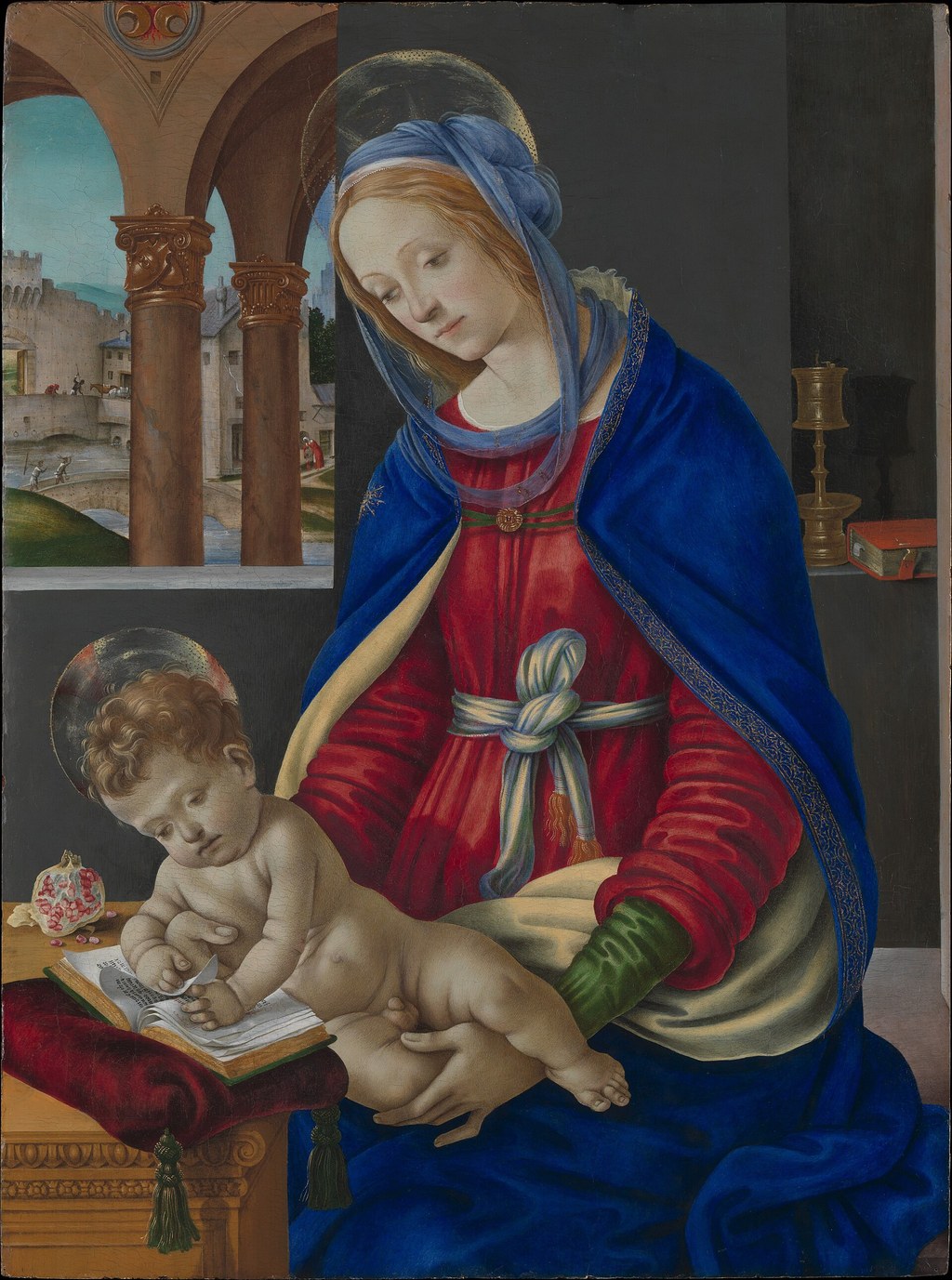
Comparison with the Met Madonna and Child. The Met’s Strozzi Madonna and Child dates from roughly the same pre-Roman period.[4] The comparison is revealing. Strozzi’s painting is private and domestic.
Nerli’s is public and liturgical. Both include strong patronal identity. Both show Filippino working for elite Florentine families. Yet the formats demand entirely different visual solutions. This demonstrates how adaptable he had become before Rome.
Comparison with the Vision of Saint Bernard. The Vision of Saint Bernard belongs to the same broad mid-1480s phase. It is poetic, rocky and psychologically concentrated. The Nerli Altarpiece is more formal because it must organise a saintly assembly around an altar. Together the works show that “pre-Roman Filippino” was already stylistically diverse. One painter could move between mystical vision and public sacra conversazione without losing identity.
Comparison with the Carafa Chapel. The Carafa Chapel reveals what happens after Filippino reaches Rome. Architecture becomes more archaeological and theatrical. Grotesques appear.
Classical fragments are reinvented aggressively. Against that later work, the Nerli Altarpiece appears controlled. This difference is exactly what makes it such a useful benchmark. The painting allows change to be measured rather than merely asserted.
Comparison with the Strozzi Chapel
The late Strozzi Chapel takes the Roman vocabulary back into Florence. Compared with Nerli, its architecture seems almost animated. Decorative sculpture and antique forms crowd the space.
Narrative becomes more theatrical. The two commissions therefore bookend Filippino’s Roman transformation within Florence itself. Nerli shows mature pre-Roman control. Strozzi shows late post-Roman abundance.
Santo Spirito and Florentine Art. The basilica contains major works by several important Renaissance artists. This matters because the Nerli Altarpiece entered a competitive and sophisticated visual environment. Filippino’s painting existed beside other family chapels commissioned from leading masters. Patrons could compare quality and prestige directly. The altarpiece therefore participated in a wider culture of artistic rivalry and devotional patronage within one church.
Family Chapels. A family chapel was one of the most durable forms of Renaissance self-representation. Palaces could change ownership. Political office could end.
A chapel connected lineage with sacred space across generations. The Nerli family arms, donor portraits and altar all reinforce that permanence. The painting became part of the family’s institutional memory. Its survival in place makes that function unusually easy to understand today.
Donor Portraiture and Scale. Tanai and Nanna are represented within the sacred composition but remain subordinate. Their scale and position communicate hierarchy. The saints occupy sacred authority.
The donors occupy devotional dependence. This arrangement solved a delicate social problem. A wealthy patron wanted to be remembered without appearing spiritually arrogant. Kneeling devotion provided the appropriate visual language.
Sacred Conversation
The altarpiece belongs broadly to the tradition often called a sacra conversazione, in which the Virgin and Child appear with saints in a unified pictorial space. The figures are not necessarily acting out one historical event. They belong to devotional time.
Different saints from different centuries can coexist around Mary and Christ. This allows the patron to assemble a spiritually meaningful community tailored to family needs. The format was especially well suited to Renaissance chapel altarpieces.
The Young Saint John and Florence. John’s presence gains further significance because Santo Spirito is a Florentine church and the Baptist was Florence’s patron saint.[1] His image connects the Nerli family’s private chapel with civic identity. Family devotion therefore exists inside a larger communal devotion. The saint is both Christ’s forerunner and Florence’s protector. This layering of meanings was typical of Renaissance religious imagery.
Colour and Visibility. An altarpiece inside a side chapel had to remain legible under changing natural and candle light. Strong colours and clear figure groupings served practical as well as aesthetic purposes. Modern electric illumination changes the viewing conditions substantially. In Filippino’s time, the painting would have appeared differently through the day and during liturgy. Its original visual life was dynamic rather than fixed.
The Painting as Architecture. Because the panel was designed for one altar, its composition can be understood as an extension of the chapel architecture. Painted arches, heraldry and figure placement interact with the real architectural frame. This reinforces the sense that the sacred world opens within the church rather than hanging independently on a wall. Renaissance altarpieces often operated as fictive architectural thresholds. The Nerli painting still allows that relationship to be experienced.
The Altarpiece and Brunelleschi’s Architecture
The relationship with Santo Spirito’s architecture deserves particular attention.[1] Brunelleschi’s church is organised through repeated columns, rounded arches and a strong sense of proportional order. A chapel altarpiece inserted into that system had to negotiate rather than ignore the architectural rhythm.
Filippino’s painted structure therefore belongs within an already classical environment. This is another reason the pre-Roman date is plausible. Florence itself supplied abundant classical vocabulary before Filippino ever saw the ancient monuments of Rome directly. The distinction is between learned Florentine classicism and the much more archaeological, fragmentary experience that Rome later provided.
Florence as a Classical Environment. By the mid-1480s, Filippino could encounter ancient-inspired architecture in buildings by Brunelleschi, Alberti and others. He could also see antique sculpture and humanist collections in Florentine palaces. The Renaissance recovery of antiquity was already deeply embedded in the city’s visual culture.
Rome therefore intensified a process already underway. The Nerli Altarpiece sits precisely at that threshold. Its architecture is classicising but not yet haunted by the strange masks, ruins and grotesques that dominate Filippino’s later imagination. This nuance makes the work particularly important for tracing development.
A Public Image of Marriage. Tanai and Nanna appear together as husband and wife. Their paired presence gives the altarpiece a marital dimension as well as a funerary and dynastic one. A family chapel represented lineage through the union from which descendants emerged.
The husband and wife therefore appear not simply as two individual donors but as the core of a household identity. Their shared devotion before Mary and Christ models the family’s relationship with sacred authority. The altarpiece can thus be read as an image of pious marriage without reducing the saints to marital symbols.
Gender and Devotional Models
The arrangement also creates parallel models for male and female devotion. Tanai and Nanna kneel within the same sacred environment but encounter different saintly figures and attributes. Saint Martin embodies charity and episcopal authority.
Saint Catherine embodies learning, chastity and steadfast faith. Mary provides the central maternal model. These figures offered a range of devotional identities rather than one simple message. The chapel could therefore support prayer across generations and genders within the Nerli family.
The Child Baptist as a Bridge. The young Saint John helps connect the formal saints to the intimate Madonna group. Because he is a child, he can enter the emotional space around Christ more naturally than an adult saint. Because he is also Florence’s patron saint, he connects that intimacy with civic identity. His presence therefore operates simultaneously at family, biblical and civic levels. This layered function is one reason the child Baptist became so popular in Florentine art.
Public and Private Viewing. Although the chapel belonged to the Nerli family, it existed inside a public church. That created two audiences. Family members could understand the donor portraits and heraldry personally.
Other worshippers could encounter the painting as part of Santo Spirito’s wider devotional environment.[1] The altarpiece therefore had to work both as private family memory and public sacred image. Its hierarchy solves this problem elegantly. The Nerli identity is clear but does not overwhelm the Virgin, Child and saints.
The Work as Family Archive
In a sense, the chapel functions as a visual archive. Names, faces, heraldry and sacred associations preserve information that written documents alone cannot convey emotionally. The donor portraits record how Tanai and Nanna wanted to be remembered.
The saints record spiritual priorities. The family arms record lineage. The location records property and patronage rights. Together these elements make the altarpiece a historical document of self-representation. Its survival in place preserves the archive unusually intact.
Material Presence and Scale. The altarpiece’s physical presence is easy to underestimate in reproduction. Inside the chapel, the painted figures occupy real architectural scale. Their bodies confront the viewer across an altar rather than within a book or screen.
This affects the emotional tone. Mary and the saints become presences inhabiting the chapel. The donors appear to kneel permanently before them. The whole arrangement performs devotion continuously, even when no human worshipper is present.
The Altar and the Eucharist. Because the image stood over an altar, it was seen in relation to the Eucharist. The Christ Child represented in paint and the sacramental body of Christ celebrated at Mass belonged to the same devotional environment. This connection gives the altarpiece a function no museum display can reproduce.
The painting was not only looked at. It participated in ritual. The altar beneath it transformed the image into part of a repeated liturgical action. Understanding that relationship helps explain the formal sacred hierarchy of the composition.
Comparison with the Rucellai Altarpiece
Filippino’s Virgin and Child with Saints Jerome and Dominic in the National Gallery offers another useful comparison with an elite Florentine family chapel. Both paintings centre Mary and Christ among saints. Both are tied to prominent families.
Both combine donor or patronal identity with religious function. Yet the Rucellai work is now detached from San Pancrazio, while the Nerli remains in Santo Spirito.[1] The comparison demonstrates exactly what original location preserves. One painting must be reconstructed historically through documents. The other can still be read spatially in its chapel.
Before Carafa: What Is Missing? Another useful way to define the Nerli style is to notice what is not yet present. There is no obsessive grotesque decoration. Ancient fragments do not dominate the sacred narrative.
Architecture does not become an independent spectacle. The figures remain the primary focus. This absence is evidence. It clarifies how dramatic the Roman transformation would become. The mature pre-Roman Filippino is already sophisticated, but his visual world remains comparatively stable.
After Rome: What Changes? In the Carafa Chapel, architecture becomes more theatrical and intellectual allegory expands. In the Strozzi Chapel, antique forms become even stranger and more animated. Against those works, the Nerli panel appears almost classical in a conventional sense: ordered, balanced and devotional. This contrast prevents us from describing Filippino’s late style as simply the natural maturation of early tendencies. Rome genuinely altered the scale and intensity of his imagination.
Why Original Context Changes Interpretation
Seeing the painting in Santo Spirito alters even basic questions such as colour and composition.[1] The chapel’s real architecture frames the painted architecture. Light enters from particular directions.
The altar establishes a devotional axis. The viewer approaches from the nave rather than from a neutral museum floor. All of these conditions shape experience. The work therefore offers a rare opportunity to study not only what Filippino painted but how Renaissance viewers encountered painting as part of architecture and worship.
Why the Nerli Altarpiece Matters. The Nerli Altarpiece matters because it preserves three kinds of historical evidence at once. It preserves Filippino’s mature style immediately before Rome. It preserves elite Florentine family patronage through donor portraits and heraldry.
And it preserves original architectural context because the painting remains on the Nerli altar in Santo Spirito.[1] That combination is rare. The work also complicates a simple before-and-after story of Filippino’s classicism.
Even before 1488, he was already working within sophisticated classical architecture and using architectural detail intelligently. Rome would transform those interests rather than introduce them from nothing. More broadly, the altarpiece provides an essential chronological control point between the Vision of Saint Bernard and the Carafa Chapel. Without it, Filippino’s Roman transformation can appear too abrupt. With it, development becomes gradual, intelligible and rooted in Florence.
Frequently Asked Questions
Discussion
What stands out to you most about Nerli Altarpiece in relation to Filippino Lippi's wider career?
Reader Insights
Notice how the page connects close visual detail with patronage, workshop practice and the wider Renaissance setting.
Which comparison elsewhere in the cluster helps clarify this work or theme most strongly?
Join the Conversation
Have a thought or observation about Nerli Altarpiece? Share it below. Thoughtful responses may be added to this section.
References
- Basilica of Santo Spirito, “Filippino Lippi – Nerli Altarpiece,” institutional artwork account. View Source
- Basilica of Santo Spirito, “Pala Nerli,” Italian institutional account and dating discussion. View Source
- Basilica of Santo Spirito, “Works and Artistic Heritage,” current collection overview. View Source
- Metropolitan Museum of Art, The Drawings of Filippino Lippi and His Circle, 1997. View Source
- Cleveland Museum of Art, Filippino Lippi and Rome, 2025–26, for comparison with the artist’s Roman transformation. View Source