 by Tom Gurney
Tom Gurney BSc (Hons) is an art history expert with over 20 years experience
Published on June 19, 2020 / Updated on October 2, 2026
Email: tomgurney1@gmail.com / Phone: +44 7429 011000
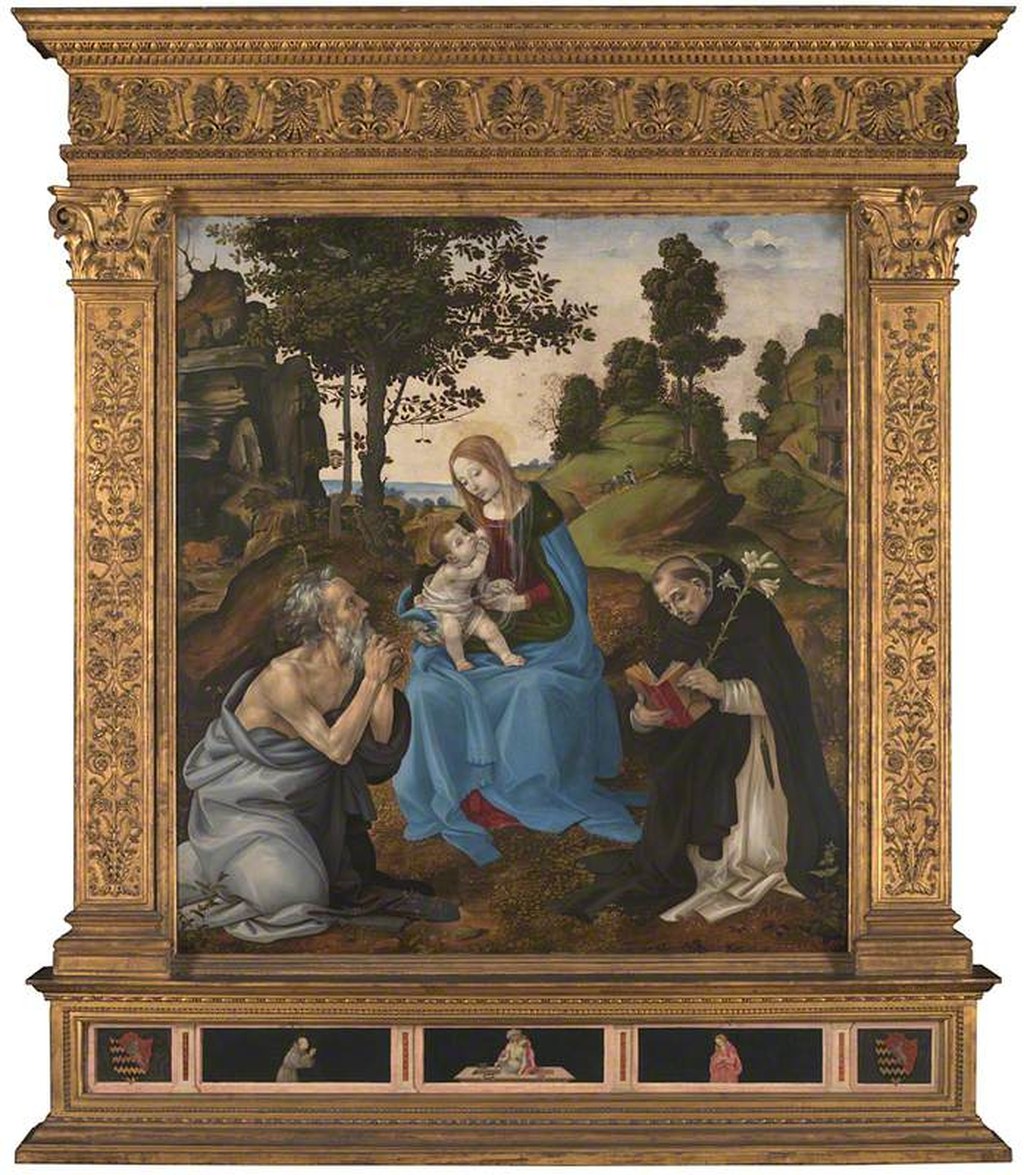
Virgin and Child with Saints Jerome and Dominic by Filippino Lippi
Filippino Lippi’s Virgin and Child with Saints Jerome and Dominic, painted around 1485 and now in the National Gallery in London, is one of the strongest surviving examples of his mature pre-Roman altarpiece style. Originally made for a Rucellai family chapel in San Pancrazio in Florence, the painting combines Marian devotion, family patronage, Dominican spirituality, hermit imagery and an unusually rich landscape programme.[1]
The Virgin sits at the centre breastfeeding the infant Christ. Saint Jerome kneels to the left, holding the stone he used in penitential devotion. Saint Dominic kneels to the right, absorbed in a book and holding his white lily. The composition is formally balanced, yet the surrounding landscape is full of secondary incidents. A lion confronts a brown bear. Jerome appears again in a cave praying towards a Crucifix. Saint Joseph walks behind a donkey. A small church stands in the distance.
The National Gallery also draws attention to a coal tit feeding its young in the tree behind the Virgin, a detail that creates a subtle visual parallel with Mary nursing Christ.[1] This combination of formal sacred hierarchy and descriptive narrative makes the work especially characteristic of Filippino in the mid-1480s. He had moved decisively beyond his Botticelli-workshop beginnings but had not yet undergone the Roman transformation of 1488–93.
The altarpiece also has an unusually clear provenance. It remained connected with the Rucellai family after San Pancrazio was suppressed in the early nineteenth century, was stored in Palazzo Rucellai, and was purchased directly from the family by the National Gallery in 1857.[1]
At a Glance
- ArtistFilippino Lippi
- TitleThe Virgin and Child with Saints Jerome and Dominic
- Datec. 1485
- MediumOil and egg tempera on wood, probably poplar
- Dimensions203.2 × 186.1 cm
- Current locationNational Gallery, London
- Original settingRucellai family chapel in San Pancrazio, Florence
- Principal figuresVirgin Mary, Christ Child, Saint Jerome, Saint Dominic
- Marian typeVirgo Lactans, the nursing Virgin
- Secondary imagerycoal tit feeding young, lion and bear, Jerome in cave, Saint Joseph and donkey
- Framenineteenth-century reproduction incorporating a predella-like lower panel
- ProvenanceRucellai family, Palazzo Rucellai, National Gallery purchase in 1857
Contents
- The Rucellai Commission
- Saint Jerome
- The Book
- Landscape as Secondary Narrative
- The Frame
- National Gallery Purchase
- Nursing and Nature
- The Rucellai Sepulchre Connection
- Jerome as Scholar and Penitent
- The Flight into Egypt Reference
- Nineteenth-Century Taste
- Frequently Asked Questions
- References
The Rucellai Commission
The Rucellai were one of Florence’s most prominent mercantile and banking families. Their name is inseparable from some of the city’s most important Renaissance architecture, especially Palazzo Rucellai and the façade of Santa Maria Novella associated with Leon Battista Alberti. Filippino’s altarpiece therefore belonged to a patronal world of exceptional cultural sophistication. The family chapel in San Pancrazio provided a sacred setting in which lineage, devotion and artistic prestige could reinforce one another.
San Pancrazio. The church of San Pancrazio was an important medieval Florentine foundation. The painting originally stood on an altar in the Rucellai chapel dedicated to Saint Jerome. That dedication helps explain Jerome’s prominent place in the composition. The altarpiece was therefore tailored to a specific chapel rather than assembled from generic saints. Its sacred identities belonged to local patronal history.
The Virgin as Virgo Lactans. Mary is represented breastfeeding Christ. This devotional type, known as the Virgo Lactans, emphasises both motherhood and the Incarnation. Christ’s divine identity is expressed through a profoundly human act: dependence upon his mother for nourishment.
The image therefore makes theology bodily. Filippino’s family artistic heritage made such intimacy especially natural. Fra Filippo Lippi had repeatedly humanised Mary and Christ through gesture and maternal tenderness. Filippino continues that tradition within a larger altarpiece setting.
The Coal Tit. A small bird in the tree behind Mary feeds its own young. The National Gallery identifies it as a coal tit.[1] The parallel is subtle but powerful.
Animal motherhood echoes sacred motherhood. The natural world reflects the central human action. This detail shows how Filippino could make landscape participate in meaning rather than functioning as neutral scenery.
Saint Jerome
Jerome kneels before the Virgin holding a stone. According to devotional tradition, he struck his chest with a stone as an act of penitence and resistance to temptation. The attribute immediately identifies him.
Jerome was also one of Christianity’s great scholars, traditionally associated with the Latin translation of the Bible. He therefore combines learning and asceticism. That combination would have appealed strongly to educated Renaissance patrons.
Jerome in the Cave. Filippino represents Jerome a second time in the distant landscape. There he prays in a cave towards a Crucifix. This duplication creates continuous narrative.
The foreground saint exists in devotional time beside Mary. The background saint exists in an episode from his own life. Different moments coexist within one landscape. This allows the altarpiece to function simultaneously as sacred assembly and narrative biography.
The Lion. Jerome’s legendary lion appears in the landscape. According to tradition, the saint removed a thorn from the animal’s paw and gained its loyalty. In Filippino’s painting the lion confronts an intruding brown bear.
The detail introduces drama into the background. The animal companion becomes active rather than merely symbolic. This is characteristic of Filippino’s delight in secondary incidents.
Saint Dominic. Dominic kneels opposite Jerome. He is absorbed in a book and holds a white lily. The lily symbolises purity and also connects visually with Marian symbolism.
Dominic’s reading establishes another form of sacred learning. Jerome’s scholarship is linked with penitential withdrawal. Dominic’s is linked with preaching and organised religious life. The two saints therefore create complementary models of intellectual devotion.
The Book
Dominic’s book is important because it represents knowledge as an active devotional practice. He does not simply carry it as an attribute. He reads.
This transforms scholarship into action. Filippino repeatedly showed saints writing or reading, most famously Bernard in the Vision of Saint Bernard. Books were one of his favourite ways of making religious thought visible.
Saint Joseph and the Donkey. In the background, Joseph walks near a donkey. The National Gallery suggests this may refer to the Flight into Egypt.[1] The detail extends the Holy Family’s story beyond the nursing scene in the foreground. Christ’s infancy therefore contains both nourishment and future danger. The peaceful central group exists within a larger narrative of displacement and protection.
The Little Church. A small church appears within the landscape. Garlands hang from its porch. The architecture gives the background a lived religious character.
This is not empty wilderness. Sacred buildings, saints and journeys inhabit the terrain. Filippino turns landscape into spiritual geography.
A Triangular Composition. The National Gallery notes that Mary and the two kneeling saints form a strong triangular arrangement.[1] This structure provides stability. The Virgin occupies the apex.
Jerome and Dominic anchor the lower sides. The formal geometry keeps the main devotional hierarchy clear despite the busy landscape. Filippino therefore balances order and detail rather than choosing between them.
Landscape as Secondary Narrative
The background is full of events that reward slow looking. This differs from altarpieces in which landscape functions mainly as atmospheric distance. Here terrain carries biography and symbolism.
Jerome prays. His lion acts. Joseph travels. A bird feeds its young. Each incident expands the central sacred relationship without competing with it.
Before Rome. The painting dates to around 1485, several years before Filippino’s Roman commission for Cardinal Carafa. That makes it another crucial pre-Roman benchmark. The work is already complex, detailed and psychologically varied.
Yet ancient architecture and grotesque ornament do not dominate. Its richness comes through landscape and devotional narrative. Rome would later redirect Filippino’s appetite for complexity towards antiquity.
Comparison with the Nerli Altarpiece. The Nerli Altarpiece belongs to approximately the same pre-Roman phase. Both works were made for elite Florentine family chapels. Both centre the Virgin and Child among saints.
Yet their present histories differ dramatically. Nerli remains in Santo Spirito. The Rucellai altarpiece left San Pancrazio and entered a museum. The comparison therefore reveals both artistic similarity and the consequences of displacement.
Comparison with the Vision of Saint Bernard. The Vision of Saint Bernard shares Filippino’s strong interest in rocky terrain, books and contemplative saints. The Rucellai altarpiece distributes those concerns more widely. Jerome appears both foreground and background.
Dominic reads. Nature echoes motherhood. The painting demonstrates how Filippino could transform similar interests according to altarpiece function.
The Frame
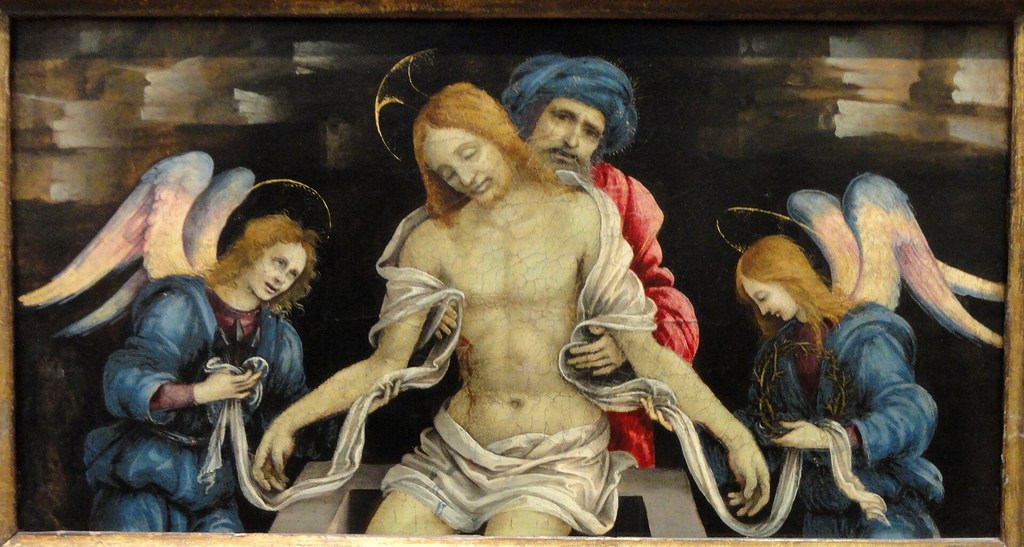
The current elaborate frame is nineteenth-century but reproduces what may have been the original format. At the bottom is a horizontal panel showing the dead Christ emerging from the tomb, flanked by Saints Francis and Mary Magdalene, with Rucellai coats of arms. The National Gallery suggests this lower image may allude to the Rucellai Sepulchre.[1] The frame therefore contributes to interpretation even though it is not wholly original. It reconstructs a plausible relationship between main image, family heraldry and Passion imagery.
The Dead Christ below the Madonna. The juxtaposition between nursing Christ above and dead Christ below creates a powerful theological arc. The infant receives nourishment from Mary. The adult body later suffers death. This connection is typical of Renaissance Marian devotion, where tenderness often anticipates the Passion. Even if the nineteenth-century frame reconstructs rather than preserves the exact original arrangement, the logic is historically appropriate.
Suppression of San Pancrazio. San Pancrazio was suppressed in 1808 or 1809. This disrupted the original chapel context. Many church artworks were scattered during suppressions and institutional reforms. The Rucellai altarpiece remained family property and was transferred to Palazzo Rucellai. Its survival therefore depended partly on private ownership after the church ceased functioning in the same way.
Palazzo Rucellai. The painting was stored in Palazzo Rucellai, itself one of the defining monuments of Renaissance domestic architecture. This created a second significant setting. An altarpiece made for a family chapel entered the family palace. Its function changed, but its patronal context remained unusually intact. The painting continued to belong to the same lineage that had commissioned it centuries earlier.
National Gallery Purchase
The National Gallery bought the painting directly from Cavaliere Giuseppe Rucellai in 1857.[1] This provenance is unusually clean and historically meaningful. The object moved from family chapel to family palace to national museum.
Each stage reflects changing ways of valuing Renaissance painting. The first emphasised devotion. The second preserved family ownership. The third transformed the panel into public art history.
One of the Gallery’s Early Italian Acquisitions. The National Gallery notes that the painting became one of the first early Italian pictures to enter its collection.[1] This is important to the history of taste. In the nineteenth century, British museums were actively constructing narratives of Italian Renaissance art. Filippino’s altarpiece became part of that educational project. A work once tied to one Florentine family was recast as part of a national collection for a broad public.
Oil and Egg Tempera. The National Gallery identifies the medium as oil and egg tempera on wood, probably poplar.[1] This mixed technique reflects the material flexibility of late-fifteenth-century Florence. Filippino could combine crisp linear control with richer tonal modelling. The result suits a painting balancing precise natural detail and large-scale sacred figures.
Scale. At more than two metres high, the panel is architecturally substantial. It was designed to dominate an altar. The figures therefore have a physical presence easy to underestimate on screen. The large scale also gives Filippino room to develop the landscape without reducing the saints to miniatures. Monumentality and detail coexist.
Nursing and Nature
The parallel between Mary and the feeding bird deserves special emphasis because it crystallises Filippino’s approach. Theology is echoed by observed nature. A tiny creature reinforces the meaning of a monumental sacred figure.
The relationship is not necessary for identifying the subject. It is an added reward for attentive viewing. Filippino repeatedly builds meaning through such secondary discoveries.
Learning and Devotion. Jerome and Dominic are both intellectual saints. One is associated with biblical translation and hermit penitence. The other with preaching and Dominican study.
Their presence creates a learned environment around the nursing Virgin. The painting therefore joins bodily nourishment with intellectual nourishment. Christ is fed physically. The saints are sustained through prayer, reading and doctrine. This combination gives the altarpiece unusual thematic coherence.
The Chapel of Saint Jerome. The original dedication to Saint Jerome explains why the saint is not merely one member of a generic holy group. He belonged to the identity of the altar itself. A worshipper approaching the chapel encountered Jerome both as patron saint of the space and as a figure kneeling before the Virgin.
This doubled the devotional relationship. The chapel named him. The painting embodied him. Such integration between dedication and image was fundamental to Renaissance altarpiece design.
The Rucellai and San Pancrazio. The Rucellai family’s investment in San Pancrazio was part of a wider pattern of Florentine elite patronage in which family chapels established a durable presence inside major churches. A chapel gave the lineage a sacred address. Masses could be celebrated there.
Family members could be buried or commemorated there. Art reinforced the family’s association with particular saints and devotional practices. Filippino’s altarpiece therefore belonged to a larger institutional structure of memory.
The Rucellai Sepulchre Connection
The lower image of the dead Christ in the nineteenth-century frame may allude to the famous Rucellai Sepulchre associated with Leon Battista Alberti. If the reconstructed relationship reflects an older programme, the reference would have linked the altar to one of the family’s most distinctive sacred monuments. The Rucellai identity would therefore operate through more than heraldry. Architecture, tomb imagery and Passion devotion could reinforce one another. Because the present frame is later, this connection should remain interpretive rather than treated as fully preserved original evidence.
Mary’s Milk and the Incarnation. The nursing Virgin was not merely a sentimental image of motherhood. Milk made Christ’s human dependence impossible to ignore. The divine child needs nourishment.
This bodily fact supported central Christian teaching that Christ was genuinely human as well as divine. For a viewer praying before the altar, Mary’s act could therefore evoke tenderness and doctrine simultaneously. Filippino makes theology accessible through ordinary maternal experience.
A Theology of Feeding. The coal tit deepens this theme in a way that is easy to miss. A mother bird feeds its chicks above the nursing Virgin. Nature appears to echo sacred nurture.
Dominic’s book introduces another kind of feeding: intellectual nourishment. The image can therefore be read through several forms of sustenance. Bodies require food.
Faith requires teaching. The soul requires divine grace. Filippino does not spell out this system explicitly, but the visual parallels allow it to emerge through contemplation.
Jerome as Scholar and Penitent
Jerome’s double identity is especially important. He is one of Christianity’s great intellectual authorities. He is also represented through bodily penitence.
The stone in his hand prevents scholarship from becoming detached from spiritual discipline. Learning alone is insufficient. The body must also be trained through prayer and self-denial. This combination of bookish authority and ascetic devotion would have been highly legible to educated Florentine patrons.
Dominic as Reader. Dominic’s absorbed reading creates a quieter counterpoint. He does not turn dramatically towards Mary. His attention remains on the book.
This suggests that sacred learning itself can be a form of devotion. The contrast with Jerome is subtle. Jerome looks towards the Virgin while holding the instrument of penitence. Dominic reads while kneeling before her. Two different spiritual practices coexist.
Animals and Moral Landscape. The lion and bear add an unexpected sense of conflict. The lion belongs to Jerome’s legend and therefore carries saintly association. The bear appears as intruder.
The confrontation gives the landscape a moral undertone. Peaceful sacred space contains the possibility of danger. This echoes the broader Christian idea that withdrawal and contemplation do not eliminate temptation or struggle. Filippino had already explored a similar theme through the chained demon in the Vision of Saint Bernard.
Repetition of Jerome. Showing Jerome twice creates a sophisticated relationship between icon and narrative. The foreground Jerome functions almost like a timeless devotional presence. The distant Jerome belongs to biography.
The same person therefore appears in two modes. This was not considered an error by Renaissance viewers. Continuous narrative allowed multiple moments to occupy one painted world. Filippino uses that freedom to enrich the landscape without disrupting the central sacred hierarchy.
The Flight into Egypt Reference
Joseph and the donkey may evoke the Flight into Egypt, introducing another temporal layer. The nursing Christ is still an infant. The distant journey suggests danger already surrounding his early life.
This quietly anticipates the broader pattern of suffering that culminates in the Passion. Tenderness and threat therefore coexist. The altarpiece avoids dramatic violence while allowing future suffering to remain present in symbolic form.
Landscape and the Viewer’s Pace. The painting encourages two speeds of looking. The main triangular group can be understood immediately. The landscape requires time.
Bird, bear, cave, church, donkey and distant saint emerge gradually. This structure suits repeated devotional viewing. A family or priest returning to the altar over many years could continue discovering relationships. The altarpiece was therefore designed for familiarity rather than one spectacular first impression.
From Chapel to Palace. When San Pancrazio was suppressed, the painting’s move to Palazzo Rucellai altered its meaning substantially. The sacred family commission became a household possession. Yet unlike many displaced altarpieces sold immediately onto the market, it remained within the commissioning lineage. This preserved a remarkable continuity of memory. The people living with the painting could still understand it as “their” family work even after its liturgical setting had disappeared.
From Palace to National Museum. The 1857 sale changed that relationship completely. The National Gallery transformed a Rucellai family object into public cultural property.[1] The painting became evidence within a national narrative of Renaissance art.
Labels, catalogue entries and gallery rooms replaced chapel dedication as the principal explanatory framework. This history is not secondary. It explains why modern viewers know Filippino through museums rather than family altars.
Nineteenth-Century Taste
The purchase also belongs to the growing nineteenth-century British interest in early Italian painting. Artists once overshadowed by Raphael and later masters were being reconsidered. Filippino entered the National Gallery during this expansion of historical taste.[1] His panel therefore helped British audiences construct a broader idea of the Renaissance that included the fifteenth century rather than beginning with the High Renaissance.
Why the Landscape Feels Modern. Modern viewers often respond strongly to the landscape because its details seem observational and almost anecdotal. A bird feeds chicks. Animals fight.
A man walks with a donkey. A hermit prays alone. These incidents make the world feel inhabited beyond the formal religious gathering. Filippino’s ability to sustain that peripheral life without losing the central sacred focus is one of the clearest signs of his maturity.
Why the Rucellai Altarpiece Matters. The painting matters because it demonstrates how much Filippino could achieve before Rome. Its main group is formally stable. Its landscape is narratively rich.
Books, animals, buildings and distant episodes turn contemplation into discovery. The Rucellai provenance is exceptionally strong, linking the panel directly to one of Florence’s great families and to a specific chapel at San Pancrazio. The work also provides a valuable counterpart to the Nerli Altarpiece.
Together, they show Filippino serving elite Florentine family chapels immediately before his Roman transformation. One survives in situ. The other survives through an unusually clear chain of family ownership and museum acquisition.
Most importantly, the painting shows Filippino balancing intimacy and monumentality. The nursing Virgin is profoundly human, yet the work remains a formal public altarpiece. That ability to make sacred figures emotionally accessible without sacrificing architectural authority is one of the defining strengths of his mid-career art.
Frequently Asked Questions
Discussion
What stands out to you most about Virgin and Child with Saints Jerome and Dominic in relation to Filippino Lippi's wider career?
Reader Insights
Notice how the page connects close visual detail with patronage, workshop practice and the wider Renaissance setting.
Which comparison elsewhere in the cluster helps clarify this work or theme most strongly?
Join the Conversation
Have a thought or observation about Virgin and Child with Saints Jerome and Dominic? Share it below. Thoughtful responses may be added to this section.
References
- National Gallery, London, Filippino Lippi, The Virgin and Child with Saints Jerome and Dominic, NG293. View Source
- National Gallery, London, provenance and in-depth catalogue information for NG293.
- Metropolitan Museum of Art, The Drawings of Filippino Lippi and His Circle, 1997. View Source
- National Gallery, London, Filippino Lippi artist biography and related collection records. View Source