 by Tom Gurney
Tom Gurney BSc (Hons) is an art history expert with over 20 years experience
Published on June 19, 2020 / Updated on October 2, 2026
Email: tomgurney1@gmail.com / Phone: +44 7429 011000
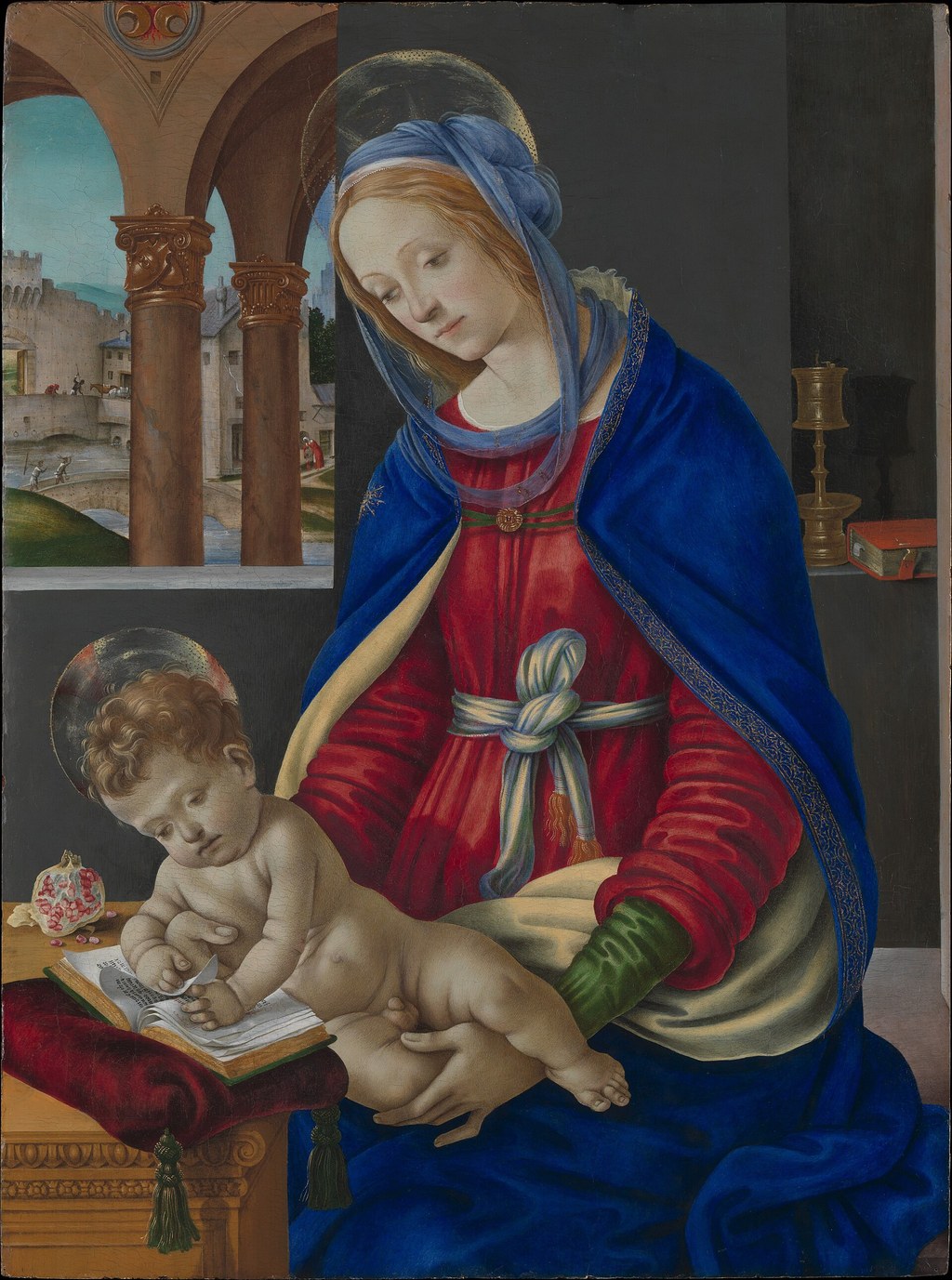
Madonna and Child by Filippino Lippi — Metropolitan Museum of Art
Filippino Lippi’s Madonna and Child in the Metropolitan Museum of Art, painted around 1483–84 for the Florentine banker Filippo Strozzi, is one of the most revealing private devotional paintings of his career. The panel is smaller and quieter than the great fresco cycles that made Filippino famous, yet it opens onto a remarkably rich world of family identity, domestic devotion, landscape, luxury materials, international artistic influence and social history.[1]
The Virgin and Child occupy a contemporary Florentine palace interior. Through an opening to the left, the viewer sees an arcade bearing the Strozzi family emblem of three crescent moons. Beyond it extends a landscape associated by the Met with the area around the Strozzi villa at Santuccio, west of Florence.[1] The painting therefore does something characteristic of Renaissance patronage. It places sacred figures inside a setting recognisable as belonging to the patron’s own social world.
Mary and Christ are not represented in an abstract heavenly realm. They inhabit architecture, furniture, textiles and landscape that connect devotion to elite Florentine domestic life. The Met also identifies important Flemish influence in the panel, especially in the view through the loggia, the close attention to still-life detail and the cast shadow of a candlestick.[1]
Those elements reveal how cosmopolitan Florentine painting had become by the early 1480s. Filippino could combine the linear elegance inherited from Botticelli and Fra Filippo with visual ideas associated with northern European painting. The surface was transformed for modern viewers by conservation in 2010–11. Beneath a thick, discoloured varnish, the Met discovered a remarkably well-preserved and brilliantly coloured painting. The restoration was striking enough to become the subject of the focused exhibition A Renaissance Masterpiece Revealed.[1]
The work also contains details that broaden its historical importance far beyond traditional Madonna iconography. A Black man appears on a bridge spearing fish, while a Black woman performs domestic work outside a house. The Met connects these figures with documentary evidence that enslaved people from sub-Saharan Africa reached Florence through Portuguese networks from the 1460s and that enslaved people were present within the Strozzi household.[1]
This does not turn the painting into a documentary photograph of one particular household moment. But it does mean that the background should not be treated merely as picturesque fantasy. Filippino’s sacred image preserves traces of the social world within which elite Florentine devotion operated.
At a Glance
- ArtistFilippino Lippi
- TitleMadonna and Child
- Datec. 1483–84
- MediumTempera, oil and gold on wood
- Dimensions81.3 × 59.7 cm
- Current locationMetropolitan Museum of Art, New York
- Object number49.7.10
- PatronFilippo Strozzi the Elder
- Original associationStrozzi villa at Santuccio, west of Florence
- Family emblemThree crescent moons
- Distinctive featuresFlorentine palace interior, loggia, landscape, still-life details, cast shadow
- Northern influenceFlemish painting
- Luxury pigmentcostly ultramarine in the Virgin’s mantle
- Social-history detailBlack man fishing and Black woman performing domestic work
- Conservation significancemajor cleaning and restoration presented by the Met in 2011
Contents
- Filippo Strozzi as Patron
- Mary and Christ
- The Loggia
- Landscape
- Slavery in Renaissance Florence
- Tempera and Oil
- Comparison with Botticelli
- Open Access
- Household Piety and Wealth
- The Meaning of the Interior
- Trade and Visual Exchange
- Conservation and Historical Distance
- Why the Met Madonna and Child Matters
- Frequently Asked Questions
- References
Filippo Strozzi as Patron
Filippo Strozzi the Elder was one of the wealthiest and most ambitious Florentines of his generation. His family had experienced political exile before rebuilding its position in the city. Strozzi used banking, property and artistic patronage to consolidate that return.
His most famous architectural project was Palazzo Strozzi, begun later in the decade. The Met panel belongs to an earlier moment but already demonstrates his investment in sophisticated visual culture.[1] A private Madonna was not merely a religious object. For a patron of Strozzi’s status, it could also be a carefully crafted expression of household identity.
The Strozzi Emblem. The three crescent moons visible in the architectural setting identify the Strozzi family. This heraldic device is one of the painting’s clearest patronal signals. The emblem does not dominate the sacred figures.
Instead, it is integrated into the surrounding architecture. That subtle placement matters. The picture remains a devotional image rather than a coat of arms with religious decoration. Yet anyone familiar with Florentine heraldry could recognise the family presence. Sacred and dynastic identities therefore coexist.
Santuccio. The Met states that the background evokes the area around the Strozzi villa near Florence.[1] The museum’s 2011 exhibition described the painting as commissioned for Strozzi’s villa at Santuccio, west of the city. This setting explains the unusually specific landscape and domestic atmosphere.
The panel was designed for a private environment connected directly with the patron’s property. The sacred figures could therefore be contemplated within a real household while the painted landscape echoed the family’s own land. The boundary between biblical image and contemporary life becomes deliberately porous.
Mary and Christ
The Virgin supports the Christ Child in an intimate relationship typical of private devotional painting. There is no vast court of saints. No donor kneels visibly before them.
The emotional centre is maternal. This simplicity allows Filippino to make the sacred figures feel physically close to the viewer. The effect continues a tradition strongly associated with his father, Fra Filippo Lippi, whose Madonnas repeatedly brought sacred affection into recognisable human terms. Filippino inherits that intimacy but places it within a more materially descriptive environment.
Domestic Devotion. Small and medium-sized Madonna paintings were important objects in Renaissance households. They could support prayer, family ritual and private contemplation. The Met panel belongs to this world even though its patron was exceptionally wealthy.[1]
Its devotional function should therefore remain central. The landscape, coat of arms, pigments and social detail enrich the historical interpretation, but they do not replace the painting’s sacred purpose. Mary and Christ remain the reason the object existed. The surrounding world tells us who was looking at them and under what conditions.
The Florentine Palace Interior. The architecture is contemporary rather than ancient. This places sacred presence inside a recognisable fifteenth-century elite interior. The device makes theological meaning immediate.
Christianity is not confined to biblical Palestine or an abstract heaven. Mary and Christ can be imagined within the patron’s own world. This kind of translation is one of the most powerful features of Renaissance devotional art. Historical distance collapses. The holy family enters Florence.
The Loggia
The opening through the loggia creates one of the painting’s most sophisticated spatial effects. Interior gives way to architecture. Architecture gives way to landscape.
The viewer’s eye therefore moves through several zones. This creates depth but also connects private devotion to the wider world. The Virgin and Child are enclosed but not isolated. The landscape remains visible beyond them. The Strozzi emblem occupies the threshold between household and exterior.
Flemish Influence. The Met explicitly identifies Flemish influence in the painting.[1] This is particularly visible in the landscape view, still-life detail and cast shadow. Northern European painting had become increasingly admired in fifteenth-century Italy.
Florentine patrons could encounter imported paintings and drawings through trade and collecting. Artists responded to northern attention to material surfaces, reflections, distant landscape and domestic objects. Filippino does not imitate one Flemish painting mechanically. He incorporates those visual interests into a Florentine devotional structure.
The Cast Shadow. The candlestick’s cast shadow is a small but significant detail. Shadows make objects feel physically present. They also require the painter to imagine a consistent source of light.
In a devotional context, such realism intensifies the sense that sacred figures inhabit the same material world as ordinary things. A candlestick is not important because of grandeur. Its significance lies in specificity. Filippino’s attention to such details makes the interior believable.
Still-Life Detail. Objects within the room contribute to the same effect. Textiles, furnishings and small domestic forms establish a lived environment. Northern painting had demonstrated how much expressive power such objects could carry.
Filippino uses them without allowing the room to overwhelm the figures. The sacred centre remains clear. Material detail supports rather than replaces devotion. This balance is one of the painting’s great strengths.
Landscape
The landscape extends the painting beyond domestic walls. Distant buildings, roads, water and figures create an inhabited world. The Met links this view with Strozzi property.[1]
If so, the landscape carries family identity as strongly as heraldry. The patron’s world exists literally behind the sacred figures. This is not merely ownership represented through a coat of arms. It is ownership translated into geography.
The Black Fisherman. A Black man appears on a bridge spearing fish. The figure is small but historically important. The Met connects his presence with the arrival of enslaved people from sub-Saharan Africa in Florence through Portuguese networks from the 1460s.[1]
Documents also record enslaved people in the Strozzi household. Care is needed in interpretation. The museum does not identify the painted man as a named individual. Nor can the scene prove a direct portrait of one documented person. What it does establish is that the presence of Africans in elite Florentine domestic life was historically real rather than unimaginable.
The Black Woman. A Black woman appears outside a house performing domestic work. Her presence reinforces the same social context. The paired figures are especially significant because they are shown doing labour rather than appearing simply as exotic attendants.
This gives the background an everyday quality. Modern viewers should resist romanticising that everyday appearance. If the figures relate to the documented presence of enslaved Africans in the Strozzi world, their labour belongs to a coercive social system. The painting therefore preserves beauty and inequality within the same domestic landscape.
Slavery in Renaissance Florence
The Met’s interpretation is important because popular images of Renaissance Florence often focus on merchants, bankers, artists and humanists while ignoring enslaved people.[1] The painting complicates that idealised picture. Florence participated in wider Mediterranean and Atlantic networks.
People as well as luxury goods moved through those systems. The Strozzi family’s international banking connections existed within that larger economy. The panel therefore provides a rare opportunity to connect Renaissance art history with the social history of forced labour.
Avoiding Overinterpretation. The background should nevertheless be handled with caution. A painted figure is not automatically a documentary portrait. One should not infer names, biographies or exact legal status beyond the evidence provided by the Met and documentary research.[1]
The secure claim is narrower and more important. Africans were present in Florence. Enslaved people are documented in the Strozzi household. Filippino includes Black labouring figures in a Strozzi-commissioned landscape. Those facts justify historical discussion without requiring speculation.
Ultramarine. The Virgin’s blue mantle is painted with expensive ultramarine. The Met notes that the brilliant colour was probably requested by Filippo Strozzi.[1] Ultramarine was made from lapis lazuli and ranked among the costliest pigments available to Renaissance painters.
Its use therefore had financial and devotional meaning. Blue was strongly associated with the Virgin. A lavish ultramarine mantle honoured Mary while also demonstrating the patron’s willingness to fund precious material. Colour becomes patronage made visible.
Gold. The medium also includes gold. By the 1480s Florentine painters no longer relied on the extensive gold grounds characteristic of earlier medieval panels, but gold remained important in selected details. This coexistence of naturalistic space, oil-rich technique and traditional precious material is characteristic of Renaissance transition. New visual systems did not simply replace old ones. They accumulated.
Tempera and Oil
The Met describes the painting as tempera, oil and gold on wood.[1] This mixed technique reflects late-fifteenth-century experimentation. Painters could combine binders rather than working within a rigid division between egg tempera and oil.
Oil allowed certain saturations and transitions. Tempera supported crisp detail and controlled layering. Filippino’s technical flexibility suited a panel that needed both brilliant colour and minute descriptive precision.
Before Rome. The painting dates from around 1483–84, several years before Filippino travelled to Rome for the Carafa Chapel. That makes it one of the best benchmarks for his mature pre-Roman style. The work already shows cosmopolitan sophistication.
Flemish influence is present. Luxury materials are present. Psychological intimacy is present. Detailed landscape is present. Rome would later add antique architecture and grotesque invention, but it did not create Filippino’s complexity from nothing.
Comparison with the Cleveland Holy Family. The Cleveland tondo, painted during the Roman period, offers an ideal comparison. Both works place Mary and Christ at the centre of elite private devotion. Both use costly materials.
Both belong to major patrons. Yet their designs differ greatly. The Met panel opens into domestic architecture and landscape.[1]
Cleveland compresses five figures into a monumental circle. Antique influence becomes much more explicit in the later work. The comparison shows what Rome changed without diminishing the earlier painting.
Comparison with Fra Filippo Lippi. Fra Filippo Lippi had pioneered a highly influential type of emotionally accessible Madonna. Filippino inherits that tradition directly. The Met panel therefore belongs to family history as well as patronage history.[1]
Yet the son’s painting is not simply another Fra Filippo Madonna. The detailed contemporary environment, Flemish-looking still life, landscape and social observation make the work unmistakably late-fifteenth-century. The intimate sacred relationship survives while the surrounding world expands.
Comparison with Botticelli
Botticelli’s workshop provided Filippino with another crucial foundation. Graceful contour and elegant figure design remain visible. But the Met painting demonstrates growing independence.[1] The cast shadow, descriptive landscape and detailed household world create a different kind of visual experience from Botticelli’s more rhythmically linear devotional art. Filippino is already constructing his own synthesis.
The 2011 Conservation. The Met’s focused 2011 exhibition was triggered by conservation.[1] A test cleaning revealed that thick, discoloured varnish concealed a much brighter and better-preserved original surface. This is a powerful reminder of how restoration affects art-historical judgement.
A yellowed varnish suppresses contrast and alters colour relationships. A painting can appear brown, dull or stylistically heavy when the problem belongs to later coatings rather than the artist. Cleaning allowed Filippino’s colouristic ambitions to re-emerge.
A “New Acquisition”. The Met described the restored picture as transformed so dramatically that it seemed like a new acquisition.[1] That phrase captures the interpretive consequence of conservation. The painting had been physically present in the collection for decades.
Yet viewers had not been seeing its colour correctly. Restoration therefore changed not only appearance but reputation. An underappreciated dark panel could be recognised as a major masterpiece.
Jules Bache and the Met. The painting entered the Metropolitan Museum through the Jules Bache Collection in 1949.[1] This modern collecting history is part of the object’s life. Private Renaissance devotion became international museum property.
The move changed audience and function. The panel no longer serves one family household. Millions of visitors can now encounter it. At the same time, museum research has recovered aspects of the original Strozzi context that might otherwise have disappeared.
Open Access
The Met provides the painting as a public-domain image through its Open Access programme.[1] This has particular value for a work so dependent on small background detail. Researchers and students can examine the Strozzi crescents, labouring figures, landscape and interior closely. Digital access does not restore the original villa setting. It does make a different kind of close looking possible.
Private Painting, Public History. The Met Madonna began as a private sacred object.[1] Today it provides evidence about far more than private prayer. It speaks to patronage, banking wealth, family heraldry, villa culture, imported artistic influence, expensive pigment, slavery and conservation.
This expansion of meaning is not anachronistic if evidence remains disciplined. Renaissance devotional paintings were always embedded within social worlds. Modern scholarship simply asks more questions of those worlds.
The Villa as Devotional Setting. A country villa created a different devotional environment from a city palace or church. Santuccio was connected with retreat, property and household life outside the dense urban centre. A Madonna placed there could participate in a more private rhythm of prayer.
The landscape visible through Filippino’s architecture makes especially good sense in such a setting. The painted world extends outward just as the real villa opened towards surrounding land. This may help explain why the panel gives so much visual attention to exterior space. The sacred image does not shut the viewer away from the world. It sanctifies a world of property, labour and family identity.
Household Piety and Wealth
Elite domestic devotion should not be imagined as somehow separate from wealth. The panel’s precious materials, skilled execution and patronal emblems make clear that piety could be expressed through luxury. Renaissance patrons often understood expenditure on sacred art as honouring the holy figures represented.
The same expenditure also advertised taste and resources. Those motives were not necessarily experienced as contradictory. A costly blue mantle could be both an offering to the Virgin and a statement about the patron capable of commissioning it. The Met painting makes that overlap unusually visible.[1]
The Child’s Humanity. Filippino’s Christ Child is physically present rather than hieratically distant. His body has weight. Mary must support him.
This emphasis on bodily dependence reinforces the doctrine of the Incarnation: divine nature enters ordinary human vulnerability. Fra Filippo had been especially important in making the relationship between Mary and Christ emotionally accessible, and Filippino inherits that tradition. The theological mystery is communicated through touch rather than abstraction. That quality helps explain why such images were effective in private prayer.
Mary as Mother and Sacred Figure. The Virgin occupies two roles simultaneously. She is an idealised holy figure and a mother holding a child. Filippino does not force viewers to choose between those identities.
Her costly blue mantle and visual centrality establish sacred status. Her physical relationship with Christ establishes intimacy. This combination was central to Renaissance Marian devotion. The believer could approach Mary emotionally because motherhood made her familiar, while theology elevated her beyond ordinary domestic life.
The Meaning of the Interior
The room does more than prove Filippino could paint perspective. It establishes a theology of presence. Sacred figures are represented inside the kind of architecture a wealthy viewer knew.
The result suggests that devotion can occur within ordinary household space. The home itself becomes potentially sacred through prayer. This was particularly powerful for paintings that did not depend upon church liturgy. The panel could transform a private chamber into a devotional environment.
Windows and Thresholds. Openings have symbolic as well as spatial value. The loggia separates interior from exterior without completely dividing them. Mary and Christ occupy one side of that threshold while the Strozzi world extends beyond.
The architecture therefore links sacred intimacy with social reality. The family does not have to abandon its own landscape to encounter the Virgin. She appears within it. The opening also encourages visual movement, drawing the eye from figures to architecture and then into distance. Filippino uses a household feature to organise both meaning and perspective.
Northern Painting and Florentine Taste. Flemish paintings were valued in Italy partly because of their astonishing ability to describe surfaces and distant spaces. Metal, glass, fabric, reflections and atmospheric landscape could appear with a degree of specificity that fascinated Italian patrons. Filippino’s response shows selective absorption rather than wholesale imitation.
He retains Florentine emphasis on contour and figure design while borrowing northern descriptive effects. The painting therefore belongs to a genuinely international Renaissance. Florence was not developing in artistic isolation.
Trade and Visual Exchange
The same commercial networks that made families such as the Strozzi wealthy also helped artworks, luxury goods and visual ideas circulate. Bankers and merchants operated across regions and courts. Paintings could travel.
Drawings could travel. Objects could enter private collections. Filippino’s northern-looking details therefore fit the social world of his patron. International finance and international visual culture were not unrelated phenomena. The household that commissioned the painting participated in both.
Landscape as Possession and Observation. If the background indeed evokes Strozzi land, landscape operates on two levels. It is naturalistic observation. It is also patronal geography.
The hills, buildings and labouring figures become part of a world controlled or inhabited by the family. This makes the sacred foreground and economic background inseparable. The Virgin appears before a landscape whose ordinary life depends on property, labour and hierarchy. The painting therefore contains social structure even when its primary subject is devotion.
Labour in the Background. The background workers deserve attention precisely because they are small. Elite Renaissance art often monumentalises patrons while labour appears at the margins. Here the labouring figures sustain the sense of a functioning landscape.
Fishing and domestic work make the property feel inhabited. The social-history significance comes from asking who performs that labour. The presence of Black figures, combined with Strozzi documentary evidence, reveals a social reality hidden by more idealised accounts of Florentine household life.
Beauty and Coercion. The painting’s visual beauty should not prevent recognition of the unequal systems it may record. Renaissance Florence produced extraordinary art while participating in slavery and other forms of coercive labour. Those facts belong to the same history.
A responsible interpretation does not condemn the painting for containing its society, nor does it erase uncomfortable evidence to preserve an idealised Renaissance. The background lets us see how sacred culture, wealth and inequality could occupy the same household world.
Conservation and Historical Distance
The 2011 restoration also reminds us that every old painting arrives in the present through material change. Varnish darkens. Earlier restorers repaint losses.
Wood responds to humidity. Colours alter at different rates. The object modern viewers encounter is therefore both Filippino’s work and the result of centuries of preservation. Conservation attempts to distinguish those layers without pretending that time can be reversed completely. The Met’s treatment was especially important because so much original surface had survived beneath the darkened coating.[1]
Recovered Colour and Recovered Meaning. Restoring colour altered interpretation because colour was tied directly to patronage. The ultramarine mantle cannot communicate Strozzi expenditure if it appears dull and brownish beneath varnish. The landscape cannot reveal northern influence as effectively if tonal relationships collapse.
Conservation therefore recovered historical evidence as well as aesthetic brilliance. The painting’s material splendour became legible again. This is why restoration can affect scholarship rather than merely appearance.
Why the Met Madonna and Child Matters
The painting matters because it brings together intimacy and historical complexity. At first glance, the subject is simple. Mary holds Christ.
Yet the world around them is extraordinarily specific. The Strozzi emblem identifies the patron. The landscape evokes family property.
The ultramarine records expense. The cast shadow and still-life detail reveal international artistic exchange. Black labouring figures connect the sacred interior to the documented presence of enslaved Africans within Florence and the Strozzi household.
Conservation reveals yet another history: the modern recovery of Filippino’s original colour beneath later varnish. The painting therefore demonstrates why private devotional art deserves the same depth of study as monumental frescoes. A small domestic image can preserve the structures of an entire society.
For Filippino’s career, the panel is equally important because it shows how sophisticated he had become before Rome. The Roman transformation would make his art stranger and more antiquarian. But the Met Madonna proves that landscape, material luxury, psychological intimacy and cosmopolitan observation were already central to his mature identity.[1]
Frequently Asked Questions
Discussion
What stands out to you most about Madonna and Child Metropolitan Museum in relation to Filippino Lippi's wider career?
Reader Insights
Notice how the page connects close visual detail with patronage, workshop practice and the wider Renaissance setting.
Which comparison elsewhere in the cluster helps clarify this work or theme most strongly?
Join the Conversation
Have a thought or observation about Madonna and Child Metropolitan Museum? Share it below. Thoughtful responses may be added to this section.
References
- Metropolitan Museum of Art, Filippino Lippi, Madonna and Child, object record 49.7.10. View Source
- Metropolitan Museum of Art, A Renaissance Masterpiece Revealed: Filippino Lippi’s Madonna and Child, 2011. View Source
- Metropolitan Museum of Art, technical notes and catalogue information for Madonna and Child.
- Metropolitan Museum of Art, The Drawings of Filippino Lippi and His Circle, 1997. View Source
- Santa Maria Novella, institutional history of the Strozzi Chapel, for comparison with later Strozzi patronage. View Source